Mamie Eisenhower: Unwitting creator of THE iconic color of the 50s, “Mamie Pink”


A recreation of Mamie’s bedroom in a movie
Mamie Eisenhower’s inauguration gown“Mamie Pink.” The iconic decorating color of the 50s, arguably. Ubiquitous in fashion as well as 50s bathrooms and kitchens, of course!

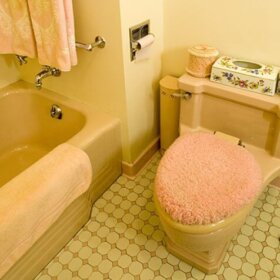
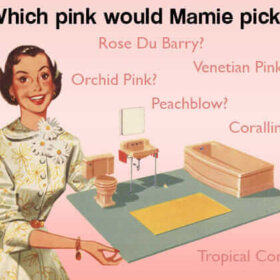
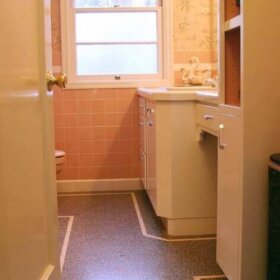
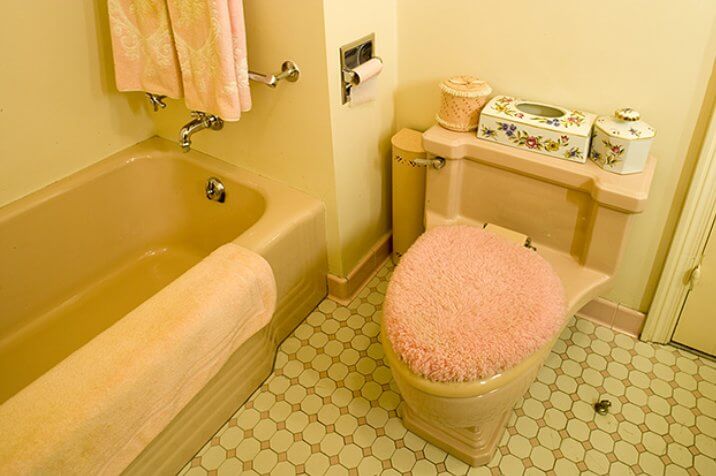
The mid-century trend to pink seems to have come directly and irrefutably from Mamie Eisenhower, first lady from 1953 to 1961. Pink was Mamie’s favorite color. She wore a pink gown with 2,000 pink rhinestones to Ike’s inauguration. Ike sent her pink flowers every morning. Her bathroom in Gettysburg was pink down to the cotton balls. She re-decorated the private quarters in the White House in pink. So much so that reporters called it the “Pink Palace.” The color also seems to have been known as “First Lady Pink.” As a result of all this pink-think, there was probably no question that American women (and marketers) would pick up on it. It also was a color trend right in line with the exuberance of the time — and even supportive of the return of women to the home after WWII and their complete remaking of the American domestic landscape.

In fact, my own informal research from scouring marketing materials from the period indicates that pink kitchens and baths arrived solidly in ‘53, reached a total frenzy in 1957, then pretty rapidly started to fade after that, as other trends took hold. A typical adoption curve for a trend like this.

I have an aquamarine kitchen - the decorating gods sided with my husband on this decision. But I really truly wanted pink. I have to admit, a total fixation.

So much so, that: Tomorrow I am starting a very special series: More than 60 pink kitchens, rolled out over the week. A festival of pink pink pink to start the month. So be sure to check back in, to check it out.
Mamie Eisenhower’s White House bedroom
Meanwhile: Here’s a nice story about Mamie:

All About Mamie

By Jan Biles
The Capital-Journal (Topeka, Kansas)
Published Sunday, November 18, 2007


mamie-doud-eisenhower-1948Not much is known about Mamie Doud Eisenhower.

She was a dutiful wife and mother who stood in the background as her husband, Dwight, excelled in his military career during World War II and then led the country from the Oval Office as the 34th president from 1953 to 1961.

The different looks of Mamie Eisenhower, wife of President Dwight Eisenhower. She is one of the subjects of a new series of books about the lives of U.S. first ladies.

Former Topekan Marilyn Irvin Holt is bringing Mamie Eisenhower out of the shadows with her new book, “Mamie Doud Eisenhower: The General’s First Lady.”"People try to dismiss Mamie in today’s world,” she said. “She always referred to herself as a homemaker but she was not living the ‘happy days.’ I find her more enlightened than the stereotype of the 1950s.”

Holt, who formerly worked as director of publications for the Kansas State Historical Society before moving to Abilene in 1990, said “Mamie Doud Eisenhower: The General’s First Lady” is one of the books in the Modern First Ladies series being published by University Press of Kansas.

Previously published books in the series cover Hillary Clinton, Jacqueline Kennedy, Nancy Reagan and Lou Henry Hoover. Coming this spring are biographies on Barbara Bush and Grace Coolidge, with books on Eleanor Roosevelt and Pat Nixon to come later.

mamie-eisenhower-hat-and-hat-rackHolt, who had written a book for University Press titled “Indian Orphanages” in 2004, said the publishing consortium contacted her about penning a biography of Mamie Eisenhower.

“They thought Mamie would be a good topic because she’s the one first lady there’s been little biography written about,” she said. “They wanted the underlying theme of (the series to be) how these women approached the role of first lady and how they may have shaped it.”

Holt said two biographies on Eisenhower were written in the 1950s and two in the 1980s. The most recent biography was written in 1996 by her granddaughter, Susan Eisenhower.

Holt said Eisenhower was the last first lady who wasn’t expected to have a cause. For example, her successor Jacqueline Kennedy was devoted to renovating the White House while Lady Bird Johnson spearheaded a campaign to beautify America and Nancy Reagan touted the “Just Say No” to drugs effort.

Instead, throughout her years as a military wife and first lady, Eisenhower sought to create a home where her husband could be comfortable. It was important to her that she be seen as an asset — not a distraction — to her husband’s career.

“She really didn’t seek recognition for what she was doing,” Holt said. “She didn’t push herself forward. She had no agenda. She believed the country elected her husband, not her.”

mamie-eisenhowers-blow-dryerEisenhower followed her husband’s lead in using a “hidden hand” approach to make her opinions known. The first lady never spoke openly about her views on integration but made her point by being an honorary member of the National Council of Negro Women, inviting Mahalia Jackson to perform at one of her birthday celebrations and making sure the 4-H Club Camp for Negro Boys and Girls were included in special tours of the White House.

While researching the first lady, Holt said, she was struck by two things:

• The press accurately portrayed Eisenhower’s personality. She was outgoing, had a good sense of humor and an unfaltering memory for people’s names and faces. Magazines and newspapers were the primary source of information because few homes had televisions during World War II, when her husband commanded the Allied forces in Europe, or in 1952, when her husband was elected president.

“She let them in on her life without having favorites,” she said, adding she had no image-maker or coach to help her relate to the press and American public.

• During World War II, Eisenhower was very isolated. Some of that isolation was self-inflicted because she didn’t believe the wife of the Allied commander should be seen socializing at night in Washington while the troops were fighting overseas.

Holt said Eisenhower became “withdrawn,” was under “quite a strain” and had a long wait until her husband came home from the war.

Even though the press seemed to tap into the real personality of the first lady, gossip columnists tried to tear her down by spreading rumors that the first lady was an alcoholic. In truth, Eisenhower had Meniere’s disease, an inner ear problem that caused dizziness and loss of equilibrium.

Eisenhower held the Victorian attitude that one’s personal life and health problems weren’t to be discussed in public.

“If she had talked about it, it would have gone away,” Holt said.

Holt, who has written five other books, said she doesn’t have any other volumes in the works. Next on her to-do list is a chapter for a book series on the culture of childhood.MAMIE MOMENTS

Here are some interesting nuggets from Marilyn Irvin Holt’s book, “Mamie Doud Eisenhower: The General’s First Lady.”

• Mamie Eisenhower, born on Nov. 14, 1896, in Boone, Iowa, was the only general’s wife to become first lady in the 20th century. She was married to President Dwight “Ike” Eisenhower.

• When the Eisenhowers were married, Mamie didn’t know how to cook. She could make only fudge and mayonnaise. However, she loved to entertain. The couple rented a piano and they would invite friends into their home on Sunday nights.

• The Eisenhowers’ first child, Doud Dwight, nicknamed Ikky, died of scarlet fever when he was 3. The next year, the couple had another son, John Sheldon Doud.

• Mamie believed in creating a “home-as-refuge” for her husband. To create a sense of permanency, the master bedroom in almost all of their homes was decorated with green walls and pink accessories.

• Mamie heard rumors about her husband having affairs, but she never believed he was unfaithful. Nonetheless, she was jealous of the women he was seen with. She took up golfing after she learned her husband went on golfing outings with Marian Huff, whose husband was on Gen. Douglas MacArthur’s staff.

• The way Mamie wore her bangs became an item of debate. She was told to get a new hairdresser and to get rid of them. She was told she looked like a 6-year-old; some critics wondered how her husband could stand looking at her. She ignored them and wore her hair the way she wanted.

• Mamie also was criticized for wearing charm bracelets. Her favorite featured “Ike” charms — a helmet, a tank, a map of Africa and five stars to devote the rank of general.

• Mamie wore a pink gown studded with 2,000 rhinestones at her husband’s first inaugural ball. The color became known as Mamie Pink. Although her wardrobe wasn’t predominantly pink, she used the color in decorating her homes. The bathroom in their Gettysburg home was entirely pink, down to the cottonballs and toilet paper.

• Mamie believed she should respond to the letters the couple received. During the presidential campaign, the couple received about 5,000 letters a week. She would respond to at least 75 each day.

• As first lady, Mamie was in charge of the household budget. She budgeted $100 a month for the family’s personal meals. She used vegetables grown on their farm, studied the newspaper ads for bargains and insisted leftovers be used in the next day’s lunch.

5 Responses to “Mamie Eisenhower: Unwitting creator of THE iconic color of the 50s, “Mamie Pink””

  1. [...] Postwar Steel Forum « Mamie Eisenhower: Unwitting creator of THE iconic color of the 50s, “Mamie Pink” [...]

  2. on 01 Apr 2008 at 3:04 pm Lori

    Love the pink dress! Boy did I learn alot today! Thank you bunches for stoppin by and telling me about the great pink kitchens! I would love pink appliances!!

  3. on 01 Apr 2008 at 5:43 pm Hooked on Houses

    How fascinating! Great post! -Julia :-)

  4. [...] they even have a classic Mamie pink… a very nice sky blue… and what appears to be a pretty authentic mint green - the first [...]

  5. on 27 Jul 2008 at 2:47 pm olive22

    Our home has alot of what I call ‘Ethel pink’. She was the dear woman that loved this house as much as I do but her two color passions were pink and avocado…with the avocado being the ‘update’.
    Since everything was in such good shape and high end when it was purchased, I could not see ripping it out. Anything that I have changed has always included a bit of Ethel pink or green in her honor.
    It is funny, the neighbors still say…”She lives in Ethel’s house’.

Trackback URI | Comments RSS

Leave a Reply