
Nate writes:
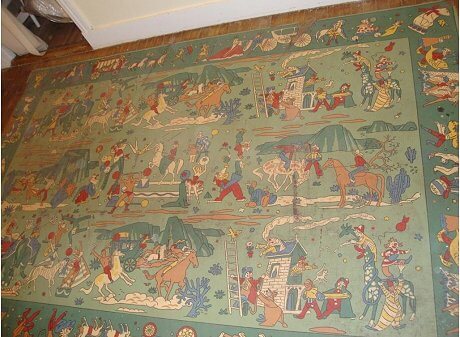
Hi, We just bought an old house, and under a carpet in one of the bedrooms was a “something” — I am not sure what its real name is… It is 6 feet by 8 or 9 feet, and is a fantastic picture / mural. Looks like it is on masonite or some other fiber type board. The “rug” is not attached at all — we can pick it up and move it. It is not gummy at all, seems like just fiberboard, maybe 1/8 of an inch thick. The house was built back around 1900 as a schoolhouse, then sold, dismantled, moved and rebuilt maybe around 1935. The family we bought it from had it since the mid 50′s… I would like to … see if anyone knows anything about it. Thanks!
Nate, it’s hard to say what this is made out of – there are a number of possibilities. I recommend that you have it looked at by experts to (1) identify and value it, (2) discuss how to preserve it, and most importantly – (3) to ensure you know what materials it may be made of so that you can make informed issues about environmental and safety issues. In an old house, you want to check every surface for lead and asbestos, for example.
That said, here are some possibilities that I am aware of:
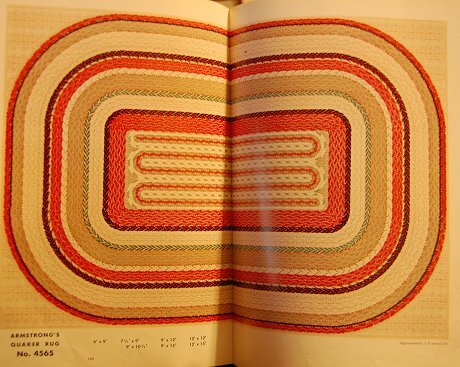
1. Impregnated and enameled felt: I have a 1954 catalog for Armstrong flooring, and it is mostly all tile and sheet. But, at the back, in a very small section, they they still feature several rugs like this, with the “Quaker Floor Covering” brand attached. In their description, they say the rugs (two shown here) are made of felt impregnated with a waterproofing and strengthening saturant. It then has sealants on the top and bottom, a leveling coat, then is painted with the design and baked. (“Impregnated… saturant… paint” = code words for get it tested to know what you have.)
2. Linoleum: While my catalog shows a kind of felt-painted-rug, bona-fide linoleum rugs also were produced… and it could be that you have one of those. Here is a link to Secondhand Rose and their discussion of linoleum rugs and the process with which they were made. By the way, I am pretty sure these are wicked expensive and then some. So much so that the price is not even mentioned, and they forewarn you of the difficulty to install. Read: Brittle. The linoleum or linoleum-style rug that I once saw at an estate sale was flexible, but very brittle. In fact, I could not buy it because it was clear that it would bust into pieces if it were not kept absolutely flat.
3. Other: You say your rug feels like it is on a piece of masonite or something stronger and less flexible than linoleum, so it could well be that you have something that I have never seen or heard of. (Most of my focus is on post-war decor, whereas these types of rugs, I believe, were more popular in the early 20th century.)
One thing is pretty clear to me, Nate: I bet your your rug is quite rare and valuable. Novelty and juvenile designs like this are always very collectible. And even with the condition issues, your rug has tremendous charm. Perhaps it belongs in a museum. Good luck, and many thanks for sharing.



Anaglypta, with painted detail
Was my 50s fireplace originally painted – or unpainted? Spokane Chris ponders. 


This is very interesting…I’ve done some floorcloths and know some history of painted rugs but what I know is that they were usually done on canvas…they were made because real rugs were only afforded by the wealthy, but that’s also going back to the 1800′s, early 1900′s. Maybe with more modern times — more modern materials….I’m wondering if there is a wall this fit exactly on because generally designs are not applied in only one direction, which this one is except for the border. But, with the border, it is definitely ‘rug like.’ I would definitely guess that it is for a child’s room due to the nature of the characters.
Looking forward to learning more details!
That is so wonderful! I have seen linoleum with similar patterns. Lino is pretty thick, the old stuff is anyway. Don’t walk on it!
If you have to move it at all, wait till the room is very warm to do it. Linoleum is mostly linseed oil, sawdust and pigments, and it softens up a lot when it’s warm. It’s less brittle than when it’s cold. If it’s linoleum, that is.
Denise – thanks for that mention of vintage floorcloths. To be sure — linoleum rugs (and whatever postwar-material versions that followed) are a continuation of the floorcloth tradition. A couple of years ago, there were lots of stories in magazines about how to make your own floorcloths, as I recall. When I visited Rejuvenation in Portland in March, in their store they featured an artist who was doing floorcloths, I think in more contemporary designs. I can’t find the photos. Drats. They are somewhere in my hard drive.
I have seen sheets of this in block patterns with fairy tales, usually cut into squares and sold as tiles. I also have a big piece of real linoleum in the basement in more of a 30′s rug type pattern. Very thick, very stiff, and at this stage very brittle. The one pictured looks similar to the fairy tale tiles I have seen, which seems to be a different material. Google “little miss muffet linoleum tile” to see an example.
Wow! That’s pretty amazing. I wonder if it dates back to the home’s schoolhouse days? I can’t offer any insight, I just wanted to thank you for the post. I’d love to know what the folks at Antiques Roadshow would have to say about it!
Oh my goodness gracious! That is one gorgeous art rug and Pam is usually right about these things…it probably is worth some money! If if were me I would contact Jane Powell, the “bad girl of bungalow writing” and get her opinion on it. She’s written several books all of which are wonderful, but one specifically on Linoleum. Let’s see some more pictures Nate!
Great find!
With those graphics and colors I feel that this is from the late 1940′s/early 50′s and was used as a “play area” rug for children or mural.
I don’t think it has a school connection prior to 1935.
On further inspection…it might have been in production right up until 1960. It is very sophisticated- and I think childeren’s items between the wars were pretty “basic”.
This has a television look.
AND- I think children as “action figures” was a post-war concept….Prior to this, the firemen and cowboys would have been adults. Very interesting.
Linoleum rugs were VERY popular in the, oh, second quarter of the 20th century. Some friends of mine just discovered a cowboy-themed one in an old house purchased by acquaintances of theirs.
I hope you’re not walking on that!
I would hang it up on a wall, maybe in a hallway or someplace like that.
Wonder why they laid carpet on top of it?
My husband sends a warning that these many of these floorcloths contain asbestos in them. So don’t disturb the edges too much. It is a beautiful floorcloth!
Real linoleum does not have asbestos! It’s a “natural” product.
I want this so bad, it’s making my mouth water!!!!!
Lara, I still recommend you get your floors tested because so much of this old stuff looks alike. Also, you never know what they used for adhesives. Bottom line: New/old house? Get an expert in to tell you what you are working with, and make informed decisions accordingly.
i have one of the 48 states that is 6′ x 10′….i want to sell it
tom, no buying/selling here on the main blog – you can head over to our forum http://retrorenovation.com/forum/
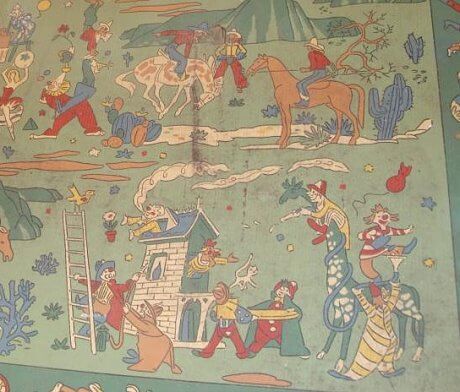
I’m wondering if it’s not made from a printed fabric? The top and bottom rows within the body of the rug are identical series of vignettes. If it were an original design / mural, it would be nearly impossible to replicate the detailed scenarios, but not for a print (think children’s Star Wars sheets or the like). The owner would be able to see with a closer look, if it’s hand painted or printed. The illustrations seem to be from the Howdy-Doody era. What a great surprise to find in a house!
The great floorcloth source Pam mentioned in Portland is Gracewood Design: http://www.gracewooddesign.com/
Custom work is a specialty.
Ever had a kitchen linoleum that is too cool to trash but too worn or damaged to save? A heart-wrenching decision. Custom floor cloths can be an interesting way to preserve the memory of an original floor treatment in a remodel – with a practical size made to fit in the new space and the colors and pattern tweaked to suit the new decor or updated tastes. Passing on the linoleum’s DNA in a way…
Bo – Thank you for the name. I will put it on my list to do a bona-fide post spotlighting the Grace Wood floorcloths.
wow! this is really cool! i true treasure find!
Nate, what a superb find!
I have some expertise in this area, since antiques and art are a specialty- my opinion based on only the photograph, is that this is not as old as the schoolhouse, and most likely dates to the period of the Second World War, especially if it’s on masonite.
It’s condition is too good, first of all, and the imagery is indicative of the period.
The best news is that if you are planning any future renovations and need extra funds to accomplish it, you have it in this wonderful piece.
I would seriously get it appraised by a competent dealer in American folk art. The quality of the work, assuming it’s entirely hand done is superb, and could be quite valuable.
Get if off the floor for now, if you can, if not, then cover it in a non-abrasive canvas cloth, and keep furniture and people off of it until it can be safely moved.
Congratulations!
That is way cool, and to think that it was hiding under the carpet all of those years just makes it that much cooler.
My dad once told me that when he was growing up, his cousins had a rug in their room that had outlines for games printed on it (checkers, backgammon, hopscotch, etc). I never really understood what he was talking about, but it must have been a linoleum rug similar to this one.
Two-thumbs up, Pam! Thankfully, all my flooring is hardwood or ceramic! I will definitely keep that in mind when house-hunting (and, one day, restoring!).
Historic New England has a similar piece in its archives. It has planes, trains and buses on it and it measures more than 6′ X 9′. It is currently in production to be reproduced here at Canvasworks (http://www.canvasworksfloorcloths.com). When it is reproduced it will be done on heavyweight canvas, using very flexible, environmentally friendly paints and sealers and will be totally functional as a floor covering.
The person who asked why it was under the carpet? I don’t know the why, but we certainly see a lot of that around here in the older homes. We found linoleum underneath carpeting in many rooms in this 1913 house we’re living in now.
Hey everyone,
Thanks for offering thoughts and insights on this- very helpful and encouraging. My dad is visiting, and he believes it is linoleum – if you look at some of the broken edges there is a blackish layer underneath the art layer, but then under the black is more cardboardy (I know, not a real word, but you get the idea…)
I can try to take some better pictures of the artwork, if people are interested.
One question — I live in north east MD, near PA and DE borders, just a few minutes off I 95, hour from Philly, hour from Baltimore. Does anyone have any experience with an appraiser in this area, or a recommendation that might help in that regard? I think it is a very cool piece, and would consider keeping it, but I know that we are not going to be able to give it proper care and feeding. So if it is worth money, that is probably the direction I would look toward. Thanks again! — Nate
Hi Nate, contact Jeff Kamel in Philadelphia at the Kamelot Auction- they are honest and easy to deal with, should be able to help you appraise it. There will be a fee for a straight appraisal, though if you were interested in selling, I think they would waive this. Best of luck.
I’m sure its valuable and interesting too,with the circus/cowboy and Indian theme. Look at the house burning with the clowns waiting to catch the kitty,and the clown putting water from the watering can to the hose! Very cool.
Hi Nate!! I have one too!!! I got it from my Gramps’ house when he passed. I, just today, Started to research it and I am so excited to see something like mine. I can’t (don’t know how to attach a picture) Mine is a picture of a US map w/ cowboys, Indians and ships all around the edges. I contacted Second hand rose, listed above and I am supposed send him a picture. I know mine is made by armstrong at it is a linoleum rug. I think yours and mine are worth alot of money. Yippee!!!! I’ll keep you posted if you are interested. I would love to know about yours. Excited researcher, Patricia
My daughter just bought a row home in Philadelphia,PA. It is 3 stories and under the two area rugs on the third floor are old linoleum rugs. One is floral, the other is pink with old nursury rhyme characters on them. Haven’t been able to find out much about them or their value. We don’t want them. She would like to sell them if possible, but we are not sure how to go about doing this or learning the value of the rugs. We have reason to belief there may be at least two more on the second floor but have yet to remove the carpeting in these rooms. Any insight or information would be greatly appreciated!
Susan, I don’t do valuations on the blog. And, all buying/selling needs to go on the Forum: http://retrorenovation.com/forum … That said, if I were you, I’d find the bestest antiques dealer in town to help you identify what you have, set a value, and sell these. Also, from my personal experience seeing these in a house — do not try to move them yourself. This old flooring can get very brittle and break easily. Not only will that dramatically affect the value, you don’t know what’s in the stuff until you have it test.
My friend and I just removed a 65 year old lino rug from it’s original home the day before yesterday. The brittleness can be overcome by painstakingly heating the lino with hairdryers and rolling it onto a large diameter core inch by inch. We managed to do this with a beautiful 9′x10.5′ piece without any cracking. Here’s a link to the photo album I posted to my Facebook page about the process:
http://www.facebook.com/album.php?aid=279176&id=698285263&l=8f7fc0cbd7