

 What are the key elements of 1940s interior design and decorating style? What colors, shapes, patterns and “feel” did we generally see in 1940s homes? And why? Based on the advertising illustrations and magazine articles that I’ve seen from the period, starting around 1946 to about 1953, what we typically call 1940s interior design had eight general characteristics.
Eight styles of 1940s home interior design:
- Innocent
- Sentimental
- Sunny
- Sanitary
- Patriotic
- Traditional-colonial revival
- Hollywood glamour
- Streamline Deco Jazz age
I write about each one of these design ideas in more detail below.
Special thanks to: Bradbury & Bradbury, which made this slide for me. It also showcases one of their 1940s reproduction wallpapers.
Disclaimer up front: I don’t have a degree in this – I’m a passionate observer, who is still “putting all the pieces into place.”
Recovering and rebuilding after World War II dramatically affected 1940s interior design and the size of 1940s homes
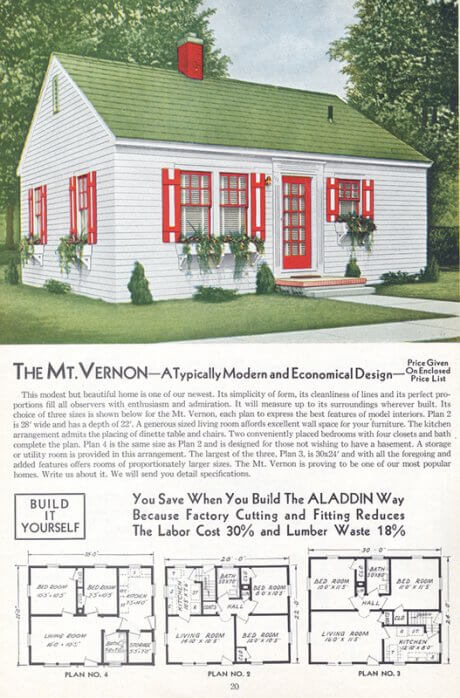
In the immediate wake of the war’s end, there was a tremendous housing shortage. I’ve read that we needed to get 6 million homes built as quickly as possible. And I’ve even seen references indicating that the government was concerned that if we didn’t deal with the housing (and jobs) situation quickly enough, America’s young men would become restless and political – in a bad way. So, we built houses as fast as we could. Usually: Very small houses by today’s standards, no more than 1,000 s.f.
I also swear I’ve read somewhere that there were prohibitions on building more than one indoor bathroom at some point… I need to find the source.
 Also, in terms of design, in this immediate postwar period, the “look” still tended to be similar to that of the late 1930s and wartime period. There had also been material shortages during the war, so manufacturers had put all their new-design work on hold. A good example: After the war, when Heywood Wakefield retooled its factories to again produce furniture, its Riviera line was really just the same, but with new handles, as the Rio line produced earlier.
Because of the shortage and ramping up from 1946 until 1953, these years are generally viewed at more “40s style” than “50s style.” (In his terrific book Populuxe, Thomas Hine looks at the 1953-1963 years, which were more exuberant.) So what did the 1946-1953 interior design look like? Here is additional explanation of the eight characteristics:
-
Innocent 1940s interior design:
 When I look at some 1940s interior design and decor, I see a real sweetness. We still were a nation in which the masses did not have a lot of material affluence. No clutter, far less excess. Thanks to Kohler for this 1949 image from their archives, which, with its soft hand-painted illustration gets at the warmth and sentimentality of the period.
 -
Sentimental 1940s interior design:
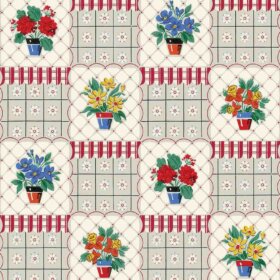
When the war ended, the nation was immensely grateful to have their men and women all back home. It had been five years of tremendous sacrifice. I see a lot of ads like this one, that celebrate the simple pleasures in life. Wallpaper is sweet, flowery. In fact, there was A LOT of wallpaper in 1940s interior design — it’s an essential!
-
Sunny 1940s colors:
 Kind of same as above. There was so much to be grateful for, that we did not necessarily need “more stuff” to be happier. One other thought is that we still were a nation with a lot of farmers and apartment dwellers – the spaces were small, money was tight, and as a result, interiors and their decorative appointments were simpler.
 -
Sanitary 1940s kitchen design:
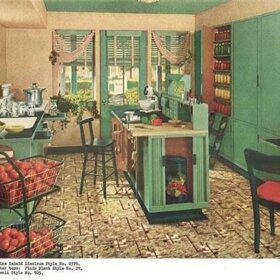
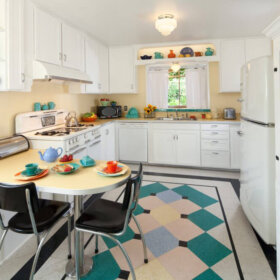
 White kitchen cabinets, or wood. Remember, we still were a nation concerned about vermin and disease, including polio. When your kitchen is white, you can see the dirt and crumbs — and get rid of them.
 -
Patriotic 1940s decorating style:
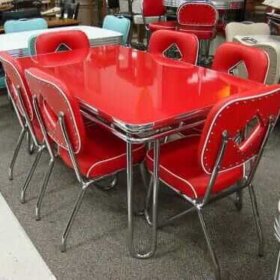
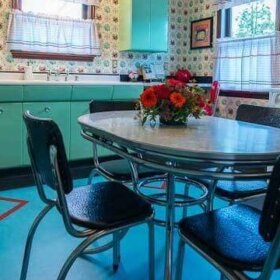
 I see a lot of red-white-blue kitchen color combinations in the kitchens of 1940s homes. I also see richer colors – full-on primary colors and jewel tones – than in the later 1950s pastel period. I’ll attribute this to carryover 1930s preferences and to the influence of Hollywood, but there may have been other factors — there often are, often related to technological innovation.
 -
Traditional Colonial Revival 1940s furniture and interior design:
 My mom, who grew up in the 1940s, says the furniture was all dark wood where she lived in Pennsylvania – the influence of Europe, she recalls. Of course, we also had Heywood Wakefield blonde – but we also had colonial maple from Heywood Wakefield, Cushman, Willett and scores if not hundreds of small regional manufacturers. The more I explore the history of interior design – of all eras – the more convinced I become that: We are a traditional nation.
 -
Hollywood glamour 1940s decorating style:
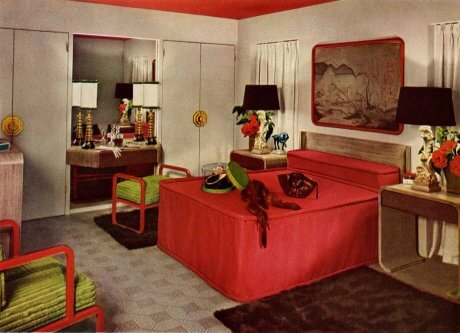
 Think Nick and Nora and the Thin Man. We did not get television until 1949… before that, our idols were often very glamorous. Remember women’s clothes from the 1940s – their hats and tailored suits and gloves and bags and hose, the whole very put-together thing? That’s the look I think of for 1940s bedrooms and living rooms – formal, very put together. In other rooms, we also may see large prints used on wallpaper and barkcloth pinch pleats, often tropical.
 -
Streamline – deco – jazz age 1940s high-contrast color schemes:
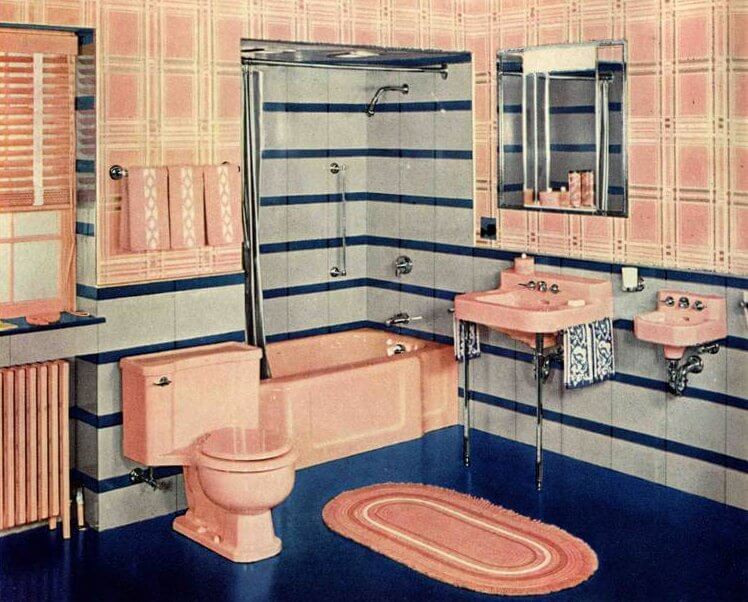
 In 1940s homes through to 1953, I think I see more high-contrast bathrooms. That is: black bullnose (or dark green or maroon bullnose, depending on the field tile color). These high-contrast color schemes are a carryover look from the streamline jazz age era.
Post-1953, the bullnose is less likely to be black and more likely to be the same color or a similarly toned contrast color, e.g. pink and mint, pink and robin’s egg, etc.
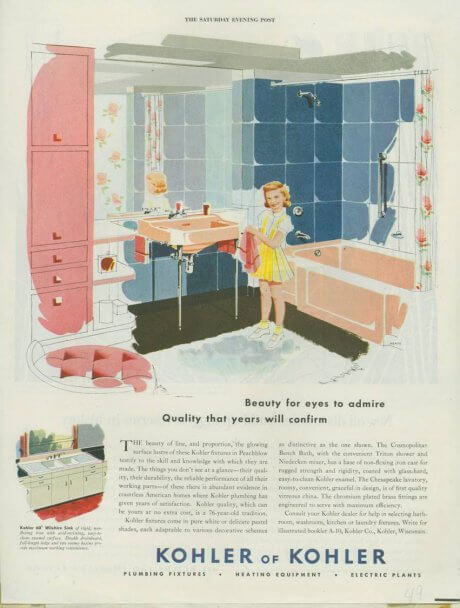 When I look at some 1940s interior design and decor, I see a real sweetness. We still were a nation in which the masses did not have a lot of material affluence. No clutter, far less excess. Thanks to Kohler for this 1949 image from their archives, which, with its soft hand-painted illustration gets at the warmth and sentimentality of the period.
 White kitchen cabinets, or wood. Remember, we still were a nation concerned about vermin and disease, including polio. When your kitchen is white, you can see the dirt and crumbs — and get rid of them.
 I see a lot of red-white-blue kitchen color combinations in the kitchens of 1940s homes. I also see richer colors – full-on primary colors and jewel tones – than in the later 1950s pastel period. I’ll attribute this to carryover 1930s preferences and to the influence of Hollywood, but there may have been other factors — there often are, often related to technological innovation.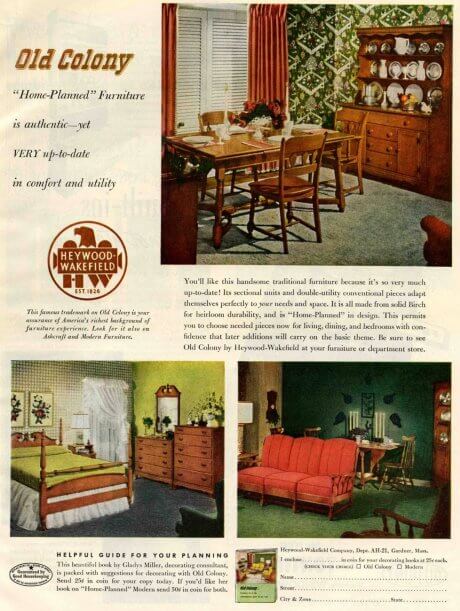


Tony Roland says
I want to restore a 1938 home. Where can i get help?
pam kueber says
Hi Tony, if you want help consider professionals who specialize in historic restorations.
VR Hoye says
I am looking to restore a fireplace hearth in my 1949 brick bungalow. the previous owner tiled over or gutted the original. The surround is marble with a painted Georgian painted mantle. I think I am the 4th owner of this home so I am not sure if the mantle is the original either. What kind of replicated tile should I be looking for? Thanks
pam kueber says
Hi VR, I don’t know the answer to your question — I’ve never researched this subject. One idea: What do the neighbors have? Sometimes it was the same builder, using many of the same materials, in an entire neighborhood.
kerry chelf says
If I were you, I would look for glazed art deco tiles to incorporate in a horizontal row across the top of the firebox–in soft, muddied tones like air mint green and warm neutrals… These should not be difficult to source, and are in keeping with your bungalow simplicity.