

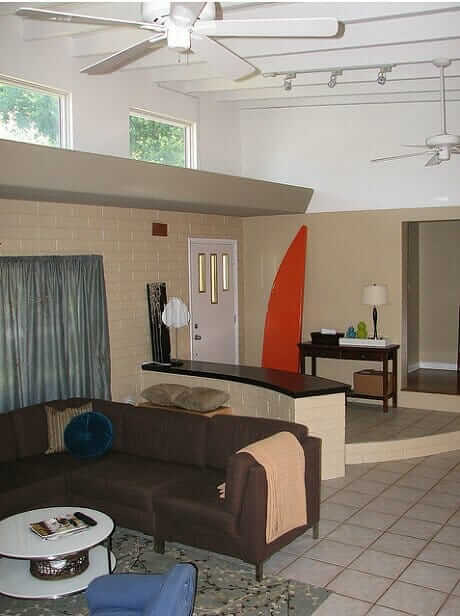
Jen’s *new* mid mod home in Florida has a beamed ceiling… she needs to add insulation… and writes in for advice: Does she need to keep the beams?
Jen writes:
Hi Pam,
I just recently found your blog and love it already! You’ve got tons of great info, and I’m desperately hoping that you and/or your readers can help me out with some advice. A few months ago my partner and I purchased a unique, mid-century home in St. Petersburg, FL. It has tons of great features and even more potential, but we’re having difficulty making design decisions. And so far, we haven’t been able to find anyone with an MCM mindset locally (designer, contractor, etc) to help.
Our immediate issue is in our living room, where we have exposed beams on a high angled/sloped ceiling. There is currently no insulation up there, and it is desperately needed, but I hate the thought of losing the look of the exposed beams. Our current plan is to insulate and drywall the ceiling flat, then add faux beams. We also plan to replace 2 ceiling fans with MCM style pendants and remove or replace existing track lighting, possibly adding recessed lighting instead. If we do faux beams, we need to determine how many and what size. If we do less than the exact size and number of beams that we currently have we can save some money, and it would still have the same effect, but they won’t match up with the exposed beam ends visible on the exterior of the house. Is this a big no-no? It wouldn’t be too obvious since there isn’t a contiguous view of the beams inside to out, but there are 3 high windows that could allow the interior beams to be seen from the exterior of the house. Oh gosh, does any of this make sense??
Please let me know what you think. We’re at our wit’s end, paralyzed by indecision!
I’m happy to provide more pics and more info – anything needed. Thanks! jen
Thanks, Jen for your nice comments about the blog, and for sending in your question. I’ll open it up to readers… But this time, I’ll start with my thoughts:
- Great house!
- Insulate the ceiling for sure — you must do what you must do, especially when it comes to saving energy.
- If you want, I think you can get away without recreating the beams altogether — by painting the ceiling and the back part of the wall that is still white. You seem to have that dusty blue going on below – put that on the ceiling and sort of “L” it to the back wall. Leave the white space on the sides (between the beige of the wall and the blue of the ceiling) and around the front windows alone. It think the whole scheme might be quite dynamic… sort of Mondrian, but not too too, because a sky is blue, too. Keep picking up that orange, too, throughout your decor.
- I don’t have a big problem with the ceiling fans — they are appropriate for your climate. Maybe get them in an antiqued brass base with wood blades, though… to add additional texture to the ceiling if you dispense with the beams.
- That ledge below the high front windows is perfect for a lighting solution. Is there some kind of uplighting there? For sure should be – would be fabulous!
- With a room that large — and a ceiling so high — I am not sure how good cans are going to do you … Those spots – they’re for the entry way, I get that, I think. Gosh, this whole issue of lighting is a big deal. I don’t have cans in my 45 x 15 living room/dining room — I have all task lighting — lamps. I prefer that for living areas. There are cans in my kitchen, though, because you don’t put lamps there.
- Paralyzed by indecision: We’ve all been there! Trust your gut. Good luck, the house is happy you found it.
Readers, what do you think Jen and her partner should do? Beams? No beams? …. ?


Oh, I hate the thought of losing the beams! I think the fact that they carry through from the exterior makes it more important. Is there no space between the ceiling and the roof where you could add something? There are so many types of insulation available now – from rigid to blown-in – that I have to believe there’s an option for you to do something effective in even a very small place. Consider a roofing option too. There are reflective roofing materials that might help, and could be applied only on that very interesting roof over the beamed room. I understand that ceiling fans can help, but I think you’re right in taking them down for pendants. There are some interesting metal fans out there that might make an attractive option if you want to consider keeping them for comfort’s sake. The track lighting has to go! It’s not really right for the space. Lastly, since I’m urging you to keep the ceiling, look at changing the color as well. I wish I could come up with a color menu or photo to share, but some searching online may show you how stronger colors can really make woodwork pop. A warmer, yellow-white might add depth to the ceiling and could coordinate with the warmer taupe you have below. Maybe do all the white in Benjamin Moore Linen White or Navajo White? A less stark contrast can unite the space without detracting from the dramatic features. It is very likely impractical and more than you want to get involved in, but if the wood underneath is good, a medium-natural stain would be amazing.
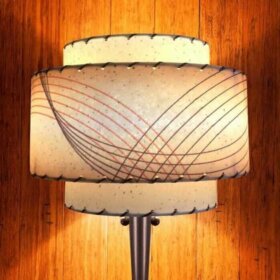
I agree with Pam on the lighting. Exploit that ledge for some uplighting, perhaps and avoid ceiling cans, which will be distant and hard to maintain without special tools. There are great floor and table lighting options that you can scout over time and that are true to the era.
I think the room is so spectacular and hope that you can find a solution that lets you keep the beams.
You don’t need the beams – it will look great without them. If you add them, the ceiling will probably appear too low. They will also sit too close tops of the windows, which will look odd.
Here’s a cool ceiling fan to consider. I’ve been in love with it for years, but never had a space it would work in. Your high ceiling would be perfect: it’s the Cirque Ceiling Fan by Minka Aire.
You can always add the insulation to the roof. The current membrane or other roofing material can be removed and rigid foam board insulation can be added to the deck before a new membrane is rolled out over that new insulation. No mess inside and no loss of interior features. Hope this helps.
I had a similar situation in the MCM Ranch that I bought. My solution was to attach a nailer strip inside of each beam 3 1/2 inches from the ceiling. Fill the space with R13 then drywall the space between the beams. The beams in my house are 9 1/2 inches deep so I only lost 4 inches of depth.
Hi Jen,
One thing I would suggest is pick up a copy of Atomic Ranch magazine before you do anything to that ceiling. They feature many MCM homes such as yours. They also have a large resource of architects and designers that deal with such homes.
A few questions you might try to answer before changing the architecture of your homes. 1. Was it designed by a known MCM architect? 2. Is the home a classic example of his work.? 3. This might be a big one, will changing the ceiling lower the value of your home?
I personally LOVE the look of the exposed beams. Is there another way to address the energy needs? I learnt the hard way with my home on a few things. Don’t change anything drastically till you have lived with it for a while. Especially structural details.
Beat of luck, John AKA AtomicHipster
Pam/Jen,
I am an interior designer that works for a general contractor that performs both commercial and residential work. Recently, we had this same dilema with a older lake cottage that used the exposed beams and 3 1/2″ tongue and groove doug fir boards to support the roof. The solution to this problem was solved by using a product called Cool-Vent, a roof panel system that is actually applied to the exterior of the house. The advantage in doing this is that you wouldn’t have to change the look of the beams or the decking on the ceiling. Now the disadvantage of doing this is that you have to strip off the roof (I’m not sure if you are in need of a new roof) and then apply the panels, reinstall a new roof on top of the panels and then modify the fascia on the exterior of the house to cover the panels. The roof will look a little “thicker” from the exterior.
I’ve attached a link to see some pictures about the product… this is not my company’s website… I know nothing about them, however, the pictures on their website show pretty clearly how the product is used.
I hope this helps!
Love the website- as I find inspiration from it everyday too!!!
-Kristin
http://www.deerparkroofing.com/capecod.php
Hey Pam,
I am a long time reader and fan of your website. This morning however I feel compelled to comment on the subject. I think that it would ruin the MCM vibe of
the house. Interior work like that is messy and expenisive and can alter the property value. I have seen the same roof-ceiling deliema solved with Cliff May
homes and others with post and beam construction by insulating the roof deck
with a high densety foam and osb sheet material similar to sips panels this is then roofed and can be done by local roofing companies. Check out the Cliff May
Ranchos website for more info. thanks Al
Wow, this is why I love Retro Renovation readers – cumulatively there is so much knowledge out there. I really like the idea of insulating from the outside! My knowledge of this type of issue is limited… Thanks!
I love your ceiling. How about rigid insulation cut to fit between the beams and painted white to match?
That is a great house – can the roof be insulated from the outside with foam insulation so that no changes are required to the interior ceiling? Maybe you need a new roof anyways? I like the wood planks just as much as the beams.
I think the end walls should be all one colour up to the ceiling – but I do like the white ceiling & the white around the clerestory windows and the fact that the brick/block walls and ledge are a different colour.
How about a fan from Minka-Aire?
We moved into a mcm house last July and nearly all of it has been retained from the 50s, no home-depot mistakes. Best decision we made was to agree to not touch anything major for a year. Let it sit and research options. Have you found the lottaliving forums? Also a great resource.
What a fantastic house you have!!!
btw, my gut instinct is that I’d work to keep the beams.
Hi Jen…..Love it and am not tech-saavy enough for the construction aspect!
I would think long and hard about the recessed lights- they are great but I actually would go for big white square 1974 tracks. I LIKE the white fans and because of the height and color of the room-they aren’t calling too much attention.
What year was your house born? It looks a bit more 1970 than 1950. Personally, I like to pick a starting date of a house and add the best of each decade in its’ history. To add recessed lighting (which looks great) seems to be doing it the other way around.
20 years from now, retro-renovators will be hunting for vintage Lightolier tracks!
Great House.
Pam,
I have the same issue at my house and here is how I addressed it. I added 1inch nailers to each beam 3 1/2 inches from the ceiling. I then added 3 1/2″ R13 batt insulation between the beams. I am then closing the space off between the beams with 1/2 dry wall. The beams in my house are 9 1/2 inches deep so I am only loosing 4 inches total with the insulation. So i still have 5 1/2 inches of exposed beam in the house. I found that batt insulation is cheaper than foam/board type. This might work for you. Also to make the job easier I had a contractor install the nailers. I am doing the insulation and dry wall myself.
I agree on the idea of exploring alternative insulation ideas- those beams are part of the bones of the house; they are beautiful, and the thought of seeing them covered up with fake beams on the outside hurts my throat.
There are so many things we can do to make our houses cooler that don’t involve sealing up tight as a drum. Cross ventilation, attic fans, better roofing, shade arbors in places where the hot sun falls on the house, plantings…
Please don’t seal up another beautiful vintage ceiling inside a cheesy fake ceiling!
I love the beams – but what attracted me to this photo was that GORGEOUS curved half-wall! *SWOON*!
I love this home. What a shame it would be to alter the interior. If financially possible, I feel the homeowner should go with the roof option. Otherwise, I guess you do what you gotta do.
My husband is a faux artist. You would be surprised what you could do with paint. I don’t know the thickness of the board — Is it possible to cut to size the foam board insulation, and apply the foam on the interior – in between the beams – directly to the ceiling that is there now. Then have an artist “faux” it with paint to look exactly the way the ceiling looks now, Giving it the bead board look. The loss would be only in the appearance of how deep the beams appear, depending on the thickness of the foam board.
It’s not just beams- it’s the paneled look peeking between them. I’d definitely try to insulate from the outside. Pam’s idea of uplighting from the ledges is great- it’ll diffuse the light nicely and show off the lovely beams.
Jen-
You have the perfect backdrop for the “Uber Chic International Pop-Art” house. I see some Calder artwork and big mobiles. Embrace it!
First of all, what a fabulous home – inside and out! I agree with keeping the beams and finding a solution for insulating from the exterior. This elelment is so important to the design of the home that destroying it or covering it up seems to go against the mid mod mantra of keep as much original as possible. How many of us have grieved over original elements removed from our homes over the years for the sake of convenience and “updating?” I never thought about lowering the property value of the home, but that’s another motivator for maintaining the originality. Good luck Jen and Jen’s partner!
Oh no! Please don’t cover the beams! This house has “structural integrity” as the architects like to call it. Please no ‘faux” anything! I would explore what other options might be available for insulation. I think you might really regret it if you change the nature of the house. It’s a beautiful house and a fine example of mid century architecture.
If you don’t want the added trouble and expense of the solutions that required you to strip the roof and do outside insulation, I’d definitely add new beams after you insulate and sheetrock it. Make them the same size as the real beams so it still looks like the beams you see outside continue on as if nothing happened.
Beams are AWESOME = do not remove them!
I may be duplicating some of the suggestions from above, but you can install a radiant barrier that will act as reflective insulation. You can install it a variety of ways so that you don’t have to change the interior.
Hopefully your house is in need of a new roof and you can perform the insulation work at the same time as you install new roofing.
All the best,
Edwin in Charlotte
Meant to include this link:
http://www.insulation4less.com/
Keep the beams…they tie in the exterior to the interior in a very obvious way to me.
Just say no to faux…..
I have nothing to offer re technical solutions to the insulation problem, but I HAD to register my delight with this gorgeous home. What a treasure! I think other commenters are right: try at all costs to preserve the original beams and ceiling – they MAKE that room.
Good luck, and enjoy your fabulous space!
The ceiling is an integral part of the architecture…. It would be a shame to hide even more of the home’s details.
I know it’s not exactly close by, but Sarasota has a large MCM community and you may be able to find local resources/contractors with midmod sensibilities to help you with ideas.
Thanks for the tip. Sarasota’s not too far of a stretch!
Hi Jen,
Your home has a striking resemblance to many details of a particular MCM I hope to own one day — mixture of flat and shed (or “clamshell”) roofs — so I’ve ruminated about the same dilemma. Thanks for sharing so many pics of your terrific home; it makes it easier for all of us armchair experts to give feedback. (Looks like you replaced the front door between taking outside and inside photos?) There’s already a ton of fantastic & equally valid info in the previous comments — enough to make your head spin — but I’ll add my 2-cents’-worth. As a perfect example of the dilemma of what to keep original & what not to, I’ll make a strong case for going either way; read on (my apologies for the incredibly long reply).
You’re right, it can be a real challenge finding builders, architects, etc. with that “MCM mindset”, whether it’s for the architecture, interior design, or landscape design…..you have to be a tireless advocate for preserving the right details & look, in the face of easy-but-inappropriate solutions that most contractors (and home-improvement stores) are ready to offer. And when you do find ones with a Modern aesthetic, they tend to be a lot less Mid-Century Modern than what I call “contemporary-Modern”; I see a lot of really cool examples of the latter, but mid-century design was not all about hard straight 90-degree angles in homes, patios, and swimming pools. Seems like there’d be some like-minded folks, though, right down the road from you in Sarasota (where MCM was so prominent it even gave rise to its own “Sarasota School” style).
In the first case, i.e. if you keep the same exposed rafter look to the ceiling, since you obviously need to go with insulation on the OUTside, research various local roofing companies; here on the East Coast we don’t have the advantage of those on the West, where literally thousands of MCM owners face the same issues, with their Eichler, “Eichler-like”, Ain, or similar homes. My fear is that you might find a flat-roofing contractor whose recommendations may be fine for industrial or commercial roofs but not quite the right approach for a residence & its particular aesthetic concerns, since it’s just not common [in your area]. Besides RetroRenovation, your new friend should be the Eichler Network website, which is an amazingly rich resource for both design and nuts&bolts info — this article in particular: http://www.eichlernetwork.com/HDinsulate2.html That approach is to use sprayed-on closed-cell foam insulation (whereas cut-to-fit foam panels might not be quite as perfect a seal against protrusions, espec. over time), followed by a couple of layers of a sprayed-on elastomeric polymer. White roofs (as this finished surface is) are proven to be extremely effective against the “heat island” effect of our cities; I think they also offer it in tan or light grey, if that brightness would be objectionable to you or neighbors. Of course this means first stripping off your existing roof surface (I’m gonna guess it’s tar & chip), whether it’s worn out or not. I dunno what this technique costs per SF, but from what I’ve read anecdotally it ain’t cheap. But it’s a great way to go. Even when/if you do find a roofing contractor(s) to do this in your area where it’s probably uncommon, keep in mind that limited competition means you may get wildly varying quotes. The advantage of this technique, over one linked in a comment above where there’s a ‘sandwich’ of airspace with OSB (wood sheathing) on top, is that it’s a lot thinner (like 2″-3″ for all the R-factor you need, varying on the flat sections of roof to ensure drainage), thus you wouldn’t hafta go to the add’l. expense of a wider fascia all around the roof edge. (But that OSB type would be great for other home styles where you need to nail on conventional shingles — take note, all you mid-Century Modest folks. For example, it’d look ridiculous to have a sprayed-on roof on a steeply-sloped Cape Cod…..also, I dunno how that technique addresses flat roofs.)
So Option #2: insulate on the INSIDE….luckily you have plenty of room to drop the ceiling a bit, even on the low side of the ceiling, and without coming too close to the windows……in fact I think it’d even benefit from coming lower visually on that low side. This approach means you could put [much less expensive] fiberglass batts between the rafters (they appear to be 2x6s; you might even want to add shims along the bottom of each to have a more effective 2×8 insulating cavity). Then cover with 1/2″ sheetrock. (I’m a dedicated D-I-Yer, but good sheetrock contractors are cheap, fast, and create a minimal mess….not to mention you DON’T want to have to install sheetrock against a ceiling yourself, believe me.) Here’s the part I’d HATE to give up: the look of the T&G ceiling! I’d investigate some kind of thin wood paneling to apply to the sheetrock with nails & glue to match that grooved look, similar to the fake beadboard panelling so popular in recent years that looks virtually identical to separate boards once painted. (I know there’s a company on the Eichler Network that’ll create styles of exterior grooved wood siding; you may want to talk with some local lumberyards about custom-milling such panels, if not off-the-shelf available. You could instead, of course, install actual thin boards, but I think that’d be unnecessarily costly both in material & labor.)
Then I’d create fake beams attached to the new ceiling. (Now, I’m all about purity in architecture, and preservation, but hear me out.) The existing rafters — 2x6s, they look like, spaced probably @ 16″ o.c.; what we call ‘stick-built construction’ — while not exactly unseen in MCM homes, would nonetheless look “more MCM” if it was a “post & beam” style, which used big ol’ 4″ x 10″ solid beams of Doug Fir, spaced farther apart. Since such wood is nearly impossible to source nowadays, the common substitute is “glu-lam” beams (sandwiched thinner wood glued & laminated for super strength). A MCM home I recently toured had a sensitive new addition with glu-lams, covered in “1x” (“one inch-by”-something wood planks) to appear solid like the original beams elsewhere. You don’t need any structural support — you already have the rafters — you just need to make hollow, lightweight, three-sided, boxed-in beams of 1x’s nailed to a 2x framework against the ceiling. I’d suggest being really painstaking in filling in any gaps along edges with wood putty or Bondo, after assembly, to avoid giving away the fakery. You do the same thing on the OUTside overhang (without sheetrock of course) to carry the beam look out through the wall. As far as beam spacing, I’d go about 4′ or 5′ o.c., dictated by the width of the wall into even increments….and of course, between the windows rather than over them (since they’re supposedly “resting on a support post”, right?) Incidentally, I don’t really have a problem, visually, with you giving this central raised roof the beam look, while the flat-roofed side wings are “beam-less”; that’s the case already.
As far as color, you might want to consider a dark brown (“bronze”) for the beams, then maybe a very-slightly-beige ceiling color so as to not be too stark a contrast. You might wanna use a solid-color stain, as Eichler homes did to allow the wood texture to convey better.
To take this all a step further, if it were me, I’d consider actually replacing those clerestory windows with ones of better proportions that would make sense as far as the beam spacing…..might as well go with energy-efficient double-glazed ones, which Code might dictate anyway……not as overwhelming a project as you might think; just a matter of opening up that wall around them and re-framing in new ones with different header widths. The location/widths of the present clerestory windows don’t have a lotta rhyme or reason to the rest of the facade so it’d be an opportunity to correct a fairly-prominent feature.
I’m personally not so opposed to “can lights” as other readers here; yeah, they aren’t authentic to the period, but the whole idea is that the light source is not the focal point, just its effect, espec. if you put a dimmer switch in as you should. (In the same way, I don’t have a problem with a new stainless-steel range in an MCM kitchen.) Eichler owners are often vexed by how to run wiring in their exposed ceilings; you wouldn’t have that problem. By if you do stay more authentic & nix the can light idea, I LOVE that ledge with the canted fascia; great place for indirect lighting (again, dimmer-switched). We could go on & on with landscaping ideas & suggesting a cork floor to replace the ceramic tile, and……but I’m sure I’ve already surpassed the RR too-much-information record!
Thanks Ted for all of the great info! Can you come over and be project manager??
Hah! Would love to. Can we put it off a couple of months? — I think FL might be a bit too warm for me right now.
There are a number of different types of rigid roof insulation now that have excellent R factors (which several folks have suggested) applied on the exterior. These were originally invented, I understand, to insulate post and beam structures with exposed wood ceilings to preserve the integrity of the post and beam look. I found a site that explains the different types of rigid roof insulation products. The only trouble with these can be the treatment of the “edge” of the insulation at the end of the rafters. There has to be some carpentry option to camo the thick edge of the insulation. I believe I once saw an episode of This Old House on this, but couldn’t find the episode just now. Anyway, love the beams (and hate, hate, hate ceiling fans, I’m afraid) here’s the site that explains different approaches to rigid roof panels:
http://www.buildings.com/ArticleDetails/tabid/3321/ArticleID/5646/Default.aspx
Gorgeous house! I have to pipe in and say keep those beams and the plank ceiling, they really fit in with the styling of the house and add a lot of interest as well. In the picture of the front exterior I thought I saw a column of glass blocks by the front door but from the interior they do not appear plus is the front door different?
There’s no glass block by the front door…I’m not sure where you’re seeing that. Yes, there are 2 different front doors in the pics. We recently replaced the old paneled door with the door with the 3 windows – it’s our new Crestview door and we love it! Still needs to be painted.
(Fourth picture) What looks like glass blocks are probably house numbers – there are four of them stacked to the right of the front door in the “old door” picture. Love the new front door! Glass blocks would look really cool there too.
Agree with keeping the beams. As far as the ceiling fans: Here’s a link to a ceiling fan made by Hunter – better than any fans we found at the big box stores: Hunter Fans 25753 48″ The Retro Contemporary Indoor Brushed Nickel Ceiling Fan w/ Light & Blades. Found it on line and had installed recently in our 1960 ranch home. Works really well, both as a design element and in cooling efficiency.
http://www.amazon.com/Hunter-Contemporary-Indoor-Brushed-Ceiling/dp/B0009N0VCK
My aunt’s haouse has the exposed beams in the living room, and in fact the beams and the T&G above are still varnished…no one ever went at them with paint. Now…I love my Aunt dearly, OK? With that much said, she’s definitely the earthmuffin, go green, save the fire ant (or whatever) old hippie type. Certainly into energy savings.
She wouldn’t touch her ceiling if you paid her, and lives with it as it is…she’s an artist, and I think the aesthetic is valuable to her. Me too, really.
What about using a few inches of hi-density foam insulation (with a vapor barrier laid first, maybe?) and then re-creating the T&G OVER that, BETWEEN the beams?
Dave
We did consider that too, but it would be very labor intensive. We’re not going to be doing this work ourselves, and we don’t want labor costs getting out of control.
YES!
I have a similar problem in my 1952 post and beam. The exposed wood beam ceiling (unpainted in all but the kitchen) was a big selling point for me, and I wouldn’t dream of altering it. That said, my home office is situated on a corner of the house that makes it roast in summer and freeze in winter. It’s a 8′ x 12′ room and the prior owners had actually added a dropped tile ceiling, which I removed with minimal damage to the wood underneath.
I’m going to insulate this room the cheapest and easiest way I know: Home Depot has large styrofoam insulation sheets, about an inch thick, which I’ve used in my closets for a year now. They seem to be really effective, and so easy – just cut and wedge them between the beams.
In the office I need a more polished look so, I’ll cover them with .25″ thick plywood luan (also known as paneling), which will be secured in place with a tiny strip of molding attached to the side of the beam (it’s risky to nail anything into the roof, for obvious reasons).
The luan can be painted, or stained to match the wood in my case. I’ve collected a lot of gorgeous photos of ceilings where something like this has been done. You’re lucky because your beams look really deep, maybe even 6″ which gives you lots of room to add insulation and still keep the original beam.
I’ve heard mixed reports about outer insulation on the roof top. Someone I know had it done years ago and said it didn’t help much, and it’s def not cheap.
Keep the fans but get ones that have lights on them as well, so you can have that option. The only place I’d put a recessed / can light is directly over the front door entry, you can easily stick it right in the soffit and I bet you have electricity running through that already.
Good luck!
Great idea on the Luan ply!
The Luan ply can be replaced by a .125″ ‘Doorskin” ply (intended for making hollow core doors and available at most lumberyards). The doorskin comes in everything from ‘mahogany 57′ (my name for Luan and other varieties of odd mahogany relatives) to some pretty awesome maple, and of course teak veneers.
Doorskin is cuttable (multiple, careful passes required) with a utility knife and straightededge as well as the traditional methods, and can be contact-cemented directly to the insulation. A lot of components for boat interiors are made with doorskin backers anymore, in fact.
Just for trivial giggles, if you cut a section out of most RV’s, you’d find a .020″ FRP outer skin contact-bonded to foam on one side and doorskin on the inside of the foam making up most of the house sides under the wallpaper.
Dave
I would like to add – I have the Hunter fan linked above but in white and chrome, in my kitchen. It’s VERY retro looking (and huge) in person, and because of the metal edging it really looks like a 50s diner style. I also got mine for a lot less, new in box from eBay. I think I’d go w/something more sleek & sophisticated for this living room?
Also – would love to see carpet in the sunken part of the living room (I know you didn’t ask about that, sorry!) It would warm the space up and make it less cavernous. Keep the tile on the elevated areas … this will also minimize the chances that people “miss a step” when passing through.
Off topic but — just saw your post on the NYT Living Rooms blog — way to plug mid-century modest, Pam!!!
Thanks for that, Pam. I “recommended” your comment. Hope people notice.
Wow! Thank you! Thank you everybody for your wonderful responses and comments! To address some questions that have come up:
- The paint was done by the previous owner. That color is EVERYWHERE in the house. It will change eventually. (open to suggestions!!) We’re also going to replace the flooring, probably with wood. The tile is awful.
- The house was not built by anyone significant and has no historic pedigree that we’ve been able to determine. It was built in stages between ’50 – ’53. There aren’t any similar houses in the neighborhood. We are definitely concerned about reducing the value of the home, but we also want to make smart modernizations where we can. Especially in regards to energy efficiency. Our electric bill is through the roof!!! (pun intended)
- We’ve also considered insulating from the outside. The roof is right on top of the ceiling you see – there is no space in between. (The rain is so loud!) The problem is, we don’t really need a new roof. It’s also pricey, but insulating from the inside and finishing it is going to be also. Kristin – the Cool-Vent product that you mentioned looks very interesting…we haven’t seen that before and are looking into it now. Thanks for the tip!
- We’ve also considered doing an all wood ceiling, although the assumption is that it would cost a small fortune.
- There is already faux in the room – that brick is not brick. The brick pattern was “drawn” into the wet stucco. The curved half wall that Mel loves (we do too) has the same faux brick. It’s actually just concrete block and is hollow. (A planter once, maybe?) The dark brown top is wood and lifts right off. Please don’t tell my 3 yr old!
- There is lighting up on the ledge already!
- You all make good points about the recessed cans. We thought of it as a “modern” replacement for the track lighting. Although if we replace the fans with pendants, that should be plenty of light for the room, really. Ceiling fans are very popular here in FL, but we never use them. We’d much rather look at some attractive pendants.
I hope I answered everyone’s questions! I wish I could share my whole house with you…we could use input inside and out. We have a large outside courtyard in rough shape. I should really get busy documenting the whole thing and getting my “before” pictures together. Thanks again to all of you, especially Pam for allowing me to share my dilemma.
Jen
Jen, I was thinking: Globe lights would look good where the fans are. Like the big round white orbs… In a frosted finish, rather than gloss, for the orbs, if you can find them. A thought….
I was actually thinking the same thing, or maybe something like the George Nelson Bubble lamps?
yes, that’s a great idea, too. i presume you’re already nosing around vintage stores… see what the retro decorating gods send you!
Wow, early this morning I glanced at this post when there were no responses, and now there are over 30. Readers LOVE it when someone has a wonderful house with some sort of issue to resolve.
I think it’s important to save the existing interior beams, since they are a continuation of the exterior beams. They definitely seem to lead you into the house, and then continue their sweep through the house. I think you would give up a major architectural element if you covered them over, and I don’t think lowered beams would feel quite the same. I would do research on roofing materials, and see if you can find some insulation products that could work there.
The front door on the exterior shot isn’t the same as the front door on the interior shot — or am I looking at two different sides of the house or what? Would be nice to have some color on the exterior side of the door, maybe the orange or one of your other interior accent colors. Wonderful house, good for you!
i had comment moderation still on from when i was out of the house all day on wednesday. oops!
Thanks! We recently installed a new Crestview front door (the one with the windows). Some of the pictures are from before installation and show the old door. The new door still needs to be painted, and we’re pretty sure we’re going to paint it an orange similar to the big orange “thing” currently sitting next to the door.
Wow, whole lotta comments on this one, so sorry if I repeat any suggestions or points already made. This is a great question though, and highlights something I think may be pretty common…
There are a lot of pros and cons to beamed ceilings, they are beautiful and interesting, but also a poor choice as far as insulation goes, the beams easily become dingy with dust and dirt and are difficult to clean, and because they are usually minimally wired, there is not much overhead lighting causing the spaces to look exceptionally dark at night.
Because your beams and ceiling have been painted monochrome white, much of the intended visual impact is lost, everyone still notices the nice high ceilings, but the actual character of what the designer intended is in my opinion lost.
So I vote for the drop ceiling, leveling it off at the bottom of the beams. You will still have a fantastic high ceiling, but one that you can #1 insulate (Florida!) and #2 add some nice recessed lighting, maybe even add some additional ducting for your HVAC if you think you need it. (Home Depot by the way recently got in a great ceiling fan in teak & steel, very MCM/ Danish looking and just around a C-note each, check ‘em out, I think they would be great in this space!)
If the beams were unpainted, or your house located elsewhere, I might vote otherwise- I can’t side with painting the beams, (I’m never one for painting woodwork, and especially beams which are usually rough-cut… It just looks cheap to me to see rough sawn lumber painted.) and I also have to respect the need and desire for a more energy friendly option.
And by the way, if it is not already there, absolutely add some indirect up lighting on the ledge under the windows, you can even play with colored lighting and create some very cool effects!
I agree 100% about painting the beams. I never would have done it, but it is what it is. It really doesn’t look very good up there…it would need some cleaning up, etc. to make it look pretty if we were to keep the inside as-is.
I wonder what you (and everyone else?) thinks of doing an all-wood ceiling. Armstrong makes ceiling planks, I’m sure there are others. We’re trying to price it out now. I’m sure it’ll be high. It would warm up the room, but darken it too (depending on the finish). But would it be too much wood if we did wood floors later? grrr…. it’s so frustrating to try and figure everything out at once!
Oh, and yes, there is lighting already up on the ledge. We have some colored LED lighting elsewhere in the room; I’m sure it’ll make it’s way up there eventually.
A wood ceiling would be nice, it could be left a natural color or kind of a Heywood-Wakefield “champagne” color and not darken the room too much. The same kind of boards that the original ceiling was made with- tongue and groove w/ chamfered edges- is still available and reasonably priced. An advantage here is that there would be no need for additional support structures to be installed as it would be with drywall or bead board wood panels. (Finishing would be a bear though!)
I personally would not do wood ceilings and wood floors together. With wood floors, I would stick with conventional drywall ceilings, maybe even with gold-flecked acoustic popcorn for the extra vintage feel. If I went with the wood ceiling, I’d go large black slate with next to zero grout lines, or perhaps even stained concrete with some funky rugs.
Some side notes that might help…
I’ve seen several of these ceilings here in Arizona, save for humidity, our climates are not too different. The rooftop insulation methods do not work in my opinion, and the result is usually unpleasant ascetically. I’ve never known someone happy with the result given the cost. The problem is that for insulation to work its best, there needs to be an air space between the insulation and the space being insulated… rooftop insulation does not provide that. One other big concern, asbestos. Most gravel style roofs like you describe have asbestos under the gravel, perfectly safe under normal conditions, but since the gravel has to come out before the cool coat goes down, it’s gonna be a problem. Upgrading with a steel roof would avert these issues though, since it is usually laid with a new support structure over the top of the old roofing, you gain a slight air gap and don’t have to disturb the current roofing material.
Heat pumps are the way to go in south, but older ones are notoriously inefficient. An older house was probably set up originally for a swamp cooler. Swamp coolers use only a few registers, and large duct work. Heat pumps work best with smaller ducts and multiple registers, (something you can install with a drop ceiling) and to really work at its best, you have to run your ceiling fans with a heat pump… air circulation is key with heat pumps.
I have some hard won experience in learning these things, not with my own home so much as the trials of others.
I agree that you should keep the beams and insulate from the roof. My neighbor had a similar problem. He just added the extra insulation under the roofing. It raised his roof line just the tiniest bit. Can’t tell now, and he has those beautiful beams still. Keep the beams!
HI. WOW-GREAT HOUSE!!!
Just a few points here:
1. You said that you’ve only owned the house a few months. Maybe putting up with higher electric bills in the summer will be offset during the cooler months. That’s what we have to do–high bills for about five months a year and very low bills during the spring and fall.
2. It seems to me that you wouldn’t need much insulation during the winter as the average low in your area during Dec-Jan is 52-55 degrees. That’s pretty warm, really, especially since the average high temperature during those months is 70-72.
3. What color is the roof? A white one would not absorb as much heat in the summer.
4. We once rented an old house that didn’t have any insulation. The heat or AC ran all the time and the house never did really get warm or cool efficiently. We had someone look at it and it turned out that the heat pump was too small for the house. Maybe that’s your problem?
Hope this helps and good luck.
I should add for clarification that most houses south of, say, Atlanta use heat pumps. A heat pump does double duty–it cools the house in the summer and heats it in the winter. Thus any house that has heat pump problems will not be able to heat or cool the house efficiently.
http://home.howstuffworks.com/home-improvement/heating-and-cooling/heat-pump.htm
We already know our HVAC is inefficient, and we do have heat pumps. Plural because we have 2 units and both will need to be replaced before too long. The advice we’ve been given is to button up the house as much as possible first (thus, addressing the LR ceiling now), in order to more accurately calculate the capacity we need. Hopefully, we’ll then be able to go with smaller, less expensive units when we do replace them.
Yes, we do have a white roof already. IT has some sort of granular stuff on it…it ends up all over the yard every time it rains.
We purchased the house in November and went through a recordbreaking cold winter, so we have actually seen both temp. extremes already. It’s not good either way.
OK–well it sounds like you have everything under control…in that case, the only thing that I can say is that I vote for keeping the beams white and as original as possible. Good luck with whatever you do!!!
Jen, what a great house!
I would certainly investigate insulating the roof from the outside myself. But whether you are able to preserve the original ceiling or just reproduce it with a drop ceiling, I would vote for staining the beams a darker color than the rest of the ceiling. If you preserve the ceiling I would consider stripping the beams and staining them. If you are looking for a less-expensive way to finish a drop ceiling then stained or painted beadboard between the new beams might recreate the look you have. The reveal will be narrower but I think it would work and I’m pretty sure it would be cheaper.
You say you don’t use the fans and probably already know this, but they can make your house much more energy-efficient. In summer they can make the house feel cooler and require less AC, and in winter if you reverse them they’ll recirculate the warm air down from the ceiling and keep you warmer. Google mid-century ceiling fan and I’ll bet you can find some amazing-looking ones that will be as attractive as pendants.
We have a somewhat elaborate but worthwhile system of free or cheap things to keep our house cooler/warmer. In the summer we have bamboo shades hung on the outside of the windows on the south and west sides of the house. Preventing the hot sun from ever hitting the house is much more energy-efficient than simply blocking it from the inside with blinds or drapes. You can also use that cling film if you don’t want shades, or add awnings, although your house has pretty wide overhangs. We have also planted deciduous trees and shrubs, and I’m planning a lattice with deciduous vines. We open all the windows at night or when it’s cool and close them as soon as it starts to heat up. In winter we reverse this, opening drapes on the sunny side of the house to let the sun warm us up.
I’d be feeling very sunny if I had a house as cool as yours!
Also, I don’t if they would work in your climate, but whole-house fans, attic vent fans, and operable skylights and roof windows are other ways to get the hot air out in summer.
I love your house! The thought of losing the beams, or any of the height in the ceiling, is very sad. And I love them painted white. If you need a new roof anyway, I would try to add rigid insulation under a new roof. It’s what I’m planning to do when I have the cash.
Thanks, Kristin, for the info about this.
My short answer is to keep the roof original. If you want to insulate and keep the roof then replace it completely, rather than try to adapt to original roof inside or out to be something it was never in the first place.
But why do you need to insulate? To keep warm, cold or both?
What comes to mind if you adapt to roof for insulation is lack of air flow, trapped moisture with dry rot to follow in the “new insulated roof.
Like a house that uses radiant heating and cooling in the floor with high ceilings the goal is to keep the air within 6 to 8 feet of the floor comfortable. Hot air rises, cool sinks. You appear to have concrete tile floors and solid brick features that offer thermal mass for cooling and heating. Use them to your advantage, if possible. Also, if those above the front door / wall windows don’t open convert them so that you can take advantage of convection cooling and air flow.
The Discovery Channel’s Planet Green Channel show “Renovation Nation with Steve Thomas” show’s web site notes as follows:
“Be Smart Where You Put Your Money and Energy.
John’s graph from the Florida Solar Energy Center says it all. When the weatherization contractors come to get you to insulate your house, (the most expensive thing you can do to save energy) you can show them that this makes no sense, only 7% of the cooling load is coming through the walls. A couple of hours with a caulking gun to reduce infiltration would do more.
When they tell you that you need to install expensive new low-e tinted windows, remember that an awning or a shutter is more sophisticated and flexible; you have the choice whether to let the sun in or not.
Tape up your ducts, turn off your computers and save your money. The simple, low-tech tried and true methods cost less, save more energy and work forever.”
Link : http://planetgreen.discovery.com/home-garden/10-ways-to-keep-cool-without-air-conditioning-a-planet-green-roundup.html
My 1951 wood framed half set into the hillside house in the San Francisco Bay Area is uninsulated and we freeze in the dead of winter and cook on a summer afternoon. It has a nominal 5 to 7feet below grade basement for one half the perimeter of the homes foot print and a concrete floor that keeps an uninsulated space the same size as the living space upstairs the same cool but comfortable temperature year round.
Regards,
Karl T.
I have a similar issue with my house – great beamed ceilings with practically no insulation.
Another woman in Phoenix who has the exact same house as I do put an additional layer of paneling between the beams and I’m guessing she installed some insulation and wiring at the same time. The nice thing is she stained the panels and it really makes the beams pop from the ceiling and gives a very rich look to the rooms. This might prove to be more cost efficient than insulating the entire roof.
Take a look at her pictures on Flickr.
http://www.flickr.com/photos/mattandjenny/2219491099/in/set-72157600784038317/
Jeff,
I looked at those pics….nice job all throughout the house — not just the ceilings but the whole interior design, and some cool stuff going on outside too!
That looks like a pretty acceptable solution — I’m guessing she must’ve used the 2″-thick closed-cell-foam pink insulation board from Home Depot (a bit pricey: about $27 per 4′ x 8′ sheet), between the beams and under that grooved panelling. Then the inside edges are retained with a barely-noticeable narrow molding, like quarter-round or something. (They no doubt also used constr. adhesive & small nails up against the ceiling too b/c of those wide spans.) It’s clearly a post & beam house, based on the spacing of those beams…..so the beams, which I assume are 10″ deep, can handle stuff between them and still look substantial, with at least 6″-7″ still exposed.
In Jen’s case, with her stick-built house, I’m not sure that’d come off as well since those look like 2x6s (actual size 5-1/2″), so by the time you add the insul board & thin panelling, you’ve got maybe just 3″ or so showing. Anyway, at the end of the day it’s all up to what they themselves decide is best.
I’m envious of you folks in Phoenix w/ all those Ralph Haver designs and so much other cool MCM stuff!
Ted, exactly. The beams aren’t huge, and if we took up too much of the in between space, we’d be left with dinky looking beams.
Please don’t take the MCM out of your MCM home. Keep the beams. Ditch the fans (at least the ones on the beams – maybe you can relocate them).
We have a very low angled roof line as well — you have to G.I.-Joe-it through the highest pitched part. We chose GreenFiber insulation http://www.greenfiber.com/
Someone painted our beams white (they were originally walnut veneer). We painted them black for contrast but wish they’d been left alone. http://www.flickr.com/photos/24047957@N06/4806370938/in/set-72157621516784206/
If you can see the beams and they extend to the exterior, it’s nice to have them the same color inside and out for continuity.
P.S. totally agree that if there is no space at all for insulation to go with an exterior solution.
If we do end up leaving the beams as is, I would like to paint them a darker color for the contrast – I was thinking brown. Your black ones look great, along with the rest of your room! Beautiful…
Thanks for your kind words. Best of luck with your project; let us know how it goes!
Here is a response from my architecture-trained husband: Wow, what a cool house! In my opinion, the style must remain as is, which means no dropped ceiling, no faux beams. You are not going to fool anybody, they will look like faux beams. Go up on the roof, take it off, do whatever you have to do to get a vapor barrier, insulation and ventilation up on the roof.
I know this might be more money (although with all that faux beam stuff it might not be, depends on the contractor) but you’ll maintain the style and charm of the house, which is what makes it so cool. No one will go Wow! when they see a dropped ceiling and faux beams.
Also, as stated earlier, there are three items you need to be concerned with when you insulate — insulation, vapor barrier, and ventilation (and well, of course, a fourth thing, the waterproof roofing barrier above those three). Consult with a local contractor on how to achieve this. It probably will be done quite differently than where we live in Kentucky.
Yes, houses like this one are wonderful, but, this insulation issue gives a reason why most houses aren’t built like this, but are built with a hardboard level ceiling and an attic. Not as cool to look, but more functional.
I dream of having a home like this one day.
I can’t proffer technical advice, but the tongue and groove ceiling and beams really “make” the house. Please consider some of the options folks have offered up that wouldn’t mess with the beautiful ceiling.
There are actually some really great fan options out there, and keeping the fans in your climate may be a good thing. I’ve spent quite a bit of time researching for my own house. Try lumens.com. Also Hunter Fans website, and believe it or not, Lowe’s and Home Depot *online* have some great ones too. Good luck!
I love the look of this ceiling, but, having lived in FL, can appreciate how many MCM accessories you’d be able to afford if your energy consumption dropped.
With those deep beams, why couldn’t you install rigid foam insulation against the ceiling between the beams, then follow with faux-plank ceiling tile between the beams against the insulation?
Yes, it would be a pain to cut the tile so the pattern runs perpendicular to the beams, but that would keep the plank look we’re all admiring. The tile would add to the R-value somewhat, and even using 2″ foam, you’d have a good six inches of beam left exposed. Also, the combined weight of foam and tile would be negligible, eliminating any structural concerns adding a second layer of drywall might bring up. You’d want to caulk all joints between foam and beam (and walls).
I’d definitely keep some kind of ceiling fans. With higher ceilings, I think you need to move the air around. I’d also add warm-white neon rope lighting around the room’s perimeter or maybe on top of the ledges. Not MCM authentic, but you can hide it behind trim. It costs next to nothing to run, but adds a ton of light. Put it on a dimmer for infinite control. Then, you can have fun picking out great vintage lamps for just the right ‘look’ without worrying how much actual light they put out. I freely admit to hating halogen lighting; they put out way to much heat.
Great house. I love that grey rug.
Easy. 1. Keep the interior. 2. Strip the flat roof, seal exposed field, construct cross-supports and apply rigid structural insulation. 3. Apply top ply sheathing and top with seamless membrane. 4. Reflash and seal perimeter. This should add 6″ max to the roof. Consult a structural engineer; however, your beams should carry the load nicely. In your climate, you might have to apply H-T’s and bring that portion of the roof up to code (tying the roof-proper to the bearing walls with Hurricane Ties).
Oh, I forgot: The best membrane for your application is relatively new; however, a competent roofer should know about it (if not, find another roofer). The material is from Grace Industries and is called Tri-Flex. It will outlast all forms of felt and bitumen by leagues.
Actually, with the roof built-up this way you should consider installing recessed & minimally-invasive LED downlights.
Hi Jen,
I say keep the ceilings! I’m looking for a home in the area and I hope I can find one as nice as this! Since you have so much glass, did you give any thought to having tint put on the windows? My mom has that, it lets in plenty of light, and her bill went down quite a bit after she had it done. Also, I would insulate the heck out of the rest of the house to try to offset the a/c loss. Good luck with your amazing house…I’m sure you can work something out!
Do you know what I’d give for a house with a post-and-beam ceiling and clear story windows??!!! My husband and I dream about a house like yours.
I suggest looking into solar energy before you make any big descsions. It’s much more economically feasible than it used to be. There are lots of rebates and tax incentives available now for green updates. Plus, you sell the energy you don’t use back to the power company.
If you need to redo the roof, look into structural insulated panels. These are a rigid foam insulation with a layer of chip board on each side. They would make the entire roof structure thicker, but would leave the underside of the roof unchanged. And they’re really well insulated.
We insulated under a new roof and were able to keep ceiling details original.
Keep the beamed ceiling! As Chad indicates above, you can insulate the roof from the outside to prevent solar heat gain inside the living room, as well as the other insulated ceilings in the home. I have a similar vaulted beamed ceiling in my own living room, and when the existing roof shingles need replacement, I plan to insulate the whole exterior of the roof. Insulating the heck out of the rest of your home will not reduce the heat gain in the living room or offset the a/c loss. Tinted windows will not help in this istuation. I have tinted impact resistant windows, but the reduction in solar heat gain is minimal. All the heat is coming through the vaulted ceiling in the living room.
Yes, keep the beams! I don’t know the details, but have also heard of roofing materials/techniques that can help with your energy costs – spend the money there, not on recreating the beams. Also, I wonder if there is an original Terrazzo floor under your tile?