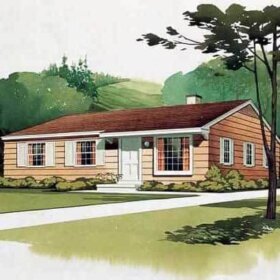

What kind of driveway material is appropriate for a midcentury home? Pavers? Concrete? Pea gravel? Asphalt? Reader Jane does not like the pinky-gray brick paving blocks added at some point as the driveway of her 1958 home, and welcomes our ideas and suggestions. I have some immediate reactions and thoughts… but I have not researched this topic… Readers, what do you think? Read on for Jane’s complete question and story…
Jane writes:
I searched your site for any info on driveways… but I think it is a topic you have yet to cover! My midcentury home has been unfortunately renovated with a pinky-grey interlocking brick. I [*h*-word edited by pam] interlocking brick. With a passion. Looking up ways to cover it seems to result in no answers – apparently, everyone on the internet wants to put this in, not cover it or take it out!
Wondering if you have any thoughts on midcentury driveways — I think concrete looks best… but maybe pea gravel would be a cheap way to cover up the interlock… I dunno. I was thinking to maybe post a pic of my Midcentury Don Mills (Ontario) house exterior and have some of your readers weigh in on cool midcentury driveway ideas.
Forgive the lawn, it’s Canadian winter, everything is dead at the moment.
I just got a quote from my family contractor, he said 8 to 10 THOUSAND dollars just to rip out the interlock and put in plain concrete. Ay caramba! Now I know I need some more options! I wonder what else would look good with this house.
Dumping pea gravel over the interlock is looking like the cheapest option… but can you roll giant recycling bins over that stuff? Will it get all over the road? So many questions!
Can you just pave over interlock? I’m guessing the experts will say no…
I also asked Jane for more info on what got her into this lovely home. She responded:
I have always had a fetish for Mid Century houses. Didn’t grow up in one, but I had friends who did. I swore one day when I could afford one, I’d buy one! We bought the house in 2010 after a very loooong search – they say no one leaves Don Mills, except in a hearse. People all moved in in the late 50s when it was built, then loved it so much, they never moved out. So housing stock is hard to come by. Don Mills is the only area in Toronto (within commuting distance to my job) that has these types of homes. First modern planned community in Canada. Lots of great MCM houses. And a great place to live.
Anyway, after 10 months of searching, we found this one. Unfortunately it had fallen prey to some ‘flippers’ who bought it in 2008, put in some cheap Home Depot/Ikea updates, then resold in 2010. I’m in the process of trying to undo all that they did, such as putting fake wood floor over perfectly good linoleum (arrrgh!), painting over wood panelling (gasp!), ripping out kitchen (silent weeping), etc.
I have pics of what the original house looked like in ’58 – but doing before and afters will wait for another time, when I am happy with my interior (but will I ever be happy?) haha.
By the way, the grey in the front was picked from that palette of Eichler colours you posted ages ago – Chelsea Grey. Thanks for that – they have been very useful. I’m picking some more from that set for my fence.
Cheers, Jane
Thanks, Jane, for all this information. This is a good one. Readers: Read more about historic midcentury Don Mills at Jane’s blog, Don Mills: Rediscovering the Suburban Dream.
And now: Let’s hear your ideas… I’m gonna hang back, read your ideas, think about ‘em, and pop in later with an opinion and ideas…



I’m no expert, but loose gravel would just end up being a mess. Not to mention rolling your recycling bins over it.
Concrete guys will probably tell you you need a solid base under their concrete and your pavers probably wouldn’t qualify as solid. Once concrete dries it has no flexibility. It just cracks.
My first thought as a “best bet” would be asphalt. It goes down soft. And stays somewhat flexible. It might be able to get into the cracks of the pavers and which would help stick it into place.
An inch or two of asphalt is what I would be pursuing.
Do not do pea gravel! I had a pea gravel driveway at my first house and I hated it! The gravel would get stuck in your tire treads and roll out to the street. It was always a mess.
I’m a fan of the pavers. I wouldn’t spend money to change a thing. They look like they are in good shape. I wish I had a full driveway. My 1952 home has two cement “ribbon” strips that I can never seem to hit with my tires, so I have a big tire divot on one side and the grass is dead between the two strips. It’s a major eye sore for me.
There is a process called tar and chip or macadam where a tar is sprayed down and pebbles are impressed into the top, giving the look of a crushed stone driveway but more solid like asphalt. It is an old fashioned process, they way roads were made in the old days. Here is a youtube video http://youtu.be/IgYnrFt3TqM
Another option could be large precast concrete squares? Large squares were popular in patios back then.
I actually like the pavers – the pattern is interesting and I think it works well with your home.
Personally I would love the multi coloured crazy paving option, but in this case would agree that tarmac would be the easiest/cheapest option. And there are quite a few options to have a gravel type surface finish applied to the tarmac. Looks like gravel but without it turning into a beach!
If it were me, I’d leave it. If it’s functional, then it’s fine. I don’t think it looks too bad with your house. Driveways are big, so costly, no matter what you do.
I do agree, concrete would look best, if you must replace the brick.
IMO every detail does not have to be period perfect. I’d live with the driveway and put the savings into mid century furnishings. But that’s me.
I agree with Chris. And speaking of Canadian winters….it’s no fun to shovel snow on pea gravel, or that pea-gravelesque (sealed) stuff.
You could do a test spot to stain the driveway. I would have to say that the midcentury modern driveway would be concrete. Do a google image search of midcentury modern houses and look at driveways. Houzz had some good pictures. However, concrete is expensive. The pavers with the curb to me look nice. Maybe it is the landscaping that needs enhanced along the drive.
Our neighborhood assoc. did a survey of our 600+ 1930-1960 homes, including the driveways and garages. There were still some of the driveways that look like two sidewalks going back to the garage with grass in between.
It’s a good look and is more eco-friendly as it doesn’t add to more run-off. I would think it should be cheaper than a solid concrete drive?
A lot of us are planning to do the two concrete strips when we redo our drives.
Louisa (and Jeanne),
Those are called “Hollywood” driveways. You can google image search for ways people have jazzed them up. However, I like them the regular way, they do help with run-off, and the enviros are hyping them up as alternatives to full driveways. Remember, when those were popular, tires were narrower that they are now.
As for Jane’s driveway, I’d say, leave the pavers and think about painting or staining them.
The tires were narrower? Weren’t the cars wider?
The width of each tires footprint was narrower than the majority of tires today. The width of automobiles track (distance from left side tire to right side tire) might have been wider but it depends on the size of the current vehicle as to how wide it’s track is likely to be (and many small cars have wide tracks in order to provide adequate interior space).
Thanks for the info, Lee! I will do a google search for some inspiration. I suppose if I spruced them up somehow, I’d be happier with them. The term “Hollywood” makes the two strips seem hip now.
I actually think the pavers look great! They are done very nicely and add an architectural element to the driveway as well. In the end it is up to you to decide if $10-15K is a justifiable expenditure to make the driveway period appropriate.
Just think of all the nice period appropriate furnishings you could buy with that kind of money!
Also I would ask, what do the other homes in your area or street block use? If the driveways in your area are original, then that should answer your question as to what was the norm back in the day.
LEAVE IT. It may not be the most authentic, but it’s maintenance free and perfectly OK looking. As someone who constantly struggles with upkeep on old houses, I say if it’s not broke, don’t fix it.
My parents had the two concrete strips for many years. It was OK, but keep in mind that there’s usually a dead patch in the middle from liquids from the car–the odd oil or other drip kills the grass. (Unless you actually park in a garage!)
Thanks for your comments, and keep them coming! I am intrigued by asphalt… and agree that concrete over the pavers (even patio stones) will crack. Good to know pea gravel is a PITA.
I do like the look of the 2 strips with grass inbetween, too. But it still necessitates removing the interlock.
Even more interesting is that some of you like my driveway, ha ha! Please, feel free to come and take it away…
I agree with asphalt. I think the color and lack of pattern would go nicely with your house. I’m sure you would have no problem selling the bricks from your driveway. That would help offset the cost of the asphalt.
be sure to consider your location insofar as freeze/thaw and snow in addition to adjacent plantings (trees, etc. that might promote heaving).
like others,i’d suggest first attempting to stain a dark gray/black — this could be a DIY job. second, gray pavers that you actually like (which would necessitate a rip-out) and lastly, ripping it out and starting over with a poured concrete with lots (and lots) of control joints as your winters would be tough on a solid slab.
asphalt… would look like the first syllable of the word (and the texture of the pavers would eventually telescope through).
I don’t know what it’s called, but it looks like pea gravel in concrete. I’ve seen this used at some Mid-Century homes around here…
It’s called aggregate, I believe.
And I understand it is expensive and should be resealed regularly.
My husband with the architecture background calls it “exposed aggregate”. We had it done when we replaced our cracked, broken, RED concrete back patio and I love it! It wasn’t a lot more expensive than having the standard smooth or brushed concrete, just took one more step. The MCM look is perfect for this great house, Jane, so do consider it if you decide to go for complete driveway replacement.
I love the look of Turfstone Pavers. I’ve been thinking of doing my driveway and backyard (small) with it. Very eco friendly (no run-off).
I would use pavers, in a color that compliments the color of brick on the house.
The second I saw that photo, I knew it was Don Mills. Beautiful. I think I know what street it is on too.
An asphalt driveway, though boring, might be the best for T.O., but I would dress it up with a border, like the one that is already there, and a concrete ‘landing pad’ in front of the carport to the front door.
You can’t put asphalt on top of the interlock – you need a good deep gravel base or your driveway will heave in the freeze/thaw cycle.
You could save some money by taking out the interlock yourself. Not exactly the most fun job but…
Also, I agree, my front yard needs some landscaping love. That is this year’s project. Last year was all about the inside… this year is all about the outside! I’m taking out some old dying bushes, moving some beds around, and putting in some interesting perennials and edibles.
In the summer, weeds like to poke up through the interlock driveway. But that is not the additional foliage I desire!
I actually like the way the pavers look. Maybe you could stain them a different color, that would be the cheapest alternative for change. I have a blacktop driveway and that does take maintenance. It must be sealed at least every other year, a real mess. Concrete can also be a problem with cracks and heaving. DH has gravel at his office, and that takes a lot of work. In winter, the plows move the gravel off the driveway and in spring is must be put back. Also, cars track it into the street where it washes down into a low area up the street. If I were you, I would keep the pavers until they need work, THEN look into replacement.
PS the asphalt also cracks and needs to be repaired every spring. After just 20 years, we are getting recommendations that we get it redone completely.
I actually like the look of the pavers, but I bet the color is whats putting you off more than the actual pavers. Perhaps consider staining them a different more neutral color? Since the pavers are just cement, you should be able to use the same process you would to stain a cement drive or patio. The cost would be minimal and you might find you like it after all.
Elaine an I apparently had the same idea.
Great minds…..
I also think stain is the way to go. the pavers are in great shape, and you can stain lighter or darker depending on your taste.
If you want to replace the pavers, I’d use concrete. Considering snow removal, ice, salt and such, its the most durable practical choice in a northern climate. I don’t think the pavers would be stable enough for anything to be laid over them.
Have you considered a little sweat equity? Okay, well, A LOT of sweat equity? Perhaps you could remove the pavers yourselves, it would save quite a bit on the labor costs of the new driveway. Maybe you could sell the blocks to someone who loves the look? Like thru Craigslist? Or a sign in the yard while the work progresses? Or, maybe you wouldn’t dislike them so much if they were re-used on a patio in the back?
Failing all of that, I would call a concrete place and check to see if they could be stained.
In my experience, asphalt (with some maintenance) will last longer and better than concrete in salty winter conditions.
Staining! I like it! You’re right, the pink colour (its more pink than the photo shows) is really what’s turning me off the most. It makes it hard to pick house colours because everything clashes with it.
I’m all for pink bathrooms. But I draw the line at pink driveways!
Oooooh off to google staining now…
Pink goes with grey, black, blue, green, red. Be creative.
Hi Jane,
I could suggest that you leave the pavers in if they are still in good shape, repair what needs to be done (Dips,etc.) and simply roll over it lightly with black driveway sealant in 2 or 3 coats. It will leave the outline of the pavers original but will make it look fantastic! Don’t fill in the cracks too much (Which is why I said to roll on lightly). But filling in wide gaps will prevent weeds from growing in between.
Another option is to have it painted/stained and then seal it with a semi gloss or matte clear finish. You could do a marble effect, granite effect, you name it! My suggestion would be to have a medium pink coral, Marbled paint treatment (Same colour as the “Submit” Button.
and then sealing it with a semi gloss clear finish.
All the best!
-A
I know it isn’t your favorite, but I think I’d have to learn to live with the pavers…they are in good shape and were expensive. I think you could put your money elsewhere and be happier with those projects.
Jane ~ I love your house! It looks just like my next door neighbors home in Albuquerque, New Mexico except his is stucco and wood. I would keep the pavers and as mentioned above possibly stain/paint them. Those of us who live in mid century modest homes have thing we love about them and updates made over the decades that need to be “undated”, I don’t think the driveway looks out of place. Next question, how will you spend the 10,000.00 you just saved? (hee hee)
If you decide to keep the pavers and do nothing, I will offer you one last very good suggestion, You can power wash it, after it dries, you can put a semi glossy or glossy clear finish over it to give it the “wet” look. It’s really quite beautiful that way.
I lean towards what is correct for the house when it was first built or at least what was correct for other similar houses in the area when they were first built. If you can’t find period photographs, or what was originally used for the driveway surface is not to your liking, I would take either the asphalt or two cement strips suggestions above and run with one of those. I also think that pavers do not look great and definitely do not fit the period (at least in most of the eastern part of North America).
The above said, I would stick with the pavers (they look to be in great shape, installed well and recently), and save money now either to spend on other things that are more important to you or to save towards driveway or other restoration work in future.
You should also check with your town or municipality on what the regulations are. Many areas have rules that limit how much surface can be impermeable (this may be why the previous owner went with the pavers, at least in part). Don’t get your heart set on something that codes will disallow . . .
Two concrete strips with grass center is very 1910-1940. 1945-1960 most commonly used full slab concrete for driveways. Asphalt was more common during the 60s and 70s because the price of concrete went up.
Despite period appropriateness, I think any current renovations should take present day considerations into mind. Impervious concrete for example is more expensive, but really alieviates problems with run off and overflow of sewers. Reinforced “parable” grass also relives all of that solar gain and sound reverberation of hard surfaces, and light colored pavement is preferred. But “if it ain’t broke don’t fix it” model is most green. That’s a lot of pavers to end up in some landfill.
ETA: gravel is very rural and is very uncommon in suburban driveways such as this one.
I would call that a herringbone pattern. In my MCM neighborhood I’ve seen pink roofs (now gone), pink siding, blue siding, pinkish stone detail on the front, greenish stone (both original). I would get over it and maybe you will even learn to like/appreciate it. I’m curious why the previous owners didn’t throw the money into a garage instead. Maybe they were bricklayers.
No! Must keep carport.
Don Mills back in the day – went looking for the photo and found it on Jane’s blog
http://donmills.wordpress.com/2010/07/07/deepwood-crescent-then-and-now/
While my personal choice would be to keep the carport – they are very functional if a bit of a nuisance when snow or leaves start blowing – I think leaving this sort of decision to the owner is important. Particularly important when the owner does seem concerned with the period aesthetics and doesn’t plan major alterations.
Jane,
I live in Toronto and had clients in that area as I am a jack of all trades. I could come visit you if you like and share some fantastic ideas. Restoring homes and vintage things is my passion. You can email me at OddJobber@hotmail.com
Most of the houses in the neighbourhood have asphalt. I don’t think anyone has concrete, that I have seen. So asphalt was probably the original driveway style of my area.
I’m googling staining… still not much info (lots of info on how to get stains OFF of interlock, though!)
I am thrilled with all the feedback and interest. Thanks everyone!
Personally – I wouldn’t stain, rip out, or otherwise do anything temporarily cosmetic to your driveway.
What I would do in order to Mid Century-ize is I would create a pattern using the existing pattern and pull selected pavers and replace them with a tan colored pavers of the same type to match the brick on your house.
I think this could be done relatively easily, and cheaply, and then there would be no worries over stain wearing off, and would be a lot less expensive than asphalt.
Think: interlocking squares, or diamonds, or something doable within the pattern you have just by changing the color of a few of the pavers for contrast, and to tie in the brick color on your home.
That’s my .02!
Very good idea, Tami, about using another color paver for a pattern! And, this would be an inexpensive option. Perhaps you could continue the look with the path to the door using mostly the tan color and maybe the pink pavers you took out. Power washing would help too.
I agree with the landscape option. If you spend some time researching landscape of the period, you can get an amazing change with less money, and the dw will blend. If you can do the labor, you can do in preplanned stages for far less expense.
The links to the neighborhood pictures are beautiful Now I see the setting, asphalt is probably correct and wouldn’t cost as much as concrete. Perhaps, if the pavers are easy to lift, you could offer a Craigslist thing for people coming to get them free for the labor?
I had tar and chip before I did asphalt and it was hard to shovel snow and hard for kids to play on all those little rocks. We put asphalt over the tar and chip drive and it has been fine. To me, tar and chip looks like an appropriate drive for a colonial neighborhood or a country setting.
My 1956 asphalt driveway is crumbling and needs to be replaced but I’m broke. Your driveway looks great and it’s in perfect condition. It’s similar to the old brick driveways but without the weeds growing through the holes and spaces. Be happy and you can spend your money on the interior.
I agree with Lynda Davis – I bet if you post on Craigslist that someone could have them for free if they come and remove them without totally tearing up the area around it, you would find someone that’s doing a patio project that would break their necks to find a few friends to help them come get them. Those things can be expensive and that person would jump on the chance to get them for free. And it would be a great reuse/recycle mission!
If you decide to take away the stone, I think I might know a few people who may be able to use it. You may not even need to do any labour. Please let me know if you do make a painful decision.
This may be the case were you don’t love it but, the best decision is to live with it.
Thoughts on the alternatives:
Gravel (I have this on my 1951 house an hour south of you in London, ON) …every spring you have a mountain of gravel to get out of your lawn … picking and raking gravel out of the lawn is not a fun way to spend a Saturday. Also if you don’t hand shovel it but use a snow blower, every so often the blower will hit a stone at the right angle to fling it from the blade and well depending what it hits that could be ‘unfortunate’.
Concrete: Would be most authentic in my opinion, but with the constant freeze-thaw cycle in Southern Ontario from December thru March, you need a good, well drained base to keep from heaving badly, meaning the pavers need to go, the sand under them needs to go, proper drainage gravel needs added, then the 4-6″ concrete slab needs poured. It’ll look great, and last, but cost you 15 grand give or take.
Asphalt: Same problem as the concrete. With the cimate issues in Don Mills, you need a proper base or it will crack. You can not put it on top of the pavers as the pavers will be moving all winter lawn. Asphalt is black and absorbs more sunlight during the winter and therefore warms the ground under it and expands and contracts more. The material is much more flexible as long as it slides nicely over the surface its on, the pavers would lock to it and cause it to crack and delaminate. Asphalt repair is a major issue each spring in sw Ontario because of the freeze thaw cycles and layers not bonding well to each other (take a drive around town right now for examples).
Tar and chip on top will crack in the winter along the joints of the pavers like the asphalt and will also have stones work their way free resulting in loose gravel bringing you back to the issues of the gravel driveway option.
Pavers are one of the most common driveway materials in the GTA because they handle the freeze-thaw better than most other options. Concrete would be great, but the key is the proper base under it or its going to heave and crack so your left deciding if you’re willing to pay the cost to get it?
We had to have our driveway redone a few years back, and I really really wish that we’d put in the “two strips with grass/gravel in between” option, instead of solid concrete, like was there when we bought the house. Next time it needs replacing, that’s what I intend on doing.
Wow, I think that the current driveway looks really pretty!
Our driveway is black asphalt with cracks and grass growing through so I’d love to have those bricks. I wouldn’t recommend gravel of any kind – it’s less than fun as it washes away if you’re on any kind of a slope and really is hard to get rolling bins up and down.
Love TappanTrailerTammy’s thought process – so sad to rip out a totally functionally and virtually maintenance free driveway – so many wish for that! I’d try to do the LEAST possible – and save the $$ for re-making the inside!:)
I have a handyman working on the entrance to my livingroom. He said that the asphalt driveways are very hard on the hardwood entrances into the 1950′s homes.
Our subdivision was built with concrete and a few neighbors did asphalt in the 1970′s…those are now being replaced with the pebble finish – crazy expensive. (This is our next replacement…circa 1948 cracked concrete driveway on a hill!)
I’ve used exterior masonry stain in our house to cover our pink/purple brick fireplace (I’m with you on the pink bricks!). I blogged about it here: http://craftywaffles.blogspot.com/2012/02/if-you-dont-like-it-then-you-should-put.html. We are super happy with it and have gotten tons of compliments on it. I think a dark grey/charcoal would be a great look with your house’s grey siding and should cover the pink well.
You can get it in about 20 different colours and it’s only about $30/can at Home Depot/Rona. I’m not sure how long it would last in the Ontario Winters, but even if you need to re-stain every spring at $30 a pop it’s a low cosmetic investment until the driveway needs to be relplaced.
If the environmental factors weren’t such an issue, I’d say concrete with exposed aggregate pavers.
My neighborhood of modest ranchs were built in 57 with asphalt drives. Living in the Mid-Atlantic area, winters can sometimes be brutal – snow, freezing and thawing. The asphalt seems to be the most durable but like anything else, there are maintenance issues and you have to maintain it. As others have pointed out, nix the stones and chip / seal. You will go nuts with the stones going everywhere, they will be tracked into your houe as well. Applying a finish of some sort will not last and you will not be happy with the material peeling off the surface of the pavers once you start driving on it. Your drive appears to be solid looking and in good shape. It doesn’t fight the house appearance and detract from its curb appeal. As Pam says: Love the house you’re in. Try power washing the drive and sweeping in new sand between the pavers. The “new” appearance might make you happier.
Be sure to check your local codes for what kinds of driveways are allowable. Obviously it will vary from place to place. My house (1920′s) has the two-strip driveway (our neighborhood got driveways in the 1940′s), but it was grandfathered in to the existing regulations, which no longer allow them. Gravel isn’t allowed, either. And this is an older urban-core type neighborhood, not a new suburb, so it might be that other older neighborhoods now are under similar regulations.
One note on pea gravel, my moms next door neighbor had it when she was growing up ( and for that matter when I was growing up) to stay looking nice…it takes UPKEEP. Every weekend the Mr. was out there raking it and edging it, to make sure no grass took hold and to clean up leaves and such…it took him hours ( long driveway) but still…unless you want or can put in the time to keep it looking like you want it to…I would go with another option. I hate to say that the concrete or asphalt, is probably your best bet. I live in a mid century neighborhood ( barely…mid 60′s to mid 70′s) and most of the houses have concrete ( the few that have installed asphalt stick out quite a bit) Good luck!
So, we have a paver driveway, too, although not so nifty and interlocking like this one — it is made of bricks recycled from some other purpose who knows when. I appreciate all these comments because it is on our list of things to replace. It is VERY uneven; both lumpy in spots and unevenly graded so parts of it are much steeper than others. The repurposed brick is also very slippery when wet and we are on a hill, so you have to be real careful stepping out of a car.
After reading all this I will be looking into replacing it with the “two strips” option which would be very appropriate to this 1909 house (and 1957 detached garage). If that isn’t allowed we will probably do the interlocking pavers. Water is an issue for us being mid-slope on a hill, so whatever we have would best be permeable.
I don’t know if it is pricey, but my kids’ school added permeable concrete sidewalks when they remodeled the playground and they are very attractive. Would look good with MCM design. It is a little reminiscent of pool decking in texture but grey in color.
Grew up in a mid 50′s development on Long Island (during the 70′s/80′s)- everyone had two strips of concrete with grass in the middle- in front of all of the capes, ranches, and upgraded split levels- no distinction. In the 80′s people switched to asphalt- more cars per family- needed the extra driveway space. My parents upgraded to asphalt then too. Next in the 2000′s everyone went to pavers when the asphalt finally gave out. I’ve noticed that pavers are good at handling snow and ice- melts quicker and more cleanly. Your driveway looks great- and costs a small fortune. I think it would be less prominent if you landscaped the right hand side all the way from the curb to the house. A nice bed of shrubs and flowers- maybe geraniums and coleus during the summer- would blend the driveway into the background.
I do not like the pavers, either. I’d post them on Craigslist (or the Canadian equivalent). I’m pretty sure someone would pay you for them, even if they had to rip them out. Then I’d get concrete with all those little stones in it. I believe original 1950s driveways were concrete with a mix of stones in it, not like the more homogenous concrete they have now.
Or you could just figure it’s good enough and move on to the next project.
I think the pavers look nice actually. They probably increase your property value if you ever sell. Putting in asphalt or gravel on top would decrease the value of your home. I wouldn’t do it considering they are pretty inoffensive and in good shape. I’d invest some money in nice midcentury landscaping instead, if you want to upgrade your curb appeal. And FWIW, my midcentury house has an original interlocking brick walkway to the door, and an original interlocking brick patio in the back yard, so the style is not totally un-period even if the materials are more modern.
Okay, here’s a twist to what everyone has been saying. Yes, I understand you don’t like the pavers, but honestly, I don’t think it is the pavers that are the problem. The brickwork is fantastic, but it’s the edging of the driveway I have a BIG issue with. The EDGING of your driveway is demanding all the attention away from the house.
WIth it being a RAISED, STRAIGT edging, the driveway is requiring everyone’s attention.
Solution: Before removing the entire driveway, please remove the edging first. Then take step back and take a look. Just that little bit of work will completely change the look of the driveway as well as the house. The geometric pattern of the driveway fits with the “Geometric 50′s”. So, start small before you spend all that money on something you might hate in the end.
Our front walkway is made up of similar pink pavers, and those raised straight bits along the edges are what keeps the pavers from all seperating out – I should know because ours doesn’t have the side rails! If you take them out as Jacy suggested you’ll need to replace it with something (wooden pre-treated ties maybe?)
Thanks so much for this post! I am in Florida and have a concrete drive that has heaved from tree roots. I think Hollywood is the style for me
I’m in the ‘if it ain’t broke, don’t fix it category.’ I’d REALLY have to hate something to spend $13 000 on a cosmetic fix. But if you do decide to go for something else, here’s another vote for anything but gravel. It is horrible to have to shovel snow over gravel and makes a huge mess come spring.
My MCM home has a concrete ribbon driveway filled with quartze pebble set in cement. We therefore don’t have the unsightly issue of our tires missing their mark and compacting the lawn strip. Works really well and I love it with our home. Having said that, I also think your driveway is great. I wouldn’t change it, driveways are expensive to replace.
My 1952 house has crushed limestone pebbles, although some of the same-era neighbors have larger crushed limestone chips, concrete, asphalt, or brick. Pavers in this pattern is just a cheaper substitution for what would formerly have been brick. Use concrete stain to to change the color to something you like better.
Or you can pry out some of the pavers randomly or in a pattern and plant moss or traffic-tolerant ground cover (garden centers usually have a selection of these) in the resulting holes–also something that was done in the period. Driveways were often about the materials that were available locally, regardless of the architectural period.
I have a concrete driveway and would love to have her’s!
I’ve seen crushed granite on DIY network, but I have no idea on cost, how it holds up, and if it’s period appropriate.
Asphalt is not eco-friendly and still expensive.
I would love the pavers!
I think your driveway is fantastic and would trade it for my concrete driveway any time and any day! I would not add any crusher fines or gravel as you will end up tracking them into your garage and then house. You will also have ruts where you drive over time and will spill over into the lawn area. I would not remove and replace as what you have is far superior to concrete.
There are many benefits to having a interlocking paver drive – it allows stormwater to seep into the spaces between, whereas concrete is impervious and runs off causing increased flooding.
I think you should just hang a bicycle over you fridge and call it a day!
Short of trying listing it for free on Kijiji if someone would take it away, Jane, I’m in the leave well enough alone group. If it could be stained, bonus, but gravel and our winters…nasty….and concrete doesn’t really love our winters either. It all becomes a maintenance nightmare. If you have asphalt put over it I wonder if you’d have heaving problems.
The little house I bought has a very expensive concrete that looks like stone side yard and path and stairs and, sigh, a need for maintenance every spring after the freeze thaw cycle is over. (Please let it be soon!) I’m lucky, I suppose, as it could always be decked over but that will have it’s own complications because it’s not smooth.
While I wouldn’t choose that kind of driveway either it does look nice with your house so maybe different plantings and trees could make it less of a bother to you?
P.S. Jane, the photos of the Don are unbelievable…..OK, believable but they did have to be seen to be believable.
I’m agree with the no pebble – it wreaks havoc on the snow blower and is a pain to shovel snow off of. This I know, because I have an asphalt/partial dirt-pebble driveway and I live in MI.
But guess what I’m getting for my birthday, in April? A whole new asphalt driveway – right down to the street
No more dirt/pebbles at the bottom and my asphalt will be smooth with tree root divits to trip over! (I have the original asphalt on my 65 ranch – some on the street have concrete).
HI Pam-
Pavers, absolutely not! I never see them in a vintage home. If going vintage, I would recommend aggregate concrete which is very common in this era. Stamped concrete in a large geometric pattern in another treatment that I have seen.
However, if going more contemporary or “green” one can do a porous surface to better handle water runoff, and if done properly it will also do very nicely and perhaps enhance your karma at the same time.
Best,
Kathryn Madison
Hi Kathryn!
Hey Jane, I just want to let you know — I have some more research on this under way… There’s a slight hold up. Stay tuned!
1. Not sure why people keep saying “railroad ties”. Railroad ties are huge, 1′X1′ tar-soaked pieces of wood. The sides of this driveway are concrete.
2. Putting pea-gravel on top of pavers would be a nightmare. What is going to keep the gravel there? Nothing. It will wash off into the street, leap the curb and end up in your lawn, the vehicles will move it off to the side as they go in and out… gravel only works over dirt surfaces, where it can sink in and get a foothold.
3. People are suggesting yanking out the concrete edging on this driveway. I would make darn sure first that they are not crucial to keeping the pavers in place! With the weight of vehicles moving back and forth over the pavers, I doubt they’d stay in place just floating in the dirt, so those side walls may be very important!
4. I watched the stain video… am I the only one to notice the end result was ghastly? All that work for a blotchy, two-toned mess. When the salesperson in the video has to remind you eight thousand times about how important it is to avoid the nozzle dripping stain on the surface, you just know that thing is going to leak and spit all over your driveway.
My take on this whole project is this: The driveway looks fine – it’s the landscaping that’s making this place look tired. Leave the driveway alone and concentrate on the lawn and plants. And I’m not talking about “it’s winter” – I know it’s winter. I’m talking about the layout, the motley assortment of scrubby evergreens (needs variation), and the shape and size of the shrubbery. The driveway looks in beautiful shape, don’t mess with it. Get that yard taken care of – that’s something that can be done one thing at a time, as you can afford it.
READ what I wrote. I started calling them railroad ties because that’s what they look like – of course they are concrete. READ I point out that you need to consult with a pro before pulling out the railroad ties. *coffee no breakfast yet*. Yes, I don’t like the two-tone either. Just use one-tone.
If it’s something that could be done economically, I think the present driveway would look a lot better if the pavers were all running parallel to the direction of the driveway. I think that would give it a less colonial vibe. It would look even better if they could be placed in a grid pattern, rather than offset rows, but I expect that might destabilize the surface… or maybe not. In mid-century houses, I’ve seen that arrangement used a lot on walls… perhaps because they were made of cement block(?)… but also in the placement of rectangular tile work. The color of the pavers looks more grey on my monitor than pinky, so I don’t see that as a problem. Maybe they look worse in person. Since they’re already there, and are, in fact, pretty practical, it would seem a shame to discard them before trying to utilize them if at all possible. But I certainly understand wanting the driveway to look appropriate for the period. In my opinion, though, painting them would be a bad idea. MAYBE if they can be stained evenly. MAYBE. Good luck.
I did my MCM driveway with pavers. The great part about them, 1) ease of finding them 2) cost 3) you can make patterns! Don’t know how to post pics here but…
Regardless, I would encourage everyone to think about the drive as an integral component to the entry sequence. The walkway from the drive should be incorporated with it. It’s exterior space and needs to respond as such!
cheers!
What if you we’re to cut squares in the drive pull out the bricks and replace those sections with concrete that was dyed to match the color of your brick on the house. then take the bricks you pulled out and use them on the sidewalks creating the same pattern of the drive to create continuity?
It would be my guess the pattern that you chose could be created to match patterns that were seen a lot in the 50′s. Work with what you have, save time and money to be used elsewhere in areas that need it worse.