by pam kueber on September 30, 2009
HOW DID AMERICA END UP WITH 5 MILLION pink bathrooms? Credit goes to: A super-efficient military wife with sparkling blue eyes.
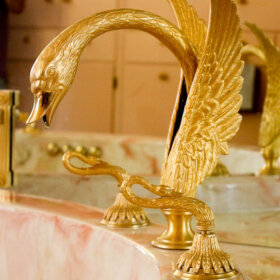
Mamie Doud Eisenhower had a tried-and-true method for setting up new households as she traveled the world with her husband the General. She knew she looked good in pink. Put the two together and ultimately you get: Mamie Pink bathrooms all across America. Five million is my conservative estimate. Maybe even 10 million, a reader yesterday estimated. Today we dive into the story of how Mamie Eisenhower led us down this primrose pink path. Above: 1960 Christmas card made by Hallmark for Mamie. All images in this post courtesy The Eisenhower National Historic Site. Heck yeah there is more…
by Erica Donnis on September 4, 2009
A view of the Koravos family kitchen. Courtesy of Historic New England. Used on this site with permission.
THE 1957 KITCHEN from the Koravos family home in Andover, Massachusetts is the eye candy of the America’s Kitchens exhibition. Imagine original robin’s egg blue metal cabinets, stainless Westinghouse wall oven and cooktop, and canary yellow Formica counters with space-age patterning, all in near pristine condition. Mrs. Koravos preferred to cook in a second full kitchen in her basement, leaving this one on the first floor, which her guests would see, clean and clutter-free. Heck yeah there is more…
by pam kueber on September 4, 2009
This photo of the White House family kitchen is from 1992…but if you jump onto this White House Museum page, you can see the kitchen when it was first installed in the private family quarters area by and for Jackie Kennedy. And glory be, it sure looks like her cabinets were Geneva’s. Heck yeah there is more…
by Erica Donnis on September 3, 2009
Kitchen accessories from the trade catalogue “243 New Ideas for Your Kitchen", ca. 1955. Kalamazoo Stoves and Furnaces, Kalamazoo, Mich., publisher. Promised gift to Historic New England from a private collection. Used on this site with permission.
ACCORDING TO AMERICA’S KITCHENS, many of the things we take for granted today in our kitchens were introduced or became widely available in the 20th century, driven by emerging technologies, consumer demand, and commercial marketing that influenced people to update frequently and to buy the latest gadgets. Heck yeah there is more…
by Erica Donnis on September 2, 2009
A view of the Gropius House kitchen. Courtesy Historic New England. Used on this site with their permission.
THE AMERICA’S KITCHENS EXHIBITION profiles the sleek, black and white kitchen and pantry designed by Bauhaus architect Walter Gropius for his 1938 Massachusetts home. According to curator and co-author Nancy Carlisle, the adjoining galley spaces are “models of efficiency” that function almost as “laboratories.” They contained the latest appliances, including a General Electric dishwasher and garbage disposal. The kitchen and pantry, in the rear of the house, worked well when the family employed a cook. But when Mrs. Gropius took over the meal preparation, she found it difficult to interact with family members or guests. Consequently, Mr. Gropius would often spend time with his wife there, assisting by loading the dishwasher or simply sitting and chatting while she worked.
Erica Donnis is an independent historian and museum consultant based in Burlington, Vermont. This is her third vignette taking a look at America’s Kitchens – both the book and the traveling national exhibit. Find out more about the Gropius House, which is now owned by Historic New England, here.
by Erica Donnis on September 1, 2009
“Kitchen No. 7,” from the trade catalogue “Kitchen Hints,” 1947. The Kitchen Maid Corporation, Andrews, Ind., publisher. Collection of Historic New England. Used on this site with their permission.
THE 20th CENTURY WAS A TIME OF RADICAL CHANGE in kitchen design. As Nancy Carlisle and Melinda Nasardinov describe in America’s Kitchens, a focus on efficiency in the early part of the century transformed kitchens into compact units, with matching cabinets and built-in appliances topped with spans of countertop. Efficient kitchens were meant to reduce workloads, but their small size and usual location in the back of the house also distanced cooks from their families and guests. The open floor plans of the 40s, 50s, 60s, and 70s were a reaction against that isolation. As Nasardinov frames it, they “transformed kitchens from service spaces into social spaces” by blurring the boundaries between cooking, eating, and living areas.
Erica Donnis is an independent historian and museum consultant based in Burlington, Vermont. This is the second installment of her week-long look at America’s Kitchens — both the book and the national traveling exhibition.
by pam kueber on September 1, 2009

Julia Child donated her kitchen to the Smithsonian in 2001. She had been in it exactly 40 years, since 1961. Here is her kitchen still in place in her Cambridge, Mass., home, before it was disassembled and moved to its exhibit space in Washington, D.C. On the Smithsonian’s website, Childs talks about how the kitchen included many favorite things that made her happy — as a kitchen should, even one that’s been the site of a famous TV series. (I presume those are tracks for cameras and lights we see on the ceiling.) Another interesting thing I spotted on the Smithsonian website: For the exhibit, the Smithsonian’s graphic team re-created the speckled linoleum kitchen floor originally in the Childs kitchen by making color copies then laminating them onto other flooring in a repeat pattern. Julia Child’s Kitchen at the Smithsonian.
by pam kueber on August 31, 2009
THE MID-CENTURY KITCHEN: It encapsulates so much about American culture of the time, including modern design, space-age technologies, and postwar consumerism. All this week at RetroRenovation.com, we’ll be taking a look at the mid-century kitchen and its place in the history of America’s Kitchens. Leading each day’s kitchen stories will be my good friend Erica Donnis, an independent historian and museum consultant based in Burlington, Vermont. She recently visited the America’s Kitchens exhibit and will be bringing us spotlights on design and technology — and a couple of fabulous examples of mid-century kitchens.
by Erica Donnis on August 31, 2009
Office of War Information Poster No. 57, “We’ll have lots to eat this winter, won’t we mother?” Alfred Parker (1906–1985), graphic designer. (Washington, D.C.: United States Office of War Information, Division of Public Inquires, 1943). Promised gift to Historic New England from private collection. Used on this site with permission from Historic New England.
Reviewers generally don’t gush, but I can’t help myself! The America’s Kitchens publication and exhibition both nimbly cover a broad topic without bogging down, and they touch on important issues (think slave cooking, Irish servants, and women’s roles) along the way—without hitting you over the head with it. Both are filled with great quotes and visuals that readers of this blog will eat up (no pun intended, of course). In the exhibition, I especially enjoyed the opportunity to browse through vintage American cookbooks in a reading area set aside for that purpose. There are even recipe cards on hand in case you find something to try at home. Enjoy! — Erica Donnis
Erica Donnis is an independent historian and museum consultant based in Burlington, Vermont. This is the first installment in her week-long look at America’s Kitchens — which now encompasses both a book and a national traveling exhibition.
by pam kueber on August 31, 2009
If you are obsessed with mid-century kitchens, looking for design ideas, or interested in kitchen history, check out the book America’s Kitchens by Nancy Carlisle and Melinda Talbot Nasardinov with Jennifer Pustz, and its companion traveling exhibition, which place 20th-century cooking, eating, and entertaining within a historical context. The traveling exhibition is currently on view at the New Hampshire Historical Society until January 27, 2010. Future venues include the Long Island Museum of American Art, History, and Carriages and Heritage Museum & Gardens. For more information, see AmericasKitchens.org.