• Mid-century modern landscaping: The first in a special series

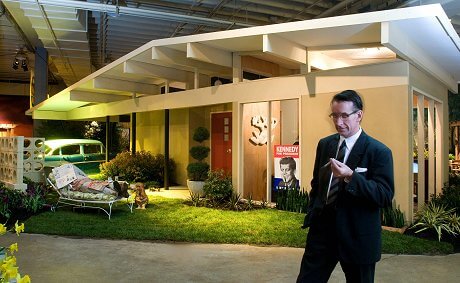
    I met Ted Cleary of Ted Clearly Landscape Architecture when we both spoke at the Charlotte home show — that’s him, playing up his mad men persona, in front of the mini-Eichler he designed, installed and landscaped for the event.  He and I got along famously, in fact, we were kind of a Friday night double feature: Mid-century homes inside… and out.  I’ll tell you: I learned a lot about landscaping mid-century modern homes, in just one hour of listening to Ted.
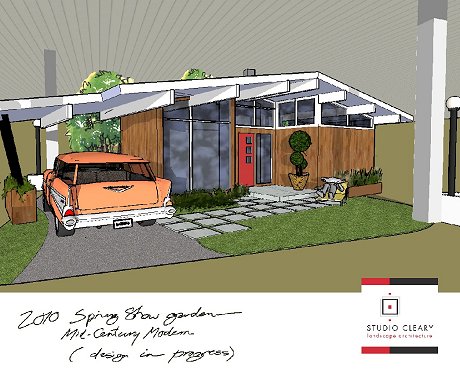
    When I first showed Ted’s sketch for the landscape design of this Eichler house, I promised more coverage of mid-century modern landscaping ideas. So here comes: Ted himself on some of the basics of mid-century modern design,  the first in a new series of guest posts from him. I’ll feature one or two a month — pretty much as many and as fast as he can crank them out. I know this is a big “want” and “need” of many readers. In fact, after you read this first story, I’d love to hear more from you about landscaping topics you’d like to Ted him cover.

    Ted writes:

    Can you start by telling us about yourself and your background in landscape design?

    I’m a sole practitioner, designing and managing the construction of landscape projects for a mostly-residential clientele.  After Clemson University’s five-year LA program, I followed the path of most young graduates and went to work at conventional landscape architectural firms, whose focus is typically on larger commercial projects.  While these provide great experience in such technical issues as drainage and construction detailing, the reality is that the bread & butter work of most firms are conventional shopping centers and office parks and the like, where the developer is motivated to follow only the most basic landscaping requirements, rather than the sorts of cutting-edge high design praised in architectural journals.  I’ve always maintained that you could train a monkey to sit in front of a computer and stamp tree symbols on a Wal-Mart parking lot plan.  I gravitated to garden design, where the “end user” is excited about really making their home their own modest version of paradise, and the opportunities to do it creatively are so much greater.  

    Why did you get so interested in mid-century landscape design?

    All across America, we have subdivisions built in the past two to three decades filled with contemporary interpretations of French Chateaux, Arts & Crafts Bungalows, and other period, historic styles.  A trait they usually share is that they’re designed with square footage as the driving factor, and often their scale, in relation to each other and to their own outdoor spaces, makes for awkward relationships.

    In recent years, I believe the movement toward houses that are bigger on design quality but smaller in size has really developed a following.  You can build a new home with this philosophy, but why not look for it in an existing older home with a sense of age and continuity, when there’s so much great post-war housing stock?  Our parents’ generation happily raised families in these homes, under more modest conditions of space that fit better with today’s smaller families.  While there are indisputable issues to deal with in an older home of energy efficiency and the like, and some interior layout changes are usually in order to make them more livable, I’ll take a cozy older home with real lap siding, true-divided-lite windows, and a lovingly maintained garden hands-down over many of today’s characterless big boxes.  But, to complete this picture of domestic bliss, the outside spaces should reflect the style and period.  In most cases this landscaping has ‘lost its way’ through the vagaries of time, weather, and changing tastes; I want to see it more reflective of its history.

    For this first story, can you tell us, in general, what are the key, foundational elements or drivers of mid-century landscape design. Like… the theory behind it… that residential homeowners should be thinking of?

    Well, I think we can look at it in a couple of ways; traditional homes had one ‘look’, but mid-century modern ones quite another.  With the latter, a seamless quality between inside and outside was an integral aspect of mid-century modern architecture, and there’s a very recognizable vocabulary of rectilinear patios, clean lines, and bold curving shapes with no focal point or symmetry.  Influential landscape architects such as Garrett Eckbo were strongly influenced by the abstract painters of the mid-century.

    But as Pam has pointed out, most of these modest post-war homes instead reflected a traditional style, whether we’re talking about a Cape Cod, a neo-Colonial, or a rambler.  If you carefully study garden books of the ‘40s and ‘50s, when you scrutinize the black and white or fading color photos, you’ll see that the better landscaping really was not a lot different than what we garden designers today think of as basic, sound design principles:  overlapping plant masses, interesting specimens, a sense of ‘movement and rest’, and entertaining areas using hardscaping materials and geometries in sympathy with their house’s style.  We could speculate that our parents and grandparents, having weathered a deep, sobering Depression and the full-on sacrifices of a second World War, were looking for the comfort of traditional styles in both their homes and the landscaping that surrounded it, but in a simpler and more affordable version geared toward the middle class.  There seemed to be a bit more emphasis on bright circus-like colors with big Dahlias, Hollyhocks and high-maintenance Hybrid Tea Roses, yet designs tended to be a bit more ‘tight’. Today’s trend, by comparison, introduces somewhat relaxed, native perennials and shrubs, which have become more mainstream not just for the aesthetics but the environmental aspects of water conservation and so on, which of course was virtually a non-existent concern back then.  One easily-overlooked aspect of mid-century garden design is what’s not included:  the sorts of materials like stackable concrete block walls or vinyl fencing that weren’t around back then, and an absence of the over-the-top luxury added to so many expensive backyards in recent pre-Recession times.  It’s interesting to me how the influences of Modern design crept into the look of many otherwise-traditional gardens, no doubt because of popular magazines like Sunset, in a similar way to the merchant builders who cobbled together different features they admired into their hybrid home styles.

    How about showing us one nice design – and why it’s great.

    Mid-century modern garden design is very diverse, even though it has an unmistakable ‘vocabulary’ as I described.  But if I had to choose one specific project that’s really iconic for the period, that would have to be the Donnell Garden in northern California. Thomas Church is generally recognized as the first landscape architect to reject his Beaux-Arts training of classical formality, in favor of a Modernist approach that both responded to and defined the “California Style” of relaxed outdoor living.  In 1946, Church created a pool area whose genius is in the clean, sweeping curves that echo distant views of rolling hills and San Francisco Bay beyond the rural landscape of their ranch.  The Donnell descendants have done a wonderful job maintaining it in its original state, and I think its elegant simplicity is the reason it still draws admirers today to see it, sixty-four years later.

    Thank you, Ted! Readers: What other landscaping topics would you like to see Ted write about?

  • Get our retrolicious free newsletter.

    Newsletter-sign-up-2NMAS

    Comments

    1. Fantastic! I look forward to seeing more Ted on the site.

    2. TaraUB says:

      Thank you for this new series! We’re in the midst of trying to figure out landscaping for our MCM and I so don’t want a bush of some sort on the corner of my house! I’d rather go bare for years while we figure it out than put something in that I’ll hate. This info will really help us.

    3. Jessica Evett says:

      Wonderful post and really looking forward to the rest of the series! Since you put out a call for topics, I’d love to see more of Ted’s thoughts on landscaping for mid-century modest homes out here in the Western U.S. As he pointed out in this article, selecting plants that are appropriate for our arid climate (we live in the Colorado Front Range) is very important for water conservation, and it would be interesting to see a feature on waterwise landscapes with mid-century design in mind.

      • Ted Cleary says:

        Jessica,
        This is indeed a worthy topic to cover……in fact, there’s so much to it that three or four posts could apply. At least as important as WHAT plants to use, however, are all the practices to follow that apply to almost all our locations: soil amendments,; mulching; rain harvesting; certain types of irrigation; and so on. When I do get around to this topic, I’ll try to address it from a mid-century-design perspective…..I don’t think that aesthetics have to go out the window to have a “responsible” garden, and, after all, the mid-century designers were all about form following function.

    4. Tamara Hoffbauer says:

      Great start to an important topic! Can’t wait to read more. Would personally love to hear some ideas for ultra-low maintenance landscaping with a MCM feel, and the ever-popular “what to plant when all you have is shade”. As the owner of a modest MCM home on a relatively wild and heavily wooded 1 acre plot with poor soil and little sun, I’m searching for landscaping alternatives that go beyond just plants, grass, and patio but still look like one with our home and property. I have the (hopefully misguided) idea that most MCM landscaping was manicured and weed-free, with lots of California influence. What can those of us in the wild Midwest do to still capture some of that feeling even in areas that are not conducive to that style of landscaping? Thanks for the great article!

      • Ted Cleary says:

        Tamara,
        Don’t be discouraged by shade! It actually offers a wide variety of plant textures that, composed together properly, make for beautiful combinations. (Think a sea of soft ferns among darker, glossy wide evergreen leaves.) Jon points out below that the cliche’d mid-century modern home usually seems to be in a desert or tropical setting — which can look gorgeous — but Modernism as applied to the landscape is, or should be, a lot more about the philosophy (simplicity, clean lines, plant textures), rather than the “stuff” (an obligatory Agave, for example)…..so you can create an appropriate design even if you live in a more temperate climate, such as I do in North Carolina.

    5. Marcela says:

      Oh thanks so much! we’ve been working on ours for the last 5 years, since we live in FL we are trying to keep it very tropical but like the earlier posters stated, we want to keep the MCM feel to go along with the house.
      I can’t wait to see more

      • Ted Cleary says:

        Marcela,
        BUT…..having said that, I DO envy you! — you can’t beat the variety of tropical plants, with their wide range of hugely dramatic textures, that Florida offers. At some point I’ll be discussing one of MCM’s brilliant landscape architects who made the world see how fantastic that tropical setting can become: Brazilian Roberto Burle Marx.

    6. Jon Miller says:

      Thank you for this series! So much of the information and pictures of really cool MCM landscaping are what I would call either desert or tropical modern, which doesn’t work so well here in the Midwest. Ideas for the Midwest would be appreciated!

    7. Laura says:

      Fascinating article! Thank you and would love to read more from Ted. I am like Jessica and would love to find out more on design of xeric landscapes for mid century modern homes. I live in Calgary, Alberta – cold and dry. I’m also interested in finding out how to design a garden that is modern and also baby friendly. Geometric sections of pea or lava stones would be considered ‘lunch’ for my 10-month old.

      • Ted Cleary says:

        Laura,
        A great idea I hadn’t thought of. Being the dad of a 6-year-old, and now twin toddler boys, it’s made me a lot more aware of “baby-friendly”! You know, the mid-century modern tract homes — the Eichlers, etc. — as well as I’m sure all the other non-modern, post-war styles, were designed and indeed marketed to be great places to live for Baby Boomer families. I’ve seen some great ideas from back in the day for really inventive play structures, back before we filled our yards with blow-mold plastic playsets. This subject is rich with angles & one I look forward to covering.

    8. Sara in WA says:

      I would think that making plant selections is going to be difficult as there are so many regions/climates to deal with. Maybe a general plan using shapes & textures of trees/shrubs/beds for various mid century homes including both traditional and modern, low ranch or boxy split level, might be a helpful approach. Local sources can help with actual plant sections.

      • Ted Cleary says:

        Sara,
        It’d indeed be overwhelming to try and come up with comprehensive plant palettes for every USDA Zone and every specific climate across the U.S. (and Canada!). But there are actually quite a few plants that not only “work” aesthetically, but are happy across a broad range of our garden zones, so I won’t completely shy away from naming names. But you’re right: it’s a lot more important to tailor your choices to your area & conditions, once you first know what you’re looking for as far as traits — evergreen vs. deciduous; flowering or foliage color; sun/shade; mature size; texture; etc.
        I often encourage my clients to collect magazine clippings for our first meeting, of gardens that ‘speak’ to them; I don’t care if it’s a garden in England and a certain plant they love in it will never survive here — rather, i want to see what kind of LOOK appeals to them….then I can find the right substitute that works.

    9. Cindy says:

      This is a great topic! I’d love to hear more about hardscaping for MCM homes, specifically which materials will work in lieu of flagstone which none of my landscaper contacts suggest using because it’s slippery. Also, what shapes, sizes, and materials for planters around a patio?
      Thanks for great variety, Pam!

      • Ted Cleary says:

        Cindy,
        “Flagstone” is often mistakenly lumped in with “Slate” (which is only ONE type of flagstone); flagstone can be cut, split or sawn from all types of stone, such as basalt, bluestone, sandstone or others which all have a gritty (non-slip) surface to some degree. Slate, having a low absorption rate when it gets wet, will indeed be slippery. If you like the look, I’d suggest visiting some local stoneyards to see what’s available in your area.

        Beyond that, the nomenclature gets a little fuzzy: what I call “flagstone” are the rectilinear-cut (“ashlar-cut”) pieces, all cut at right angles that fit together jigsaw-puzzle-like, which I think usually are a much more modernist, or just generally mid-century, look…..I call “fieldstone” the same kind of stuff, only they’re IRregularly shaped pieces….but not all stoneyards or stonemasons follow the same naming convention.

      • Ted Cleary says:

        I also wanted to point out that, if you’re talking about “planters” being pots or containers, there are definitely styles that DON’T do justice to a MCM home (e.g. some kind of heavy concrete Classical Grecian urn from the big box store — ugh!). Luckily, there are more and more styles out there with a modernist look to them.

        But if you’re talking about “planters” being built-in masonry boxes as part of the house structure — a very common trait — it’s hard to advise without seeing the specific home.
        I plan to, from time to time, present quick conceptual make-over sketches to mid-century homes either on Pam’s blog or on my own blog, expected to be up & running this month.

    10. Josie says:

      I would like to see a list of popular combos in mid-C. I tend to picture red geraniums…and….and…? Or blue junipers…and more blue junipers. I have a hard time pulling together classic-looking beds.

      When you picture that cute ranch house w/ little mounding foundation plantings and single specimen tree, what were the common vs. bold choices? What was gauche? Was there any point in the 20th C. Americans WEREN’T planting Japanese maples?

      Thanks in advance I’m so excited to see these posts.

    11. Deb says:

      One issue we’ll all face at some point (depending on the diligence of the previous owners of our homes) is the issue of lot grading–that the grading of our lot has deteriorated over the years, resulting in poor drainage and possible flooded basements and most importantly, foundation damage.

      Ted: Please write about improving and correcting lot grading. I keep hearing about how easy this is supposed to be, but I’m not quite sure how to proceed. Is it as simple as just adding more topsoil? I think my husband and I will need to install window wells around our basement windows too. Could you talk about that?

      Along with the lot grading issue, there is the issue of mature, exisitng landscaping. Here I’m specifically thinking about root systems damaging foundations and sewer lines. Someone told me that I needn’t worry too much about the roots of the lilac bushes against the front of my house; because the bushes are so old, their roots would have grown beyond my house’s foundation. Is this true? Any information you have regarding the sorts of root systems different types of plants have, and the hazards that they may present would be most appreciated.

      Thanks Pam for the awesome website! :-)
      Deb
      1945 Semi-bungalow, Edmonton, AB

      • Ted Cleary says:

        Deb,
        Thanks for bringing up an aspect of landscape design that’s often overlooked: grading. Otherwise-beautiful designs are often created, in the flat 2-D world of paper, but when they’re put in the ground, it just doesn’t look or function right, because the topography wasn’t given enough attention. Slopes can be real opportunities for subtle design-making, even within the small scale of a residential yard.

        But you’re referring to something a bit different: drainage problems, which are related to grading. The specifics are too much for a cursory discussion here, but just remember the basics: water only flows downhill! You usually have several options for whether you make that happen across the ground surface, or under it…..but in the end, where the water comes out —- away from undesirable locations like a basement wall — has to be lower than where it goes in. Adding more topsoil, for example, may help a lot depending on the situation, or may be a total waste of effort.

    12. nina462 says:

      thank you for this thread! I’m deciding what to do for my ranch gardens. I did finally get a red geranium for the front porch that looks great…but lonely. I have a huge side garden that I’m trying to plant flowers along with veggies. I was able to get a snowball bush from my grandfathers house (via my Mom’s house) and rose of sharons are making a nice border. Any other ideas for a 65 ranch yard would be great! Maybe some photos?

      • Ted Cleary says:

        Nina,
        This is also the kind of advice that’s better left to actual examples (see my note above, about occasional conceptual make-overs to come)……but in general, (REALLY general), terms, ranch homes are often all about ‘horizontality’; they benefit more from low plantings that reach far out into the yard than a lot of upright spiky things. And accents like a split-rail fence (I know, sounds kitschy, i would’ve thought so too before I started to appreciate these retro styles) may be just the ticket to echo the lines of a house like yours.

    13. nancy says:

      I have been gone a few days & missed this! Really sorry. I have a new garden that I would like to put some lights in? Any suggestions on lights that would set off the garden & the 50′s house?

      • Ted Cleary says:

        Nancy,
        Landscape lighting is one of my pet issues…….it’s often overlooked, but a really well-designed lighting project can absolutely take a garden from “nice” to “breathtaking”. And I say this with the caveat that (as in many things) Less Is More; the examples you can see on websites of lighting manufacturers are, IMHO, often over-the-top.

      • Ted Cleary says:

        [sorry --- hit "submit" prematurely!]
        …..again, one can’t really design the lighting system without seeing the site and its garden, but a few GENERAL principles I advocate:

        (1) am not a big fan of visible light fixtures, e.g. path lights; a few are OK as accents, but most lighting should come from somewhat-hidden sources — you want to create the EFFECT, not draw attention to the SOURCE.

        (2) if you have mature trees, use them! One of the prettiest effects is downlighting through the foliage (“moonlighting”) either onto pathways or onto a pool of lawn or plantings. In fact I sometimes advise clients if lighting is only one of a long wish list but the budget’s really low: don’t do anything but add lighting! That way, at night you can instantly transform a ho-hum landscape into something really magical b/c of how you selectively draw attention to existing features.

        (3) Since low-voltage lighting was in its infancy back then, it’s really not too authentic to have an elaborate LV lighting system…..therefore this is one of those cases where you’re going for an “improved version” of the real thing, vs. true authenticity. Again, another reason to create subtle effects rather than see a lot of sources.

        (4) This is gonna be hard to swallow for many readers, but one should count on spending about $200-225 PER FIXTURE for really good quality; maybe around $75-100 if you do all the electrical and grunt-work yourself. It’s easy to underestimate the cumulative effects of weather over time, and unless you choose from among 3 or 4 of the high-end, well-engineered product lines, usually of bronze w/ lifetime warranties, you’ll simply have repair issues to deal with sooner than you want. The inexpensive sets from the Big Box stores sure have attractive prices but believe me that you get what you pay for. There are a number of mid-to-high-range lines too, but since the biggest percentage by far of what you’re paying for is the labor to install a system, hopefully once & for all, l just favor the best. Along with good fixtures are all the assoc. components that matter — high-quality transformer, wire, etc.; I always have my systems soldered at their connections……not very commonly done (it’s a lot easier to just twist & jab bare wires into a wirenut), but one of the most susceptible points for corrosion.

        (5) As far as retro-looking fixtures, I think the bullet spotlights mounted on houses fit both the modern and many “modest” styles….not to be confused with the “prison lights” mounted up high to scare off intruders! I’m a big fan of dimmer switches on such line-voltage (i.e. 110v) lighting, to make a nice balanced transition from inside to outside.

        (6) It’s really important to minimize ‘hot spots’ of glare; nearly all the fixtures I install get a wide-angle lamp and then, depending on the effect I see after installing them, a diffusion filter of some sort.

        This is a longer reply than it probably should be, but yes, look for an article on this at some future time on either Pam’s or my own future blog.

    14. nancy says:

      Ted- I appreciate your input & will keep these suggestions in mind. I agree with what you are saying. Where would I begin to look for fixtures…?

      Thanks for your help!

    15. James says:

      Tell me, what do you think of Japanese-style gardens for MCM’s? It seems to me that MCM architecture and Japanese architecture have much in common. Thoughts?

      • Ted Cleary says:

        James,
        Absolutely right-on. I think a lot of it can be attributed to Frank Lloyd Wright, who (although his outsized ego probably would’ve rejected any labels put on him), was definitely a Modernist, or at least greatly influenced that movement that followed. Wright developed a fascination with Japan after spending a couple of months in 1905 touring the country. He subsequently spent a decade creating one of his most elaborate works, the Imperial Hotel in Tokyo, as well as many other designs, and mentoring a group of Japanese assistants who went on to create their own landmarks. And maybe too, was a certain popular fascination with exotic Asian and Japanese culture (never mind that we had been arch-enemies in the war) that the troops brought home with them.

        So many of the two aesthetics you mention share common beliefs — a sense of restraint and simplicity; clean lines and the ‘void’ being as important as the ‘mass’ (in other words, what’s not there is as important as what is); strong geometric shapes and yet a real sense of feeling organic, which seem like contradictions but aren’t. So, that Zen-like quality you’re talking about definitely has a place in MCM garden design — tailored to the climate and surroundings. A topic I’ll definitely cover at some point, probably over more than one blog post.

    16. bobbie says:

      This site is exactly what I am looking for! We just purchased a MCM home outside of Philadelphia, and the yard has been very neglected! Not only do I need lots of ideas, but I also need to find a landscape designer who is sensitive to MCM…anyone know of such a designer in the Philly area?

    17. John says:

      Ted Cleary said to buy high quality outdoor bullet lighting fixtures. Can he or anyone who knows, list some of the names of companies that make these?

      thanks
      john

    18. Ted Cleary says:

      John,
      I was just skimming through old RR blog posts and saw your new comment (i.e. added about three weeks ago). Way back in May when I was asked that, I declined to respond b/c I wasn’t sure if it was appropriate to promote a certain brand…….but what the heck, I’ll do so now. So if you’re still listening:

      I use, almost exclusively, CAST Lighting. (All these names can of course be found with a simple Google search.) CAST fixtures and their associated components (e.g. transformer; lamps (bulbs); etc.) are, in my opinion, the absolute best value if you want quality that’ll last decades, not just years, trouble-free. They’re made of cast-bronze, which will weather to a sort-of dull chalky patina. You can learn alot more about the line from their website. (Most all the lighting manufacturers have great sites full of helpful advice both design- and technically-related.) I always take the extra step of doing a CAST-recommended technique of dipping the stripped wire ends, after they’re twisted together, into liquid solder to absolutely make them as one before they get covered by twist-on wirenuts filled with Teflon goop. This is probably the most vulnerable place in the system for the effects of weathering to creep in, so I think it’s well-worth doing. You need a special solder pot sold for the electronics industry to do this (and BTW, please use lead-free solder); there’s no guarantee that even a contractor who installs CAST will do it, so you should discuss this. CAST’s product line is simple, based on the concept (which I strongly agree with) that you want to see the SOURCE of the light, not the fixture in most cases…….occasionally I’ve wished for some more fixture choices but that’s not a big issue at all. What I really like are the available lens filters (other manufacturers have these too) that I use often, to diffuse light and avoid “hot-spots” of glare.

      Unique Lighting is another good line worth looking into. Although every manufacturer has their own particulars about assembling a system (and of course is convinced it’s best!), like CAST they use a “hub” technique where the fixtures are linked in a kind-of spider arrangement to distribute voltage in precisely equal amounts; with LV lighting, voltage drop is an important concept to understand for long lamp life. With most systems today (unless we’re talking about the simplest arrangement of a half-dozen lights on a condo’s patio), the transformer will be a “multi-tap” type, which allows the installer to connect to either a 12v, 13v, 14v…..on up to maybe 18 or 22v tap, which is a tremendously helpful innovation that let’s you run lights FAR away from the transformer’s location, if you have a large lot, without voltage drop.

      Working down in price, I kind-of like Vista and Kichler, if I really am forced into it, and both have plenty of fixture choices. The easy ones to toss out as serious choices are pretty-much the lower-end lines the big-box stores carry, often sold in kits. My philosophy is, though, the biggest part of what you pay for per fixture is in the labor & assoc. stuff like wiring, so it just makes sense to go with a high-end product line who’s fixture might be another $10-15 more than the lesser option. BTW, for a professionally installed LV lighting system, done with quality in mind rather than the cheapest guy in the phonebook, you should figure on around $200-250 per fixture (gulp). But it’s easy to underestimate the cumulative effects of weather over years’ time, and going the cheap way is going to mean frustration with a malfunctioning system a lot sooner than you probably want to deal with.

    19. Jacqui says:

      Brilliant topic and so timely it’s scary! Having finally recovered from the emotional trauma of a gut/rehab on our mid-century modern ranch, we’re now faced with landscaping. And by “landscaping” I mean actually having grass.

      Seriously, we have nothing. Then again, you could say we have one of the most extensive assortment of weeds in Florida.

      I look forward to more posts!

      Thanks, Pam & Ted!!!

    20. Tom says:

      First of all love this topic……!!! And look forward to seeing more posts! I have been deciding on what to do with a troublesome landscape issue. My MCM has a large bank in the front yard that slants down to the street. At its highest point from the street is some 25 ft and the lowest about 5 ft. and at about a 40 degree slope. I have pulled out all the former bushes to rid myself of poison ivy issues ……every summer I have a bout with the stuff and have since planted grass. Although the grass is a good replacement of course its difficult and dangerous to cut…..plus weeds do grow up and I spend time weed whacking them. What would Ted suggest for such a problem issue that would keep in line with MCM landscaping? Thanks so much !!

      • pam kueber says:

        Tom, I don’t think that Ted is checking this anymore…. I would suggest you talk to a well-recommended, local source, since there are likely different solutions for different geographies…. Sorry I cannot be more helpful, this is not my area of expertise. Good luck!

    21. Stephen Heller says:

      I wish that this had continued. What would be a period correct retaining wall for a 50′s home?

    Leave a Comment --

    If you are under 14 years of age you may read this message board, but you may not participate.
    Here are the full legal terms of use you agree to by using this comment form.

    (required)