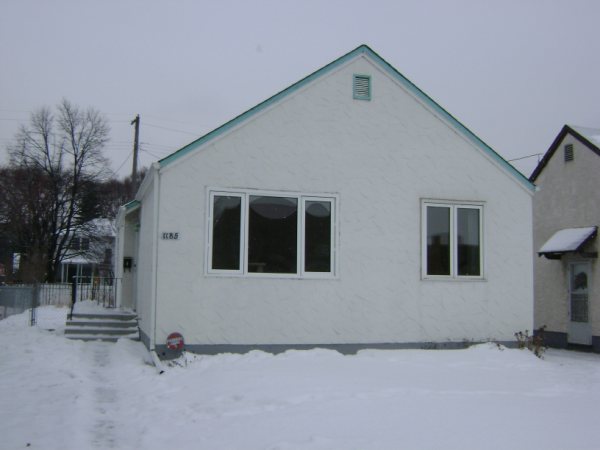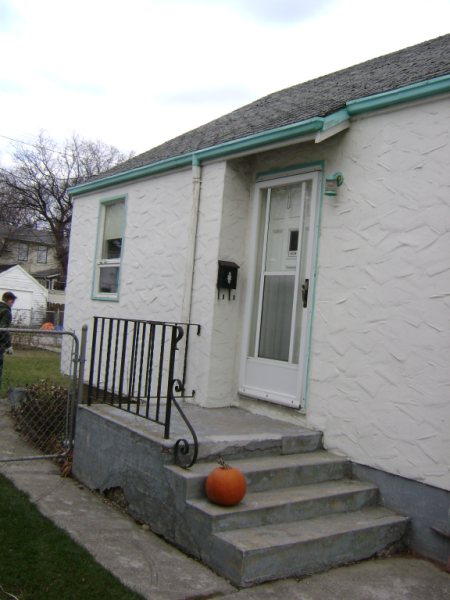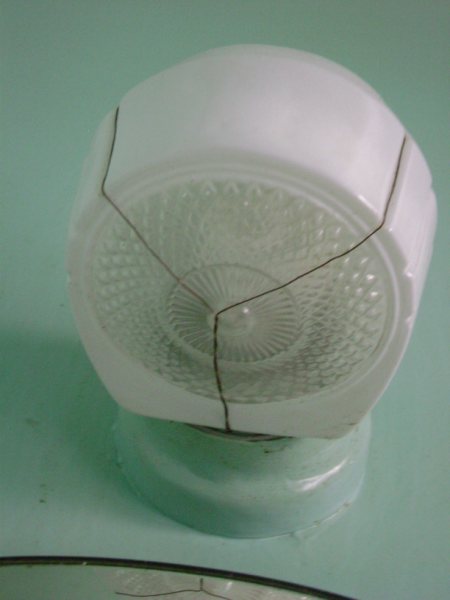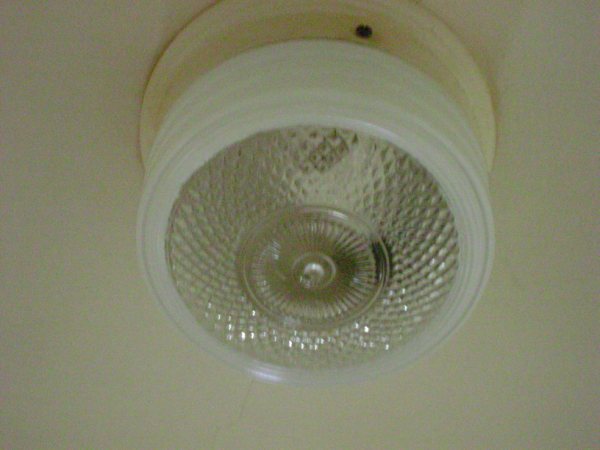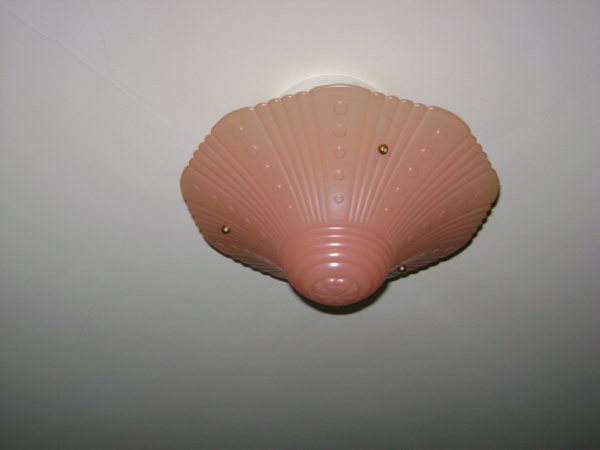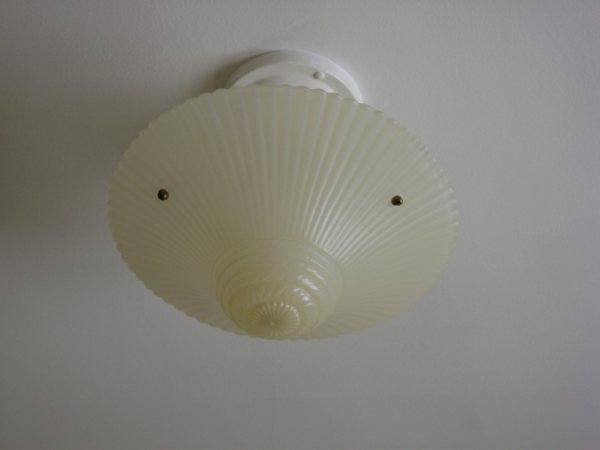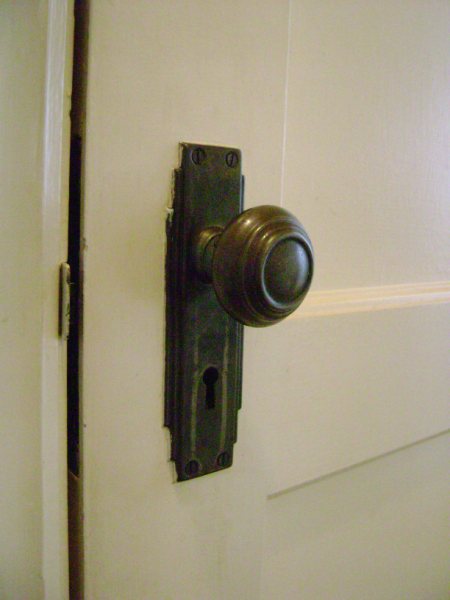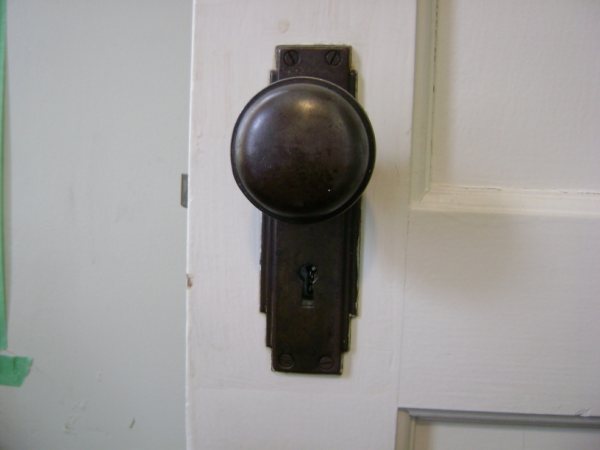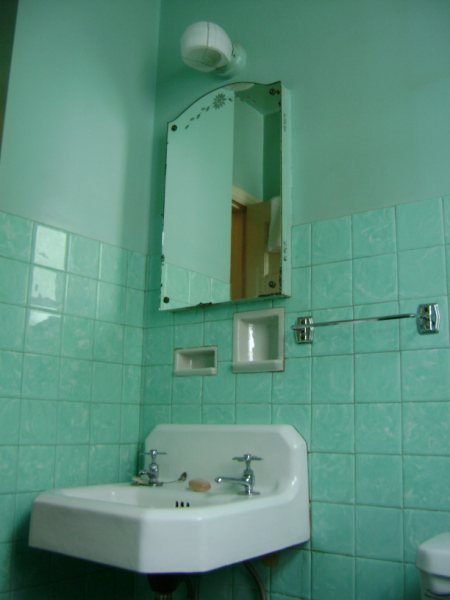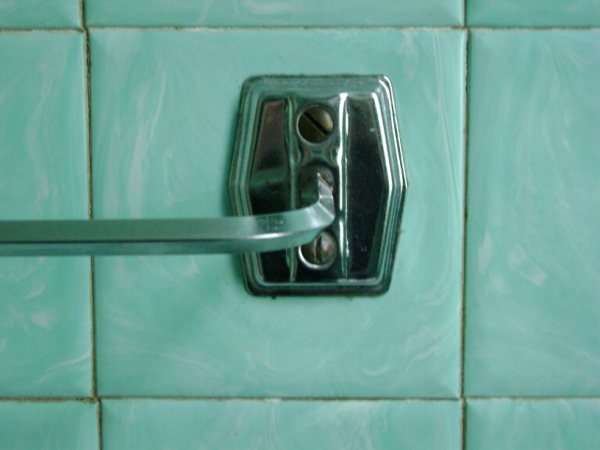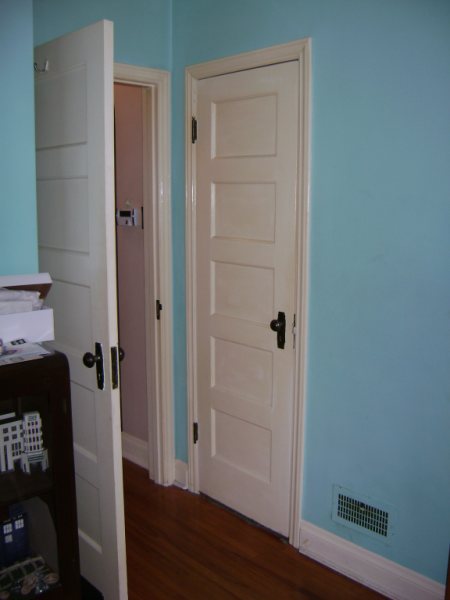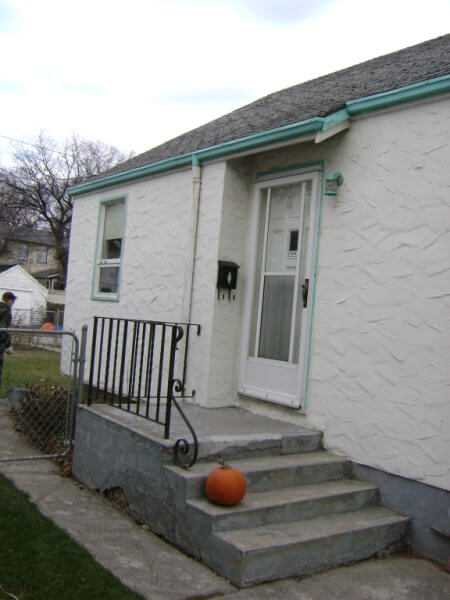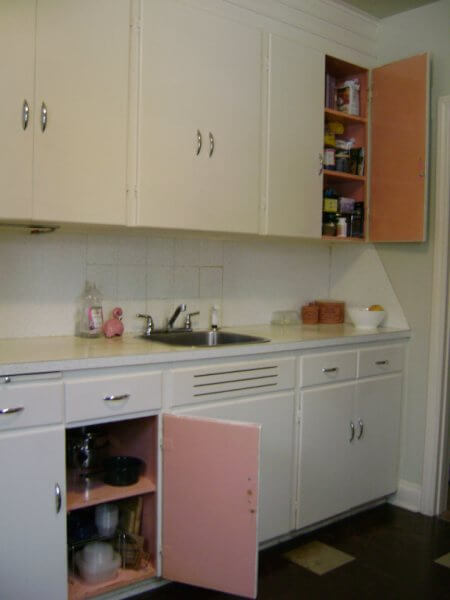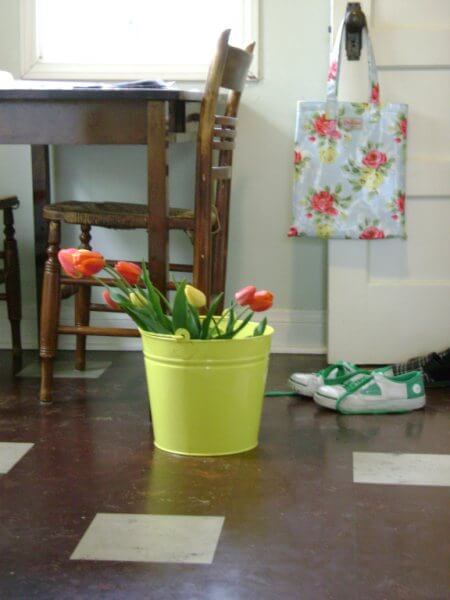

I am super interested in the early history of postwar housing — and the teeny tiny houses are among the most fascinating. I’ve seen these called “Tom Thumb” homes, but in reality, a huge percentage (maybe a majority?) of homes in the first few years after World War II ended were quite small — 700… 800…900 s.f. And, for a goodly number of years into the 50s, many many homes were still only around 1,000 s.f. Recently, I learned from reader Sarah that the phenomenon was the same in Canada. She and her partner Liz live in a 1946 “Victory Home” in Winnipeg. Sarah has sent photos from inside their 731 s.f. bungalow, and Sarah also shares some history about Victory Homes in Canada. 29 wonderful photos!
Sarah first wrote me in early January (umm, it’s taking me a long time to get reader submissions posted…):
Hi Pam,
I have just discovered your site and it is wonderful. My partner and I have a 1946 “Victory Home” in Winnipeg, Manitoba. It’s chock full of original features. It is very lovely, and very modest (731 sq feet)!
I wonder if you would have any interest in seeing some photos? I would also love to contribute to sharing pictures and information about early Canadian postwar homes in the hopes that there are other Canadian readers of your site out there who might contribute. There doesn’t seem to be a similar Canadian resource.
Thanks for your consideration and happy new year.
Sarah
Sarah and Liz’ Victory Home photo gallery (click on first thumbnail to launch the slide show):

I ask Sarah for more info and pictures — for sure. She sends them — what a sweet house — perfect — along with more info on Victory Homes and how she and Liz ended up in their little bungalow:
First, some notes on victory houses (most people refer to them as veterans housing, but victory housing sounds so much more exciting!):
“In Canada these homes were built and owned by Wartime Housing Ltd. The crown corporation bought materials and land and followed through with orders for homes across the country. Victory Homes came in two models: a two-room bungalow or a four-bedroom, one-and-a-half story house. They were tiny by today’s standards – and without basements and furnaces – but they met the need.
After the war, many veterans moved into Victory Homes and renovated them. Some of them, enlarged and updated, are standing today. But there was still a post-war housing crisis. The entire economy was affected by a continued scarcity of materials and of the money to acquire housing. In 1946 the federal government responded by creating the Central Mortgage and Housing Corporation (now the Canadian Mortgage and Housing Corporation). The assets of Wartime Housing Ltd. Were transferred to CMHC in 1947 (including the responsibility of housing veterans) through the Veteran’s Rental Housing program.” Source: International Metropolis…. Complete PDF…. More info from the Canada Central Mortgage and Housing Corp.
Sarah continues:
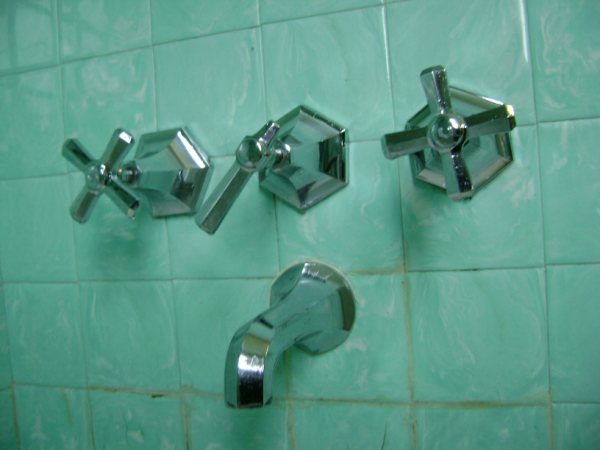
I have attached a bunch of photos of the fixtures in our house and a few of the exterior. I’ve also attached a picture of my partner Liz and I. Our house is sort of sideways on the lot (in comparison to most of the other houses like ours). There was only one owner before us, and she didn’t change a thing as far as we know.
We started our house-hunting journey in 2006 in the heat of a seller’s market in Winnipeg.
We initially had our hearts set on a 1910s or 1920s 2 or 2.5 story character house. We soon discovered (to our dismay) that in the areas of the city that were convenient for us as dedicated public transit users, houses are mid-century. Liz decided we needed to develop an appreciation for mid-century houses, so she borrowed some books from an architecture library on CHMC (Canadian Mortgage and Housing Corporation) house plans from the 1950s. We made 13 (over-asking price!) offers and finally had our offer accepted on a tiny 1946 bungalow/victory house. We had been making offers on 1950s bungalows and the odd 1950s 1.5 story. Our house was the first 40s bungalow we had ever set foot it.
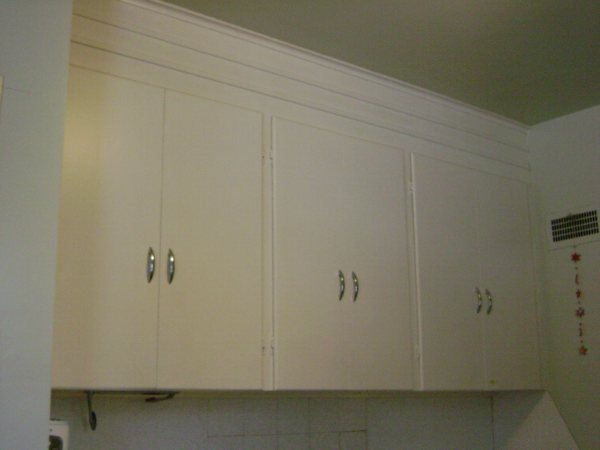
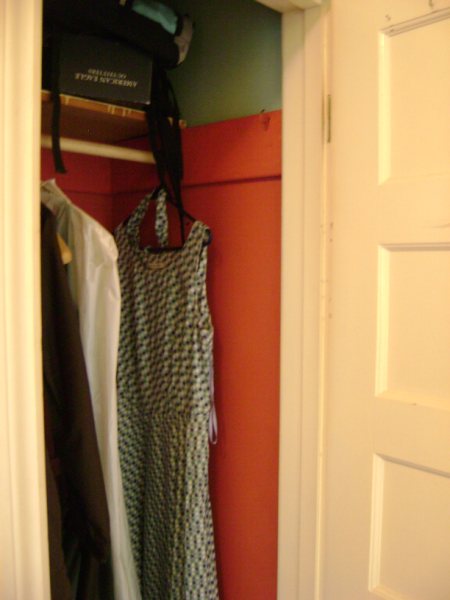
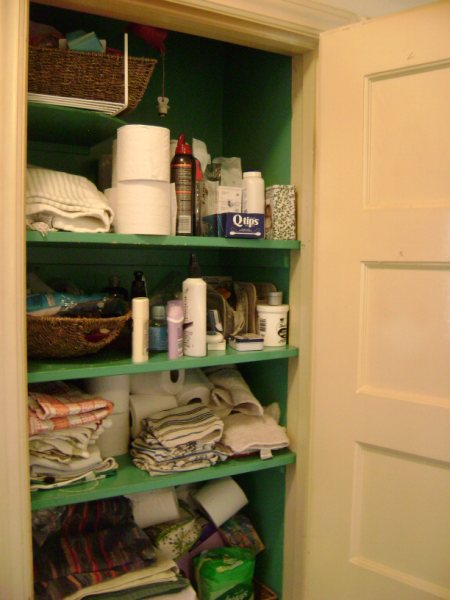
Ours is the rarest of victory homes (2 beds, no dining room) so most of the documentation of victory homes overlooks our type. The layout is so functional, if a bit too teensy. There is a coat closet, a linen closet, and two other hall closets, not to mention bedroom closets. I included photos of the insides of the kitchen cabinets and some closets to show the colours. At first we thought the former owner just had a thing for bright colours inside her cupboards and closets but after looking at the 1941 Sherwin Williams Paint and Color Style Guide I think it was probably part of the trend shown in some of the images – bright paint colours inside kitchen cabinets.
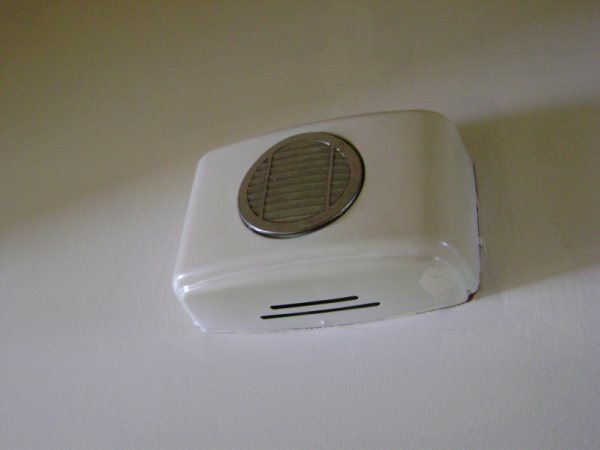
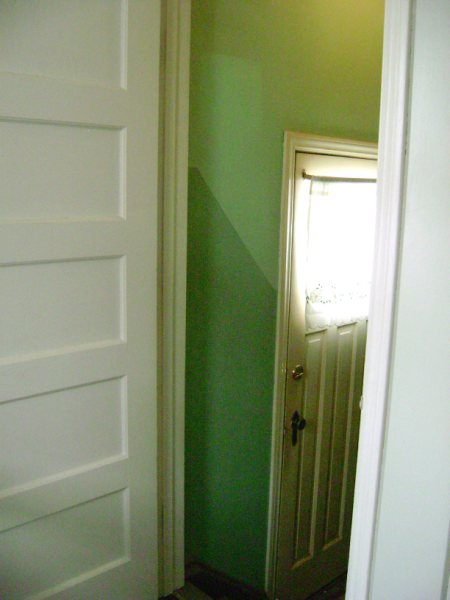
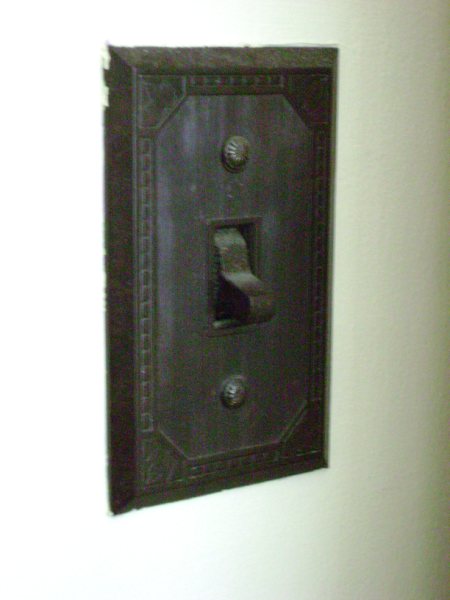
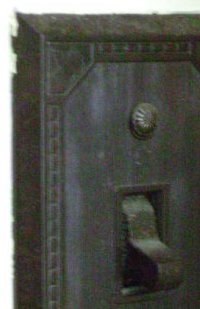
Speaking of paint, I included some photos of the tiny back landing which is painted in two shades of green. A 1940s decor choice? Also, the covers on our light switches each have a tiny maple leaf in each corner – not sure if they’ll show up in the photos.
For the past couple of years we have been focused on getting a new roof, furnace, windows, grading, and cleaning the layers and layers of nicotine off of every inch of the house. We have only painted one room, and we don’t have our window coverings yet. We need a new kitchen counter and backsplash, and the bathroom needs some updating. We want a more efficient toilet, and the tiles around the tubs are all cracked. We want our updates to be in keeping with the 40s (and the house) but we also want a solid surface counter top. One problem: I really dislike 4×4 tile (did I say that?!?!). I really like basket weave, penny, and honeycomb tile. Do you know if they were “in” in the 40s? I am having a hard time finding distinctly 40s fabrics and tiles (other than 4×4).
Oh yes, the house really needs come curb appeal, too. We are thinking maybe a mint or spring green repaint on the original stucco. Any thoughts or suggestions you have on anything related to the house would be appreciated.
We both love mid-century houses and interiors now and are so thankful we didn’t get the kind of house we set out for! I discovered your blog over the holidays and can’t stop reading it. It’s fantastic.
Where did you live in Canada??!!
Cheers,
Sarah
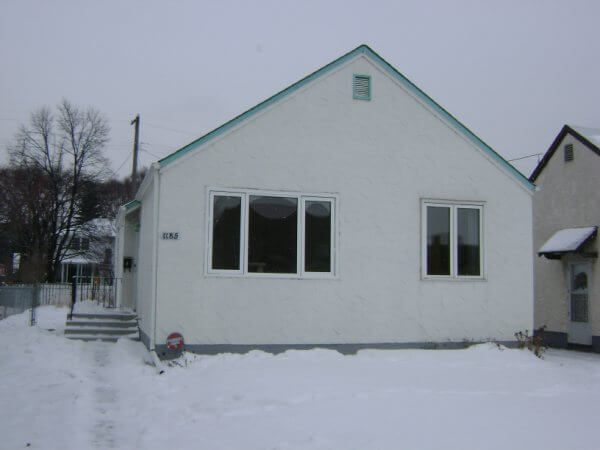
Thank you so much, Sarah. What a darling house — so small, but so full of charm, I love it.
For a 1940s house, if you don’t like 4×4 tile for the bathroom, how about subway tiles for around the tub? Oh and as we discussed via email, those sure do look like plastic tiles in your bathroom. I have NO PROBLEM whatsoever with ripping those puppies out — I had three bathrooms full of them, and I was a happy pammy the day they were gone. In my bathrooms, the plastic tiles were absolutely rotted through, they were not watertight and 50 years had done their damage, no question. Ceramic on concrete board – yes! If you need to re-do the floors, I think that octagon or small six-sided mosaics (same as what you call honeycomb) — with or without color dots (which could be nice) would be appropriate. For exterior paint ideas, I’d point you at the library of Aladdin Home images for inspiration.
And I love love love hearing about Canadian postwar housing history. I lived in Canada for about six years of my adult life — I went there for two jobs with Ford. The first time, I lived in Toronto, in Cabbagetown. The second time around, I lived in the Bronte area of Oakville, a Toronto suburb. BTW, I have been to Winnipeg — a wonderful town, I had a great time! Thank you so very much for taking the time to share your home with us all. Circle back as you continue your updates, we’ll all want to see what you and Liz do with it to make it your very own.




Win a “Love the House You’re In” collage of your house
12 places to buy aluminum awnings — including from three companies in business since 1946, 1947 and 1948
Win a “Love the House You’re In” custom collage of you and your house 
Liz and Sarah, take a look at American Olean’s line of hex tiles.
haha – “hex” tiles – that’s it, i had a brain freeze! thanks, maria!
Oh–and I’d love to see a rough floor-plan sketch of this sweet little mouse house.
Mouse house! I love it
. That’s what I’ll be calling our little house from now on. I will try to find a similar floor-plan online to show you.
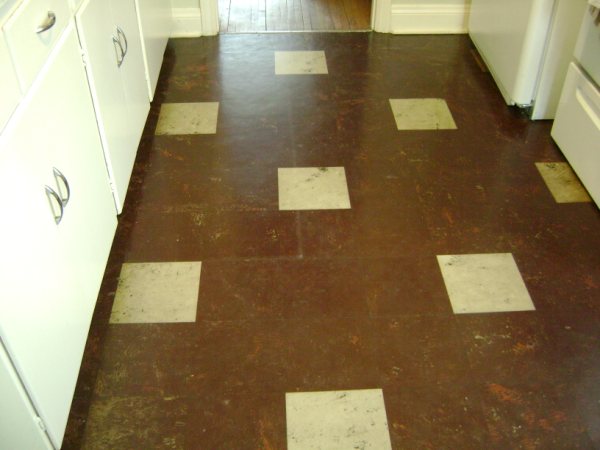
Wonderful pix of that great little house! So many jewelbox details! Things are so cheap these days by comparison. When I was a baby to about 8, we lived in a brand new house built in 1946, as were all the houses on the block. Seeing your pix took me on quite a journey of nostalgia. We had linoleum in our kitchen, a sort of medium green with creamy streaks. Across the street it was a deep red with marbly looking spots. We all had bright colors, and I remember a couple of changes in the kitchen and living room. I think the bathroom was just white tile.
So nice to hear from someone to whom this type of house was really and truly “new.”
The colour scheme you have described for your house (green, cream, white) sounds really different from anything I have seen in these parts and really fresh.
Rather than replacing a vintage fixture, there are dual flush toilet conversion kits for older less efficient toilets – an easy fix where water conservation is desired. I’ve been looking into these after seeing one installed on the “Ask This Old House” TV show. My bathroom fixtures are all pink (salmon) and a new white toilet would look out of of place. If yours are white Sarah, then a new replacement may be the way to go.
Thanks!
What a charming home and interesting article. But I am confused – houses in Canada without furnaces?
Sounds a bit strange, doesn’t it. Maybe they had wood-burning stoves? I know we sure as heck need some heavy-duty heat source in Winnipeg.
Maybe it is because I am only 5’6″…..but I LOVE small homes….and cars….
2 ideas for your consideration: Because it is stucco- I would love to see vines. One on the left corner and one between the front windows. A frame can easily be made from pipe so that it stands two feet away from the house…Honeysucle or Dutchmans Pipe would be pretty. Pick one and let them grow together. Add a few hollyhocks and Bleeding Heart and it’ll be “Grandma Time”. I would not recommend Wisteria anywhere near a slab foundation home: It will practically be sprouting through the concrete floor of your livingroom!
Can I also suggest a white and black porcelain mosaic “basketweave”tile tile for the bath floor? It is a 20th Century classic and can be compatible with just about any color scheme.
Think cute and best wishes!
Thanks for the comments. Suggest away! “Cute” and “Grandma” are perfect for us, and the house. We love the idea of a vine and were planning to grow one between the windows but hadn’t thougt to grow one to the left and let them grow together. Brilliant!
Ah basketweave tile… perfection!
Thanks! I used lengths of gavanized pipe from the home center. Not too $$$. I built it into inverted l_l shapes using screw-on elbows and t-joints in the center with pipe and flange (to attach it to the house). The open ends I sunk 4 feet in the ground and planted at the base. Set this at least 2 feet from the house for trimming, access, window washing and moisture control. It will look like nothing for a few weeks…not too hot the first year……and then- you are going to expect Jack and the Giant to come running down any moment!
You could also train it to wrap around toward your doorway as well. Google Image: Dutchmans Pipe.
Best wishes to you both, Gavin
Careful with the vines. Some of them secrete acids that will eat into your stucco. There have been problems with this on historic buildings. Ivy and virginia creepers are quite bad for it from what I understand. Perhaps a trellace on the wall for the vines to grow on would be a prudent decision.
….If you DO go with the vine idea…let it reach for the sky….or at least the roofline.
In your snow-y climate, it can easily be kept in check and not swallow your home!
Sarah and Liz–Your lovely bungalow reminds me of one I owned briefly in Delaware. Mine, too, had pink inside the cabinets and in my bathroom closet–one of only two tiny closets in my house, I might add. Instead of your closets, I had a small dining room. I love the idea of green paint on the exterior. I have never been a fan of picket fences, but my house had a white picket fence–plastic, no less!–and it was immensely charming. One side was covered with an unidentifiable but very lush vine in the summer. There were large hydrangea bushes planted alongside the front of the house. This combination of picket fence and hydrangeas is iconic late 40′s/early 50′s curb appeal, at least in the mid-Atlantic region, and when I saw it in front of my bungalow, I understood why. Do hydrangeas grow in Winnipeg? There must have been an equivalent post-war garden shrub.
Yay for pink inside cabinets! What you have described about your house in Delaware does sound very charming. Do you recall if partial fences – corner fences – were used in your old neighbourhood? I like the idea of a corner fence… Hydrangeas do grow in Winnipeg and I think their size and shape would really add some character and curb appeal to our sorry front lawn.
My neighborhood had a variety of houses–not all little bungalows–with every sort of fencing and landscaping imaginable. Yet it had a strong, cohesive appeal. A corner fence sounds great, to me–and very low maintenance, like the hydrangeas.
Love this house! I’m in Calgary and we have quite a lot of mid-century and earlier homes still kicking about, unfortunately they all cost a FORTUNE. All are located in the inner-city, building goes in rings from the downtown out and so do the prices for the most part. My sister lives in a 1959 split-level, which has been renovated to shreds unfortunately but is only 1100 sq ft. Her entire neighbourhood is all houses roughly the same size. They didn’t get much bigger than that until the late 1960s, early 1970s though the lot sizes were huge all the way through.
Thanks Rueby! Even though house prices went through the roof in Winnipeg, I bet it’s still nothing compared to Calgary, eh. Is the inner-city the most or least expensive ring?
I hope not all of those houses have been gutted!
This house is just adorable! I love the light fixtures and the bathroom vanity. Our ranch-style bungalow is just over 800 square feet and I thought that was just about as small as it got – you’ve definitely got us beat!
I vote for the mint exterior repaint! Or maybe a seafoam green? That’s the color my grandmother painted the teeny-tiny bungalow that she and my grandfather built in the early 50′s, and it’s still fabulous.
Beautiful home – good luck!
Hi Elena, what a cute little blog you have. I’ve added it to my blogroll, but it’s an ordeal to refresh it – it’ll take me a few days (at least) to do that….Meanwhile, rest assured, it will appear.
Thanks, Pam! I’m in Massachusetts too, just a little further east!
Thanks, Elena. I checked out your ranchalow – it’s gorgeous, chock full of character, and practically a castle compared to our house
. Your attic finds are amazing! I was hoping for something like in our house and my wish came true. There was a stack of old wedding photos in their original covers on a shelf in our basement. What a score!
Seafoam would be great. Do you remember what colour your grandparents roof is? Do they have any accent colours?
Hi Sarah – that’s amazing! We found a box of photos left by the original owners as well (I just wrote a post about it). It’s so wonderful to find pieces of history like that! When were the wedding photos taken?
My grandparents have a gray-ish roof with a complimentary white for trim – I think it’s sort of creamy, actually. The whole effect is really sweet and fun. I bet it would be a great look for your house!
Re curb appeal: How about beefed up moldings around the windows and maybe even the gables… and for sure, window boxes? (I want to see those two windows securely on the same plane.) I guess that would be messing with the historic integrity of the exterior… but it could be sweet… Also, how about investing in the walkway to the front door — so the feng shui energy knows for sure how to get in. Widen it…nix the concrete and go for brick pavers… prettify it with shrubs, maybe a bit of statuary — a pixie? Lots of great ideas coming in!
Lots of great ideas, indeed – and thanks for yours. I know what you mean about the historical integrity issue… It’s tricky when the exterior and front yard are so plain and that is the original state. A facelift in keeping with similar but fancier early post-war styles will hopefully help keep the integrity.
One-owner houses are special–it makes you feel as though you have been given a trust. And so many lovely touches.
I LOVE the bath faucet! I would be tempted to take the hint from those hexagonal escutcheons (as well as the hexagonal shape of the sink and the towel-bar wall plates) and throw some hex tiles into the mix (maybe the floor?).
The hex theme seems very “late art deco-y”, which is definitely in keeping with your time frame. Since the lav faucets are different, I wonder if these were a replacement for original ones that broke. (You could change them to ones with hexagonal escutcheons…) I don’t know the logistics of rebuilding vintage faucets, but I’m guessing that could be done, or you could get a reproduction, like the “deco style lavatory faucet” from bathsfromthepast.com . (If your sink is two hole–I can’t tell from the photo–they can put the hex escutcheons on a bridge faucet.)
Yes, yes, yes! Thanks for the info about where to get a reproduction.
Hey there!
I’m Canadian, I’m Canadian!!!
I live in a ~400 house mostly original mid-century subdivision in Surrey (a suburb of Vancouver). The houses are a mix of standard ranches (~1100 sqft), ranches with basements (~2000 sqft) and split levels (~1700 sqft). I live in a one owner, 1955 standard ranch with basement (1.5 stories). We have been able to hold off some of the McMansions/Megahouses attracted by our large lot sizes (>7500sqft) by successfully down-zoning the neighbourhood to 3200 sqft max including garages and outbuildings in a city that normally allows 3500 sqft plus basements. Still having problems with a city that doesn’t enforce it’s own bylaws but at least we’ve stopped the mass bulldozing that has happened on the streets outside our neighbourhood.
I love the tiny Winnipeg house and would love to see pics of the neighbourhood.
Yikes, mass bulldozing. Glad to hear you’ve managed to stop it and hang on to your neighbourhood’s character. The home and lot sizes you describe still seem huge in comparison to ours
. Your house sounds great.
If you do want to check out the general area I can give you a couple of radom address in the area to “google street view”: 1185 Mulvey Ave or 515 Cambridge Ave. Most houses in the area aren’t as tiny as ours.
Darling house! I love the colors. I definitely would not be able to survive with all of my junk, er, treasures in a house that size. I agree though these fantastically efficient, back to basics houses are making a comeback.
It is funny we have the same Bakelite leaf plates on the original plug outlets in our 1915 house. Mine may have been updated as I haven’t really researched vintage electrical plate styles. They may have been scrounging through old stock in order to get these houses built or even still manufacturing them.
The dorm I lived in, which was built in the 50’s, had the hex (honeycomb) tiles in all of the bathrooms with pink and yellow subway tiles. I was just in a friend’s aunt’s house from the 40’s and she had original basket weave tile. Styles didn’t change as quickly back then plus my philosophy on a situation like this is if it makes you happy, use it! Now if you were replacing all of the nifty original doors and light fixtures I would have a different philosophy. LOL
Mint green stucco outside would look fantastic! I am also seeing window boxes, shutters and a picket fence. I’m all for the cute though so I understand if anyone is horrified and digusted by those ideas.
Don’t forget to share pictures of your updates and restorations when you finish.
Thanks, Cara. We have a lot of “treasures” too, and luckily a basement to store them in given the size of our house.
Very interesting that you have the same leaf plates in your 1915 home. What part of the country are you in?
It’s really helpful to hear all these feedback about hex and basketweave tiles, as I would like to keep the floor tiles close to what they might have been. We’ve just been to a couple of open houses for 1945 homes in the area and they both had hex tile floors and the same plastic wall tiles as ours – but in a red wine colour.
Worry not – we are in love with the doors and light fixtures and could never change them!
What a GREAT house! I agree, you need to bring some of that amazing detail and charm outside. Wider window frames is a solid suggestion. Would this style of home have had shutters? Working, or at least the appropriate width shutters and window boxes could do a great deal for charm. Consider doing a two tone paint job, with a line below the windows.
I love geraniums for this era of home. A hearty second on vines, or trellis of some kind, and right now it’s calling out for shrubs.
Another alternative depending on the shade of your thumb would be to plant a victory garden in your front yard.
Dwarf fruit trees, trellises for pea vines and raised boxes would do wonders to give definition to your home.
If you don’t go for picket, what about an urban farmstead look with wood post and square wire fencing? like so: http://www.productionfenceworks.com/residential/residentialWood/wood-wire/Georgia-fence-three_files/Snellville-Wood-Fence.jpg
Candice, thanks for the link to the urban farmstead fence. I have never seen that before. Looks like it would be great for growing vines. And thanks for the other suggestions too.
I love, love, love the idea of a victory garden. We are working toward that in the back yard.
I love your house. It is nice to see that other folks enjoy retro style as much as I
JT
Super sweet house. I love the pops of color in the cabinets and closets.
I too live in a “victory” home. The original floorplan was a total of 850 sq ft with two bedroom, a bath, living room and kitchen. There were a couple of additions in the 70′s but house still tops out at 1100 sq ft. The house didn’t even have air conditioning until 1999 (I am in Florida). I love my little house and I cannot imagine living anywhere else.
What a doll house, you lucky ones! Love the switch plate covers and the door escutcheon. We had great success cleaning ours from our 1949 home with “Goo Gone”…it was a project to do over wine and the results were awesome. (Of course, I waited to do this as part of the projects to sell the house, so someone else is enjoying the shiny escutcheons now – - at least I pray they didn’t “update” them!)
I agree with black and white hex pattern tiles for your bathroom floors and then white subway tiles for the walls.
This link will take you to a photo of black, white and gray hex tile pattern that you may like:
http://www.oldhouseweb.com/product-showcase/hex-tiles-mix-and-match.shtml
Keep the toilet if you can and just install a dual-flush knob…they work great!
For the exterior I would take advantage of how well evergreens do in your area…there are wonderful dwarf and slow-growing varieties which you will appreciate when it comes to your spare time. I agree with Gavin that some vertical climbing green will enhance “the bungalow” feel.
Have fun and cherish the bit of history that is safely abiding in your hands!
We are so slow to really try to clean up the switch plate covers, etc., because I am terrified to ruin or break anything! I will have to trust in goo gone… I too pray that your shiny escutcheons are still in place and well loved.
Good call about the evergreens. There are some very mature ones in the neighbourhood and they look amazing. I love how they tower over the teeny houses. I like the idea of slow-growing or dwarf varieties. I think they would look great toward the front of the yard with a corner fence. Thanks, Alice!
It’s adorable. I love it!
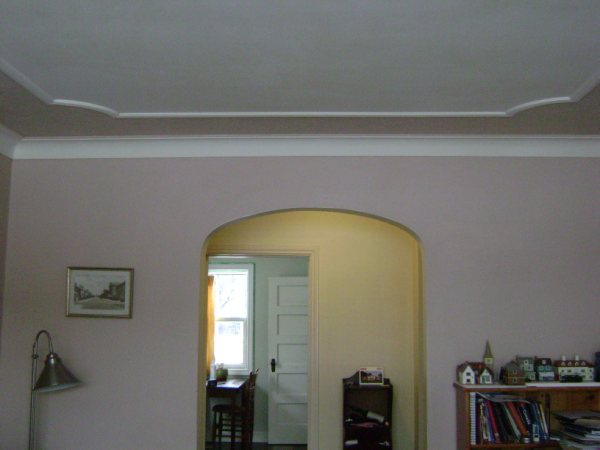
Nice house. I love the detail on the living room ceiling.
Thanks so much Pam for showcasing our little mouse house
. It is such a pleasure to hear such kind and generous words of appreciation for our modest little house from everyone who has commented. All of the comments and suggestions re: curb appeal and bathroom floor tiles are ever so helpful and inspiring. Yay!
Love the idea of a mint green repaint! There’s a local house that is mint green with chocolate brown trim and it looks fantastic. It’s great to see the inside of this house…there are a bunch of “Tom Thumb” houses in my neighborhood, all built at the same time as our 1948 house. They are mostly 550-600 sf one bedrooms and 700-750 sf two bedrooms. Really darling little houses, on half-lots. Some are built next to each other in mirror images, so they resemble a duplex (but are detached, on separate half lots). I am really charmed by them (in fact we have a pair next door).
Wow – 550 to 600 sf. Are they one beds? If you have the original bathroom flooring I’d love to know what it is.
This post has me REALLY excited because my husband & I just bought our first home – a 1955 bungalow in Calgary. The people we bought it from are the original owners and not much work has been done to it. Some of the work that was done was done in the 70s so we are hoping to revert back to the 50s esthetic for the rooms that do need work – like the bathroom which is really quite disqusting and needs to be redone (although I’m hoping there is interesting tile under the – yuck – carpet that was installed in the 70s). I will be following this comment thread for lots of ideas!
Oops – I forgot to mention that when we were looking for a house we saw a number of victory homes in Calgary too. We thought for sure we were going to end up with a 2-bedroom 800 sq ft home but luckily (for us) ours is just over 1000 sq ft and has THREE bedrooms which is very nice to have when you have a toddler and another baby on the way. And yes, as someone mentioned before, those 800 sq ft houses are really expensive and a lot of the ones I saw had been renovated and not with any thought to keeping the original asthetic like this Winnipeg cutie.
Hi fellow Canadians!! I too live in a war-era home, in Ottawa. It is spectacular, also with one former owner. Ours was actually built in 1953 so I don’t know if it technically qualifies for the distinction, however down our street are smaller versions of our 1.5 story 3 bed (I think our square footage is approx 1100) and I know they were building them for some time after the war. It is funny, you can see how the neighbourhood grew outwards as the years passed. Most of the small, actual Victory Homes in my hood have been bought up by Ottawa Community Housing, which is great when you think about it because the people who live there are as grateful to have them as the veterans were when they came back from overseas. In another local neighbourhood, alot of the smaller war homes are being bought up by developers who are building doubles or condos on the lots. It is a sad thing to see go. I mourn for the lost history and design that the new houses just don’t have and never will. Thanks for featuring some Canadian house history on here! It’s great to see. Good luck with the reno’s Sarah and Liz! (ps I think some geraniums out front would look stellar, too!)
This is a fun thread. I learned to crawl on the kitchen linoleum in our new postwar bungalow, so I can see it now just as it was. My parents did replace it with the new asbestos tile, also in green. The outside was originally a pale green, not mint, a little more yellow, with salmon trim. My parents changed it to the new asbestos shingles in pink and burgundy. The pink was on the bottom half, and the burgundy on the top half. The kitchen was also pale green and salmon, and I don’t recall a color change. I think inside the cupboards was cream color. On the countertops, there was white hex tile, and I think also on the bathroom floor. My dad built a little island divider with curved shelves, very modern, and surfaced the shelves with some kind of linoleum.
Maple leaf light switch plates, how cool is that!?
Nice house, I have an older (1924) small house 850sf and it takes some getting used to but there is no wasted space and I find the quality is much better on smaller houses.
Nice find!
Love this house. Reminds me so much of my own including the project list of things needing to be done. Ou home is 734 sqft, 1949 and I am going to go ahead and paint the interior closets with bright colors! Love that!
Liz and Sarah, it’s obvious that Retro readers love your house! It certainly is a treasure, and I appreciate how you took close-ups of the special features.That mint green with chocolate trim idea that hillary suggests sounds yummy, like Andes mint candy.
Just bumped into all of this while trying to find info on how my house might have looked originally. Great comments and house in Winnipeg is wonderful! I have a 1946 cement/stucco bungalow in Massachusetts and am feeling very fortunate because it tops out at over 1000sf. Good size kitchen with original white-painted wood cabinets (no bright interiors though) flows into dining area. Then a front-to-back living room, and two smallish bedrooms with tiny bath in between…all with original hardwood floors (except bath). Had one owner for over 50 years and those people took advantage of every inch to add storage spaces–amazing! Younger couple had it for a few years and did some critical updates (roof, plumbing and electrical) plus tile in kitchin/dining and bath. Anyway…great to read all the comments. PS….I’m stuck with an reddish-orangy roof so Ive stayed with cream body, whte trim. and the least offensive dark rust i could find for shutters.
I just love your little house!
So happy to find this post! I’ve been doing some research tonight trying to figure out what our 1947 “war box” as the realtor called it (and I’ve adopted; I love it) might have looked like originally. At some point some weird moldings were put in — well, not weird exactly, just a little more elaborate that I feel were original. Plus they get dirty — too many little nooks and things to clean. I’m sure that someone tore our what was probably a lovely tile bathroom too, and did a rather shoddy job putting in wood siding, and that will eventually come out, too. Sigh.
I am rambling a bit, but this was fun to find. I will say though that our actual current living area (one floor — someday we’ll double it by finishing the basement) is about 850 square feet. Compare this to our old Cincinnati house that was three stories and 2500 square feet! But you know what? Aside from our big old farmhouse kitchen, I don’t miss the Cincinnati house AT ALL. I was constantly losing things! So I say small houses forever!
Mary T.