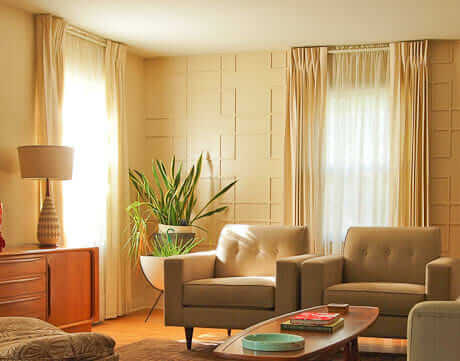
I’m following up on yesterday’s story about Dave and Kris’ lovely mid-century modern living room with this post that specifically applauds their window treatments. These are beautifully executed and give me the jumping-off to spotlight six tips for this style of window treatments for a mid century modern interior:

- Pinch-pleat draperies: Rock the Casbah. I am the world’s #1 fan of pinch pleats. They are tidy, yet warm and welcoming. They are harder to find than panels … because they are harder to make, but not THAT much harder… as you will recall, Gavin and I even got in a hissy fit one time over whether they require more fabric than panels. I think the determining factor is how full you make either. Where to get pinch pleat draperies? I tend to favor finding someone local who can make them to fit your windows perfectly. This is what Cindy did, for example. Other sources: For off-the-shelf, readers seem to like J.C. Penney’s Supreme line, including their prices; there are othe pinch pleat options on the JCP site, use the Search box. Vintage — you may be able to find pinch pleats vintage, too, and these can also be adapted (made smaller) or pieced together to make wider widths.
- Stack back: This is a term you must conquer if you are to use pinch pleats. Basically, it means: You need to think about how much space the pinch pleats will take up when they are open… and plan this into your calculations for how wide to buy your pinch pleats. For example, Dave and Kris’ drapes look to have about a 12″ stackback (on each side). If they have a 40″ window… with 4″ trim on each side… a 4″ overlap at center… and 4″ returns (the fabric needed to wrap the traverse rod 90-degrees to hug the wall) they would order a pair of panels that span approximately 76″ combined. When closed, this would allow enough fabric to cover the entire window (from return to the center, overlapped)… and when the drapes are open, the stackback would begin at the edge of the glass (covering the trim.) I hope to heck I got this right, and I am sure that if not, Gavin will correct me. There are places like Smith & Noble that have calculators — seek them out. Really, it’s not that hard. If you are having someone make the drapes — give them super careful measurements of your window and they will do the calculation.
- Sheer panels underneath: I love how Dave and Kris have put sheer panels underneath the pinch pleat. This makes the room all glowy — let’s in the light, but maintain privacy, if that’s required. However, if you like to open the windows wide during the day, the sheer are going to be a pain. Alternatively, you can opt for sheers on pinch pleats — that is, two layers of pinch pleats. The downside to this, is that your draperies are going to extend farther into the room. Sheer panels can be tucked right behind the single traverse rod holding your solid pinch pleats; you’re gonna have a 4″ or so protrusion into the room. If you have two traverse rods, one stacked on the other, I think you’re talking 6″ miniminum protrusion, because their needs to be enough space for the bottom set of sheers to open and close. I was in England this summer and in the humongous drapery section of John Lewis, I noted that the brits seem to use kind of “pin-tucked” (I think that’s the word) sheers on traverse rods, under their pinch pleats. The pin-tuck design is flatter — so I think the protrusion is minimized. Sorry, I am sure that this is really hard to understand.
- Position of top of draperies: Note how D&K’s draperies start at the top of the wall where it meets the ceiling. But look at the light — the window starts much lower. They have installed the draperies floor-to-ceiling to fool your eye into believing the windows are larger and also, to accentuate the height of the wall. With the sheers in place, in particular, this works magnificently. Lesson: First consider whether you can take the drapes all the way to the ceiling — especially if the window is already vertical (rather than horizontal) in its orientation; no need to think that your drapes “must” start right above the window — which would, in this case, have broken up the lovely overall lines of the room.
- Position of bottom of draperies: For mid-century interiors, I am also a fan of draperies that just barely brush the ground. Tidy. Linear. Also, easier to open and close, and to keep clean.
- Traverse rod: Paint it! You can also paint your traverse rod to blend in with the wall color or in this case, the color of the sheers behind it. I just laid out my traverse rod to the correct (installed width) and put two thin layers of spray paint on it. My traverse’s sit on top of ivory colored grasscloth, and spray painted almond, are barely noticeable.
Do you have a fear of pinch pleat drapes… of traverse rods… of making homemade pie crusts? YOU CAN DO IT, and you will be a better person for the effort!
And remember, all my stories about window treatments for mid century homes are located in the Category: Retro Accents / Window Treatments.
Daves


Funny you post this story today…Last summer, I found a really nice set of vintage thermal pinchpleats that are hanging in my living room, blocking any drafts not held out by the storm windows. It’s a pretty “heavy” look, and although I prefer the lighter look of sheer panels, these are much more practical for the kind of winter we’re having this year.
Penney’s has a good selection, too, but you can’t beat the price I paid for this set at the thrift store, $10.80 + tax, and it goes to helping the Goodwill’s mission of helping people.
Amy- thermal backings and “black-out” linings will always add more bulk to the way draperies hang. : (
They are relly “clunky”, like a pair of platform shoes, but they really help with keeping the room warm.
I was window treatment-less for six years before deciding on pinch pleats and have never regretted my decision. I heeded your advice to paint the rod so the eye can focus on the draperies and not the white of the traverse rod.
Dave & Kris’ draperies are beautiful and fall so gracefully! Love these…..
Pam, Thank you for posting more pics of this beautiful home! Just wanted to weigh in on J.C. Penney’s pinch pleats. I have the Jewel Tex pinch pleat line (on sale online right now too!) They come in six colors, I have the ‘green clay’ color, a pale grass green. The fabric has a really pleasing grasscloth texture and appearance and drapes beautifully.
Over a year ago on here someone recommended the Macy’s Coronado sofa line, it looks very similar in style to Dan and Kris’ lovely living room set from Younger. Based on seeing the Macy’s sofa here at retro renovation, I bought it last year and absolutely love it. It has gorgeous MCM lines and the fabric and stuffing has held up very well to daily use. Macy’s has at least twice annual furniture sales..
I have lovely gold pinch pleats in my living room but I am afraid of making homemade pie crust. It’s intimidating.
Go for it Jenny!
If everyone here stops by my house next Monday at 9a.m., I swear you will all leave at 2p.m. with a perfect pair under your arms! No matter your ability…it is all straight lines.
Find directions in an old Singer book….and try making one panel from an old sheet, with a piece of drapery lining…and the top heading (1 1/2 yds) of something called buckram. Total cost for this test panel: Maybe 10 bucks. Once you understand the steps…the finished draperies will be easy. Honest. You can begin in the morning, and by the time your favorite tv program comes on that night, you can sit on the sofa-folding and handsewing your pleats.
haha, you’re exaggerating a bit. if you use patterned fabric, you must also take care to match the seams, and the spot where two panels meet up. ordering the right amount of fabric also can be a pain… but it’s just math. i have an old consoweld instruction booklet somewhere. if/when i find it, i will scan it for intrepid sewers….
Why, why, why didn’t God make you my sister?????
The pattern on the fabric is like a wallpaper. After making the initial horizontal pattern cut, all additional cuts begin at the same point.
I expect you here Monday at 9 a.m. : )
If I were going to be even remotely close to you on Monday at 9 a.m., I would be there with bells on for your tutorial. Plus, I LOVE your house.
amy, you can do it, and you will never ever go back to boxed after. my favorite recipe for homemade pie crust is in maida heater’s (vintage) chocolate desserts book. he recipe, err instrmuctions, are 6 pages long! not to intimidate you… but what’s good about these instructions is that they provide detail for every itty bitty step so in a way it is NOT intimidating. oh, and the chocolate desserts — to die for!
I just ordered the book from my library and will give it a whirl! Thanks for the reference.
I have lovely pinch pleats in my bedroom (floor to celining and light blocking fabric) and can’t imagine anything else. I had them made to measure because I could not find the height I needed. However, Penney’s does have a good selection of sizes and colors. Everyone always comments on how classy the pinch pleats look and they are just so MCM!
Ah, the drapery dilemna: anyone know how to hang pinch pleats from the ceiling?
troysf, they do it in hotels all the time — i assume there is hardware OR, as i maybe think, there is accommodation on the traverse rod to screw it to the ceiling rather than the wall. i am travelling right now — at the alt blogging conference in salt lake city, or i would go look at mine. in any case: the trick is in the traverse rod, just be sure to get the right kind…hey, i’ll also add this to my list, do research, and a post
That’s right…. make sure to use anchors in the ceiling!
There are also tracks available just like the curtains used in hospitals for curtain panels.
Some types of traverse rods have attachment clips to add a secondary non-pulley-ed rod behind the frontpiece. These can be used for pocketed sheers or pleated, so long as they stay stationary.
I have a set of vintage, lined, barkcloth pinch pleats from probably the 50s that a friend of mine purchased at auction and gave to me. They must have spanned an enormous window of some sort because when help up, the panels are just huge! I’ve had them in storage for several years until I purchase a home (wich should be closing next week!) and I’m hoping they aern’t dry rotted. They were discolored and sort of yellowed, perhaps they were in a smoker’s home. Can these soak in a tub of woolight then hung to dry or will it destroy them? I don’t dare put them in a washing machine.
I would caution you if they have a thermal backing…make sure the backing doesn’t stick together while it is drying. I had this happen on a vintage set and it stuck together like glue. I had to pull them apart, which left large areas that were no longer opaque. Blackout liner was the solution to salvage them, but close look revealed how flawed they were.
Good luck- I hope you can use them!
Thanks Wendy – fortunately mine are lined with what appears to be a simple cotton fabric or possibly cotton mix but not thermal. I will definitely keep the thermal information in mind if I have to go with another set.
Larry- if these were mine, I would carefully take them apart…meaning remove the lining, the buckram, dismantle the pinch pleats so that ley lie flat. I would not separate any seams in the face fabric that created the width of the panel.
I would then take the drapery material to a professional cleaner. This would give you new, fresh fabric to use and tailor to to the sizes you need.
If you send them to the cleaners as is, the cost for cleaning and re-training these panels as “draperies” would be quite pricey.
Take one panel to the cleaners (as-is) and see what they think about the stability of the fabric prior to doing anything. Good luck.
I bought some vintage lined pinch pleats off of ebay and had them dry cleaned. The cleaners charged per pleat. They came back really nice. I can’t remember what the charge per pleat was, but it was worth it to me. They were nicely folded with paper strips holding the folds, which I left on for a day after I hung them on the rods.
For Larry to take them apart and have them re-made to fit his new home is a good idea, though. If they are large, there will be plenty of fabric to work with.
Oh, yikes! Completely dismantling the curtains? Oy vey. Not what I wanted to hear.
I actually spent *more* on getting the curtaines tailored to fit my windows than I spent on the curtains themselves (which were expensive enough as it was). The curtains were originally two huge panels of pinch-pleated atomic goodness, but I had to have them each split in half to accomodate the three windows in the living room – one huge window and two smaller windows.
I’ve checked with a couple of cleaners in town to see what it would cost, but none of the ones I checked with do drapes anymore and it sounds like the ones who do would be prohibitively expensive. Crap. It took me a couple of years to finally find something that my husband and I both agreed on (no small task, let me tell ya), that would accomodate about 14′ of window span and fit within our budget. I might just have to take my chances soaking them in OxiClean and then hang them up to dry. Or just hang them as is. My living room is pretty dark. It just might work.
try vacuuming them also — with the proper attachment.
I’m interested to see the replies to this because I was actually going to ask the exact same thing – vintage barkcloth curtains, simple cotton lining (which is perilously close to falling apart, so I might have to re-line them with another fabric), and wondering how best to clean the yellowed areas without ruining the curtains, which I’ve spent a pretty penny on.
Heather, I was very lucky to have gotten mine for free. Once I get moved into the house I’ll have to take a closer look and see how stable the fabric is. Thanks for the suggestion Gavin, I guess the cheapskate in me was hoping I could just do a gentle soak/rinse with woolite in the bathtub, a nice gentle air dry on the line outside and then would just have to cut to correct widths and finish up the cut side, but alas, is it ever that easy?
I am a firm believer in finding other people (the cleaners) to blame my own mistakes on!
You could “maybe” get away with it….but I think they would be better made up freshly. Stiffer headings, etc.
BTW- I once saw lined draperies left as found with the width reworked by basting the area of the new side hem and using a blind stitch up the side-folding in the cut lining and face fabric. I did look pretty good. They cut at the point of the next pleat over to provide a return.
I might be getting a little technical here….but will explain it all when I see you, too, Monday at 9. Be prompt! : )
congratulations on the new/old house, Larry.
Thanks Pam, it’s a 1945 modest little house but I’m sure not much is original from 1945. I know the kitchen isn’t, it’s probably from the 60s, but i do think the original cabinets were brought down to the washroom in the basement, plainish plywood but original handles…I think. I remember the first post I ever put on here was that I was lamenting that I had to wait to be able to buy one and you told me to be patient and that the decorationg Gods would bring me a house…you were right!
I had sheers in my home at first, but they were ugly. Since my home is early ’50s, I have built a cornice over the front window, and have vintage pinch pleats, and it looks very period correct.
The drapes stay closed for now, since I have no sheers up, but will be ordering original-style aluminum Venetians next month (oh boy oh boy! I’ve waited 8 months!). Gavin and I already talked about the sharpness and cleaning of these things.
Also I grew up with pinch pleats everywhere I went. They look more expensive and “grown up” IDK for a lack of a better word. Anything else looks bland to me, like college students using tab tops from WalMart in their apartment.
Good Job!
Hi Pam! Great information as usual. Let’s not forget cornices. They’re easy to make (a wood box, upholstered in batting and fabric) and look very mid-century, and they hide the business end of window treatments beautifully. I’m planning on implementing them in my remodel.
yes, Brini, you are right! I’ll have to do a post on this. I have several cornices that I’ve purchased at estate sales, and can show them.
I recently made myself pinch pleat draperies for my living room. The finished width was over 13 feet wide, so it was quite a production. They’re silk dupioni with a poly/cotton drapery lining. I used Wrights Pleat Tape (http://www.wrights.com/wrights/products/featureproducts/pinchpleattape/pinchpleattape.htm) to create the pleats. The pleat tape is designed for a 2.5 to 1 fullness, which ended up seeming a little full for a mid century look. Part of the fullness may also be due to the fabric. I might try to find a steamer and see if that helps, too. But I’m pretty happy with them overall, I think they fit in my 1966 ranch and they’re much better than not having any window treatments at all!
Photo:
http://sphotos.ak.fbcdn.net/hphotos-ak-snc4/hs1195.snc4/154732_10100378812304040_13963014_66767201_868413_n.jpg
I can highly recommend J.C. Penney’s pinch pleats. If you can’t buy the off the shelf sizes, they will custom make them for you – and it’s not nearly as expensive as one might think. Tip: Sign up online to get their coupons by mail. They send them out often and we got all of our custom made pinch pleats for half price!
I’m also so glad that you mentioned stack back. This confused the life out of us to start with as we were new at the pinch pleat ordering. The people who work in the drapery dept. at Penney’s are very well trained and have a computer system that they can put your measurements (wall and window measurements are both needed) and they’ll tell you exactly how much you need for stack back. They’ll also give you a handy brochure so that you can go home and measure with their charts. Another thing about stack back is that if your windows go all the way up to the corner of the room with very little or no wall at the ends of the windows, the pinch pleats will definitely cover up part of your window – so it’s something to consider if you want to be able to see out of your entire windows.
Ahh the pinch pleat dilemma. My 30 year old thermal backed pinch pleats were custom JCP, covering to the floor, WALLS of windows. Oh to have back that service! It cost $800 back then (1981). Custom service, in my home, not available anymore. So, I recently resolved to make myself, done it before, with pleater tape. Then… I did the math. >The cost of fabric, plus Roc-Lon Thermal lining, pleater tape, pleater tape hooks …. outrageous! (tall/long/wide windows times 2.5) Absolutely prohibitive (for me) on these window sizes. I’ve optioned out now .. to vertical faux woods (real wood warps in the desert) and pinch pleat drapery panels, with my 50′s tropical bark cloth. I’ve loved the drapery thermals for the desert heat & cold. And I can only hope that I’ll love the faux woods for hopefully ‘almost’ keeping out enemy temps. I know I’ll enjoy the angled open feature in the summer. Feedback on vertical fauxs ….. very welcome. Goin’ Tiki on this room. I’d encourage anybody to definitely DIY pinch pleats… with less glass to cover. Just make sure the fabric of choice is readily available by bolts, not discontinued. And thermal lining runs around $3 yard and is essential to protect all your hard work.
Upon scouring your site for ideas, I was persuaded to replace the ugly, hated vertical blinds on my sliding glass doors with pinch pleat drapes. BEST DECISION EVER! They look magnificent. I had enough room for a stack back that reveals the entire window, luckily.
BTW, also on advice from your site, I ordered from Factory Direct Drapes — great, fast service and I’m very happy with the drapes. Now if I could just keep my kids’ hands off of them….
yay! would love to see pics, kate… you know, i think i’m gonna have to do an “upload photos of your pinch pleat window treatments!”
Oh Pam…wait till I get moved into my house and can get mine cleaned and installed..they really are terrific!
Pam, I’ll try to get some pics to you in the next couple of days. I have a before shot of the room too. (Just FYI, my house was built in …. eeeek… 1999. But I am infusing it with Art Deco/Streamline and mid-century wonderfulness. We even installed a 1930s chandelier in the dining room. My last house was built in 1852, so I am leaping forward a whole century in my decorating influences!)
Great – thanks, Kate!
I Love pinch pleats. So did Mom. I found a GREAT set of lined, pinch pleat drapes on Ebay last year. Then I found them in my 1957 Sears catalog…HOW COOL! There were 8 panels which were enough to do my living room and dining room so they would kinda tie in together. I think that there is a company that reproduces this pattern…it’s grey with turquoise, black and pink amoebas and silvery looking horizontal swipes. They seemed expensive, but not really so when you consider the cost of custom made (Material+time).
Jason, that sounds like a swatch of Melinamade barkcloth I have pinned to my wall right now. Check out her site and see if that’s it. I ordered the swatch set (fabric and wallpaper) from her for $18 and it was well worth it.
I used to think this style of drape was really archaic-looking, but when we moved into our 1950′s-era home, I knew nothing else would look right on our windows. We had all of our pinch-pleated drapes custom-made by this company.
http://www.factorydirectdrapes.com/store/pinch_pleated_drapes.asp
They are made here in the US, and they have tons of different fabrics. I don’t really have a basis for comparison, but the prices seemed reasonable and the quality of the drapes is excellent.
Love your blog.
I was so glad to find this post today. I have a window treatment dilemma, and I am venturing into unchartered waters. We’ve just moved into a 50′s ranch that has a ton of very large windows, and I was thinking of putting pinch pleats on the front windows. However, the front window “unit” is a huge picture window flanked on each side by a double hung, making the whole shebang 154″ wide! It’s a fantastic feature of the room. Maybe someone out there can help with my questions.
Would I just have 2 drapes (one on each side) that meet in the middle to cover the entire window unit? Or would I have 2 on the ends and 2 where the double-hung windows meet the picture window? Does anyone ever just put them up as stationary pieces?
Also, any thoughts on using shades instead of sheers? Basically layering pinch pleats over shades. I’d like the privacy and light transmittal that you get from a sheer fabric, but I want to be able to open and close something easily.
Finally, is it possible to get a traverse rod that would span the entire 154″?
Thanks so much!
Kristen-I will post tomorrow. Have to go to work.
Kristen- So may unanswered questions here: Aftter subtracting the window, how much wall space is left on each side? Is the window the focal point of the room? Is it casual or more formal? And most important-How much money do you have to play with?
If it were myself, and just from the facts you have provided- I would cover that entire wall with floor to ceiling draperies top to bottom-side to side. I would hang them on a ceiling mounted travese rod…bot only open them as far as the center picture window.
Sheers are pretty formal as undercurtains and obtainable everywhere for less than $10 a panel….but I prefer the look that Shane and myself (imagine that, huh?) go for: 2″ Venetian Blinds for light control.and a true mid-century look.
Good luck.
Hi Gavin,
Thanks for your reply. I have about 5 to 5 1/2 feet on each side of that window unit. The window is very much a prominent feature in the room – it’s at the front of the house and faces the street. (Hard to believe, but there is another 7–8 foot window in that room as well! So I will want to replicate what I do on the big window with the other one.)
Since we have a 2nd den-like area closer to the kitchen, we are planning to keep this room fairly formal to “showcase” some of our mid-century furnishings and style (if you know what I mean).
As far as price, well if I can do it reasonably, that would be ideal. I’ve looked at Smith and Noble and The Shade Store, and sometimes get sticker shock. I need to check out JC Penney.
I like the idea of floor to ceiling drapes. When you say that you would only open them as far as the picture window, do you mean that you would always keep the double-hung windows covered by drapes, even when they are open?
Kirsten,
Our house before the present one was a 1956 ranch with the same window scenario.
The previous owners had installed custom made pinch pleats of gold antique satin which opened from the center of the picture window and “set back” (thanks, Pam) against the outer frame of the double-hung windows. They were gorgeous. I never used any sheers with them.
These curtains hung just to the sill of the windows which made for easy furniture placement and really lovely “wall drama”.
Hope this helps a little
This is helpful, Annie.
When you say they were “set back against the outer frame of the double-hung windows, do you mean that when you opened them completely, they revealed the entire window unit? In other words, they never covered any part of the window when they were open?
Kirsten,
That’s right, these curtains – to the best of my recollection as we sold this house in 1993 – when completely opened revealed the entire window unit.
This would mean that the traverse rod had to’ve extended beyond the window itself in order to hold all the “set back”.
Does your window unit extend all the way to the floor or stop short?
Kirsten, My front window setup in our 1963 Cape Cod is similar to yours except my window is about 112 inches wide. I have pinch pleats from JCP layered over a shade and have been very happy with the set up. I tried a couple different combos including sheers (which are now hung on their own over our other smaller bay window in a different room). Smith and Noble sells nice wood traverse rods up to 156 inches. They can be a little pricey but they have really pretty hardware. I have a shade that is a traditional ivory roller shade, but a high quality one that operates with a pull cord instead of just tugging on the bottom. To make it fit with the era it has a scalloped bottom with short cream colored fringe as trim. So it looks quite pretty when it is halfway or 3/4 of the way down in the evenings and early morning! The shade is just sheer enough to let a warm glow of light through material but still protect our privacy. Then my pinch pleats are layered over them. Really, I hardly ever close my drapes because the shade gives enough privacy. Good luck!
Kristen- I recently moved into a 1955 colonial which sounds to have a similar window set up to yours. I was lucky that the previous owners had the pinch pleats already there! What it looks like they did was put two drapes on each side with the traverse rod running the whole length of the wall. This allows the curtains to bunch together on the section of wall space and exposes the double hungs when the curtains are open. When we close them we use the cord to pull the first set closed which covers the picture window and then we have to arrange the second drape a little by hand so it doesn’t looked bunched around the double hungs and taut in front of the picture window. We usually just leave them open but they look great either way. Hope this made some sense!
Kristen-Just a thought:
Traverse rods can be made to open left or right. Our studio room here has a french door flanked by a window on each side set 2ft apart from a centered door. The entire length is over 200″. The longer rods come-the price gets larger, as well.
I hung TWO 120″ rods end to end over the entire length and hung 4 60″ wide floor to ceiling draperies, using six wands to close and open.
I can have a solid wall of drapery
or, large drapery panels flanking the doorway,
or drapery/window/drapery/doorway/drapery/window/drapery.
Pleated sheers from Penney’s extend the lenght of the entire unit.
Hi Gavin,
Thanks for your description of your studio room. Very helpful. This is a question about measurements. You seem to be such an expert! Based on your studio room, it sounds like you are covering 240″ of window/door, so you have 2 rods at 120″ each and 4 panels at 60″ wide each. Have I got it right?
I’m wondering about the measurements of drapery panels themselves. If I buy a 100″ wide pinch pleat panel from JCPenney, for example, will it already have fullness built in? In other words, if I stretch it out to its full 100″, then will it be flat or “full”? Is your drapery full looking when you cover all of your windows and french door?
Thanks for helping out a newbie!
I was one of those JC Penney’s Custom decorators in the late 60′s/early 70′s. Pinch Pleats were almost the only thing we made. Open weaves came into being while I worked there. They were very popular for modern houses, as were woven woods. One thing your folks need to know to help get a professional look is the pinning and hanging. That needs to be very carefully done, as the entire effect would be ruined if not hung properly. Also, if they have a very large span of window, buy heavy duty rods. I once did a huge wall in red velvet with black sheers(no, not a house of ill repute). We used an electric rod they were so heavy. I loved that job.
Linda, I was a “decorator” for Montgomery Wards back in 1978-79!
I just graduated with a graphic art degree and couldn’t find a job right away, so I took that job. I got intensive training on measuring for pinch pleats (and other window treatments), because we had to order the fabric as well as the rods, etc. Although it wasn’t what I really wanted to do for a career, it was fun while I did it. I sold lots of pinch pleats even in the late 70s. And yes, woven woods were popular, too.
If any department stores offer this service, I would recommend it. I remember visiting the “drapery workroom” to see the actual drapes being made and other department stores used the same workroom as Wards. Plus, having a professional install and hang them is a plus.
Although, my mom ALWAYS made our pinch pleats and as a perfectionist – they always looked great.
Check estate and garage sales for deals on pinch pleat (traverse rod) draperies. I bought custom-made, lined draperies plus valances for $35 at a sale last summer and was able to replace the drapes in 3 rooms of an apartment. I haven’t had traverse rod draperies since I was a kid but now I love them — so easy to open and close.
yes, Lisa, if you really do open and close your draperies every day, traverse rods are the best! remember to be safe with the pulls, though… I have a post on this in the database.
My goodness, 48 comments already! I think this is #49. Folks must be snowed in & logged on their computers all day long!
Gavin, do you have a blog of your own? I would love to read what you write!
Yes I do have a blog…it’s called RetroRenovation! (I’m kidding Pam!)
I do not have the focus, dedication and personality a blog demands. I leave that up to our hostess: Thankfully she extends an invitation to her party over and over again.
Gavin, consider yourself an official Retro Renovation Supreme Contributor! I KNOW readers look forward to your daily take — as do I! There are others who contribute very frequently, too — gosh, if I start naming them I will miss someone — I am really truly grateful for your active participation, as well. It’s what makes this all worthwhile!
So very true. What a wonderful sense of community you and so many others have engendered, Pam.
I often play the “WWGS” game while reading posts and comments: What Will Gavin Say”???
Read today’s post in a few hours…
.
While Pam is away I am going to hi-jack the the Penney’s drapery chapter and explain to folks how to “train” their curtains. Several readers yesterday hinted at the idea, so I guess I’ll share some hanging ‘how-to” today. Technical…many paragraphs and lots of words….
If you don’t mind….o.k?
Now – don’t forget the drycleaning for pinch pleats. My mom has a huge bay window (the type you can sit in) and I take her pinch pleats in for drycleaning every other year. It’s about $60…but they come back really nice & pressed! So you might want to figure that cost into it – well worth it for keeping them nice & pristine. She bought her drapes at JCPenneys around 1990 and they are still doing very well.
To me, pinch pleats are the most perfect drapery style. I had mine custom made locally and they were expensive, but they are fantastic. I may change out the hardware/ traverse rod sometime for a different look but I will always want pinch pleats, or as my Mom used to call them, ‘draw drapes’. I have the aforementioned cheapo tab curtains from Home Depot in my bedroom and sewing room, but they are just temporary. When my sewing skills improve, I may attempt to make some draw drapes for those rooms.
Found this site through the NYT. What a hoot! It’s great. I live in a 1957 ranch house that was pretty much intact. Still have the original birch plywood kitchen cabinets with black colonial hardware and Westinghouse wall oven. Alas, the pink master bath is no more. The built in place shower had structuaral and plumbing issues so it had to go. Anyway, the previous owner left the JCP drapes and sheers that covered the standard picture window with side double hung windows. They hung from one long traverse rod. There was just one problem – they were bright pink. They stayed up one year. If only they were some other color! But I like venetian blinds so maybe those with some panels on each side.
Great site! Can’t get enough!
Welcome, Jay. “What a hoot” just about sums it up.
Here’s an option for sew-it-yourselfers – pleater tape. My mom always used it in the 60s and I made drapes myself with it in the 80s. I didn’t know if they still make it but I was in JoAnn fabric Thursday after reading the blog so I looked and sure enough, it is still available.
It is fabric tape with narrow pockets woven in. You buy the hooks to go with it, they have 3 prongs that fit in the pockets, pulling them together and creating the pleats. Single prong hooks for each end. You can leave more or fewer empty pockets between the pleats to get the look you want depending on size, fabric, etc. You can take the hooks out to wash and iron flat. If you are going to wash make sure you preshrink your fabric. Many home dec fabrics say dry clean but if it is cotton you can wash it.
I remember getting the tape and hooks first, figuring out the spacing, then taking the hooks out, measuring the tape to get the size for my panels, then figuring the amount of fabric I needed.
You may not want to go this way for a large ceiling to floor project for multiple windows, but for kitchen or bathroom valence you might give it a try.
Yes, I remember this! I mentioned those “multi prong hooks” in the JC Penny drape thread.
Hey Everybody,
I’m looking for some pinch pleat advice! I love the tailored look of them & recently scored enough vintage JC Penney panels (thanks goodwill!) to resize & use on the windows in my living & dining rms. The problem is, I have built in radiators under 3 of these windows. What are people’s opinions about running these just to the sill instead of to the floor?
Tiki Tom, see the post about Cindy and her pinch pleats. Use Category: Retro Accents/Window Treatments. Or try the Search bar. She had this issue — ran the draperies just to the sill — looks great. Take a look….
My question – I have not been happy with the curtains I put up. I got regular rods with some curtains that have back tabs so they hang pleated. Nice price on the curtain rods from Christmas Tree Shops and cheap curtains although nice, from Target. I also bought Kirsch rods for the sheers from Penney’s.
I think now that my error was not going with traverse and pinch pleat to begin with and aside from the option of also traversing the sheers, I’m most concerned with the height.
I placed 6 inches above window trim – and I’ve read you should do 4 – 6″ But, this makes for high water curtains if you use 84 like I did and 96 would be too long. So do I need to move the rod down or put them at the ceiling? I always thought drapes hung about halfway between the window and ceiling generally. I definately hate them right on the top of the window and the closer you get to the ceiling the more it makes the doorways in the room look weird.
I grew up spending most of my time in my grandparents 1955 Perma Stone ranch – anyone know permastone? Love it! Picture windows big enough to drive a truck through and seasonally changed pinch pleat drapes that my grandmother would never have now in her new house. But, I’m pretty sure they weren’t to the ceiling either – so are these custom lengths a normal thing? Or does everyone have a rod height that equals 84 or 96 to the floor? I didn’t even know to the floor was what you wanted when I started, I was deciding the top height mainly. Any help is much appreciated! The big window in my living room is actually in a corner. 3 seperate windows, 2 facing front and 1 on the side wall. I think I’ll do 2 traverse one goes left from the corner and the other right from the corner so the drapes are on each wall if that makes sense. Right now I’m using a corner connector.
No, my grandmother didn’t save all her custom drapes for 2 picture windows that matched in our adjoining living/dining:(
My first home is a 1956 ranch and I love it and I’m trying my best to bring it back, including my yellow and black tiled bath. I appreciate any help you can give a guy in delaware who can’t sew!
Yes, Jason, I think the general rule is to hang the rod such that the curtains just barely barely barely touch the floor. Yes, 84″ is quite standard. Alternatively, depending on your space, you can hang them closer to the ceiling, with longer panels, as shown in Dave and Kris’ house. Send me a pic if you’d like – I can’t promise that I would feature it, but it would be up for consideration… Use Contact to connect.
Thanks Pam for the quick reply – I’ll try to get one and also measure because I think the top of the frame to the floor may be more than 84 anyway. Not to mention that when I fluffed the curtains they seem to have shrunk lol.
Anyway – maybe some readers have some ideas as well on that. All I know is that manually pulling curtains back and forth is for the birds despite their length and appearance issues.
I have to say also – I’m new here, but I love this site!!!
I am the world’s biggest fan of traverse rods if you really want to open and close your drapes. Welcome! Sometimes the hem of the curtains can be let out to add length.
Hi Pam & friends!
I remember reading this post and thread of comments a while back & thought of them again when I stumbled across this how-to post in my daily blog reading. Looks like they are using the pinch pleat tape some others mentioned in the comments. Hopefully this tutorial will be of help to folks looking to make their own!
http://www.prudentbaby.com/2011/04/how-to-make-pleated-drapes.html
Cheers -
Rach
I keep coming back to this page and rereading it. I am getting closer and closer to trying to make pinch pleat drapes for the mega 155″ window in our front room. I’ve been told by some, “Just make grommet drapes. They’re so easy,” but with the pleating tape and pronged hook tutorial that Rachel posted, the pinch pleats don’t look too daunting. So I don’t want to give up just yet!
Can anyone tell me what I should multiply by for fullness to look right? One website’s formula I used gave me 3 times, or about 450 inches. I’ve also heard 2 or 2.5 times.
I am not sure. I think it depends on how deep you want your pleats to be. When the drapes are pulled closed, you want the whole length to sort of stretch out flat – with the pleated thingies sticking out. Gavin? Gavin?
I am still working on the pinch pleat solution for our front room. I keep coming back to retrorenovation in hopes that folks out there might have some experience to share. I’ve come to the conclusion that sewing them myself is not an option at this point.
Does anyone have any experience or knowledge of http://www.factorydirectdrapes.com out of Northern CA? They have pinch pleats at what seems an unbelievably reasonable price (compared to what I’ve priced to have them made by a local person).
I’m wondering if anyone has resources on traverse rods online… ones that would go with vintage 1950′s curtains, (which are heavy barkcloth) and are somewhat “modern” “retro” styled?
My 1960 standard ranch has a 12 foot window in the living room. I found atomic barkcloth curtains that are stunning… but the rods I find online are too “country” looking, or too flimsy – those white cheapy ones are just not going to cut it. Has any readers out there found such a thing?
Basic Kirsch’s are fine. Spray paint them to neutralize the brite white. That’s what I did.
I’m looking for something other than those Kirsch ones…
Their web site says “light to medium weight” curtains, and they don’t look to be super high quality – at least the photos on their web site and where I’ve looked online don’t seem very special. My curtains are pretty heavy, and I’d hate to purchase them and go through the hassle of installing them to just be unhappy.
Do you have online photos of yours? Any other solutions?
Justin,
I’m not sure, but I notice that SuperFine Traverse rods do not have the light to medium weight language. I think they may be heavier and are their top of the line at Kirsch. I have called Kirsch before trying to figure out how to address my corner window, which they have helped me with. I just need to get to the point where I’m ready to spend the money and take down the old stuff and patch and touch up before instsalling the new.
I would say call them because they were really nice when I called. I’m in Delaware and have been trying to find people to sew pinch pleats and I may have JC Penney installation put the rods up, but I think I could do it, but in this situation I may go with them. Then, the other normal windows I will just mimic what they did.
Jason
Pam, I knew I could count on you!!!! I just bought vintage barkcloth on Ebay…about 5 minutes ago and then came straight to your site for what to do with it!! Pinch Pleats it is and it’ll be okay to have them stop short at my windows. Cindy’s looked great. Thank you ….from all of us I’m sure….for being our go to retro girl !!!
Judy F
can i clean expensive pleated draperies in woolite
I just purchased ivory sheer pinch pleated window valances at a thrift store. I love these valances but don’t know how to hang them so they look updated. I mainly want to use them in the kitchen and maybe over a large sliding glass door in the living room. I live in south fl so I don’t want heavy drapes. Any suggestions would be appreciated. thanks
Donna — Can you submit this as a Retro Design Dilemma? It sounds like it would be a good one. Instructions are here –> http://retrorenovation.com/2012/07/17/do-you-have-a-retro-design-dilemma-ask-us/
about the post above one of the windows in my kitchen is a corner window a over the sink any ideas how to handle that with pinch pleated valance. the other window is a large window in the breakfast area and a sliding glass door. thanks