

Carrie writes:
Pam,
I was wondering if you have ever done any research on Shelf Edging and if so where could I get some. I don’t think that I ever mentioned that the previous owner had placed shelf edging in the linen closet and also in certain cabinets in the kitchen. Since I have lived in my house for almost a year now the shelf edging is starting to tear and I would like to have some more on hand when I am ready to put more up.
Any information that you have would be greatly appreciated. Always remember that you are doing a wonderful job in making Retro Renovation what is has become. I appreciate more and more the smalls details of my house that everyone else would take for granted. I sent you some pictures of the shelf edging in my cabinets I hope they help.
>Carrie
Thanks for the question and for your lovely words of support, Carrie. This was a fun one to research. From what I can tell looking online, there were four waves of shelf edging design:
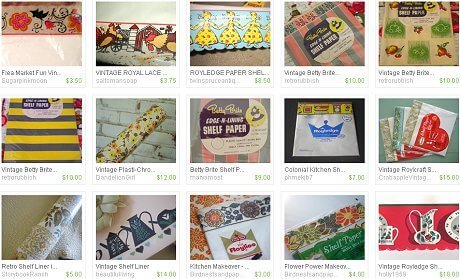
- In the “early days” I am betting the major name making this was Meyercord. They are also known for their furniture and cabinet decals. The paper shelf edging was, I am quite sure, a way for women to dress up their farmhouse and apartment kitchen shelves without having to go to the expense of renovating.
- In the postwar era, the big name seems to have been Royledge also marketed as Roylies and as Roylcraft. I also see some Betty Brite out there. You should also note that the edging came either as “just edging” or as edging attached to white shelf paper – but all still in one piece.
- In the 60s, I am seeing plastic, pleated / ruffled , self-adhesive shelf edging from Contact. I like this idea a lot. As you demonstrate with your experience – that paper is going to tear in any high-use area. Also, the adhesive is pretty nifty. Otherwise, I am thinking that housewives earlier put the edging down with thumbtacks.
- Today’s limited options “new”.
Where to get shelf edging and shelf paper?
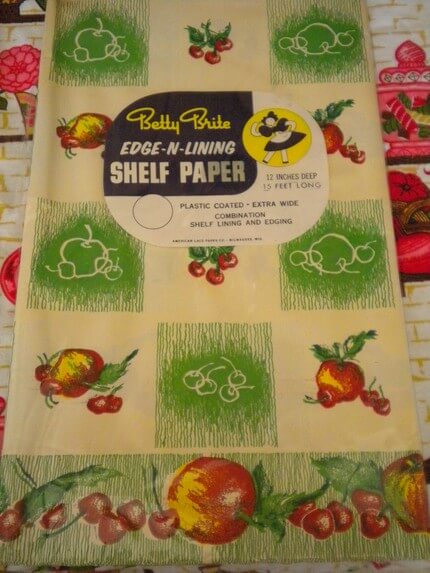
- Etsy seems to be a great source. And of course, there’s always ebay. Search terms: shelf edging, shelf paper, Royledge, Roylies, Meyercord, Betty Brite, Vintage Contact Paper.
- And, you could also see if you could make vintage wallpaper border work.
- This was a fun question to reseach, Carrie. Good luck!


Susie says
I have a few rolls of vintage contact paper and shelf liner that I really love (probably from thrift stores and antique stores), but I have to say, I am not at all familiar with vintage shelf edging. I am very intrigued and feel like I must buy some immediately for my kitchen. Excellent topic!
Maria Stahl says
If I may suggest–The old decals tend to fall apart when dipped. Two things to try: Spray them with Krylon before you use them. Make sure it dries thoroughly. Secondly, don’t dip it in water like the instructions say; just lay them on a wet washcloth, backing side down, and let the water wick up through the backing till the decal loosens. Try to keep water from direct contact with the decal.
Genjenn says
@patty
I just got a few packs vintage NIB Meyercord starburst water slide decals (ebay rocks). The water slide refers to how you prepare the decal for use. Instructions:
Carefully cut out the decal from the sheet and dip the decal in a cup of warm water for 60 seconds. Placing the decal between your fingers, “feel” if the decal slides from the paper.
If it does, you are ready to slide the decal off the backing paper into position on the object.
Hope that helps.
Maria Stahl says
As a point of interest, Royledge/Roylies/Royal Lace were all made by Meyercord. So sometimes the designs duplicate.
Carla says
I made my own shelf edging for the two cabinets over the sink that I removed the doors from. I recieved an Etsy order in some wicked red/white wrapping paper with birds on it and just cut small scallops out (by no means even or perfect.) For shelf paper behind it, and in order to hold it onto the shelf without needing staples or something, I just taped some wax paper on. Wax paper has always been the easy-peasy shelf liner. There IS a lip, but its VERY small and the dishes on those shelves aren’t ALWAYS being removed…and really, its not THAT hard to just be careful!
I also have some vintage gingham shelf paper on the bottom shelf of my dishes cupboard that I found at Value Village. I don’t see the point in lining EVERYTHING when the stuff in the food cupboard for example, would be trashed right away. I only put it where guests are most likely to see it. Other places, can just use wax paper!
gavin hastings says
Oh…wait…I’m gonna change that “Gavin as Richard Simmons” picture. And while I’m at it- can I change my moniker to “Noted Authority”?
gavin hastings says
Shelf paper was never intended to be a permenent addition to decor. It is meant to last only 1-2 years at the most…which is why most homemakers “gave up”.
I like your idea of of an edge done with scrap-booking scissors. And 2 or three thumbtacks would achieve a “true” retro look
patty says
Besides shelf edging, the thing I loved at my grandmother’s house were those decals for the kitchen cupboard doors. They used to slide off the backing with water. I haven’t seen them in ages – probably another ebay search!
pam kueber says
Hi, Patty. I know that Meyercord also made decals. But I don’t think that they slide off…
lady brett says
that fabric shelf edging is really lovely! and makes me think that you may be able to do something similar with a high-quality lace or eyelet ribbon.
pam kueber says
Lady Brett, I think you are totally correct… A good use for vintage lace edging, too? The great thing today is that there seems to be an adhesive for literally any kind of project….
paula says
I think if you made your own out of wallpaper, you could add white adhesive shelf lining (or whatever you wanted) over top of the edging if you didn’t want that bit of the edging to show on the shelf (if I’m picturing what you wrote correctly).
pam kueber says
Yes, Paula, I think you are right about adding the adhesive shelf liner. There still would be a seam at the edge, though, and I wonder how long it would last without pulling up. It’s definitely worth considering — especially given the fact that it is relatively easy to find one roll of vintage wallpaper in your travels…
pam kueber says
Paula, I am also thinking – what if you put press-on laminate on the front and back of the vintage wallpaper before you trimmed it for shelf edging? Vintage wallpaper can be really brittle. Laminating it front and back would prevent tears, I bet. And maybe the laminate would be translucent enough not to diminish the aesthetic effect – kind of transforming it into oilcloth.
pam kueber says
Vintage wallpaper that is “striped” – like this one here – http://cgi.ebay.com/ws/eBayISAPI.dll?ViewItem&item=300367848030&ssPageName=ADME:B:SS:US:1123 — looks like it would be very easy to cut into one-piece shelf lining.