

 What are the key elements of 1940s interior design and decorating style? What colors, shapes, patterns and “feel” did we generally see in 1940s homes? And why? Based on the advertising illustrations and magazine articles that I’ve seen from the period, starting around 1946 to about 1953, what we typically call 1940s interior design had eight general characteristics.
Eight styles of 1940s home interior design:
- Innocent
- Sentimental
- Sunny
- Sanitary
- Patriotic
- Traditional-colonial revival
- Hollywood glamour
- Streamline Deco Jazz age
I write about each one of these design ideas in more detail below.
Special thanks to: Bradbury & Bradbury, which made this slide for me. It also showcases one of their 1940s reproduction wallpapers.
Disclaimer up front: I don’t have a degree in this – I’m a passionate observer, who is still “putting all the pieces into place.”
Recovering and rebuilding after World War II dramatically affected 1940s interior design and the size of 1940s homes
In the immediate wake of the war’s end, there was a tremendous housing shortage. I’ve read that we needed to get 6 million homes built as quickly as possible. And I’ve even seen references indicating that the government was concerned that if we didn’t deal with the housing (and jobs) situation quickly enough, America’s young men would become restless and political – in a bad way. So, we built houses as fast as we could. Usually: Very small houses by today’s standards, no more than 1,000 s.f.
I also swear I’ve read somewhere that there were prohibitions on building more than one indoor bathroom at some point… I need to find the source.
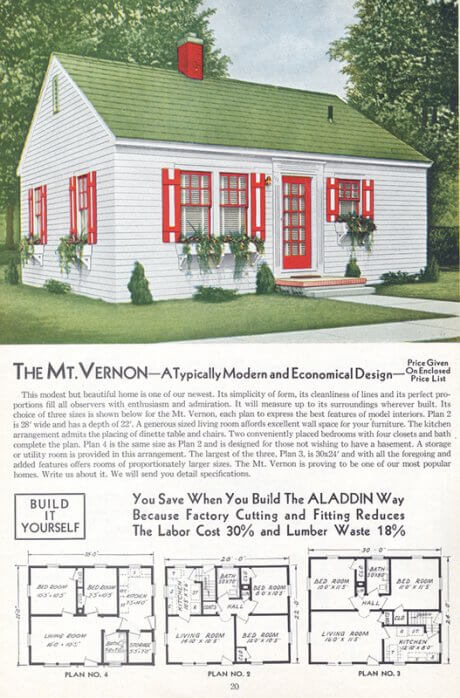 Also, in terms of design, in this immediate postwar period, the “look” still tended to be similar to that of the late 1930s and wartime period. There had also been material shortages during the war, so manufacturers had put all their new-design work on hold. A good example: After the war, when Heywood Wakefield retooled its factories to again produce furniture, its Riviera line was really just the same, but with new handles, as the Rio line produced earlier.
Because of the shortage and ramping up from 1946 until 1953, these years are generally viewed at more “40s style” than “50s style.” (In his terrific book Populuxe, Thomas Hine looks at the 1953-1963 years, which were more exuberant.) So what did the 1946-1953 interior design look like? Here is additional explanation of the eight characteristics:
-
Innocent 1940s interior design:
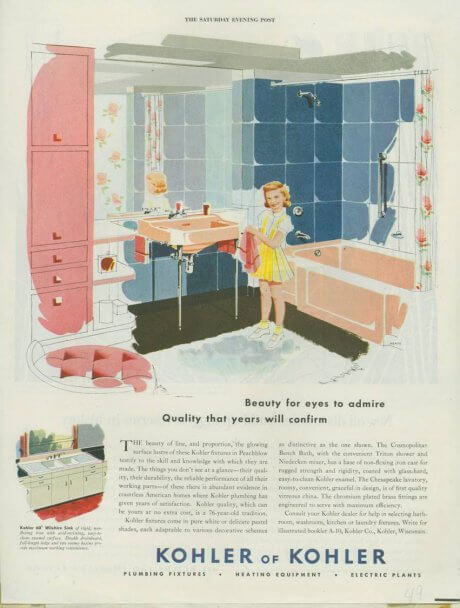 When I look at some 1940s interior design and decor, I see a real sweetness. We still were a nation in which the masses did not have a lot of material affluence. No clutter, far less excess. Thanks to Kohler for this 1949 image from their archives, which, with its soft hand-painted illustration gets at the warmth and sentimentality of the period.
 -
Sentimental 1940s interior design:
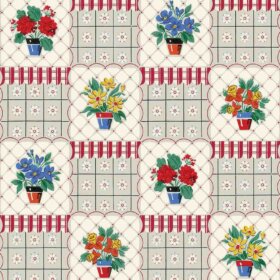
When the war ended, the nation was immensely grateful to have their men and women all back home. It had been five years of tremendous sacrifice. I see a lot of ads like this one, that celebrate the simple pleasures in life. Wallpaper is sweet, flowery. In fact, there was A LOT of wallpaper in 1940s interior design — it’s an essential!
-
Sunny 1940s colors:
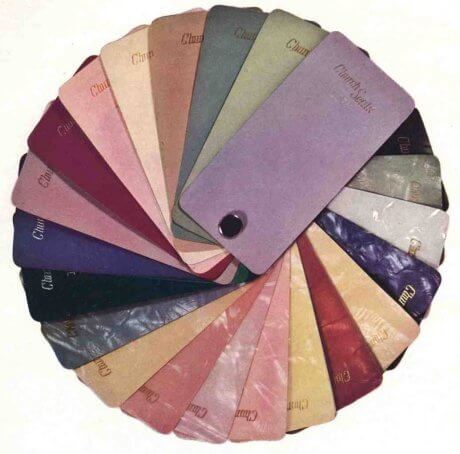 Kind of same as above. There was so much to be grateful for, that we did not necessarily need “more stuff” to be happier. One other thought is that we still were a nation with a lot of farmers and apartment dwellers – the spaces were small, money was tight, and as a result, interiors and their decorative appointments were simpler.
 -
Sanitary 1940s kitchen design:
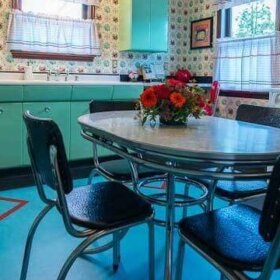
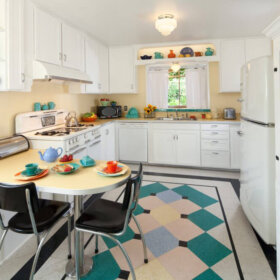
 White kitchen cabinets, or wood. Remember, we still were a nation concerned about vermin and disease, including polio. When your kitchen is white, you can see the dirt and crumbs — and get rid of them.
 -
Patriotic 1940s decorating style:
 I see a lot of red-white-blue kitchen color combinations in the kitchens of 1940s homes. I also see richer colors – full-on primary colors and jewel tones – than in the later 1950s pastel period. I’ll attribute this to carryover 1930s preferences and to the influence of Hollywood, but there may have been other factors — there often are, often related to technological innovation.
 -
Traditional Colonial Revival 1940s furniture and interior design:
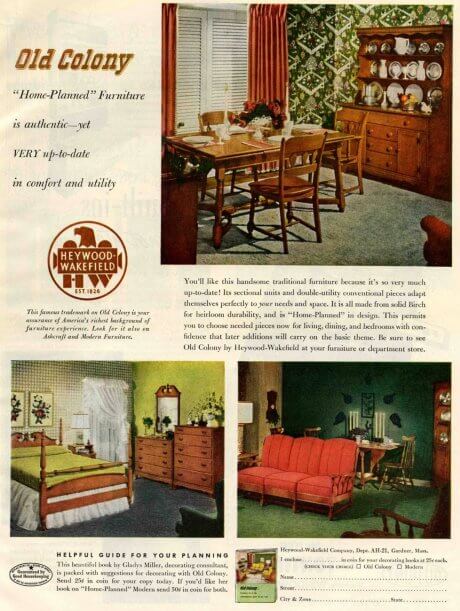 My mom, who grew up in the 1940s, says the furniture was all dark wood where she lived in Pennsylvania – the influence of Europe, she recalls. Of course, we also had Heywood Wakefield blonde – but we also had colonial maple from Heywood Wakefield, Cushman, Willett and scores if not hundreds of small regional manufacturers. The more I explore the history of interior design – of all eras – the more convinced I become that: We are a traditional nation.
 -
Hollywood glamour 1940s decorating style:
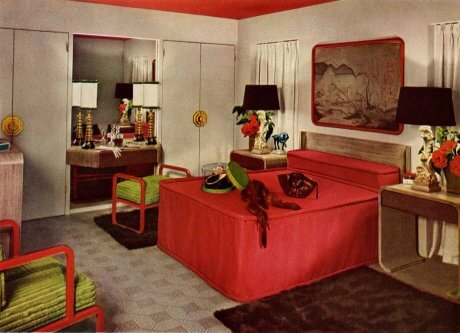 Think Nick and Nora and the Thin Man. We did not get television until 1949… before that, our idols were often very glamorous. Remember women’s clothes from the 1940s – their hats and tailored suits and gloves and bags and hose, the whole very put-together thing? That’s the look I think of for 1940s bedrooms and living rooms – formal, very put together. In other rooms, we also may see large prints used on wallpaper and barkcloth pinch pleats, often tropical.
 -
Streamline – deco – jazz age 1940s high-contrast color schemes:
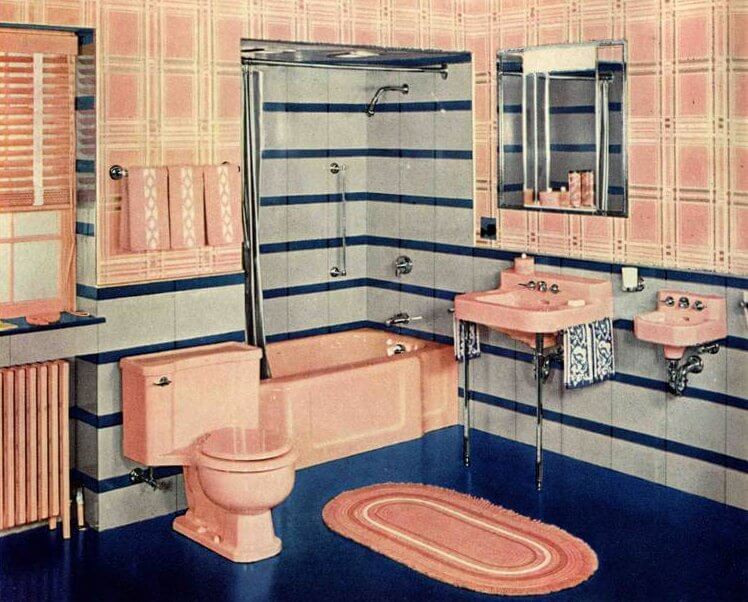 In 1940s homes through to 1953, I think I see more high-contrast bathrooms. That is: black bullnose (or dark green or maroon bullnose, depending on the field tile color). These high-contrast color schemes are a carryover look from the streamline jazz age era.
Post-1953, the bullnose is less likely to be black and more likely to be the same color or a similarly toned contrast color, e.g. pink and mint, pink and robin’s egg, etc.


Marcel says
Me and my wife purchased a 1942 cape cod in Southfield, MI a year ago. We have been updating the exterior over the past year and are now ready to begin renovating the interior. We have no clue of what theme/style fits the home the best. The original owners put a lot of money into the house. Every time has items that would not be found in normal homes. The roof was even practically all copper!
Matthew says
I’m so glad that I found this house! I’ve been working on a 1940’s Cape Cod house in Sims and have been absolutely stumped on colors. I want to make sure everything is true to the era. 🙂
If you want to see pictures of it, go here:
http://www.facebook.com/ThisSimsHouse
pam kueber says
Very cool! Let me know when you are done, maybe I will feature your Sims house here on the blog!!!!
Dana says
We live in one of the many brick “bungalows” built in the D.C. suburbs during the post-WWII period. It’s a great house with good “flow”, nice size rooms, lots of storage, original wood floors and even a garage! Definitely built to last…and it has…and it will! We’ve “updated” the kitchen and 1 bath, staying as true to the house as possible. My final “update” is to a bath that is immediately inside the front door. It has original glass block windows and shower walls and the “seafoam green” and black tiles. I love, love, LOVE the tiles! Since this is the very first thing someone sees when they come in the house, I want to remain even truer to the style than in any other room — though I will compromise in favor of storage by going with a vanity rather than a pedestal sink. That said, the floor has me baffled! Black and white? Black or white or green linoleum (supposing one can even find the right green)? Any suggestions or pictures would be greatly appreciated!
pam kueber says
Hi Dana, your house sounds lovely – perfect. Hey, send us photos here: https://retrorenovation.com/2012/07/17/do-you-have-a-retro-design-dilemma-ask-us/
Kelly says
Thank you so much for your site! My husband and I live in a 1947 cottage style house in Fullerton, CA. It is so great to be able to see what the house looked like before. We still have the original pink tile in the bathroom! We love our little house!
pam kueber says
Well, you’re very welcome!!!!
Pam says
I have a hairsalon and im thinking of redecorating, i had a telephone that came from a houseclearance that looks retro(i think) and has inspired me to redecorate in a 1940’s or retro style, i have ideas but im not entirly sure the look i have in my head will be correct, can u offer any advise that you think might help, thanks
Kaja Sofie says
Hei! This “guide” helped me decorating my apartment! Thanks!
Kaja Sofie says
* Inspired me 😉
AndreaF says
Thank you so much for this post! I just purchased a home built in 1946 and luckily the original hardwood floor, bathroom tile and kitchen tile and cabinets are in good condition. I would like to keep my home true to it’s time period and this article helps me tremendously!
pam kueber says
Welcome, AndreaF! Send me some pics some time!
Meaghan says
Hello-! Do you know what the little vent/grate is under the 1940s kitchen sink cabinet? We just purchased a 1947 home and the metal grate on this vent is missing so there is a “hole” in this cabinet. I would like to replace it but don’t know what it is called or where I could buy or make one. Thank you!
Jenny says
Thanks for an inspiring site for me, who’s looking for typical 40s interior, colors and decoration for our home. I really like the 40s “red-lips-color”, and is thinking of that in my kitchen. Since I also love teak-furniture from the 50s, I’m trying to match it if possible. Regards from Sweden!! 🙂
Richard Douglass says
Hi Pam,
I grew up in the 1940s and 50s. What one must remember is that the vast majority of houses in existence in at the end of the war in 1945 were built in the 1930s and before. Unless people had a lot of money, (and we did not, although we were not poor by any means) they bought a house, perhaps painted inside, and brought whatever furniture they had with them. Then adding things as needed, money permitting. Our furnishings were an eclectic mix of family pieces, including pieces bought over time, some of grandmother’s antiques, and our house in no way looked like a 1950s retro style. OK, we did get a formica and chrome kitchen table set, but that was about it. (Wish i had it now!) The look was overstuffed 20s/30s to begin with, and as my parents could afford it, gradually morphed into something akin to Virginia colonial revival. The fact is, I cannot recall any of my family or friends having a 100% 40s or 50s style as we know it today.
It is easy to put together a style once it has been defined, but when it was happening – that’s another thing entirely. Years down the road, someone might put together a 2010 style house/blog etc. How many of us are living in a place like that now? Likely less than 1%. Certainly not me! I am working on a 1930s updated style kitchen with colonial revival/beach/cabin casual in the rest of the house. Oh, I so need a designer to pull it all together!! LOL
It was also very true that building supplies were extremely hard to come by during the first year after the war was over. Drywall, for instance was almost impossible. My father worked for a manufacturer, and made some good deals with people because he could get some.
Great site! Lots of fun!
Richard
Kent, Washington