

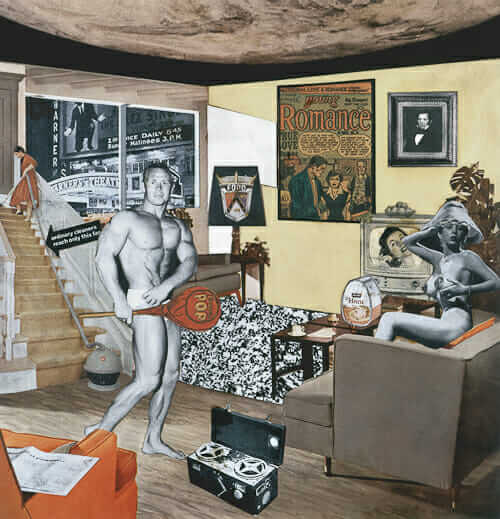
 RICHARD HAMILTON: Just what is it that makes today’s homes
so different, so appealing?, 1956
(C) Richard Hamilton. Used with permission of Gagosian Gallery and The Tate
Richard Hamilton — a groundbreaking British artist credited with producing the first piece of “Pop Art” — died this past week, Sept. 13. His 10″ x 9″ collage (above) — entitled, Just what is it that makes today’s homes so appealing, so different? — was first shown in 1956. And yes, that Tootsie Pop — and the phrase “Pop Art”– are now forever intertwined. How thrilling to learn that it was a collage — this collage — that established the term. What is Pop Art? Hamilton said:
Pop art is:
Popular (designed for a mass audience),
Transient (short-term solution),
Expendable (easily forgotten),
Low cost, Mass produced,
Young (aimed at youth),
Witty, Sexy, Gimmicky, Glamorous, Big business..
RICHARD HAMILTON: Epiphany, 1964
(C) Richard Hamilton. Used with permission of Gagosian Gallery and The Tate
I allude, quite a bit, to ‘living more simply’ — “like they did in the postwar era.”
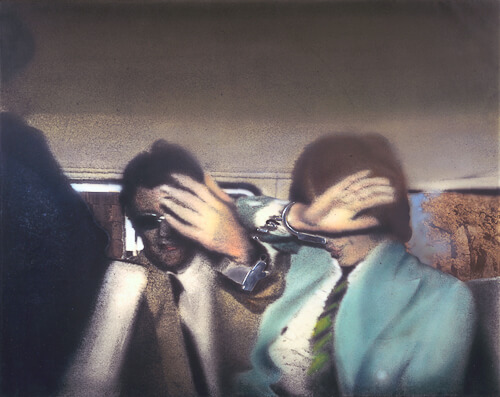 RICHARD HAMILTON: Swingeing London 67 (f) 1968-9
Acrylic, collage and aluminium on canvas painting
Purchased 1969, The Tate
But OF COURSE, in the wake of the relative affluence that arose after World War II, there were many critics… people who worried about forsaking deeper, richer values in the name of the making money and buying stuff. Hamilton’s “What makes today’s homes so appealing…” — which became his most famous piece — seems clearly to be questioning the direction that consumerism was taking us. In my reading, I take away that Hamilton’s work continued to be politically-conscious, politically-focused throughout his career. But, I was also interested in what Hamilton wrote in the Architectural Digest, when speaking about another later work:
“It looks as though the painting is a sardonic comment on our society. But I would like to think of my purpose as a search for what is epic in everyday objects and attitudes.”
Read more:
- Richard Hamilton – his obituary in the New York Times …
- This write-up for a 2003 exhibition is good…
- He also designed the famous cover of the Beatles’ White Album
- And see more works in the Museum of Modern Art’s online database – cool!
In one interview, Hamilton says that Richard Wilson and Gary Hill are, today, two favorite artists. I am now going to check them out.
Thank you, Phoebe and Gagosian for the images 🙂
Rest in peace, Richard Hamilton.


JKaye says
Thanks for this post.. I was born in 1955, a year before that fascinating collage was created by Hamilton. But I don’t think I ever saw it before now. I was aware of his later works, such as the White Album. This post caused me to realize that his works have spanned my lifetime and have been much more influential upon my life than I had realized, in terms of how they both commented upon culture and helped shape culture.
I also have enjoyed the subject of collages in recent days. My involvement with collages was pretty much limited to the late ’60s, when I put together displays made from photos clipped from Tiger Beat Magazine. The stars were billed as the “fave raves that you crave,” and included the Monkees, Paul Revere and the Raiders, and other such bands. Fun memories.
Annie B. says
Wow! A collage was the seminal work of “Pop” art. Hamilton’s work is sincerely inspirational.
Thanks for the art history lesson, Pam.
Jim says
It’s amazing that this work is so small. Basically the size of a sheet of notebook paper. You could print it out from your computer, frame it, and have a full scale reproduction.
Lenea says
Yes people will definitely pay out the nose for vintage Pop Art now!!
How very interesting. I didn’t know that Richard Hamilton coined the term Pop Art and actually started the movement. I always thought or assumed it was art related to popular culture; kitschy. Thats so very fitting that it was derived from an actual Tootsie Pop!!
Richard D. says
And wrong about “Low cost”.
Beth says
It turns out he was wrong about the expendable and forgettable part. It still looks so fresh!
BungalowBILL says
And to think we came so close to it being called Canned Ham Art.