

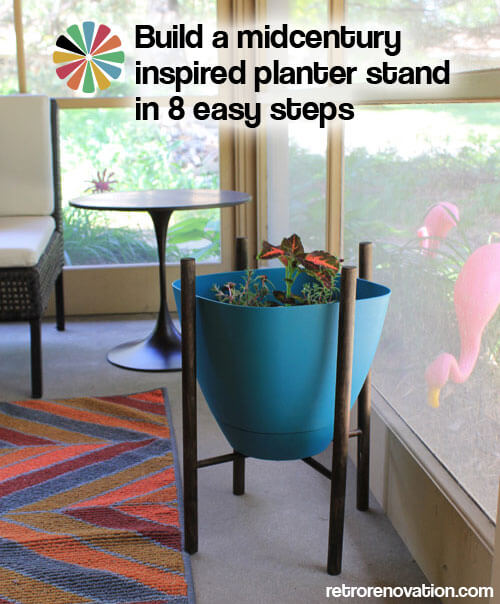
 “Window shopping” here and there this summer, I kept coming upon really cool mid century inspired planter stands. I’ve been in love with these modern looking plant stands for a while now, but I am saving my money for the real deal. Meanwhile, being a do it yourself type, I thought, “I’ll try and make one of these myself.” It only took me a few minutes of brainstorming and a quick trip to the home improvement store before I had my plan..
 The first order of business is getting some supplies together. I found this turquoise plastic 12-inch pot at Target for about $6. I chose this particular pot for a few reasons. It has nice clean lines and flat sides — which will work well with the planter stand design. It also was inexpensive, lightweight and such a fun color!
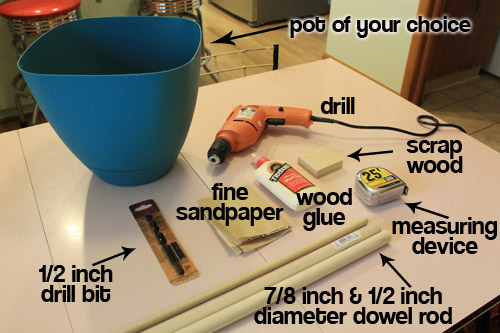
Materials needed to build a mid century inspired planter stand:
- Pot of your choosing
- Piece of scrap wood to use as a base (Mine was a scrap of 1×3 pine)
- 7/8 inch dowel rods (I used poplar because I wanted to keep the cost down-if you are using a heavier pot, you will probably want to spring for oak instead)
- 1/2 inch dowel rods (Poplar-but again, use oak if you are using a heavier pot)
- Fine Sandpaper
- Wood Glue
- Stain or paint for finishing
Tools needed
- Drill (variable speed is best so you can go slow when drilling)
- Clamps
- 1/2 inch wood drill bit with pointy tip for easy driling (I used one like this)
- Saw to cut dowel rods with (I used a hand miter saw)
- Measuring device (tape measure, ruller, or whatever you have handy)
- Pencil for marking
- Safety glasses (remember, safety first!)
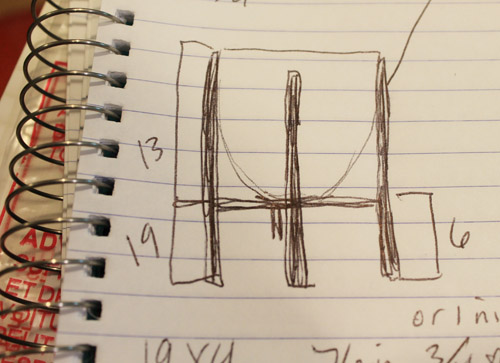
 Step 1 – Calculate the height of your planter stand
With my materials gathered, I was ready to start. I made a quick sketch to figure out my measurements. The pot I chose is about 12 inches tall and I wanted the vertical dowel rods to go just a bit past the top of the pot–about an inch. I added these 13 inches to the height I wanted the planter to sit off the ground which I decided was 6 inches. (Keeping the planter stand low increases its stability). That gave me a total measurement (13+6) of 19 inches of vertical dowel per leg.
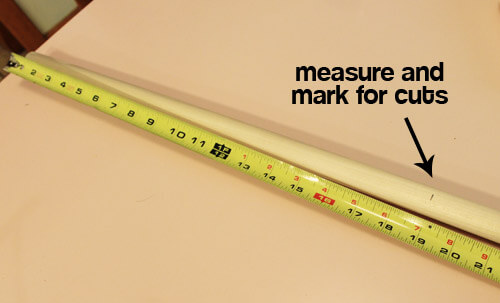
 Step 2 – Measure, mark and cut vertical legs
Take the 7/8 inch dowel rods and cut it into four 19 inch pieces. These will be the legs of your planter stand.
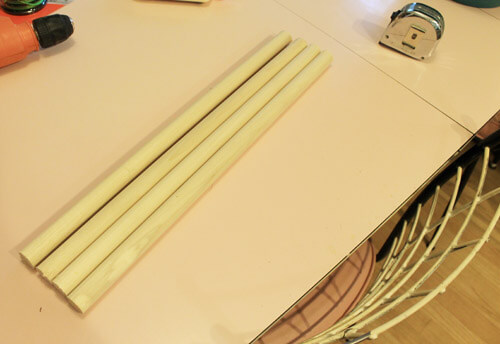 Step 3 – Measure, mark and drill holes in legs for cross supports.
From our sketch, we know that the base of the planter stand (that the pot rests on) will be 6 inches off the ground. Measure 6 inches from the bottom of each leg and mark the spot you will be drilling.
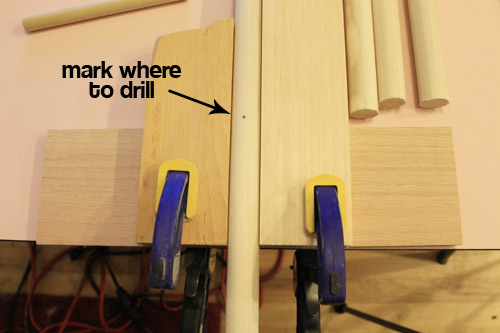 I set up my clamps with a few more pieces of scrap wood butted up against the dowel rod to help the dowel stay in place while I am drilling.
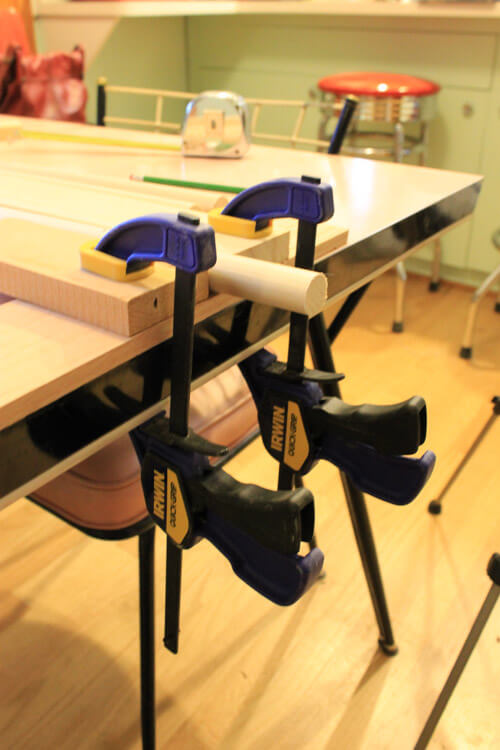 No pre-drilling is necessary. In fact, I did try to pre-drill with a smaller bit but it ended in disaster–it tore up the soft poplar wood. The type of 1/2 inch drill bit I purchased worked better without drilling a pilot hole.
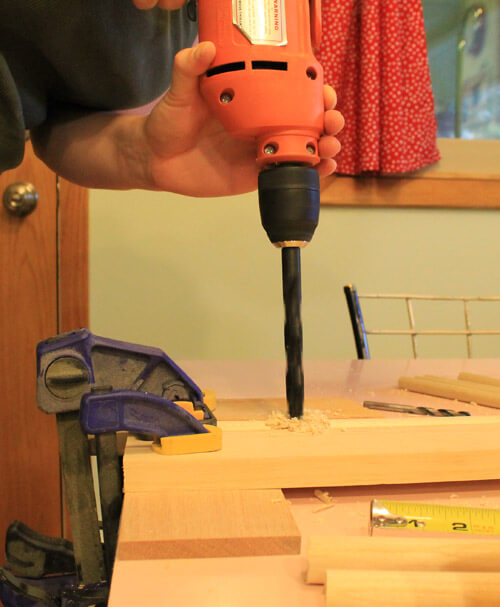 Using the 1/2 inch drill bit, (same diameter as the smaller cross beam dowel rods we will be using) drill about half an inch into the dowel rod. Repeat 4 times with each of the legs of the planter.
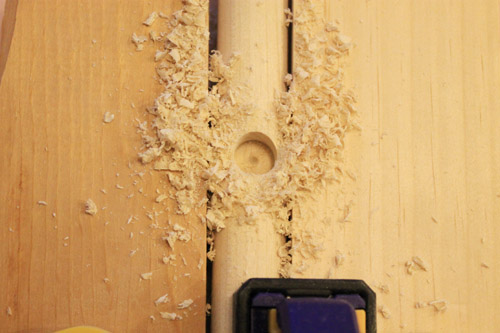 Step 4 – Mark and drill holes for the planter base
Take your piece of scrap wood and find the center of each side. I did this by using a straight edge and drawing lines across the diagonals and then the horizontals of the piece.
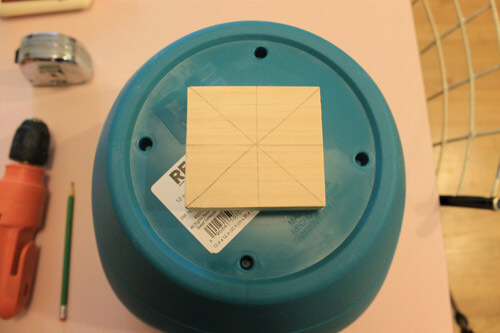 Then I marked the center of the sides where I need to drill to insert my 1/2 inch cross supporting dowel rods.
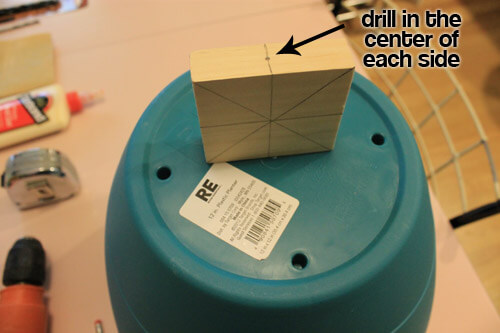 Once again I clamped down the wood and drilled about 1/2 inch into each side of the block.
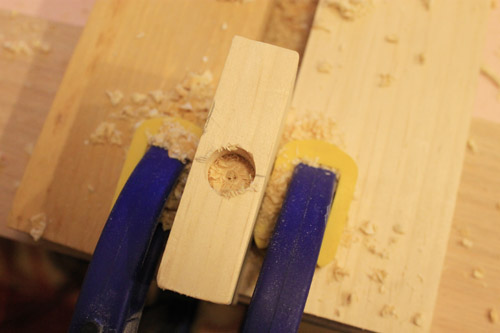
Step 5 – find the measurement of your cross beam dowel rods
Then it was back to my sketchbook to find the measurement of my cross beam dowel rods. My piece of scrap wood is about 2.5 inches square. The diameter of my pot is 12 inches. This left me with 9.5 inches of space left to span. Since there will be two smaller cross beam dowel rods going into either side of the scrap wood base, I divided 9.5 by 2, which gave me 4.75 inches per dowel rod. Then I had to take into account the 1/2 inch holes that I drilled into my scrap wood base and the vertical leg dowel rods, so I added 1 inch back to that dowel rod measurement giving me a length of 5.75 iches per cross beam support. If your scrap wood is not square, you will have to do this same calculation again to figure out the lengths of dowel rods you will need for the other axis.
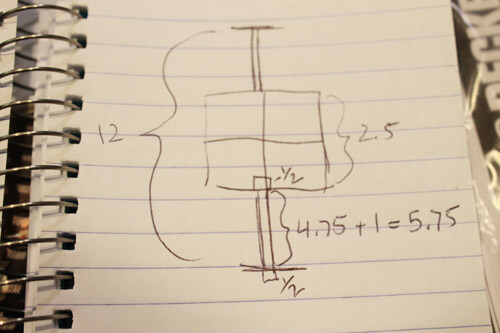 Measure and cut the 1/2 dowel rod to your specified lengths (in this case 5.75 inches)
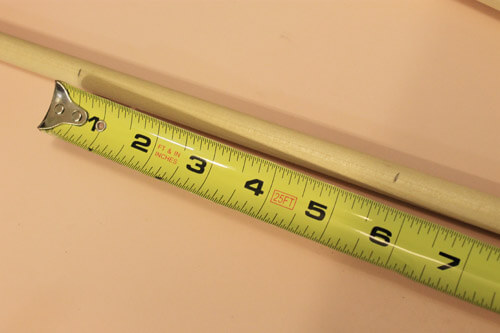 Step 6 – Do a dry fit to make sure everything comes together correctly
Once you have your cross beam dowel rod pieces cut, you’ll want to do a dry fit (without glue) to make sure everything fits and lines up the way you intended. You may have to shorten your cross beam dowel rods a bit if your holes aren’t exactly 1/2 inch deep.
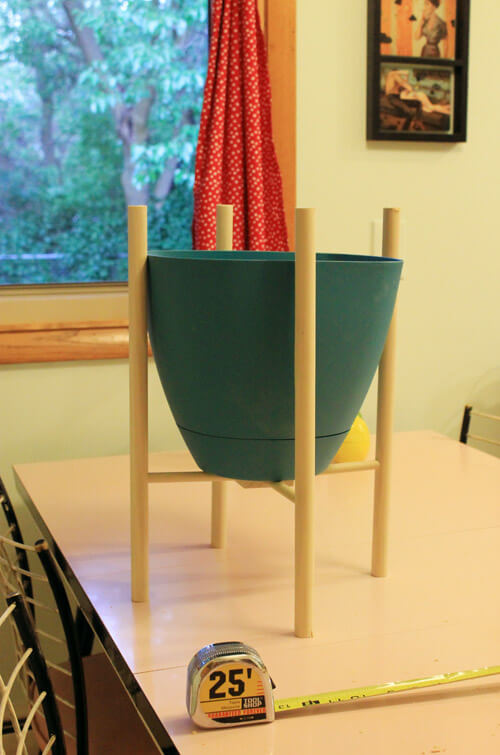 Step 7 – Sand and glue
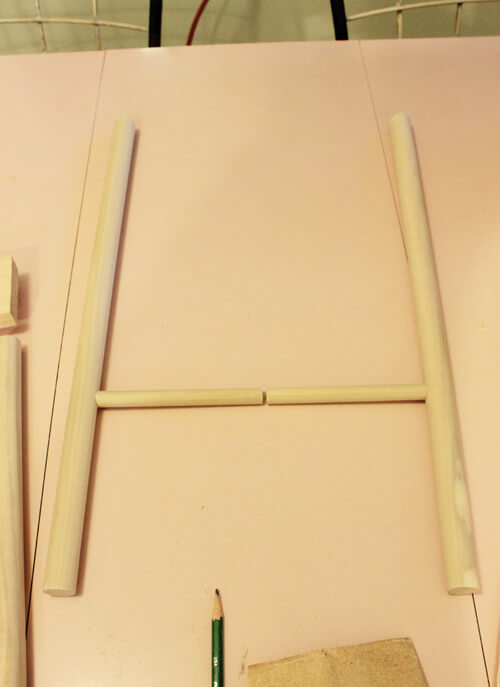
If you are happy with the way the dry fit turned out, then it is time to give your dowel rods a light sanding to smooth out any rough spots. After that, you can break out the wood glue. First glue the cross beam supports into the vertical legs using a medium amount of glue. You want to fill the hole about 1/3 of the way with wood glue. If any leaks out when you press the pieced together, clean it up right away to avoid that drippy look.
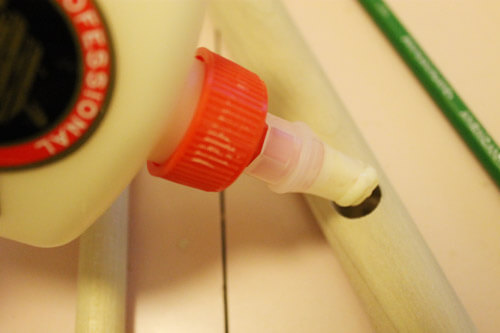 After I glued all four of my cross beam supports into mthey vertical legs, I let them dry for about an hour-to make sure they weren’t wobbily before I glued all the pieces into the center support.
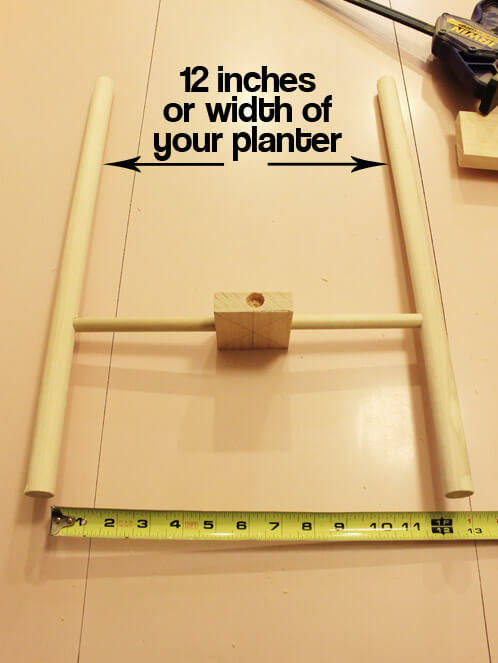
 The distance between your vertical legs should be the diameter of the pot you are going to use, in this case, 12 inches.
 Step 8 – Stain or paint and plant your planter!
After the glue had 24 hours to dry, I took the planter stand outside and tried it out with my pot. I even planted some flowers in it!


There’s my opinionated dog, Leo. For those of you who have visited my blog before, you know he always has to get his two cents in!
Don’t worry Leo, I’m going to stain it!
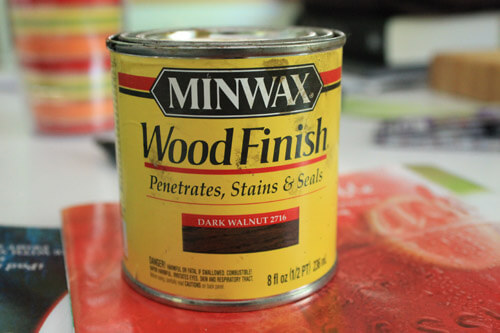
I had this dark walnut colored Minwax oil stain sitting around the house from a previous project, so I decided to use it to finish the planter. I applied the stain according to the directions on the can, let it dry and then used a clear coat spray sealer to finish off the job.
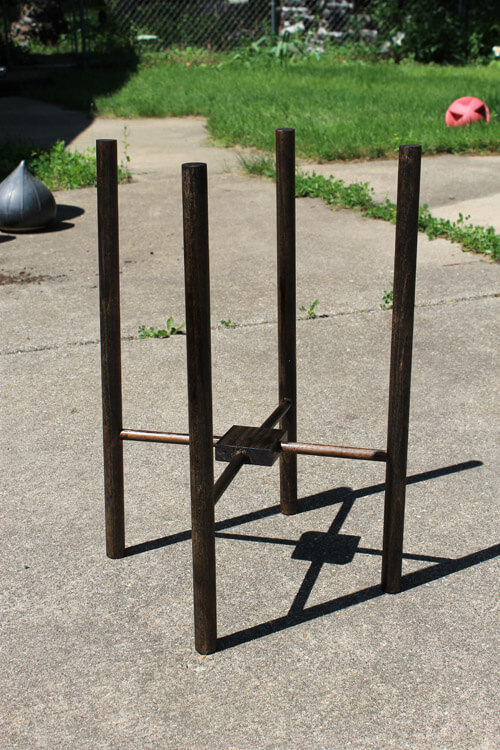 When everything was dry, I picked a nice spot for my planter to live. (Note-to prolong the life of the planter stand and keep the wood glue holding strong, I would keep this planter stand on a covered porch or inside.)
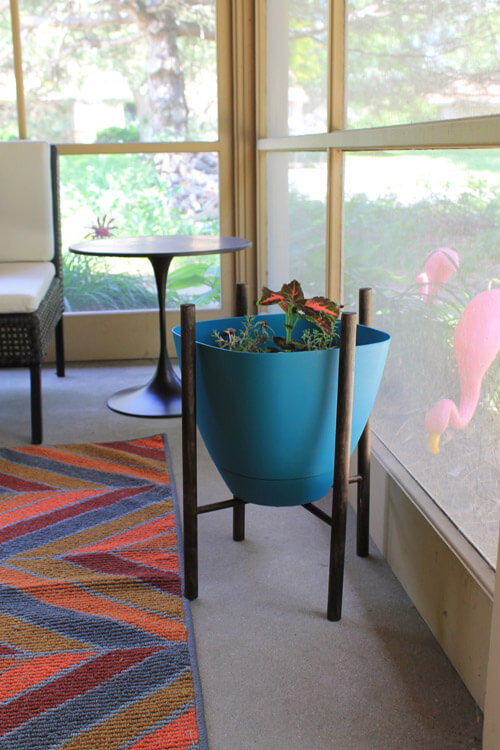
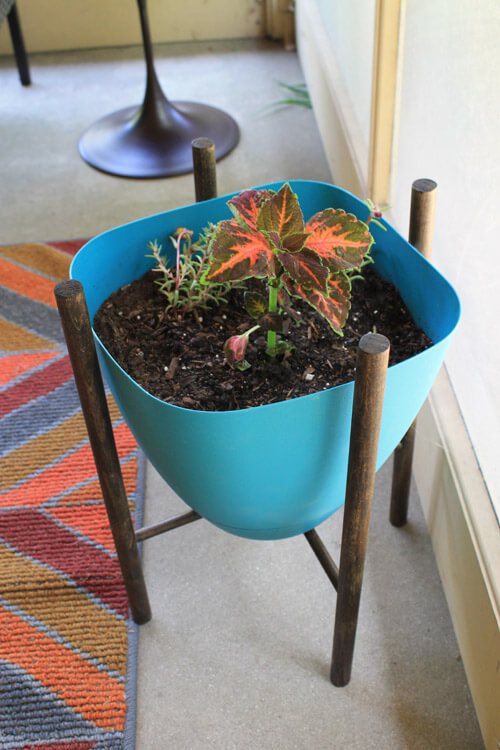 I think it adds a nice finishing touch to my tiki lounge screened porch, don’t you?
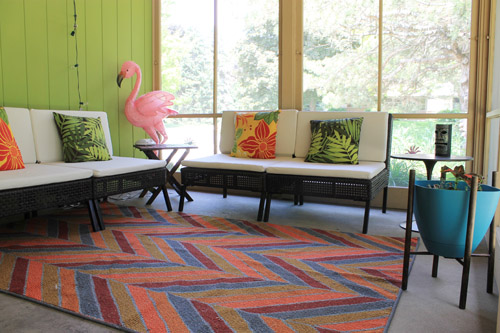
So there you have it, 8 easy steps to making your own affordable midcentury inspired planter stand.
Who is making one this weekend?





Annie B. says
I think I like your DIY planter better than the expensive repro bullets, Kate. All sorts of possibilties and variations are springing to mind after viewing this: brightly colored paint on the legs or a teak-y stain with a satin poly finish, etc. All your planter needs is the requisite monstera deliciosa.
pam kueber says
Of course, it gives me an idea to make a big “mash up” one — with wood curtain rods and bed finials and hey, how about we put a bird(house) on it!
Annie B. says
That’s an absolutely Pamazing idea!
pam kueber says
🙂 you are my favorite this week, Annie B.
IMissLiberty says
I think I have some chrome rod trimmings, left over from my closet remodel, that you can use…
ChrisH says
Nice project. It came out very well.
MsKittyMuses says
My husband and I just bought our first home, a 1955 Bedford stone ranch house, and while we were still looking at houses I bought quite a few of these pots in the turquoise and grey. The colors became the inspiration color we’ve used on our new mail box and will use on our exterior trim. I love, love, love this idea, rather than just putting them on stoops like I had planned. We’ve planned on getting one of the bullet planters for years, but this is so great, it may fill that planter sized hole in my heart instead! Thank you!
By the way, my husband found your site a few months ago, and it’s be overwhelmingly helpful already, and we haven’t even started any renovation yet! We’re so thankful you started this site, Pam! I feel like I’ve finally found my people.
pam kueber says
Well, welcome, Ms Kitty. Yup: We’re a clan, that’s for sure!
hourglass susie says
I love it! You’re so creative.
nickarmadillo says
Thanks for the instructions! I’ve been looking to do a DIY copy of that planter stand for quite a while now, but haven’t had the time to plan it all out. What a time-saver!
lynda says
The planter looks nice and your room is very nice. However, what are you going to do about watering? Will you put the pot on a tray when you water? A saucer under the pot would sort of ruin the streamlined look.
Lynda says
Hi Lynda,
This particular pot has a built in saucer. However if you were going to make one with a different type of pot, I would pick a pot with either a built in saucer like this or use one without a saucer, and keep the pot inside or on a covered porch so it would not need drain holes.
lynda says
Thanks, the built in saucer is the answer. You are very clever!
Mad for Midcentury says
I picked up a few of these planters in gray thinking that they looked a lot like bullet planters without the legs. This definitely completes the look.
MidModBeachGal says
I have been thinking of doing something similar for my home. Thank you Kate! With all of your fabulous step by step instructions you have saved me the time of having to figure out how to do it myself. Oh, and I am glad to see that Leo is now making an appearance on RR too! I love Leo. He looks SO MUCH like my Border Collie mix. I swear they could be siblings.
Jenny A. says
I LOVE this idea. I have a variable speed drill. I’m ready!! Thanks for the concise instructions. It looks great and, yes, I have been looking longingly at planters such as these for a long time.
Erin says
Lovely! I would use some furniture wax on it to give it a polished, finished look that will match it perfectly to your other furniture. The wax will also protect against any possible water.