

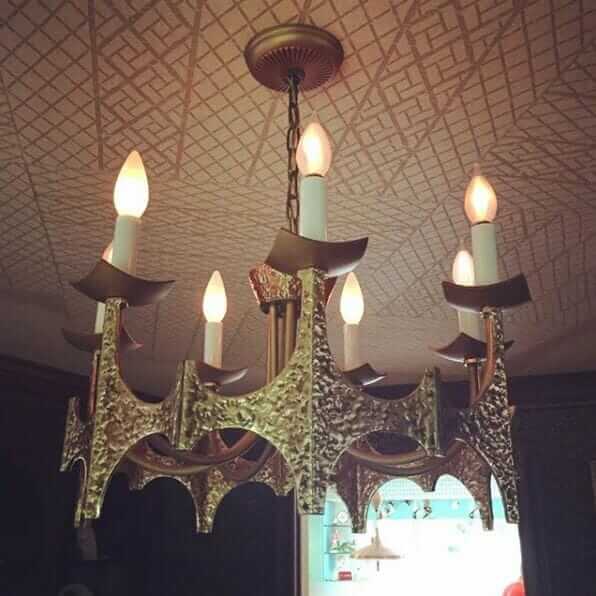
 1969 was a very good year for Moe Lighting. Last week, DH and I took down our “old” vintage Lightolier dining room light and in its place put this M-2149 Moe. Isn’t she a beauty? I bought her many years ago, cheap on ebay. I also got two sconces in the deal, and over the next several years brought my sconce tally to six “just in case”. The light looks fabulous, and it’s amazingly heavy. Oh, and if you can pause to peek above the light, you can see: I am wallpapering the ceiling too. What a pain in the neck, but it’s looking fantastic.
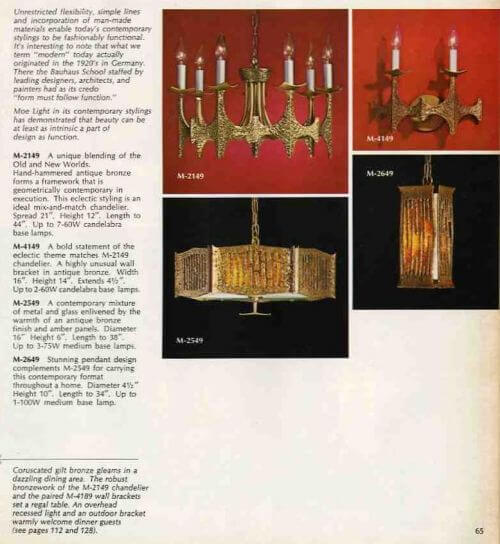
 I also discovered, when I went to pull this Moe out of “my attic lighting store,” that I have the M-2549 too! I’d forgotten. Oops! Christmas in July! My 2010 scans from my 1969 Moe lighting catalog are here.
Here’s some of the Moe text about this lighting series from the catalog:
Unrestricted flexibility, simple lines and incorporation of man-made materials enable today’s contemporary stylings to be fashionably functional. It’s interesting to note that what we term “modern” today actually originated in the 1920’s in Germany. There, the Bauhaus School staffed by leading designers, architects, and painters had as its credo, “form must follow function.”
…
M-2149 — A unique blending of the Old and the New Worlds. Hand-hammered antique bronze forms a framework that is geometrically contemporary in its execution. This eclectic styling is an ideal mix-and-match chandelier.
…
Coruscated gilt bronze gleams…
“Coruscated” — I had to look that one up. Read Retro Renovation! Improve your vocabulary!
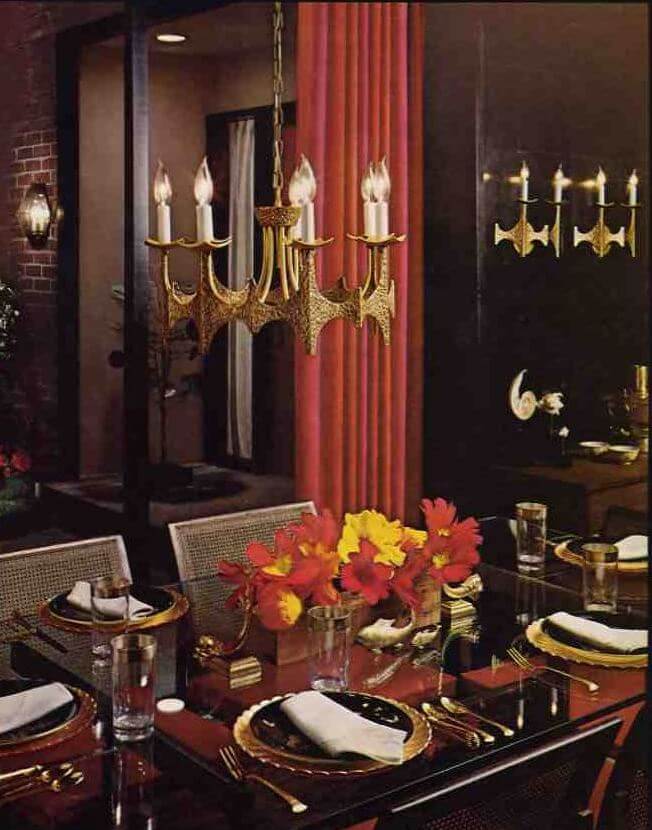
I call this style of light “brutalist”, but it’s interesting to read how Moe tied the design back to the Bauhaus era. I am not an expert on either, so I dunno really. I do know, though, is that the light works just fine in my Mahalo Lounge mashup. My “story” is that the light is pirate ship bounty: A chest of purloined gold doubloons hammered into a showy chandelier for Captain Corus Cate’s private dining room. He be swingin’ on it soon enough, full of rum and threatening all foes who defy him.
DH wants me to get some of the sconces wired in, too. Aye, matey, he’s diggin’ it.
I’ve written a lot about Moe lighting over the years — they were immensely popular. See all my Moe Lighting stories here.


John says
I LUV your 1969 Moe dining light. I recently bought a beautiful brushed copper and black Moe kitchen ceiling light which I think is from 1967 or 1968. I’m redecorating my kitchen and putting it back to the mid/late 1960s. I live in a 1966 garden apartment (2nd floor corner, one bedroom unit of a two unit building). The exterior of my garden apartment complex is just about all original from 1966 when it was built (brick, wrought iron, flagstone and cedar shakes) so I decided to restore the interior of my garden apartment back to the 1960s! I’ve got custom mixed Sherwin Williams Harvest Gold paint ready for the walls (I matched the paint to a General Electric ice cube tray from the late 1960s), a new in the box 1960s Delta faucet has been installed in the kitchen sink and I’m having a Harvest Gold, Pumpkin Orange and Brown window shade custom made. Still a few weeks away from completion but would like to send you photos when done.
Hunter Hampton says
I have always called that style, Early Conquistador, now I know the real name.
Carolyn says
Papering your ceiling – jeez if you’d known you were going to be doing this “pain in the neck” work, you’d’ve invested in scaffolding to lay on like Michelangelo.
I can’t wait to see how this all comes together – we see bits and pieces and it kinda doesn’t make sense, like that story of a group of blind people describing an elephant by what they touched. All across the land you’ll hear “Oh…” when we “get” it.
Pam Kueber says
My Louisville Ladder platform ladder is working great so far! I could not have done all the painting and wallpapering of the beams and ceilings without it! https://retrorenovation.com/2017/03/17/dentil-work/
Mary Elizabeth says
Oh, and I forgot to say, Pam, how fabulous the chandelier looks in your dining room! And stick with the pirate’s booty story–it’s perfect.
Mary Elizabeth says
I am going to look at all your articles on Moe, Pam. I was just in the Re-Store in Plainfield, CT, where I found a set of six sconces in wood and metal that seemed designed in a very similar style. For one thing, the curved built-in bobeches were the same relative size and the same shape. I was wondering to myself why these sconces were $25 apiece, even though a couple of them needed repair and they all seemed to need rewiring.
At $10 apiece, I would have bought them to spruce up my daughter’s house, which she is selling (complete with 70’s kitchen with harvest gold double ovens) when she moves to Iceland.
denise says
Ha! Plainfield. I lived in part of that town for 20 years growing up. It surprises me when going back that it grew up as I grew up. $25 for a light, it would have surprised me, too, only because I still see Plainfield and the stores and such from a teenagers viewpoint. Funny how that is.
Kate H says
How do you wallpaper a ceiling? This seems way beyond my wallpapering capabilities, which are mostly limited to bathrooms.
Pam Kueber says
I’ll do a separate story. It’s not easy, that’s for sure.
Jay says
I noticed the ceiling and thought it was the Time Capsule house the fixture came from but then noticed your kitchen in the background. Very nice! Yes, the sconces will complete the look; but where you see a pirate I see a knight – the fixture is very crown like.
James Powell says
Love this! I’m a huge fan of vintage design and plan to convert my loft into a full art deco suite. The chandelier you have is amazing!
Susie says
I wish there was more information on the older lighting. I have one chandelier that I think is made by Toledo Lighting and Fitments (off-shoot of Riddle?) and 2 that I don’t have a clue who made them. So frustrated!
Karin says
Great chandelier, and I love the old ad it appears in. I too have a chandelier of unknown origin and have looked all over the web for a similar one to no avail. The man who sold it to me could only tell me that it might be “Italian”. An antique dealer said it might be Lightolier. I still like my chandelier a lot. Not everything has to have provenance if you really love it. I’m stumped myself, but the quest goes on!
ineffablespace says
Probably when the Moe fixtures were produced, they weren’t using the term “brutal” or “brutalist” to apply to fixtures and furniture in a universal sense yet.
Brutalist comes from the French term “beton brut” meaning raw concrete, and the term “brutalist” then sort of evolved into a description of the harsh appearance of the board-formed concrete buildings and then became applied to furniture and lighting that was also displaying the materials in raw, rustic or unrefined form.
Tom Greene produced torch cut copper and bronze fixtures that started to be referred to as brutalist, and then he eventually designed fixtures to be produced by Feldman and Lightolier in small quantities. This in turn trickled down to more mass production like your pieces.
Paul Evans produced metal patchwork, welded, raw metal furniture that were originally called studio pieces and eventually this started being called brutalist furniture as well. He also designed furniture that was produced by manufacturers in small quantities and this in turn trickled down into more mass production through companies like Lane and Broyhill
So the term was starting to be used at the time but for the most part was probably applied to the architecture and not so much the decorative arts yet. Many styles of furniture are really named after the fact, because at the time they are being produced they are “contemporary”. “Mid-Century-Modern” was not coined until the 1980s apparently, after the end of the period.
Pam Kueber says
Thanks for the mini-lesson, ineffable! Design history is so interesting!
Jay says
Very interesting yet even today many design purists will only apply “Brutalism” to this particular architecture style and not the design elements that were inspired by it.
ineffablespace says
I can understand that, mostly because the usage of “brutalist” to describe these other things is a misappropriation, in a sense of the real meaning of the word.
Mary Elizabeth says
Thanks, “ineffable,” for the information. I was confused why something not a concrete building was being called “brutalist.” So now I understand that the term was appropriated. It’s interesting to think about it as now referring to anything that might look good inside a brutalist building.