

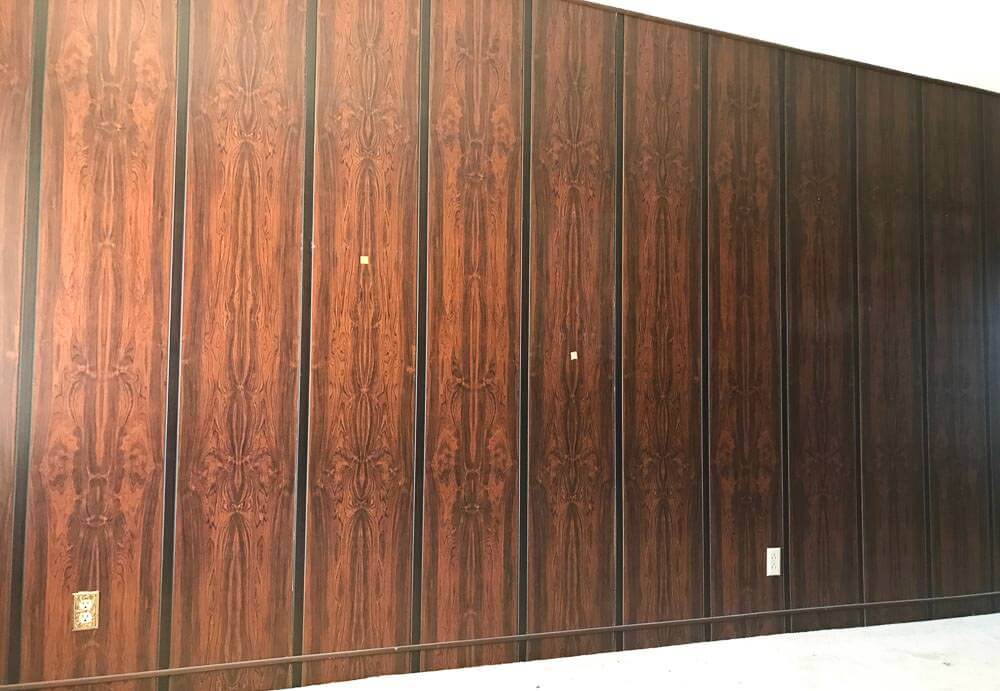
 Many of us agree that Knotty (Pine) is Nice — but what about its flashier cousin, 1960s-1970s wood paneling that got kinda … designy? Elisabeth is new to her 1968 house and her eyes are a bit in shock at her two-tone inlaid wall paneling. This sure must have been hip back in the day. She asks us: Should it stay or should it go?
 Elisabeth writes:
Hi,
I’ve just purchased a 1964 home. It is exciting but a bit overwhelming. There is a lot of paneling in the house. Looking at the May 1968 House and Garden magazine I can identify it as Georgia-Pacific Inlaid Paneling. I know it was marketed as the affordable option to real wood inlay work. It is not tongue and groove and it is not knotty pine. I am in a quandary as to whether to keep it. If it were real wood I would not have a question. I don’t mind trying to keep it with the intent of staying in keeping with the spirit of the times. However I would probably need some kind of confirmation that it is a good idea. My first instinct was “ugh, paneling”. I am new to this. Also the expense of remove and replace is weighing on me. Thanks for your time and any advice.
Best,
Elisabeth
Wow, Elisabeth, you are so ingenious to find that ad. Which wood is ‘yours’? Elm with walnut inlay? Pecan with walnut inlay? Cherry with walnut inlay? Or Walnut with pecan inlay? Surely a reader will know.
I have my own opinions, of course, but first, let’s hear from readers:
Should Elisabeth keep her circa-1970s paneling…
Or should she rip it out or paint over it?



ineffablespace says
I think we also have to learn from history.
My mother’s decorating books (mostly BH&G) from the mid 1950s are full of how to compensate for all the dark, drab, u— interiors of houses built from the 1890s to the 1920s.
They have tips on painting over stained woodwork, replacing those oddly colored tiles around the fireplace or putting in a modern mantle, taking out those light-stealing stained glass windows and windows with drafty leaded glass at the top and replacing it them with picture windows that let in lots of light.
One of my favorites is taking down that high maintenance porch with all the gingerbread and brackets that makes the interior so dark and putting up a nice concrete stoop with aluminum filagree
posts and an aluminum awning.
Honestly, the “before” pictures did not make these old houses look like there was much worth keeping, and there were a lot of dull utilitarian houses from the period, but they did not need to be stripped and painted over wholesale.
So I think “rip it all out” is the same sort of reaction our parents or grand parents had to Victorian , particularly since we have no idea what it looks like. The house could look like the set of a bad 1970s porn movie shot in the Valley, who knows? we haven’t seen it…but I think there is some evidence that maybe it should be a selective process, at least.
Lynne says
Since I’m living in a house FULL of paneling, I say live with it for now. If your not sure about getting rid of it-wait. Once it’s gone, it’s gone.
That being said, what is the overall condition? Is it a mess with nail holes or damaged areas? That’s a different story. Vintage or not, shabby and ruined has to go.
Clean it up a bit. Get some furniture and pictures in the room. Re-evaluate. Still not loving it? Then, consider painting it.
Don’t jump to tearing it out right away.
Just my 2 cents.
Leslie says
Keeper for me, love it! Remember, you don’t have to keep all the panelling through out the house. But compromise and leave some as accent walls to enforce the midcentury design.
ineffablespace says
We don’t really have any context on which to base a decision. I think we need to see pictures of the rooms, how much there is, how it affects the spaces.
One clue as to what to do comes from the ad itself: it was suggested as an accent wall.
Steve H says
I agree, a lot more information is needed. Also, I would like to know just how this paneling was constructed. Is it a thin veneer of real wood over a plywood substrate, or a printed pattern similar to laminate? My in-law’s basement had the later and it definitely had a ‘fake’ look. I think the idea of removing some and keeping some deserves consideration. Regarding painting; if you go this route, make sure the surface is properly de-glossed or an appropriate primer is used, or you’ll end up with a real mess.
Elisabeth says
Hi this is Elisabeth,
with a heartfelt thanks to everyone for taking the time! I will try to describe it. This is a home we bought across the country so I am not there but hope to start working on it soon. I am just getting my ducks in a row. Long story, but I have only seen it through pics and videos. My brother has been sending me pictures. I am going to try to describe it I know everyone is probably more visually oriented so sorry!! This house built in 1964 had one owner but I don’t know when they did what.
There was a lot of effort to put in this paneling I think. I do think it was a design effort. And there is quite a bit of it.
If you come in the front door you there is a small foyer area and about a 20 by 22 space divided as follows. From the front door you see a sunken living room (not very deep). Across from the front door is a window and fireplace. And in the visible adjacent non sunken area to the left there are sliding doors to outside. The wall on the right if looking from the front door is 20 feet of the paneling. The area next to the sunken living room is open to it except for a corner wall near the front door that divides the space. Hopefully that describes it.
As stated this paneling is on the twenty foot wall sunken living room. It is on the living room side of the corner wall that divides that living room from the adjacent space. The other side is of the corner wall is dry wall. There is a chair rail height install in part of the adjacent non sunken part so it is across from the 20 foot full height paneling. There is a hallway with cupboard doors and a built in cubby that are covered in this paneling. So I don’t think that was slapped up as an afterthought. Also, found in the garage is an uninstalled room sized door, I don’t know where it goes. But it is a door made with this same stuff and the insert is that red plexiglas with circle patterns.
I am not familiar enough with veneer to know if this is a veneer or if it is a printed pattern. But the pattern is very repetitive even with the two tones, which makes me think it is printed.
If it did seem slapped up I would not be pausing to think about it.
Thanks again to all I very much appreciate it!
Elisabeth
sherree says
Not being a big fan of the 70’s decor trends (with a few exceptions) paneling was (in my opinion) an easy way to cover up damaged plaster walls or to use for inexpensive remodels of older homes. I am not sure if yours is from ’64, ’68 or maybe a later 70’s addition but the pattern in it makes it harder to “blend in” with retro decor. That being said, I also am a believer that “if it ain’t broke don’t fix it”. If it is in good condition and is going to cost too much to remove it and repair the walls, perhaps you could leave it and work around it. The post does not say which room this is in, but it might look appropriate in an office, den or cozy family area (think Brady Bunch family room) with the addition of some colorful drapes and accessories. I hope you will share with us your decision to let it go or to keep it!
Laura says
Paint over it!
Keil says
Depends on what quality the paneling was to begin with and what state it’s in now. Also, how was it attached to the wall? Our kitchen extension had a perfect plaster finish when it was built in the early 80’s. Then someone glued faux paneling to it which just didn’t stand the test of time. Pulling it off meant replastering the kitchen. Only a fool would blithely think ‘Is old, rip it out innit?’ without considering the consequences. If it’s in good condition, I’d be tempted to leave it. It’s retro, uncommon now and gives an unique counterpoint to work with as opposed to today’s turgid contemporary colour schemes or tasteless Annie Sloane ‘shabby chic’.
Tracy says
Just because something is old doesn’t mean its good. This paneling is dark, drab and cheap looking. It was tacky in 1970’s and still is today. Get rid of it.
Chris says
Exactly.
Amanda Callahan says
Aamen
Madeline says
Keep keep keep! It’s a great warm backdrop for gorgeous dramatic colors and furnishings. 1970’s wood tones are what I consider my neutral colors – not the boring, cold, drab greys and whites popular today. Leave it and make a statement. I would!
(At some point there won’t be anything 1970’s left after the current attitude of “rip it out”… 🙁 )
Kelly says
Second this 🙂
Elisabeth says
Thanks, those are great points!
Jayne says
Paint it over. That’s what I did. Now it looks fine.