

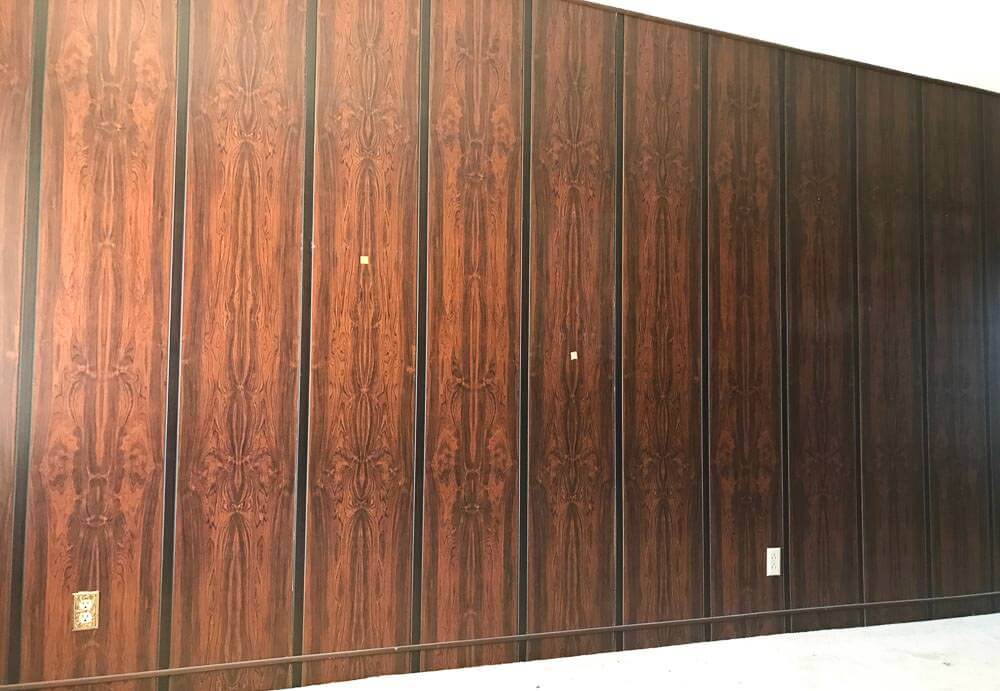
 Many of us agree that Knotty (Pine) is Nice — but what about its flashier cousin, 1960s-1970s wood paneling that got kinda … designy? Elisabeth is new to her 1968 house and her eyes are a bit in shock at her two-tone inlaid wall paneling. This sure must have been hip back in the day. She asks us: Should it stay or should it go?
 Elisabeth writes:
Hi,
I’ve just purchased a 1964 home. It is exciting but a bit overwhelming. There is a lot of paneling in the house. Looking at the May 1968 House and Garden magazine I can identify it as Georgia-Pacific Inlaid Paneling. I know it was marketed as the affordable option to real wood inlay work. It is not tongue and groove and it is not knotty pine. I am in a quandary as to whether to keep it. If it were real wood I would not have a question. I don’t mind trying to keep it with the intent of staying in keeping with the spirit of the times. However I would probably need some kind of confirmation that it is a good idea. My first instinct was “ugh, paneling”. I am new to this. Also the expense of remove and replace is weighing on me. Thanks for your time and any advice.
Best,
Elisabeth
Wow, Elisabeth, you are so ingenious to find that ad. Which wood is ‘yours’? Elm with walnut inlay? Pecan with walnut inlay? Cherry with walnut inlay? Or Walnut with pecan inlay? Surely a reader will know.
I have my own opinions, of course, but first, let’s hear from readers:
Should Elisabeth keep her circa-1970s paneling…
Or should she rip it out or paint over it?



Linda says
I think it is beautiful. Paneling can look fresh, by hanging modern art or black and white photography in light colored frames. Look for ideas on Pinterest. We kept the paneling in our dining room, it was quality wood. There was also some cheap plastic stuff in a bedroom we are removing. If you decide to remove it, try to do it gently and donate to a salvage store so it cAn find a new life.
BobinAlabama says
Elisabeth, keeping the paneling depends upon to what degree you want to restore the house to its original state. I bought a 1967 MCM house a year ago, and I’ve decided to keep the paneling. Painting it would be an inexpensive alternative, but then it would always look like painted paneling. If you want to “restore” the house, then keep the paneling and revel in the fact that your home will pay homage to an historical period that you have chosen to celebrate instead.
Sid says
I agree with Janet way up the line of comments on keeping one original wall as a nice accent and then paint over rest if you can’t handle darkness. Would retain some character and provide coziness.
Sandra L says
I would love to help you out and I love all the answers so far…but for one thing: I would need to know your furniture type (light wood, cottage pastels, etc…) plus your wall art ideas (large, ornate mirror, smattering of small picture frames, bright colored tropical art, etc….) before I could even begin to be honest. If it is all dark it is too oppressive to keep it all. However, with a light, airy feel to furniture and art then the back drop of darker paneling could look spectacular. If this is throughout every wall then I agree immediately with all other answers to paint it over with period colors on some of the walls to break it up. I live with all light colored paneling and while my neighbors can’t wait to tear it out I love mine. I have darker period and asian influence pieces and it looks gorgeous! I just tell people that if the Long Islanders can keep their old clapboard and panelled walls when they can afford anything then it is plenty fine enough for this retro girl!
Elisabeth says
yes there are a lot of variables. thank you. I might to do a gallery wall type idea somewhere because I have a lot of small and medium scale paintings. The few pieces of furniture I have are darker not light. I do like how you have described your contrasting wood elements.
Mike S. says
Our 1957 MCM ranch home was completely ORIGINAL when we bought it 15 years ago. With the exception of the bedrooms and (pink tile) bath, the entire living area was done in custom mahogany random-board paneling in a rich, medium brown. Hallways, kitchen, everything! Needless to say it was quite overwhelming and seemed too dark.
Funds being limited at the time, we only replaced the paneling in the kitchen and back hallway as part of a full, period-appropriate kitchen remodel. All these years later I’m so glad that was the extent of our changes. The look in the living room and entry is beautiful and unique.
One important exception I would take to other commenters’ advice is that light floor coverings are NOT the way to go here. You’ll end up with a room that is no ‘brighter’ but a heck of a lot more boring. Think about rich, saturated, strong colors for floor coverings that can stand up to the walls. This actually won’t make the room appear darker and will make the paneling seem much less oppressive in complement. We went with a true, medium red wall-to-wall in the paneled areas and the result is stunning.
Rick G says
I agree, red carpet is always a great look when paired with a paneled area.
Elisabeth says
Oh thank you. I will have to think about this because I was thinking of a lighter flooring option at first.
Julia says
Not every design choice in ANY era was necessarily a good one. If you don’t love it, then replace it with something else from the same era that you love. Good luck!!
Rick G says
I think you already know the answer, just by asking the question says that your not digging it. Paint is the easiest, fastest & cheapest option, either do a two tone ; or single & be extra sure to scuff / sand well to prepare; and prime – be sure to choose very 70’s colors, or at least late 60’s; if that it what your wanting ……… it will transform the gloomy look into something cool – go for it !!
Elisabeth says
no really I was so on the fence. But it is good to think I can see if we like it for a while and then if not it can be painted or handled somehow.
jazz says
My house was built in the 40’s. I bought it 3 years ago. I had this paneling in my living room. I ripped it out less than a month ago. I h**** [edited] it. Plus it was a little smelly. My room looks twice as big. If it was real wood i would’ve kept it. Love love love real wood paneling. This stuff not so much. I’m trying to keep as many vintage elements in my house as possible. Just not this.
Kara Vallow says
Keep
SusanG says
I admit that I haven’t read every single comment made, but for the first 20 or so that I did read, I keep seeing that if you can’t live with it, paint it or rip it out. My 2 cents, because I’ve been in the exact same position. First, I agree with comments that if it’s not “real” wood – but rather that cheap, flimsy faux stuff (which our living/dining/breakfast nook area was covered with) – do something with it.
If someone else stated this fix, I apologize for the duplicate answer. What about wallpaper? In particular, real grass cloth? Of course, you have to like the look of grass cloth. I had our den/dining rooms (not the breakfast nook) covered in a medium tone grass cloth (think Burt Cooper’s office in Mad Men) and it is stunning. I left in place and did not touch the original, dark-stained wood trim, baseboard, etc. It pops beautifully against the lighter tones of the grass cloth. It lends itself to a variety of deco schemes and has a timeless feel to it. There is not one single person that has entered our house and not make some remark about how cool our walls are in those 2 rooms. It’s not a cheap fix, but probably cheaper than tearing out paneling and repairing or replacing sheetrock.
Elisabeth says
thanks, I will really keep that idea in mind.