

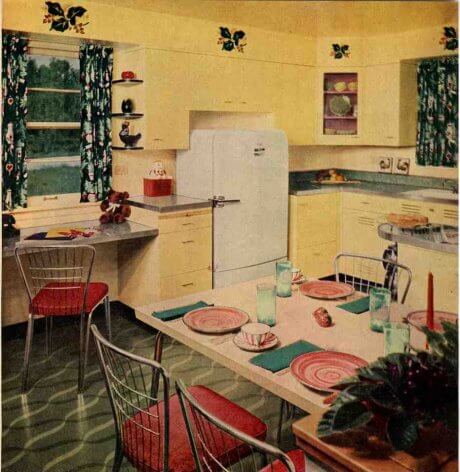
I AM AN ADVOCATE OF KITCHEN SOFFITS, or as some readers call them, bulkheads. The postwar era was all about the introduction and spread of “fitted” kitchens. Long runs of base and wall cabinets and countertops, with an integrated stove and sink and fridge. This “scientific” design was an outgrowth of the efficiency movement earlier in the century, married to the postwar industrial economy that needed to find consumer outlets for the built-up wartime production. To me, while they are an additional hassle and expense if you are renovating, soffits are a no-brainer for a 1940s, 1950s or 1960s kitchen.
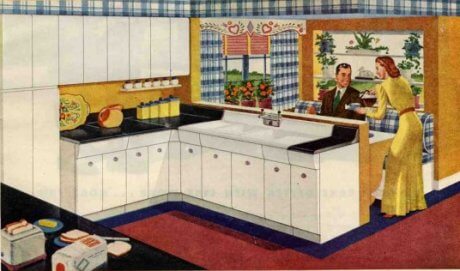
Soffits aren’t only authentic retro, they: (1) keep the tops of your wall cabinets from getting filthy, (2) are the perfect spot for vintage wallpaper, and (3) can hold and hide wiring. One of the other great benefits of soffits is that you can use them to deal with a variety of design challenges.
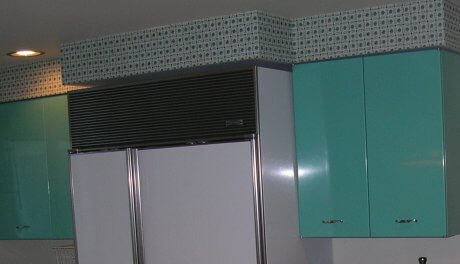
In my kitchen, I made the refrigerator look “fitted” by bringing the soffit out 24” to meet its profile (whereas the adjacent wall cabinets are only 12-13” deep. I can also mention here that I specifically chose my wicked expensive Sub-Zero refrigerator because it is 24” deep (fitted) and 84” tall – the exact height of the wall cabinets. Yes, it cost a bundle. To pay for it, I chose to wait four years to get the new car that I needed, and ran my beloved Taurus right into the ground, yes indeedy. This is a great refrigerator for a retro renovation kitchen.
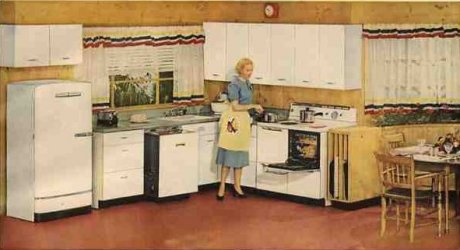 Back to soffits, you also want to continue running your soffit over windows and especially that one over the sink. That one: You can either keep the horizontal line or notch the soffit up. Like an arch, but keep it squared off. Put one-to-three can lights underneath.
Note, though, that I do NOT like those soffits that come out 24” over the sink or base cabinets. I had those in my last kitchen, I really thought they made the place feel smaller. I do understand how tucking can lights into the extended space can be beneficial. Even so, I am not a fan. (See below about ‘building in’ features like fridges with extended soffits, that’s okay.)
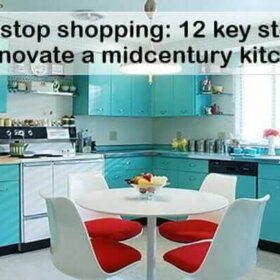
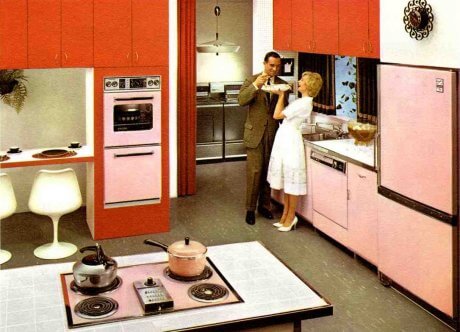 If you have soffits in your kitchen, you also can then use the same idea to fix other design issues. In this image, a 1961 Hotpoint kitchen, the wall framing the refrigerator is like a soffit and gives it that “built in feel” so important to this design.
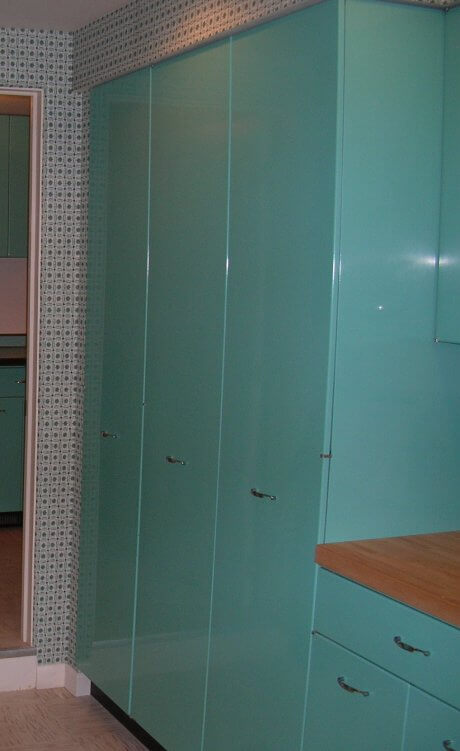
Another example: To get my three pantry cabinets to fit just right, I had about 3 inches of vertical wall space remaining (far left of photo). So, we made a vertical “soffit,” which I also wallpapered. Interestingly, a lot of people say these three pantry cabinets and the way that they are built in are what really “make” the kitchen. Another a-symmetry thing, too: Three, much better than four.
Hope all this is clear. The point: Frame things in finished drywall – whether above in a soffit or to the side like a wall – and they look “fitted.”




J. Bailey says
Non-soffit = utilize the space for my baskets, oversized dough bowls and art pottery … Wonderful way to bring my less-than-artsy kitchen from its utilitarian ambience into a kinder, gentler space :O)
Alex M says
I’m having a hard time wrapping my *head* around these *bulkheads*, as our cabs go all the way to the ceiling.
So, in the old days, the cabinets were shorter? Like, we have three shelves. We’d have to lose an entire shelf to have the soffit/bulkhead. I get that shorter cabs are easier to reach, but on the whole having the soffit seems the *more* inefficient use of space.
pam kueber says
I tend to believe that once kitchens became modularized, wall cabinets standardized to 30″ in height (as I recall). Hence: soffits / bulkheads.
linoleummy says
Hmm…soffits…wallpapered…ideas forming for my kitchen’s dropped ceiling. With the whole ceiling lower cooking smoke can escape and hang over the dining & living rooms instead! But not continuing a soffit over the doorways and maybe just having an open shelf to continue the line across would allow airflow and look nice.