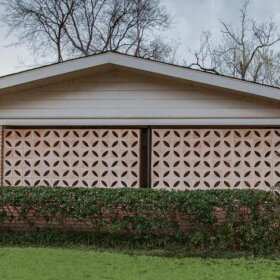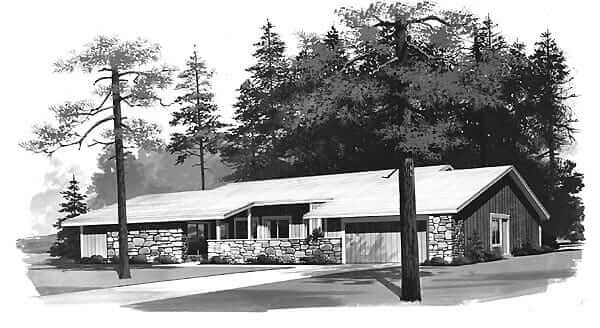
Is my house a ranch house? A colonial? A colonial-ranch? A year into the blog, I’m pretty sure in understanding that my own house is a mix…but this holiday week I’ve been doing more research into the true academic terminology, if there is such a thing. To start, here’s a story from the National Park Service that lays out how the ranch home developed, and which gives us the clues to telling whether our homes are truly ranches – or not. Some of my key takeaways:
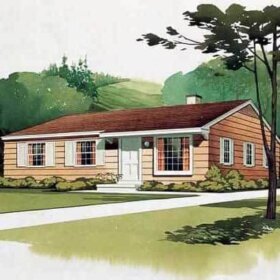
- A ranch is defined by its livability, flexibility, and unpretentiousness. It has a low sloping stance and roofline and is designed to bring the outside in.
- Yes, it has one story. But not all one-story houses are ranch homes.
- Ranch-style, ranch bungalow, ranchette, rambler, California colonial, and even ranch burger — all synonyms for “ranch.” I also know there are further sub-categories: Such as ‘Cinderella ranch’ aka ‘Storybook ranch.’
One last point: I still would like to see the actual data proving that ranch homes were the dominant style throughout the 50s. I think that cape/colonial homes may truly have been their match – especially when you consider that many of these homes might be incorrectly called ranches just because they are on a single story.
Read on for a long story published by the National Park Service —->
Click for PDF:


Retro style house numbers, perfect for 40s 50s and 60s ranch, Cape and Colonial homes
The once and future ranch
5 retro mailboxes for a ranch house 
Hi Pam, thanks for these great articles. When I had my Ranch home evaluated for energy conservation the technition also mentioned that Ranches are the most energy efficient because of their design. Fits in perfect with todays energy crisis and the need to conserve. Lets hope more and more people come to appreciate these humble yet fun homes.
JohnQ
Pam, Thanks for this as it is something I have pondered about my 1946 house since buying it 6 years ago. The realtor had it listed as a ranch and I said, NO, this is not a ranch — this is a cape. She said NO, it doesn’t have steep enough roof. Since then I have been frustrated not knowing how to label or describe my house. I finally settled on “cottage” or maybe “modified cape”, but recently a friend who loves capes and grew up in one told me “it is a cape, not even a modified one.” And, in reading this article, it seems that my house has almost none of the characteristics of a ranch other than being on one level. So, I now feel sure my house can safely be called a cape — and, I have amunition for anyone who dares to say it is a ranch just because it is on one level.
Elizabeth
Elizabeth Mary, I would love to see a photo of your house! Send it to me – pam @ retrorenovation dot com.
Also, I also found it interesting that at the end of this year-2000 article, the author notes that: “the current retrospective interest in design, music, and fashion of the 1950s and 1960s has approached the ranch house primarily with apprehension, if at all. Perhaps for now it’s just too ordinary and common.” Nine years later – interest for ranches is back – and growing!
Pam,
Great topic and article! Interesting that Bricker left out the influence that Japanese architecture had on the American, (particularly Western) Ranch style. In our area of Northern California you’ll see many ranches with asian roof details and exposed rafter tails, and along with them Japanese gardens and courtyards. The concept of movable walls, sliding panels, and lantern-like pendant lighting also are very “Eastern” in their origins and are very common here. You and your readers have also noted the popularity of oriental motifs as well in the decorating of homes in the fifties and sixties.
Also, like the sea of existing Arts & Crafts bungalows, there seems to be a hybrid and historically inspired architectural variation for every taste in ranches. You can find the Spanish “Rancheros”, the “Storybook Ranches” (my favorite) that have tremendous similarities to the 1920′s & 30′s Storybook cottages they built all over Los Angeles and the SF Bay Area, the “Prairie Style” with wide sweeping hip roofs ala Frank Lloyd Wright, the “Cape Style” which has been ubiquitous in America since the style was born in Colonial America, the split-level along with the Cliff May’s. the Eichler’s, the Streng’s and countless others that were more streamlined and “Modern”. Of course, what we see the most in this country are hybrids of all of these.
With each of the architectural “revivals” that we’ve seen just in the last 40 years, (Victorian, then Arts & Crafts, then 1920′s styles and now predominantly 1950′s and 1960′s styles) there is an initial categorizing and identification of the most iconic examples first, then it inevitably filters down to the more regional styles and eventually the myriad of wonderful and unique permutations by individual architects and builders who weren’t designing for tracts of homes, but rather creating one-of-a-kind houses that wouldn’t fit neatly into any specific category. These to me are the real “jewels” and the ones usually most endangered and most often remodelled to look more like the stereotypical icons in all the books and magazines.
Hopefully Pam your readers will all appreciate the inspiration that spawned their homes design, even if it wouldn’t make the cover of Dwell or Architectual Digest, and even if its just a family-friendly honestly-built more common “ranch”.
Embrace your homes style!! Viva la difference!!
Paperboy aka Steve – great comment. I will use it in full as a post sometime soon! It is SO very interesting to follow the resurgent trajectory of interest in midcentury homes that you describe!
Pam,
Where were you in my High School and College years??!! OH THOSE FOOTNOTES!!
Robert
PS: How many of you were told to have “x” amount of footnotes and didn’t meet that quote so you just made them up! LOL. Not me by any means. Uh Huh.
If you’re interested in the history and design of Cliff May’s ranch houses, we’re posting our research and discoveries in our personal blog at mavb.us. Currently we’re working on his formative years in San Diego during the 1930s–it gets a lot more complicated after WWII! I think Pam is right that the Cape Cod/Colonial style was as popular, if not more popular, than ranch houses–but identifying a particular style for the zillions of small “minimum” houses built post-war is very difficult since they’re so simple (Levittown billed their houses as ranches, but if you look at them, it’s not so obvious). Keeps our work interesting!
Is there any site online that you have located that distinguishes specifically a regular ranch from ranch-colonial from a Ranchette (love it–maybe that is what my “mini-ranch” really is) etc? We went walking in our neighborhood Sunday and crossed over to the side of our street beside one of the neighborhood parks (one block over). All the houses on that block had much more brick (our street is more brick veneer/low long planters/siding), shutters and windows with 12 small panes, while our street has more windows with 4 long rectangular panes in many homes. And the homes on our block seem coated in windows! Our block looks more spartan, the other more WASP-y Conservative and “rich”.
My uncle reflected on this same feeling when he grew up in this same neighborhood in Memphis in the 50′s-60′s. He felt that his house was more modern and weird due to having a sunken living room and being situated on a flat lot. The across the street neighbors had the more Colonial-looking homes situated on a small hill.
Kristin – this is something I intend to work on in 2009! Read paperboy’s comment above – I think he hit the nail on the head when he says…there were big trends… but then these got sliced and diced by builders and architects regionally, locally and as you point out, even street to street! It’s a big yummy Ranch and Cape Cod stew!
It is very funny how this neighborhood differs block to block! This block has 2 versions of the very same house–mine and an across the street neighbors who is 3 houses to the East. I should do a survey once it gets a bit warmer to see how many are of the same plan.
One interesting point: The across the street neighbor and her husband bought their home new. The only difference is our backyard is twice the depth because we back up to an alley and a vintage 50′s strip mall (yes, they play this up and it is fab) and she is on a slightly more elevated lot. The price of her home brand new in 1953? 11K!!!!!!!
Elizabeth Mary mentioned cape cod.
From http://www.hgtvpro.com it states “A first floor placed close to grade, with no overhangs at the roof and eaves.” So if you have overhangs or not, that might be helpful to you.
http://74.125.95.132/search?q=cache:F9jHOibs9osJ:www.hgtvpro.com/hpro/di_design_trends/article/0,,HPRO_20174_5384502,00.html+cape+cod+overhangs&hl=en&ct=clnk&cd=1&gl=us
I understand this blog heading had “Ranch Homes” in the title.
I do feel that to me Retro is most anything built circa 1940’s to 1970’s. More so 50′s and 60′s. So for me, Cape Cod fits into that category if built in that era as it will have many facets of that era in the style and items in it such as sinks, bath tubs etc.
In all honesty, why can’t a two story built in that ere not have some retro characteristics?
Robert,
Thanks for the comment. I did see that in the article and my house has no overhangs of any kind anyplace, and the first floor is above grade. The lack of both are some of the reasons I did not think it was a ranch. But, Pam has seen a picture and came up with the notion that it might be CapeCod Ranch, which I think is a brilliant idea and how I think I will now describe it when asked.
Inside is also a mix of Cape and ranch elements. The living room and dining room have what I think of classic traditional features — fireplace, built-in bookshelves in living room and corner cupboard in dining room — which is sort of open to the living room, a ranch element. Bath and kitchen were totally original when I bought the house, and totally not good retro. So, I have redone the bath, in more of a 20′s style, which was probably a no-no, but before I found this site and got into the retro POV. Kitchen has some original elements and some new re-do’s, which I have tried to keep to period. It does still have the 1967 GE 40″ range (which I love and hope continues to function as long as I am here) and the porcelain sink with drainboard and metal cabinet underneath. Cabinets are original but the countertops are new boomerang formica and metal edging from Dave Sanders — compliments of this site.
Elizabeth Mary
Elizabeth Mary
Sounds like your enjoying your home. Keep up the enjoyment.
Robert
Hi,
I found this wonderful site of yours at the same time that my husband and I have found a 1965 custom ranch to purchase that is definately in a time capsule, to our delight!
We are in the purchase process now and will certainly be back for ideas and information in our restoration process.
Jean
Welcome, Jean. Take lots and lots of photos so we can see your time capsule! And come back soon!
One of the things about classifying style is that there is no “true way.” The vast majority of American homes are eclectic in nature and draw on many different traditions. Mid century home styles have yet to be defined and categorized. One that is consistently overlooked is the streamlined Minimal Traditional that was derived from the Colonial Revival style and bungalow type. It showed up in the late 20s and was built well into the 50s, but because of its simplicity and affordability, it has never been considered anything but Plain Jane Vanilla.
To my knowledge there has not been any systematic survey of what types of homes were built and in what numbers from 1900 to 1960. Based on the preponderance of documentation I have seen researching thousands of popular publications, Colonial Revivals and its subtypes have consistently held the lead by a modest margin.
Modern styles including Craftsman-style bungalows, Ranch, and most period contemporaries ran a close second to the American tendency to go for the familiar, traditional, and more conservative types. The popularity of the bungalow as we typically think of it ran for a scant 20 years. By the 1930s, people were shaving the eaves off their homes to make them look like the more modern Minimal Traditional (which sounds like what Elizabeth Mary has).
I love Ranches in all their iterations but by the mid-50s split and tri-levels were superceding them in many areas. It might be splitting hairs, but I like to make the distinction.
Rikki
Rikki, we are in agreement here. Clearly, mid century homes were often a mish mash of styles (just like today). There were hundreds if not thousands of developers and design-catalog companies all pouring out architectural plans. I tend to think that is were possible to count and classify “which style” was most common between 1946-1966, it would be a pretty basic box. Kind of colonial/cape-revival, but with a lower roofline and more open inside, like a ranch. I posted these three stories in a row to begin to show some of the differences…precedents… and will do more in the future, to be sure, as this utterly fascinates me. Thanks for your comment!
Great information, Pam!
I recently bought a book that shows floor plans of Cliff May’s designs. Nice, rambling ranches with lots of glass!
Yes, sablemable, a very interesting topic indeed! It’s all I read about nowadays!
Are you implying that we’re obsessed, Pam?
Stated coyly by sablemable
no, sablemable, only that i am
I live in one of those Cliff May homes. nice article
I understand that Cliff May never studied architecture, but did he design some wonderful homes!
Joe, is the home pretty much original, or had former owners make changes?
sablemable, click on Joe’s name in his comment post and it’ll take you to his website, then on to flickr page with photos of his reno!
I AM AN OWNER OF A CENTRAL TEXAS RANCH-STYLE HOME THAT WAS INHERITED TO MY LATE HUSBAND. THIS HOME WAS BEING PLANNED OUT IN 1952 AND WAS COMPLETED IN 1954. I AM IN THE PROCESS OF A LITTLE REMODELING. MY HOME IS ABOUT 2,400 SQUARE FEET.
Great article, I happen to have a Donald Scholz designed California Contemporary in Kettering, Ohio. Here is a picture.
http://www.flickr.com/photos/scholzmcm/3311602303/
Ryan
Welcome, Ryan. Your house is fantastic inside and out. Readers will love your landscaping…the courtyard…wow!
Very good article on the history of the ranch house. The article mentions Donald Scholz Homes based out of Toledo,Ohio. I have been a fan of Scholz’s low-slung 1950s ranchers for years. My wife and I almost bought one in Bay Village Ohio about 15 years ago, but settled for a (larger) mid-century Rocky River colonial instead (and now we’re in Chicago). Any way, I have fond memories of that Scholz ranch that got away.
Did you know that there are entire neighborhoods of 1950s Scholz ranches in Ohio? In Toledo (Scholz’s home turf), there is the Lincolnshire area just west of the 1950s-era Westgate Village shopping area. One of the Lincolnshire ranches was featured in a 1950s American Home article: “Pretty Pink Ranch”. In the Cleveland area, there is the neighborhood south of Lake Road and east of Clague Road in Bay Village. The Bay Village neighborhood was built on the site of a former golf course, with a meandering creek and ravines, all the better to show off the models with the walkout basements. Curiously, the Bay Village neighborhood shares street names with the Scholz neighborhood in Toledo (Lincolnshire, Queenswood, Edinborough, etc.). Apparently Mr. Scholz was fond of the “Olde English”-sounding names, although the street names hardly suggest the rambling contemporary houses lining them.
Also in the Cleveland area, there is the Scholz neighborhood north of Hilliard Boulevard and south of the Westwod Country Club in Rocky River (as an aside, Hilliard Boulevard in Rocky River is a gently curving street of broad lawns and mid-century ranches- a real gem from the 1950s). Finally, on the east side of Cleveland, in Cleveland Heights, there is the Forest Hills neighborhood with quite a few Scholz ranches- the Forest Hills Homeowners Association even has a website with a page or two dedicated to the Scholz legacy.
I’m now living in the Chicago area. Plenty of good mid-century residential design- but still looking for a Scholz home in the area…any idea if Scholz built in Chicagoland?
Very late reply to James (I just found this page):
Yes, Scholtz built houses around Chicago. Mine is in West Chicago (about 45 minutes west of Chicago) and I think there’s at least another toward DesPlaines or Arlington Heights, which was used as a model for prospective buyers.
Actually I just discovered that there’s interest in Scholtz homes… I did not think anyone knew about them.
If you are near West Chicago, you are welcome to see our “time capsule”.
Welcome, Catherine. In my old magazines from back in the day, I see lots of mentions of Scholtz homes. I think they must have had good PR! I’ll watch for you and maybe do a future post with more photos, info…
In regards to Scholz Homes based out of Toledo, Ohio: My father worked for Scholz Homes as an architectural draftsman in the mid 60′s and 70′s. I have his original rendering /elevation booklets of “The Farmington”, “The New Englander”, “The Briarwood” and the The Early American” dating from the mid 60′s. I also have the Scholz “Custom Collection” copyright date 1977. The Custom Collection features 26 Scholz designs with exterior & interior photos of actual built homes – very retro! Very cool!
What great information – thank you for sharing! I have a Scholz-designed home in Natchez, Mississippi that was built in 1964. I have photos on Flickr: http://www.flickr.com/photos/cheetorocks/
Beautiful!
Wow… this is a much larger model than mine… and beautifully updated! I hope you get a good buyer who appreciates MCM!