

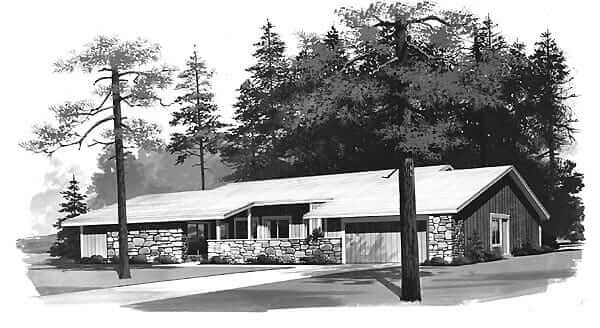
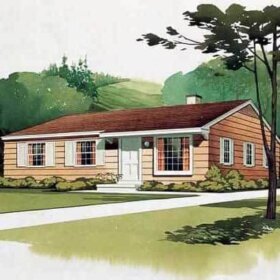
Is my house a ranch house? A colonial? A colonial-ranch? A year into the blog, I’m pretty sure in understanding that my own house is a mix…but this holiday week I’ve been doing more research into the true academic terminology, if there is such a thing. To start, here’s a story from the National Park Service that lays out how the ranch home developed, and which gives us the clues to telling whether our homes are truly ranches – or not. Some of my key takeaways:
- A ranch is defined by its livability, flexibility, and unpretentiousness. It has a low sloping stance and roofline and is designed to bring the outside in.
- Yes, it has one story. But not all one-story houses are ranch homes.
- Ranch-style, ranch bungalow, ranchette, rambler, California colonial, and even ranch burger — all synonyms for “ranch.” I also know there are further sub-categories: Such as ‘Cinderella ranch’ aka ‘Storybook ranch.’
One last point: I still would like to see the actual data proving that ranch homes were the dominant style throughout the 50s. I think that cape/colonial homes may truly have been their match – especially when you consider that many of these homes might be incorrectly called ranches just because they are on a single story.
Update, alas, link now gone:
Ranch Houses Are Not All the Same
David Bricker
Architectural Historian
California Department of Transportation
San Bernardino, California


Ryan says
Great article, I happen to have a Donald Scholz designed California Contemporary in Kettering, Ohio. Here is a picture.
http://www.flickr.com/photos/scholzmcm/3311602303/
Ryan
pam kueber says
Welcome, Ryan. Your house is fantastic inside and out. Readers will love your landscaping…the courtyard…wow!
LINDA GARNER-BETAK says
I AM AN OWNER OF A CENTRAL TEXAS RANCH-STYLE HOME THAT WAS INHERITED TO MY LATE HUSBAND. THIS HOME WAS BEING PLANNED OUT IN 1952 AND WAS COMPLETED IN 1954. I AM IN THE PROCESS OF A LITTLE REMODELING. MY HOME IS ABOUT 2,400 SQUARE FEET.
Tikimama says
sablemable, click on Joe’s name in his comment post and it’ll take you to his website, then on to flickr page with photos of his reno!
sablemable says
I understand that Cliff May never studied architecture, but did he design some wonderful homes!
Joe, is the home pretty much original, or had former owners make changes?
Joe says
I live in one of those Cliff May homes. nice article
sablemable says
Are you implying that we’re obsessed, Pam?
Stated coyly by sablemable
Pam Kueber says
no, sablemable, only that i am
sablemable says
Great information, Pam!
I recently bought a book that shows floor plans of Cliff May’s designs. Nice, rambling ranches with lots of glass!
Pam Kueber says
Yes, sablemable, a very interesting topic indeed! It’s all I read about nowadays!
Rikki says
One of the things about classifying style is that there is no “true way.” The vast majority of American homes are eclectic in nature and draw on many different traditions. Mid century home styles have yet to be defined and categorized. One that is consistently overlooked is the streamlined Minimal Traditional that was derived from the Colonial Revival style and bungalow type. It showed up in the late 20s and was built well into the 50s, but because of its simplicity and affordability, it has never been considered anything but Plain Jane Vanilla.
To my knowledge there has not been any systematic survey of what types of homes were built and in what numbers from 1900 to 1960. Based on the preponderance of documentation I have seen researching thousands of popular publications, Colonial Revivals and its subtypes have consistently held the lead by a modest margin.
Modern styles including Craftsman-style bungalows, Ranch, and most period contemporaries ran a close second to the American tendency to go for the familiar, traditional, and more conservative types. The popularity of the bungalow as we typically think of it ran for a scant 20 years. By the 1930s, people were shaving the eaves off their homes to make them look like the more modern Minimal Traditional (which sounds like what Elizabeth Mary has).
I love Ranches in all their iterations but by the mid-50s split and tri-levels were superceding them in many areas. It might be splitting hairs, but I like to make the distinction.
Rikki
Mid Mod Pam says
Rikki, we are in agreement here. Clearly, mid century homes were often a mish mash of styles (just like today). There were hundreds if not thousands of developers and design-catalog companies all pouring out architectural plans. I tend to think that is were possible to count and classify “which style” was most common between 1946-1966, it would be a pretty basic box. Kind of colonial/cape-revival, but with a lower roofline and more open inside, like a ranch. I posted these three stories in a row to begin to show some of the differences…precedents… and will do more in the future, to be sure, as this utterly fascinates me. Thanks for your comment!
Jean says
Hi,
I found this wonderful site of yours at the same time that my husband and I have found a 1965 custom ranch to purchase that is definately in a time capsule, to our delight!
We are in the purchase process now and will certainly be back for ideas and information in our restoration process.
Jean
Mid Mod Pam says
Welcome, Jean. Take lots and lots of photos so we can see your time capsule! And come back soon!
Robert says
Elizabeth Mary
Sounds like your enjoying your home. Keep up the enjoyment. 🙂
Robert