

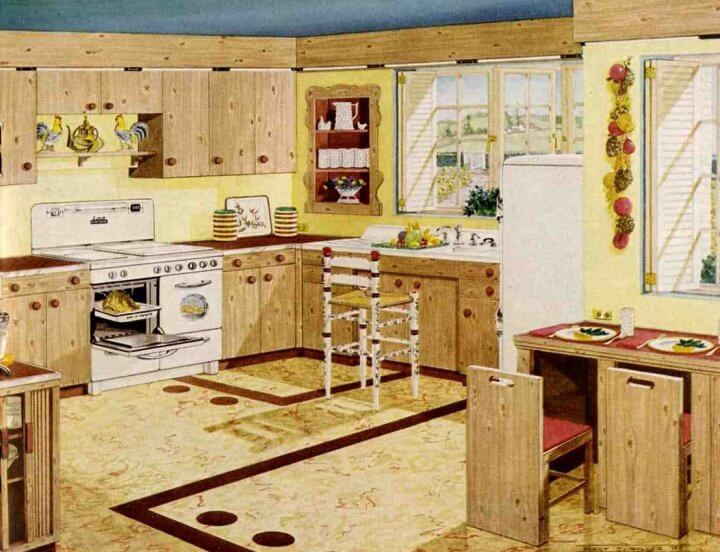
I LOVE KNOTTY PINE KITCHENS. They were very popular in the postwar era — they fit with our interest in both western ranch and early American interiors… they were were affordable… and the material was available.
In fact, in researching this post I read a 2001 story from the New York Times that said knotty pine has its fans again today – and also appeals to fans of the Scandinavian tradition.
And of course — Betty Draper’s kitchen on Mad Men is knotty pine!
As far as I can find, there are not too many mainstream cabinet companies making knotty pine cabinets today. Luckily, one company that does is: Cabico. They are a large Canadian company, and I had a positive experience with their product when I retro renovated by bathrooms a few years ago.
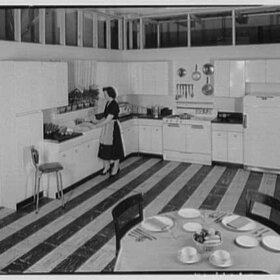
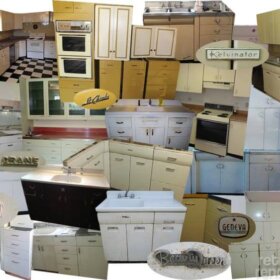
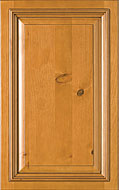 Their knotty pine – honey finish – is shown in the first door.. This honey colored finish looks pretty good, I believe, for a retro renovation knotty pine kitchen. But something even more amber/orange could be even better. Note the image above — a 1952 Formica ad — for one reference for door styles.
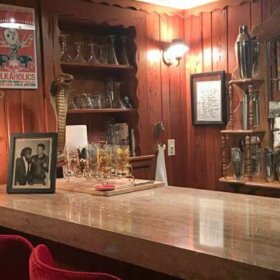
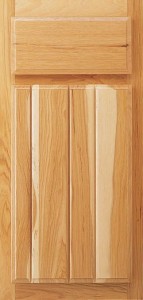 I’d also recommend a planked door like this traditional (3/4) overlay design from Dynasty/Omega. Reference only, I do not believe that Dynasty/Omega offers knotty pine. Cabico also says that they can make a full-overlay plank door.
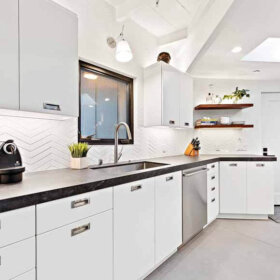
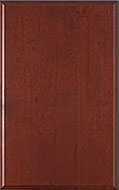 My concern about a slab style like the third door (also a reference from Dynasty/Omega), is that pine might split from expansion/contraction as it is a pretty soft wood.
Best, if you are truly interested in pursuing this look, to consult with a cabinetry professional.
Final note: I recently saw “knotty cherry” cabinets at the Eugene Home Show. They were really nice looking — definitely had the knotty-pine groove going on — and cherry is a harder wood, an even better material for cabinets.
This post has been updated from the original, which ran Dec. 26, 2007.



Jeanne says
I’ll have to send you some pictures. We have a knotty pine upstairs master bedroom and a knotty pine basement. The upstairs has built-in drawers with the black wrought iron draw pulls and the closet has black wrought iron hinges. I need to clean before I can photograph. lol
samohon says
We live in a house built in the 1950’s and we have the knotty pine kitchen and dining room walls. While I would love to change it and update my kitchen my husband refuses and keeps saying it’s worth a lot of money, etc. etc. We also have the matching brown appliances, the double wall oven, stovetop and dishwasher. We did update the flooring because of Hurricane Katrina and the water damage from the refrigerator after we left. I have to say I’m torn between keeping it the “old” way or updating because it’s so dark in there.
50sPam says
I understand completely.
Femme1 says
I’m afraid that I’ve been scarred as a child of the 50s and 60s and cannot fully embrace the love of knotty pine. I must have been overexposed.
50sPam says
Thanks, Peggy, for that info. I hear what you’re saying about slab doors. What do you think about planked doors in pine (ala my post about Omega’s)?
pderas says
A little technical information about knotty pine cabinet doors:
No cabinet maker or manufacturer would accede to your request for knotty pine slab doors.
Pine “grows” and “shrinks” a lot, depending upon the amount of moisture in the environment. So slab doors in pine would crack and break themselves apart in a few years in a kitchen. That would happen even with sturdy bracing across the backs of the doors.
What you are seeing, in that illustration of the knotty pine kitchen at the top of this post, is knotty pine veneer doors. The only way to make solid wood pine doors that will last is to make what they call a “five part door” (a frame around a floating center panel). Even those tend to dry out and crack over time, but they’ll hold up far better than a slab door would. The knots also tend to fall out as they shrink.
Some woods are just not all that conducive to being made into cabinets. Pine is on the borderline.
Enjoy your blog.
Peggy
50sPam says
–>Sumac Sue aka Judi: Yes, I agree that the colonial style knotty pine kitchens are really nice, too. Certainly, they are more typical — in a way, that’s why I liked this photo, it is opposite of what you’d expect. Knotty pine imitating steel. I will do more posts on the more classic design in the future. For sure, you would need the planked door style, and I recall that a knotty pine valance, carved/curved, is really essential, too. I also agree with your regarding the photos, they are SO MUCH FUN to analyze. People were so much into the details – I’d say even more so than today!
50sPam says
–>Sarakay, thanks for your comment! Your aunt’s kitchen sounds fabulous! There’s not a family photo somewhere, is there? I adore the idea of the matching range and yes, in a colonial knotty pine kitchen, the hardware most certainly would have been wrought iron. So cool!
Sumac Sue says
I love the look of those knotty pine cabinets, but I would want more colonial style. The recessed cubby and that chair by the sink are about the only colonial touches in this kitchen. Wait, I see some shutters too. (These pictures are so fun to examine.) Look at those mod chairs that fit under the bar, made to look like cabinet doors! This is that blend of modern and colonial that 50sPam has talked about before.
Such blends don’t always work so well. My husband got sick of knotty pine as a kid, when his dad modernized their 1910-era house by paneling several rooms in knotty pine, and putting in dropped acoustical ceilings. But he left the Victorian-style woodwork, painted bright white. Quite a combination.
sarakay says
Love the knotty pine! It reminds me of my aunt’s kitchen. She had wrought iron hardware on the cabinets, and a RED range that matched the countertops.