

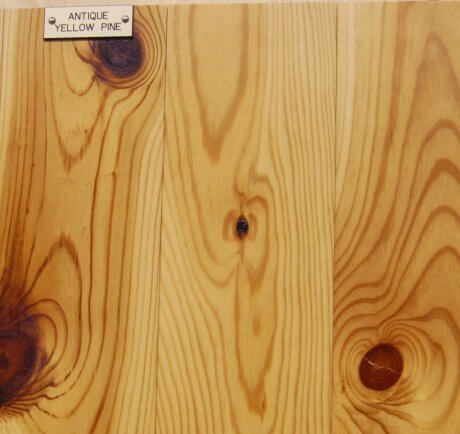
 When I originally discussed using knotty pine in kitchens, there were comments expressing concern about the wood’s appropriateness in the relatively humid kitchen environment. When I was at the Southern Spring Home & Garden Show last week, I ran into this company, Union Church Millworks of Covington, Virginia. They had some really gorgeous woods on display including “vintage knotty pine,” so I asked Kim Bennett Powers, the sales and consulting manager on hand, the knotty knotty pine question.
His response, which was very illuminating: In the 1950s, we grew our pine trees bigger… the centers got very hard as the tree aged, and we were able to use this center — it was called “heart pine” — for cabinets and other applications where we wanted hard, dense wood. It still looked knotty. Today, we do not grow our pine trees as big, so the wood never never gets as hard. So, much of the 1950s knotty pine really is a particular sub-category called heart pine. Kim says that Union Church Millworks can still get you vintage heart pine for cabinets or panelling or even floors — it’s reclaimed from demolitions and the like. But it costs something like $12 a s.f. vs. $3/s.f. for plain old knotty pine. While we didn’t have a belaboured discussion about it, Kim thought that even considering the differences then vs. now, today’s knotty pine should do fine in a kitchen. That said, there are other wood species that have a knotty look but which are naturally harder.
One more thing: Woah, the woods they had on display for floors, paneling and cabinetry: Gorgeous!


Vanessa says
Good explanation, I wasn’t sure why it was so different from the new stuff. We have some of the vintage knotty pine my husband’s grandfather had salvaged from a remodel many years ago, it was sitting stacked in his back room till we brought it home to use in our house. It’s perfectly flat and great to work with, no warping or anything. DH is milling it and using it for all the trim around the windows and doors in an addition we are putting on our craftsman style 1915 home.
karen woolery says
i have a house built in 1949 i also have knotty pine in kitchen and one wall in the livingroom where the fireplace is with a bookcase also all the storage closets in whole house are knotty pine only thing i dont like is not very much space from cabinet to counters other than that i really like it i just cant figure out what color to paint 3 remaining walls in livingroom i dont like white also have hardwood flooring
pam kueber says
I think that a great color to go with knotty pine is: green. Kind of a 1940s green.
karen woolery says
i was thinking more of a very light tan
Amy Jeannette says
In defense of the soft green, my kitchen has exactly that. And the only thing Im going to do at this time is clean it, and brighten the upper (white) portion above the (decorative) plate rail. Benjamin Moore has a wonderful shade of green called wasabi. Of course they also have a winning “flax” shade I have also used. I’m just wondering if the tan would compete with the wood color?
Michelle Dawson says
We moved into our 1950’s cape this past summer. The kitchen is awfully small and has knotty pine cabinets…believe it or not I was going to tear them down and put up steel cabinets just havent found a set in my price range. However, reading through the blogs I realized that “knotty pine” could be retro as well so we are keeping the cabinets! I am tossed about color (walls no cabinets)…it is a small kitchen so the color cant be one that makes the kitchen look smaller. I scored a 1950’s refrigerator and stove that I will be incorporating in the space but REALLY need help on chosing the right 50’s color. PLEASE HELP!!
Thanks!
Connie Manoliu says
We have a 1956 ranch and used re-milled 125 year old heart pine flooring when we remodeled our kitchen and family room two years ago. Vintage pine is not soft at all. Our has a polyurethane finish, is easy to maintain and looks beautiful with our original real wood paneling in the family room.
By the way, I also have a pink bathroom!
pam kueber says
Thanks for this feedback, Connie — good to hear!
gabby says
Glad to hear more fans of knotty pine kitchens. Many of the ‘retro’ folks online disparage pine and feel they are better with exotic woods. NOT period at all.
I’m on my second knotty pine kitchen and love them. Our house was built in 1960, and there are no issues with dents, splitting, sticky drawers, etc. I grew to like the “Mr. Ed” look with the black or copper hammered hinges and hardware.
The best part of the knotty pine is the easy upkeep! In my last house, I would just scrub and add a new layer of Amber shellac every couple of years or so. Here, we scorched the counter using a table top electric griddle for several hours ( lefse marathon), but only had to sand, re-shellac, and presto, no color matching required. Within weeks, shellac will reach the original patina, and no one need be the wiser.
Glad to know the difference between knotty pine/heart pine and what is commonly out there. Have to think about what this means for re-doing our old trailer kitchen.
pam kueber says
Hi Gabby, that’s great to hear!
MCMeg says
Our knotty pine kitchen is 51 years old. Recently I noticed the cabinet doors are splitting. We have a handyman who is going to repair them. I’m hoping it doesn’t continue.
Linda Blackmore says
My house is 62 years also. The attic was converted into a room and is knotty pine. My sisters houses were both knotty pin in the living and dining rooms. My walls are plaster–not sheetrock, but plaster. It is much like concrete, and my walls are very pretty, but they crack easily. I think(just an opinion) knotty pine was used so much was two-fold–people liked the look, and it was probably cheaper to install than plaster. Mine looks as good today as it did when it was installed. The knotty pine in my sisters houses looks as good as it always has, too.
ahenry72 says
We have knotty pine all over our 1952 home, including the kitchen, and the only place we’ve had a problem is over and around our fireplace. The heat from the chimney cases the wood to shrink and crack. Caulk will temporarily make it look better, but I’m afraid we will need to take the advice of our chimney sweep and put some drywall or concrete board in that area. Someone had painted over the knotty pine on the fireplace wall years ago anyway, so we wouldn’t be loosing any “woody-ness”.
I’ve noticed in real estate ads for older homes they often specify when “heart pine” is used, especially for flooring.
Kelly says
Aha! I had no idea! Very interesting information…
Carla says
This is actually something to think about when you buy ANY kind of wood furniture or flooring. Pine dents VERY, very easily. Its not just soft, its press-your-thumb-nail-against-it-a tiny-bit soft. A lot of “hardwood” furniture you buy today, that is still mass produced, is of this SUPER soft pine and it means hinges come loose easier from use, anything hitting or falling marks it. You can also buy it as real hardwood flooring, but again its a bit of a joke. You can’t put the chair down too hard or even wear stillettos on your floor without marking it. Its far cheaper and LOOKS nice to start, but you really do get what you pay for.
Tera says
The knotty pine in my grandmother’s home is 62 years old and has never warped. It has never been replaced and she always, even to this day, has all four burners going twice a day. Now I know why :>