

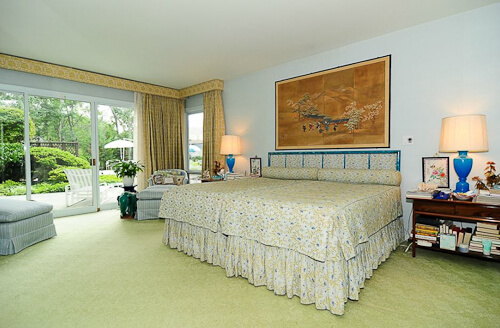
 The 1962 time capsule house with William Pahlmann interiors continues to enchant me. There have been some comments (on other blogs that picked up the story) that don’t agree — but to me, these Pahlmann rooms demonstrate how it’s possible to combine color, texture, fabric, furniture, accessories, lighting — combine it all — in a way that is extremely livable…and transcends any particular “trend” in taste. I’ve been under water, immersed, staring daily for hours at mid century decor in all its incarnations for nearly 10 years now, and these Palhmann interiors may be my favorite yet. Today, I want to walk through some of the photos again, to pull out some of the “lessons” from the best of the past that I believe they present.
.
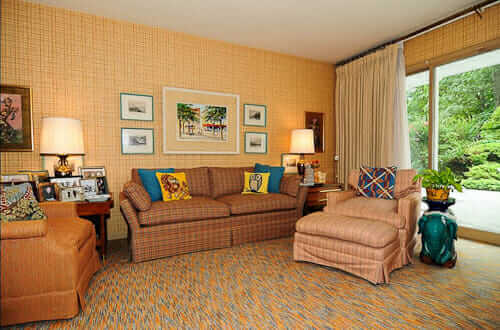 1. Yes, you can combine patterns successfully — To be sure, the den (above) combines patterns in a way that we are not accustomed to seeing today. This room, more than any other to me, demonstrates Pahlmann’s genius eye — because I think he pulls this mix off perfectly. There is both a complexity, and an ease, that is so pleasing. I don’t know that there is an exact formula for getting a pattern combo like this “just right” (rather than: “disaster”). It’s an alchemy of color, pattern and scale. For example, notice how the stripes on the ottoman and easy chair — aided by the blue elephant — pull your eye up into the seating area… my eye then keeps moving counter clockwise to take it all in.
.
2. Pick a dominant field color — and a complementary “punch” color — A key reason the “clashing” patterns work so well together is that the colors of the upholstery and wallpaper are closely related (so that’s one thing you do not have to visually harmonize). But, without the punctuation of the blue accent color — and also those bright yellow pillows — the effect might be too flat. The carpet looks to include both the primary and accent colors. And obviously, there is a motion, a dynamism, to the carpet pattern. Wow, do I adore the look of that carpet.
.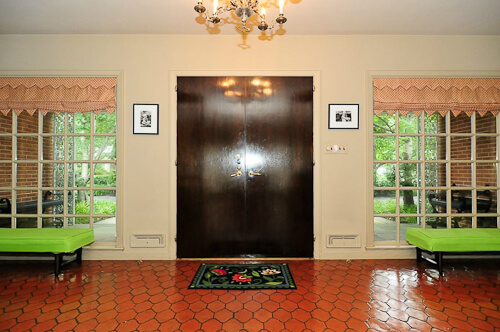
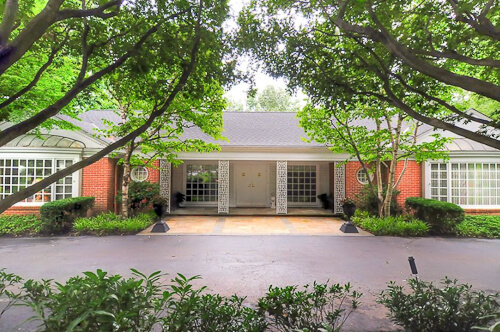 3. Get formal with symmetry — The front of the house is very symmetrical, so it makes total sense that the entry way repeats and reinforces that symmetry. Symmetry also makes for a more formal look, which I think is appropriate for an entry way — and for this house, which in reality is quite grand — six bedrooms in Montclair, New Jersey. That said, the lime green cushions and the whimsical window treatments tone the toniness down. I suspect that rug is not original. In fact, staring at all of the interior shots from the real estate listing, I suspect some of the original area rugs have been removed, along with some of the art work.
.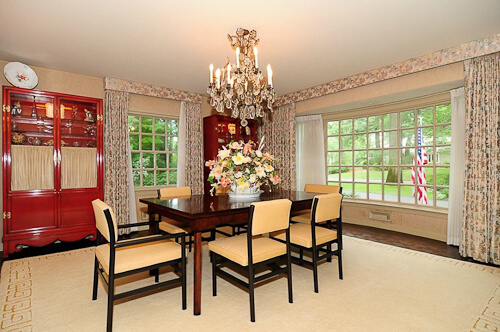 4. Love you some pinch pleats — The dining room is fundamentally formal, so again you see symmetrical lacquered china cabinets. The key message about this room today, though, is: The window treatments. Pinch pleats over sheers are The Official and Essential Midcentury Window Treatment. I also love the valance — which I consider an optional basic. Note how the sheers are bowed to hug the bow window; that’s the way it’s done; I believe there are — or were — traverse rods just for this situation. Finally, my mom says that through most of the 1950s, pinch pleats ended just above the window. In the 60s, decorators took them to the ceiling. I officially declare that either way is acceptable, with the note: Taking pinch pleats all the way to the ceiling can help the room feel taller. But I think it all depends. Oh, and in general: Bring those pinch pleats to the floor, but not touching. No puddling, but no high-waders, either.
.
5. Don’t dinkify your area rugs — Another thing I really like about the dining room is that the area rug — which I am sure must be a William Pahlmann original design — is Big. A dining room table and its chairs — even when pulled out — should sit fully on the rug beneath. To be off the rug is subconsciously or even consciously disconcerting — tippy.
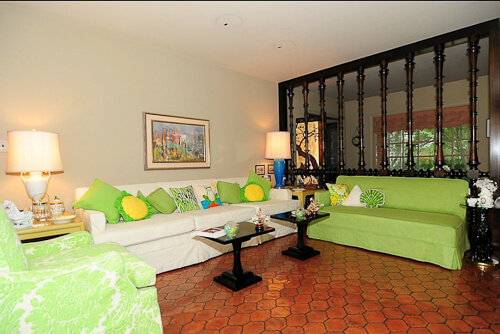 6. Sofas go long and low — I’ve been researching William Pahlmann online. One article said he had a rule that says: If ceilings are no higher than seven or eight feet, the sofa should not be any taller than 30″. To be sure, the midcentury look was long and low — in great part because ceilings were lower. Sounds like a reasonable rule of thumb to me.
.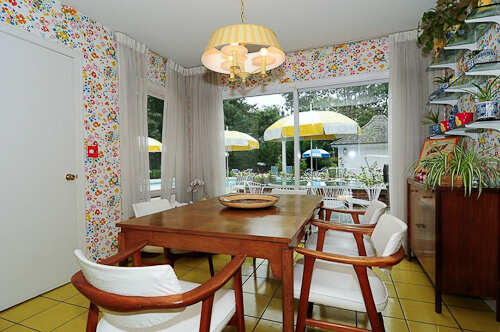 7. Harmonize your interior design with your outdoor views — Is it an accident that the yellow pendant light and tile in the kitchen match the yellow patio umbrellas visible from the kitchen window? I don’t think so. How absolutely pleasing this little touch is. My friend Margaret Roach, who has the wonderful essential blog A Way to Garden, often talks about designing your garden as a view from the window. “Look out the window if you want to make a garden,” she says in Gardening 101. If you have a midcentury home, you likely have some big windows. Work ’em.
.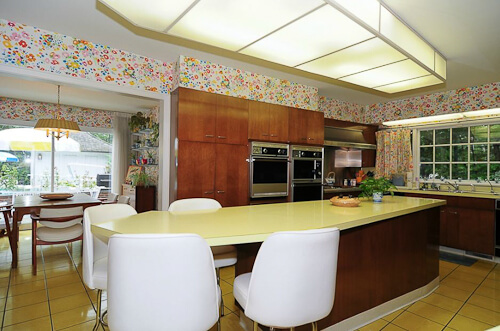 8. Love you some wallpaper — I know that wallpaper is scary. But you only live once. Stare down your fear, and give it a try. It might just make you ecstatically happy. Like in this kitchen. Oh and look how the kitchen curtain is matched to the wallpaper — that definitely is a designer touch.
.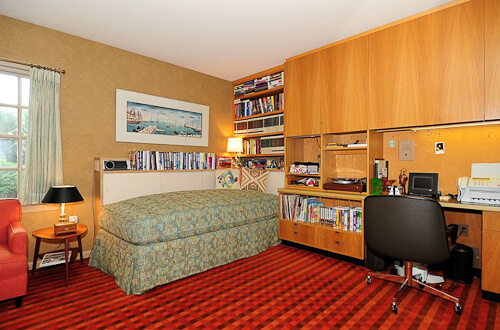 9. Day beds are very functional and versatile. I think I read that William Pahlmann introduced day beds into the midcentury consciousness. I think that in many spaces, they are a wonderful idea. I have them in our guest room, which also serves at my husband’s home office. I put J.C.Penney bolsters on them. I had custom slipcovers made for mine, but you can also find mass-produced daybed and bolster covers designed to make the whole set up look like a sofa. Pull ’em off, make the bed all regular-like — and you have a guest room. My daybeds sit at 90 degrees into a corner and read like an L-shaped sofa…. when guests come, we roll them apart and side-to-side for sleeping. Twin mattresses are cheap. Pahlmann looks to have designed a built-in for the daybed in this room.
.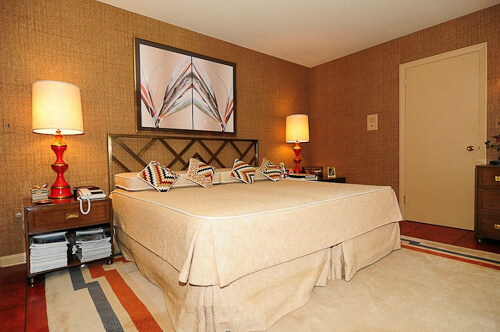 10. Bow down to the bargello — Bargello and needlepoint pillows everywhere. I repeat: These pillows are just the greatest, and can still be found relatively inexpensively on ebay. I also see them at estate sales — they were ubiquitous in the 1960s and 1970s. They are beautiful.
.
11 — Don’t dinkify your lamps — The lamps in these Pahlmann interiors are not small. I’m not sure that tall lamps make sense in a bedroom — you don’t want the bulb to shine directly onto your eyes if you are laying down reading. But in general, I think these interiors demonstrate the opportunity that lamps present to architecturally anchor a room. Don’t default to lamps that are dinky, especially in main living spaces like living rooms — use them to add height and to help your eye move around the room to take it all in.
.
12. Tailored bedspreads — Both bedrooms shown have lovely tailored bedspreads. If you are aiming for midcentury toward the modern (rather than chenille flamingoes or Bates) I think tailored is the way to go. I have done several stories about where to find bedspreads for a midcentury bedroom.
.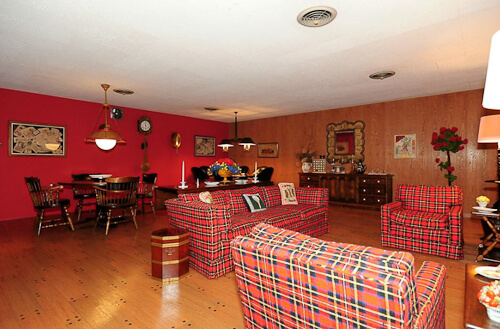 13. Color is the easiest way to add drama — William Pahlmann loved color, and he learned how to work it. I think this rumpus room is fantastic.
.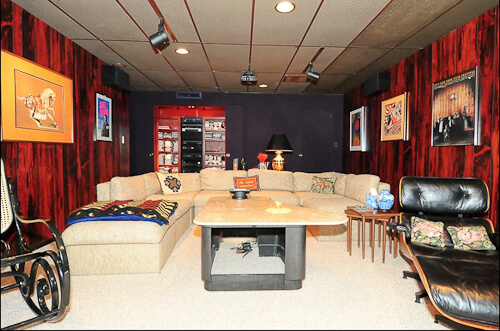 14. Get eclectic — William Pahlmann is credited with introducing “eclectic interior design” into America, including into the critical New York City design scene. He mixed eras and cultures and juxtaposed old and new in a way that first appalled — but ultimately delighted and changed — our view of what can look good together. Bah humbug with homogenous shackles. Make your own rules! And in that vein: Please ignore everything I tell you!
.
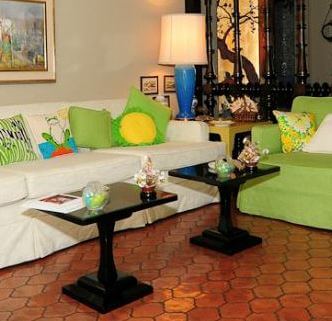
15. Match your jelly beans to your slipcovers and pillows — Okay, so this one may not be classic Pahlmann advice. But real estate agent Linda Grotenstein said this home has been beloved in so many ways — including, the owners matched the jelly beans to the slipcovers, which are switched out each season. Gribbit!
.
Want to buy this beauty? You need 1.4 million clams — I’d demand all the furniture and accessories, too, of course! See Linda’s listing for this gorgeous home here.


John says
This Pahlmann house from 1962 is truly beautiful. I’ve loved his work since the day I discovered a Pahlmann lobby in 1987. I lived around the block from 40 Sutton Place South in NYC from 1987 to 2007 and the lobby was a complete, unrenovated William Pahlmann design from the mid 1950s. The sofas were a light peach leather, area rugs in a mixture of dark green and peach wool stripes, ottomans in very high sheen dark green leather, brass sconces on wall panels of highly polished genuine walnut. The Pahlmann lobby survived for many years because there were several board members who were living there for a long time and appreciated the rare gem of a lobby that they had. As they retired or passed away, new board members felt that the Pahlmann lobby was dated. I personally made a plea to them to keep the Pahlmann lobby but to no avail. In 2007 they completely stripped the Pahlmann lobby replacing it with a tacky contemporary design that’s so run of the mill it now looks like a typical renovated Holiday Inn lobby. They refused to let me buy any of the 1950s Pahlmann furniture and rugs. They just had them carted away by a wrecking company. It was a real heart breaker. Another in a long line of nouveau riche people with no taste or appreciation of fine design.
Dan says
I absolutely LOVE pinch pleat drapes, but alas, can not afford them right now, as the big window/pation door in our living room is 10′ wide and 7′ high. I priced them, and the cost would be almost two mortgage payments.
But one word about drapes and length: If you have baseboard heat below your windows, DO NOT have your drapes cover them. I work for a power company, and handle residential issues. I was called to an elderly woman’s home because her heating bill was high. She showed me her new thermal drapes, and they covered her baseboard heaters! Whoever the salesperson for that job was should have been peanalized for that.
Not only did the new drapes defeat the purpose of her (admittedly inefficient) heating source, the liners of the drapes were discolored where they touched the heater. I don’t think they would actually catch fire, but you never know. Better safe than sorry.
pam kueber says
Hi Dan, great points. I, too, have huge windows. I found my pinch pleats for $20 at an estate sale. Bought them right off the windows! At one point, I priced out custom-made ones — it would have cost $1800 for the fabrication — fabric extra. I kept my $20 draperies. Someday – I will make both pinch pleats and sheers for underneath them – myself. It is not *difficult*, just tedious. We have a story about how to make your own pinch pleats on the blog …
Jessica Karp says
My genius mother bought a set of old decorating encyclopedias years ago at a flea market and now that I have purchased a mid century home, they have become my decorating bible. If you’re looking for more decorating ideas definitely check here. I just googled and found a flickr album with images from the books: http://www.flickr.com/photos/army_arch/sets/72157610798249850/
There are also a couple sets on Amazon: http://www.amazon.com/Practical-Encyclopedia-Decorating-Improvement-Complete/dp/B000LC8T82
And ebay: http://www.ebay.com/sch/i.html?_from=R40&_trksid=p5197.m570.l1313&_nkw=good+decorating+and+home+improvement&_sacat=See-All-Categories
TappanTrailerTami says
Great recap Pam! I’m so glad you called out the lamp size, because, nothing is worse than undersized lamps in a room IMHO. I say this as a very guilty party since technically, my bedroom lamps are not scaled well to my other furnishings.
Since I LOVE my bedroom lamps so much, I placed them on high 39″ tall narrow slant front secretary desks on each side of the bed. The desks are one of the very few “new” item in my house. It works well, and now my lamps don’t look so shrimpy next to the bed. Also, I have to put in my plug for secretary desks at the bedside, when you can find them small enough – they are WONDERFUL to open the lid, and then you have a nice table height surface for your books, eye glasses and such, and when you are leaving for the day, you just put all that stuff back in the desk compartment, and put the lid back up. No one has to see clutter on the nightstand – YAY!
Lamp size, and what era we are speaking of has everything to do with table height. In the 20’s, 30’s, and 40’s, most tables (including “official” end tables) were about 29-31″ in height. So, many of the beautiful 40’s china lamps you find run a bit shorter since the tables were higher. In the mid to late 40’s and into the fifties, the “step” style table became common with a much lower main tier, and then a higher upper tier for your lamp. Then the late mid 50’s through the 70’s arrived, the step table went by the way side, and most end tables were low, as Pam mentions with couches above. Most end tables and lamp tables slid to the 22-26″ height, with 24″ being very common. This is why lamps of the 60’s & 70’s are generally gargantuan in size compared to earlier years.
Personally, I much prefer higher tables, except in the interest of true and authentic MCM(odest) design. But that is just me…….If I am sitting on the sofa and want to read a book, I want my light casting down on me vs. the shadow created by a low lamp, or too short of a lamp. Ditto in the bedroom. In today’s new furnishings, it seems like they have retained the low table height, but lamps of today have certainly shrunk from the height of their 60’s/70’s counter parts, so in today’s Greige Nation, I think most lamps are improperly sized for the tables they sit on.
Don’t even get me going on proper lamp shade size………..that’s a whole nuther subject, LOL.
Love your blog, and I still think the Kitchen in the Pahlmann house is just the bomb!
Tami
pam kueber says
Thanks for the lesson, TTT. I need to do more on this!
J. Presley says
Another time capsule house.
Just went up for sale in Nashville in our neighborhood.
Its awesome.
Can’t wait for the open house on Sunday.
MLS 1303119
Jana (Berniecat) says
Thanks for such an interesting post! I especially like the section about combining different patterns successfully. Being a person who has eclectic decorating tastes, I struggle with the idea of patterns (what is too much, what is too distracting and whether to go with the “matchy matchy” motif). I like the pictures demonstrating Pahlmann’s examples.
Rechercher says
Twin beds made up daybed style, forming a 90 degree angle with a fairly large table at the corner between the head ends, is a classic mid-century arrangement–and I have the old family photos to prove it.
Amy says
Thank you for your good words about wallpaper. I’ve ALWAYS loved wallpaper, and when I’ve chosen papers, I’ve tried hard to find something that went with the house. (I was sad to find some wonderful aqua and then some salmon pink wallpaper beneath the awful painted paneling in my bedroom — I wish it had remained un-paneled!)
Anyway…great house, great story. Thanks, Pam! 🙂
Jay says
Pam, first off: I trust you came through Irene unscathed; I assumed that since there was no interuption of RR everything was ok. New England and upstate NY were hit hard. Philadelphia suburbs had loads of power outages, I was without power for several days.
Thanks for your design recap of this house. I searched for the real estate listing last Saturday and spent time looking at all the pictures and the floor plans so that I could match the pictures with the location in the house. I am still amazed at the size of it – nice layout. I have to agree with Rebecca. As much as I love AR, there seems to be that modernist name dropping theme that runs through the houses that are featured. MCM was more nuanced and embraced many styles and this house is proof.
pam kueber says
Yes, Jay — No major major disruptions where I live due to Irene!