

 Calling all grammarians and spelling bee champions:
What is the correct spelling — or are there correct spellings:
Is it:
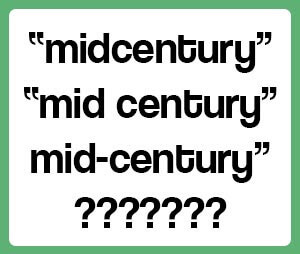
“Midcentury” … “mid-century” … or “mid century”?
As in (1): “midcentury modern sofa”, “mid-century modest house” or “mid century American history”. And would it change as in: (2) “in midcentury/mid-century/mid century America”.
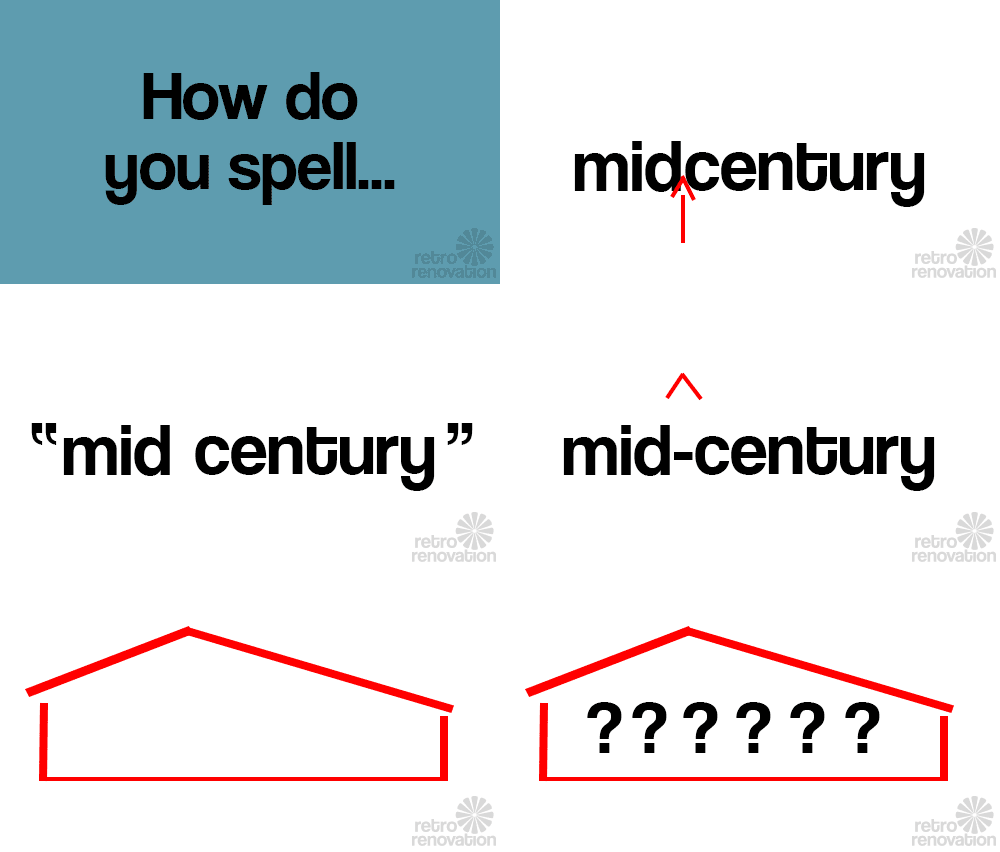
Golly, over the past six+ years, we’ve spelled it every which way. Hey: Covering all our bases and google keywords, too, I guess. However, my Meade County High School English teacher Ivy B. Hawkins — a fantastic teacher who made us diagram sentences until we could do it in our sleep — would not be amused by this lax just get it onto the www who cares about spelling anymore 21st Century (21st-Century? 21st-century?) attitude of mine.
So which is it?
Finally, what exact parts of speech do you call the word/compound, in each usage? Ack! My brain explodes! As you respond, can you also provide your citations – add hotlink in your comment. Thank you!




Trader Scott says
I’m in the AP Stylebook camp. My former college journalism professors would hunt me down and kill me if I didn’t pitch my tent in that camp.
virginia says
I’m a Mid-Century person myself. Kind of looks like what it looks like. Will we learn of any results on this one? Thanks again for all you do to brighten up my day and inspire my daydreams.
pam kueber says
Aw, thank you, virginia. Yes: I will declare a winning spelling and proceed to use it !
oh holland says
mcm -!
dahlila says
The real question should be, how is our SHOPPER going to type it for an SEO tag word? And will said operating system recognize all 3 forms or do we have to add all THREE of them to our listings. Oy.
Also, mid-century modern or mcm. It never ends. 😉
Justine says
I would say that as long as you’re consistent with the usage, any one of the variations is correct.
April says
I’m a professional copy editor, and both Chicago Manual of Style (7.85) and AP Stylebook call for the term to be closed (“midcentury”). “Mid” should be hyphenated only when it precedes a capitalized word (e.g., “mid-March”), a figure (e.g., “mid-1950s”), or a compound (e.g., “mid-twentieth century”). (Note, too, that “mid-twentieth century” as a noun contains one hyphen; as an adjective preceding a noun [e.g., “mid-twentieth-century style”], it contains two.)
But I agree with what previous posters have said about Craigslist: when I’m doing online searches or posting things for sale, I use all three forms!
pam kueber says
Thanks, April, I am reading all these and leaning toward accepting Chicago and AP style. Cuz I’m a journalist.
So would you write, “I made a midsentence pause?
or
“I made a midsection addition.”
or
“There was a midgame timeout.”
Those don’t look right to me…
Mary Elizabeth says
Just look in the latest edition of your preferred dictionary (mine is the Webster’s Collegiate) to see which words are accepted as unhyphenated. Of your examples, only midsection (which is a noun, not an adjective) is in my dictionary as an unhyphenated word.
My opinion is that the sentences below are spelled as they should be:
He interrupted me mid sentence. He interrupted me in the middle of my sentence. It was a mid-sentence interruption.
There was a delay mid game. There was a delay in the middle of the game. It was a mid-game delay.
Again, if the word was a compound adjective, not a root word with a prefix, it would be middle-century, not midcentury.
Again, different dictionaries and different style manuals (such as the National Geographic one mentioned in this stream) will have different rules and spellings. Dealing with language involves living in the ambiguities created by evolution. As RetroRenovation.com’s Blog Queen, you get to write your own manual! 🙂
pam kueber says
Wikipedia is classifying the mid- as a derivational prefix. Looks like they are saying no hyphen unless there’s a proper noun or year after.
I don’t want to “write my own manual” even though I am Queen, thank you very much. Just as I want to understand the minutiae o’ the mid-mod, I want to understand this, especially because it’s so core to the blog. For sure: The spelling in my header is wrong — THE HORROR!
Patty says
Any one can edit Wikipedia. Any one. Not considered an authority. But then in today’s world quality has slipped quite a bit in many areas.
pam kueber says
I know. But it looked pretty interesting to me… Did you read it?
Mad for Midcentury says
I’ve always gone with this rule: Adjectival compounds hyphenated before but not after a noun. (https://net.educause.edu/elements/attachments/educause/pdf/ch07_tab01.pdf)
So, “mid-century furniture,” which also allows for “mid-eighteenth-century furniture.”
However, popular usage is trending towards midcentury: http://www.google.com/trends/explore#q=mid-century%2C%20midcentury
And most news outlets use midcentury now. As others have mentioned words evolve, often losing their hyphen. I think we’re currently in the age where mid-century is becoming midcentury. However, I don’t think mid century is ever correct. (Plus, Google and most searches see hyphens as spaces so in Google’s mind mid-century and mid century are the same keyword.)
pam kueber says
Thanks for insight into google keywords trends!!
Robin, NV says
On the same theme – if you’re referring to a period in history, no apostrophes people. As in 1950s, 1960s, 1500s NOT 1950’s, 1960’s, 1500’s. Unless it’s the possessive, then it’s ok. But that’s sort of awkward in its own way since you really shouldn’t anthropomorfize a period of time.
Kirsten says
YES! YES! YES! That drive s me around the bend, sister. Thank you for saying that!
Scott says
LOL I love you both! That so sends me off the deep end too!
Kirsten says
I work for National Geographic. This is our Style:
HYPHEN
1. Modifiers: See also ADJECTIVES AND ADVERBS, PUNCTUATION OF.
A compound adjective should be hyphenated before a noun (unless the compound itself carries a modifier) but not following it unless subject to misreading or hyphenated in Webster’s as an adjective: a well-respected man; a very well respected man; a man well respected for his bravery; he is well respected for his bravery; quick-witted retort; the retort was quick-witted; a two-ton truck; a jet-pack-powered stroll; but an old stone wall (the stone wall is old).
a. After an adverb that ends in -ly, do not hyphenate unless ambiguity results:
nearly dead hopes, newly set aside parklands
b. Some adverbs do not end in -ly. Of these, compound modifiers with the following are generally hyphenated before nouns: dead, long, near, and well (well-dressed man, near-dead hopes). Unless the meaning is ambiguous or a compound is hyphenated in Webster’s, do not hyphenate compound modifiers with almost, already, best, early, ever, last, late, less, more, most, much, never, not, now, once, only, seldom, sometimes, still, very, yet. See even. Consult Webster’s, especially for compounds with over and under.
c. Compound modifiers containing cardinal numbers are hyphenated before nouns when the compound contains a unit of measurement or spelled out number:
a two-dollar tie
an eight-foot pole, but eight feet of pole
a 13½-year-old; 11- to 14-year-old children; 11- and 14-year-olds; 11-through-14-year-olds
an 11½-by-4½-foot box, but 11½ by 4½ feet
a three-by-four-foot box, but three by four feet
a 35-millimeter slide; 35-mm slide or 35mm slide
a three-by-five card or a three-by-five
a four-by-four or 4WD or FWD or 4×4 are all acceptable for a four-wheel-drive vehicle
d. With more than one compound modifier distinguish between several possibilities and an inclusive range:
Two- to three-day forecasts are now possible.
A two-to-three-day forecast would help him plan.
Snow will be in the 10-to-14-inch range.
e. A compound with an ordinal, a comparative, or a superlative is not hyphenated except to prevent ambiguity or if in Webster’s:
fifth largest city
farthest reaching trade
the best known person
the first ever race
second-growth timber
third-ranked convention city
best-selling novel
faster than normal ship
f. Do not hyphenate between capitalized words that are an entity, with certain exceptions. Hyphenate when required by Webster’s, after a prefix, or when the hyphen is necessary for sense. If one element in a compound modifier is itself a compound, an en dash may be used in place of a hyphen:
but
Holy Week ceremonies
New York skyline
Latin American countries
Los Angeles–oriented view
South American countries
Mexican-American ways
French-Canadian restaurant
proto-Aryan roots
pre-Columbian vase
color TV series
third-century B.C. head
New-York Historical Society
Scotch-Irish descent
g. Chemical terms used as adjectives are not hyphenated except if ambiguous and when used with the mass number: carbon dioxide test, but carbon-14 dating; iron-oxide red; strontium-90, strontium-90 fallout, Sr-90 fallout.
h. Dates: A hyphen means up to and including when used between dates: November 15-21; 1941-45. When using from, do not use a hyphen but spell out to or through and give complete date: from 1941 through 1945. With hyphen use only the last two digits except where three zeros would come together or decades are different: 1962-65, 1900-1901, 1900-1910, 1949-1950, 1941-1963. Never use one digit alone in a date: 1947-49 not 1947-9.
i. Foreign terms used as adjectives are not hyphenated:
ex post facto laws, per capita income, status quo regime, but laissez-faire policy.
j. A compound modifier in which the second word is possessive is not hyphenated:
park ranger’s job, magazine researcher’s inquiry, but bird’s-eye view, snail’s-pace walk.
k. A compound modifier within quotes is not hyphenated unless the compound is hyphenated in Webster’s:
a “one man” attempt, “Azores high” cliffs, a “pigeon-toed” table.
l. The punctuation can influence the meaning: red, white, and blue flags (solid-colored flags), red-white-and-blue flags (tricolors). Do not hyphenate compound color modifiers unless both elements are colors of equal value: blue-black sky, gray-green eyes, but bluish black sky, lemon yellow dress, jade green lake, cobalt blue dish, dark blue suit. To avoid ambiguity, note: light-blue suit (color), light blue suit (weight).
Note the difference between an old-brick home and an old brick home, depending on whether the bricks or the home is old.
m. Compound nouns appearing in Webster’s and widely used do not need to be hyphenated when used as adjectives unless ambiguous. For example: polar bear, sea turtle, foreign exchange, income tax, real estate, fossil fuel.
n. Dual-heritage designations are not hyphenated as a noun: African American, Mexican American, French Canadian. Hyphenate, however, as a compound proper adjective: Polish-American influence, Japanese-American art, French-Canadian politicians.
o. Use an en dash instead of a hyphen in a compound modifier when one or both of the elements is itself a compound: Civil War–era firearms, first-class–second-class rivalries. Sometimes it is clearer to hyphenate the entire term: cold–weather–related deaths, natural–gas–fired power plants.
2. Compound Nouns and Verbs: Follow Webster’s when writing compound nouns and verbs. Nouns are likely to be hyphenated or written solid, verbs to be written as separate words: shutout (noun), shut out (verb); shut-in (noun), shut in (verb). As a general rule do not use hyphens in compound nouns containing turned and cum: village turned metropolis, gunsmith turned naturalist, editor cum nuisance.
3. Syllabification: Follow Webster’s when breaking a word at the end of a line. Do not break a word from one column to another or from one page to another. Avoid breaking terms that are already hyphenated.
4. Place-names with hyphens follow the style in the NG atlas, then the Board on Geographic Names. If the place-name is not in the atlas, omit hyphens both on page maps and in text except in French-Canadian and French names: Stratford upon Avon, Saintes-Maries-de-la-Mer, Trois-Rivières.
pam kueber says
Okay, Kirsten, so then, how would you spell it?
TappanTrailerTami says
LOL! or, L-O-L!
Kirsten says
Determine your context and apply the rules accordingly. Duh. 😉
pam kueber says
Okay, but Kirsten, using your NGeo guide, how would you spell it?
midcentury modern couch
mid-century modern couch
or
mid century modern couch?
Kirsten says
mid-century modern couch
mid-century modifies.
Think of it this way:
The castle was built in the 16th century.
It’s a 16th-century castle.
pam kueber says
I see where you are taking this from your style guide now: “f. Do not hyphenate between capitalized words that are an entity, with certain exceptions. Hyphenate when required by Webster’s, after a prefix…” [emphasis mine]
However, I disagree. Do you spell unhappy un-happy? Un- is a prefix, isn’t it? There are many many many words with prefixes that are not hyphenated, it appears: http://en.wikipedia.org/wiki/Prefix
Kirsten says
For the Society, all established spellings come from Webster’s. All placenames are determined by out cartographic group. Exceptions of spelling and style are defaulted to our Style Guide within the rules of context.
It all depends on how you are using the word. Is it a proper noun? An adjective? A modifier? My advice is to follow the usage rules for a modifier and establish your own spelling rule for the proper noun (as it’s not in the dictionary). The basic idea is to establish your own style. And then stick with it. 99% of a style guide’s purpose is to establish consistency.
Sandra says
I write scripts, and if I were writing dialogue, I would spell it as it would be spoken. For example, “‘When did Rock Around the Clock’ hit number one?” “It happened mid-century.” In this case, there’s a pause where the hyphen is, as if to say “mid” century, not “late” century.
If you want to say the style, then you would spell it “Midcentury Modern” where the first word is meant to be a single word.