

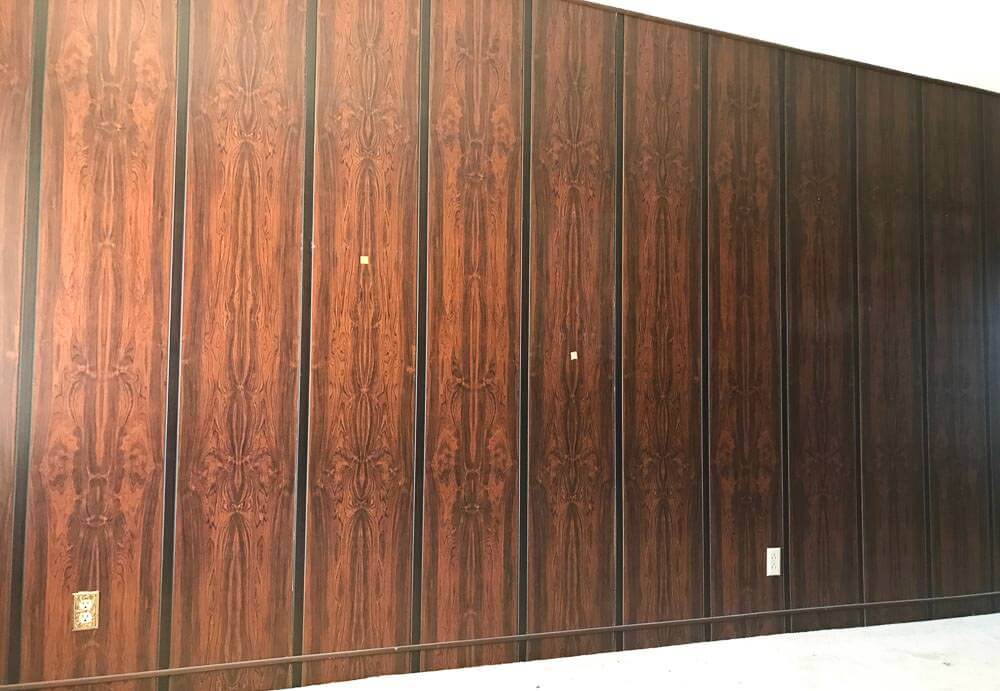
 Many of us agree that Knotty (Pine) is Nice — but what about its flashier cousin, 1960s-1970s wood paneling that got kinda … designy? Elisabeth is new to her 1968 house and her eyes are a bit in shock at her two-tone inlaid wall paneling. This sure must have been hip back in the day. She asks us: Should it stay or should it go?
 Elisabeth writes:
Hi,
I’ve just purchased a 1964 home. It is exciting but a bit overwhelming. There is a lot of paneling in the house. Looking at the May 1968 House and Garden magazine I can identify it as Georgia-Pacific Inlaid Paneling. I know it was marketed as the affordable option to real wood inlay work. It is not tongue and groove and it is not knotty pine. I am in a quandary as to whether to keep it. If it were real wood I would not have a question. I don’t mind trying to keep it with the intent of staying in keeping with the spirit of the times. However I would probably need some kind of confirmation that it is a good idea. My first instinct was “ugh, paneling”. I am new to this. Also the expense of remove and replace is weighing on me. Thanks for your time and any advice.
Best,
Elisabeth
Wow, Elisabeth, you are so ingenious to find that ad. Which wood is ‘yours’? Elm with walnut inlay? Pecan with walnut inlay? Cherry with walnut inlay? Or Walnut with pecan inlay? Surely a reader will know.
I have my own opinions, of course, but first, let’s hear from readers:
Should Elisabeth keep her circa-1970s paneling…
Or should she rip it out or paint over it?



CarolK says
I agree with James Burdett about painted panelling. We have it in our house in the kitchen-den and it’s staying although it’s getting re-painted to a better color. It’s currently maroon and when the power is out, it’s too dark to use the room. Its awful, When we moved in, the walls were white, though. That had it’s own particular challenges though when we’d hung a whiteboard and had a toddler who didn’t understand the boundary between the whiteboard and the wall. Painted panelling has its own charms. Some of the texture is still there
flyingethan says
I say keep it. I like wood paneling. I like the warmth that it provides to the look of rooms.
Caitlin says
I agree with some of the previous commenters- leave it, as-is, for a couple months to live with it. There are so many fun design ideas that work perfectly against wood paneling- it looks great with burnt orange or a vibrant green.
I agree that leaving all four walls of a room paneled can be intense, so if you’re considering removing it after living with it for a few months, think about removing the paneling on just one or two walls, if you can remove it without damaging the panels on the other walls.
James Burdett says
The paneling in our 1963 house is painted a light color to match the surrounding non-paneled walls. The room (a family room) is much brighter and contrasts well with the dark brick (dark brick was also a 1960s thing) fireplace in the room. There’s much to admire in 1960s interiors but no way am I living with the gloom of dark paneling of dubious quality
Joe says
There were two reasons that people covered walls with paneling:
1.) It was an inexpensive way to jazz up a room.
2.) It was a weekend handyman’s easy way to cover up a multitude of sins he couldn’t/wouldn’t spend time dealing with correctly.
If you don’t have access to someone with a history of the place, you’re rolling the dice with your decision to keep or remove.
Personally, I don’t like an entire room paneled, because it absorbs light and makes the room really dark. If you can determine what’s behind that paneling, you should pick one wall that’s in the best shape and keep it (treat it like it’s an accent wall). Remove the paneling from the other walls and paint them. Be mindful of one thing: if you’re lucky, they nailed the paneling up. If you’re not lucky, they glued it, so be prepared to cry and run to the home center to purchase all new drywall!
Dan says
What’s your hurry? Live with it for a few months and don’t even think about it. If it just doesn’t grow on you, then take it out – it’s your home.
Do be aware taking it out may a bigger job than you realize, involving a lot of patching and plastering. A few months after her husband’s death, a neighbor took out similar paneling that she had never liked, but her husband had. A bit of a job, but the room is so much brighter and more cheerful.
Elisabeth says
Thanks, many people are saying live with it a bit then see. I will probably opt for that. I know I am doing something to the floors sooner rather than later. So I was thinking I should decide in case taking them out later will cause a problem with new floors. But if possible, waiting sounds like a plan.
Kristie says
Live with it a while. See how it cleans up and plays with your decor. I’m in a new-to-me 1968 house myself, and someone slathered Greige paint on the paneled wall in the basement. Now, I don’t get to decide whether I like it or not. I don’t actually hate painted paneling (though I would have picked a different color), but it is a permanent choice.
Rebecca Prichard says
KEEP IT! Don’t paint it!!! The previous owners painted it in our house and I wish they wouldn’t have all the time.
Teri says
Having recently been faced with the same dilemma, I have to raise some concerns. One of the problems we had was the overall condition of the paneling (delaminating, split seams and holes to accommodate speakers), so we did remove it. Painting over it wasn’t an option due to the condition. We did paint over paneling in a prior house, and it looked great. The question is, what’s behind it? If you take it down and sheetrock over whatever lies beneath (as we had to do because it was old gypsum rectangular pieces, not full sheetrock as you’d find in more recent homes), you may be faced with door frames, trim and baseboards that no longer fit. Without pictures of the room and the furnishings, it’s hard to opine on whether it should stay or go. I’d vote for living with it for a while, and seeing what you think before doing something that will be difficult or impossible to undo.
Tracy (another one!) says
I’m not a fan… BUT I would personally keep it for now. Throw your rug down, and your furniture, and live with it for a bit. If you still don’t like it, then you’ll always have the option to paint it.