

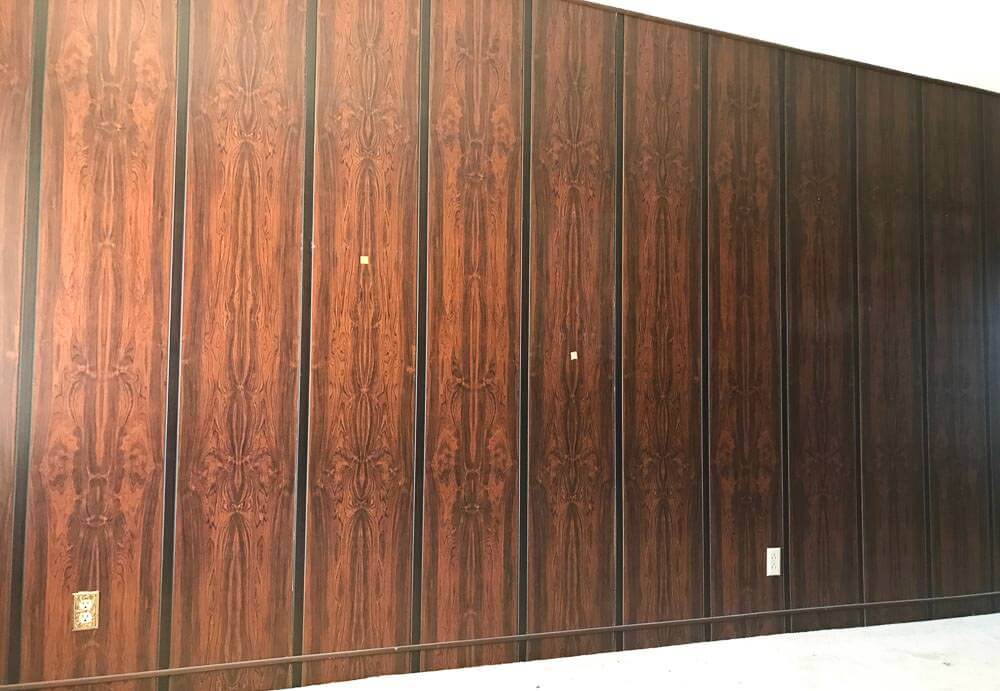
 Many of us agree that Knotty (Pine) is Nice — but what about its flashier cousin, 1960s-1970s wood paneling that got kinda … designy? Elisabeth is new to her 1968 house and her eyes are a bit in shock at her two-tone inlaid wall paneling. This sure must have been hip back in the day. She asks us: Should it stay or should it go?
 Elisabeth writes:
Hi,
I’ve just purchased a 1964 home. It is exciting but a bit overwhelming. There is a lot of paneling in the house. Looking at the May 1968 House and Garden magazine I can identify it as Georgia-Pacific Inlaid Paneling. I know it was marketed as the affordable option to real wood inlay work. It is not tongue and groove and it is not knotty pine. I am in a quandary as to whether to keep it. If it were real wood I would not have a question. I don’t mind trying to keep it with the intent of staying in keeping with the spirit of the times. However I would probably need some kind of confirmation that it is a good idea. My first instinct was “ugh, paneling”. I am new to this. Also the expense of remove and replace is weighing on me. Thanks for your time and any advice.
Best,
Elisabeth
Wow, Elisabeth, you are so ingenious to find that ad. Which wood is ‘yours’? Elm with walnut inlay? Pecan with walnut inlay? Cherry with walnut inlay? Or Walnut with pecan inlay? Surely a reader will know.
I have my own opinions, of course, but first, let’s hear from readers:
Should Elisabeth keep her circa-1970s paneling…
Or should she rip it out or paint over it?



ChrisICU says
Just remember, for every person who hates this look there will be others who will love it. And, interior design from the 1970’s can be done well. The paneling doesn’t look like ‘mobile home paneling’. It looks more high-end than that — but definitely never an expensive application. I agree with many who ask about practical matters. What’s the condition currently? Does it just need a good cleaning or is it in bad shape? If you absolutely hate the paneling, then what’s the cost of removing it?
But what I think the most important question is: What is your interior design style or interest? This is about how you want to live. Think of these walls as an asset that lets you branch out to a different perspective.
This paneling reminds me of an Interior Design book in the 1970’s by Egon von Furstenberg called “The Power Look at Home”. Dark walls, often textured or patterned, were the backdrop for bright, white, gilt, or shiny furnishings. Lighting played an important part of this style. It always looked better at night with great lighting. The goal was for the walls to be interesting, but to fade away and the focus be on the furnishings. Think chrome etageres, high gloss casegoods, oversized artwork well lit – that kind of thing.
Halston, Yves St. Laurent, Pierre Cardin, Egon Von Furstenberg are some designers from that era who did dark rooms. I bet you can find some ideas online. Some were fashion designers who also did interiors.
For more recent design ideas I think of Tom Ford’s interiors work. If you’re more formal, then I’ve seen Ann Getty’s work that could fit with these walls. Restoration Hardware catalogs also use a lot of dark walls that can give you some inspiration.
Not sure if I can include links of inspiration ideas, but here are some.
Tom Ford’s London house has a room with almost identical walls. Scroll down it’s about the 10th pic: http://www.mylusciouslife.com/tom-fords-homes-in-london-paris-los-angeles-and-santa-fe/
Here is Yves St. Laurent’s interiors with dark paneling, oversized paintings, and shiny leather and accessories: https://www.shrimptoncouture.com/blogs/curate/14129185-the-interiors-of-fashion-homes-of-designers
Von Furstenberg’s residence. The walls are red, but oversized and patterned artwork over your walls could work, too. http://littleaugury.blogspot.com/2011/03/princess-circa-1972.html
http://littleaugury.blogspot.com/2011/03/princess-circa-1972.htmlon
http://design-milk.com/nyc-apartment-inspired-tom-ford-halston/
But, if you are on the fence then don’t paint the walls. Can’t go back with paint and I’m not sure this solution will satisfy you. Hope this helps.
Elisabeth says
Ohhh,
thanks so much, this is very helpful! The Tom Ford examples are so inspiring!
Elisabeth says
thanks again, great eye! the luscious life 10th down looks like it. and thanks for the leads. I have more to ponder. It is a 60s to 70s house which is different than a 50s to 60’s house.
ChrisICU says
Happy that I found it to show you. My own house has a dark living room and master bedroom. Both rooms face south with lots of windows. My style is ‘70’s and Asian. I love the warmth of the dark rooms.
Carolyn says
Funny you mention “mobile home paneling” – to access the shower to make a repair, we needed to pull off a section and discovered some paneling was printed on both sides! Luck for us, the more sedate slim lines had been installed, a very chic soft sage green. On the other side was “of the moment” 1974 daisies in burnt orange and maize/harvest gold and avocado green on a cream field! EEEK! For a kid’s room, maybe, but not a small bathroom.
Changed out the “walnut” vanity and discovered the beautiful green was actually copper that had turned verdigris! This explained the copper carpet and gold tub/shower and toilet.
Cathy says
I say keep it up but clean it with some Restore-a-Finish or non-grit Gojo. I am doing that will my honey-colored paneling and it’s looking amazing.
Amanda Callahan says
I would remove it. The room would be brighter, seem larger & add lighter, period wall paper if keeping with the age of the home.
Lee says
Is it paintable?
I would decide based on lighting.
Dark walls need lots of light unless you like being in a cave. If there are lots of windows and/or skylights, it may be keep-able.
Otherwise, I would remove or possibly paint a lighter color.
Jen says
If it was real wood keep. If it is the fake stuff remove or cover up with drywall. I h*** [edited] paneling so much though, even though I love MCM and vintage anything!
Brooke says
I actually kind of like it. I think a whole room might be a bit much but as an accent wall it could be really stunning.
I would suggest start with re-painting the ceilings a bright white. They tend to get dingy over the years and no one thinks about how fresh ceiling paint really brightens a room. If you’re planning on leaving the existing flooring then I would decorate the room and see how it feels with the paneling as is.
If you still find it dark and overwhelming after living with it for a while then pick an accent wall and paint the others a nice white. The wood plus white walls would be a fabulous backdrop for colourful accessories/ mcm furniture
We added teak veneer paneling to our guest bedroom and really love the warmth it brings to the space and I love the wood grain in contrast to the white walls/ceilings (photo shows grey walls, but I’ve since painted them but don’t have a current photo)
https://www.instagram.com/p/BG_9PS1qK10/?taken-by=stream1313
Lynne says
Brooke, that wall is drop dead gorgeous! Where in the world did you find the paneling??
Elisabeth says
Brooke,
I agree with Lynne,
that teak veneer is so pretty!
Brooke says
Thanks Elisabeth!
Brooke says
Thanks Lynne! I found the teak veneer panels at a local wood supplier (Windsor Plywood) and it’s considered “cabinet wood”
It’s a 1/4″ plywood with veneer and we glued/pin nailed the paneling to the drywall. It also came in a 1/8″ thickness which might have been closer to a flexible wall covering but we wanted a bit of extra strength.
The sheets were only $45 each so the wall was roughly $150 (which isn’t far off a high end wallpaper).
The wall itself is finished with Watco danish oil (not stain used) and a thin rubbed wax
TeeCee says
I’d have to paint. Could leave one wall as the panelling…
Martha says
The first home we bought had this same paneling. It was in fine shape, so I used Murphy’s soap on it and it cleaned up nicely. However, the living room/dining room combo had only one 4×6 window at each end of it and one was from a covered porch, so the room was so dark. About six years later a broken pipe forced some reno work and I took the opportunity to paint the paneling white and I was never sorry. It gave my little house a new life and light which it had never had before. The walls looked tongue and groove after and I enjoyed the bright new room.
Kathy says
If it were mine, I would decide on the long-term concept of the home. Retro with updates? Retro full bore? Partial retro rooms? I would make sure the the mood of the room is a good part of the concept of the paneling also. If the whole house is paneled, I would probably take some down just because it can be overbearing. But a good retro room with just paneling might be fun blended in to the hallways, etc that adjoin it a bit. With the right furniture and fixtures it would be a really fun project! Most of all, you have to be comfortable. I grew up in a 60’s home, and I can say, I have never felt more at home as when I can step back in time and throw myself on that 10′ couch and watch rabbit ear’d tv. Remember back then wallpaper was a big thing too. Fun! Have fun.
Elisabeth says
thank you!
Fun is the name of the game, really it is!
Elisabeth
Sally Fries says
We removed paneling in our 1970’s rec room and found mildew behind it that we never would have known was there. I’m glad we were able to have the wall moisture treated instead of inhaling mildew all this time. Just a thought.