

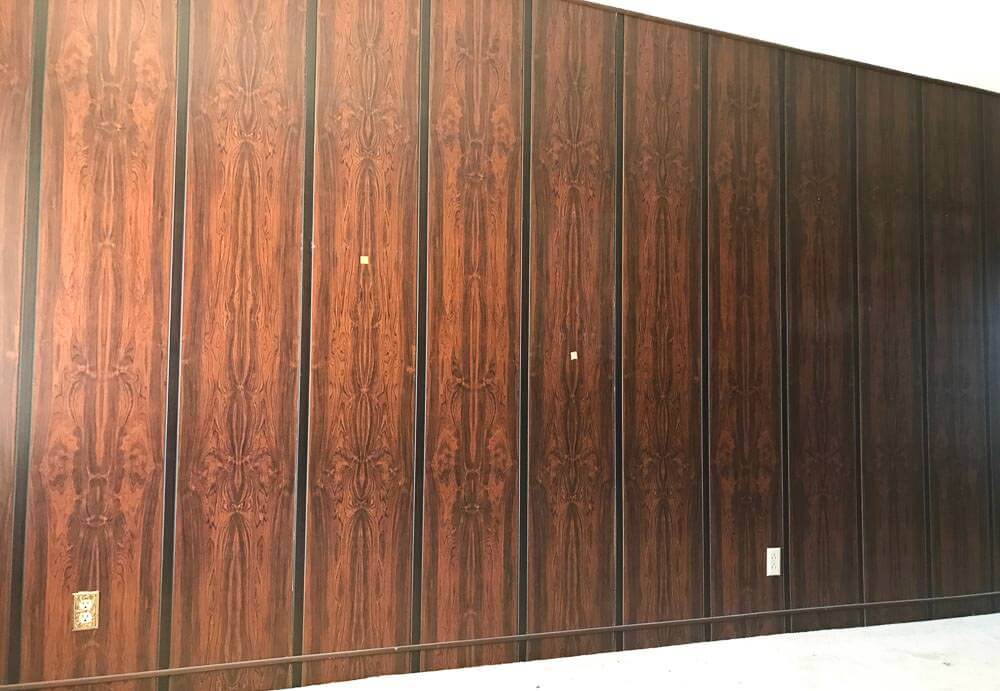
 Many of us agree that Knotty (Pine) is Nice — but what about its flashier cousin, 1960s-1970s wood paneling that got kinda … designy? Elisabeth is new to her 1968 house and her eyes are a bit in shock at her two-tone inlaid wall paneling. This sure must have been hip back in the day. She asks us: Should it stay or should it go?
 Elisabeth writes:
Hi,
I’ve just purchased a 1964 home. It is exciting but a bit overwhelming. There is a lot of paneling in the house. Looking at the May 1968 House and Garden magazine I can identify it as Georgia-Pacific Inlaid Paneling. I know it was marketed as the affordable option to real wood inlay work. It is not tongue and groove and it is not knotty pine. I am in a quandary as to whether to keep it. If it were real wood I would not have a question. I don’t mind trying to keep it with the intent of staying in keeping with the spirit of the times. However I would probably need some kind of confirmation that it is a good idea. My first instinct was “ugh, paneling”. I am new to this. Also the expense of remove and replace is weighing on me. Thanks for your time and any advice.
Best,
Elisabeth
Wow, Elisabeth, you are so ingenious to find that ad. Which wood is ‘yours’? Elm with walnut inlay? Pecan with walnut inlay? Cherry with walnut inlay? Or Walnut with pecan inlay? Surely a reader will know.
I have my own opinions, of course, but first, let’s hear from readers:
Should Elisabeth keep her circa-1970s paneling…
Or should she rip it out or paint over it?



Leslie says
I say keep it. I once lived in a house that was built in the 70s with dark paneling and I mudded over it and painted. I regret that decision and wish I’d left it original.
Kathy says
I rather like it and it could work in a den or cozy dining or sitting room. The pattern exactly repeats itself, so I don’t know if it is veneeer or not, or printed. If it is just one room, I would keep it for awhile and decorate with lots of light fabrics and accessories–the contrast can look great. Add a macrame wall hanging in homage to the era!
If the entire house is this dark, then selective painting could be a good option, and can look surprisingly good. I had about 6 different types of paneling in my rental property, including 4 in the hallway alone, and I painted it all antique white and it looks so much better, especially since most of it was 70s fake with heavy patterning. The house is a Folk Victorian, so it was used to cover cracked walls. I took some of it down and patched the plaster, a messy process, and painted the rest.
Yours is nicer than mine was, so perhaps an accent wall with shelves or pictures, perhaps behind the big screen TV, could look good.
I am wondering about that little strip on the bottom. Might be worth covering with a real baseboard. Nice molding can make a world of difference in a room. Also, I think rooms with lots of wood tones look better with off white or linen/oatmeal tones or cream rather than bright white,
Karin says
I concur with the other posters. Leave it for a while. If you need to use the room, decorate it with furniture and objects that you love. Eventually you will arrive at your decision one way or another.
Personally, I would paint, but use a faux bois technique to replicate light paneling.
Pam had a post on this light paneling. Check under “Lawrence Bill`s 1955 Pecky Cypress Living Room“. Something like that.
I think it looks surprisingly fresh and modern, and its light color would brighten the room.
You could try it out on some loose paneling and lean it up against the wall to see if you like it. Good luck!
Retro Retro says
https://retrorenovation.com/2008/08/12/lawrence-bills-1955-pecky-cypress-living-room/
There you go.
Watching the black/white episodes of Perry Mason from 1957 to 1965, I noticed Perry Mason’s office (set) seems to have that identical paneling.
Paneling was originally a very, very high end product (check out 18th and 19th century French and English manors) made more affordable with veneer paneling.
Then in the late 60s and 70s the paneling got cheaper to buy, but cheaper looking as is popularity grew and companies tried to make it more affordable to working class families.
Kelly says
Some comments suggest that paneling was installed to dress up a room or to cover damaged walls. Another reason many mid century homes have this type of paneling, especially in basements, is that DIY was very common in the era. The panels could be installed by homeowners, without the fuss of taping, mudding and sanding required with drywall. And in these cases, the panels were often nailed directly to the studs with small color-matched nails made for the purpose. My parents’ mid 1960s unfinished attached garage to family room and dining area conversion was done this way.
mike says
but with modern fire codes this wouldn’t work. Drywall provides some measure of fire protection that you won’t get with the paneling. In short, to do this today you would need to install a thin drywall panel under the paneling.
Pam Kueber says
Check local building codes, folks — consult with your own pro’s!
Jason says
my first opinion is that it needs to go for a couple of reasons:
1. its dark!
2. its visibly thin. It may not actually be think but just looking at it does not inspire confidence. And when I say thin, i might be trying to nicely say “it doesn’t look like high-end, solid material”.
3. From an aesthetic standpoint, its not attractive to my eye and will be difficult to match with wood furniture. also, it reads more like 70’s style to me. If you are leaning in a mid-century, 1960’s look for your home, this product will class.
4. it won’t be terribly difficult to remove it and replace with drywall, no will it be expensive. drywall is some of the more affordable work you can do to your home.
Please know these comments come from someone who tries to save nearly all original features! But this one doesn’t appeal to me
Tom Wyatt says
Keep it! Or, at least send it to me! We’ll give it a good home in our 1953 rambler, wherein the previous owner succumbed to fashion pressure and painted over most of the paneling.
ineffablespace says
I am not sure, but I don’t think a house from 1964 would have needed a renovation by 1968-9, so I would question that this drywall is covering old damage?
Although I guess anything is possible.
KStacey says
Ha! You should meet my cousin. He bought a brand new house about 6-7 years ago, and has completely remodeled it. Heck, a year ago he was talking about the new kitchen backsplash he was putting in, which TOTALLY confused me, because we had the exact same conversation about a year prior. The sad part is that I couldn’t even tell the difference either way, lol!! And my uncle (his father) was always the same way! Constant “upgrades”. Since the readers/posters here are obviously more into preservation, we can’t imagine something like that. But I could totally see somebody living in a house for a only a couple years and redoing their walls to be more “fancy”. Or maybe it was sold again a few years after it was built. I can see it now, “Honey, do you like this house? It’s in our price range and the school district we wanted and there’s a tree for little Timmy’s swing out back.” “Oh I just don’t know Harold, the walls are just so flat and plain, I just can’t see myself living here…” “don’t worry honey, I’ll put up some awesome fancy super-duper special paneling!” Haha!! And the American dream lives on.
Lynne Lendo says
I had similar paneling in one room, and there was no drywall behind it, just the framing. We ended up painting it a light ivory, and it just blends into the rest of the house, as all the walls are the some color now.
Edward says
But it IS real wood, albeit a veneer – just like the plywood cabinetry and doors we’ve all learned to love! “Learned” is the key word here. The 40 year mark is the most dangerous time for period decoration: “dated” “kitschy” “cheap”; all were said about gold speckled Formica, aluminum cone sconces, and even pink bathrooms! Step outside of yourself for a moment before you decide.
Elisabeth says
good point, thanks!
Amarissa Parker says
I totally agree with the idea to leave it for a time, with your furnishings, to see how you like/dislike it. My home was remodeled in 1966, and has THREE different kinds of wood paneling lurking about in it. I absolutely love the warmth it gives off, and the change in color from room to room!