

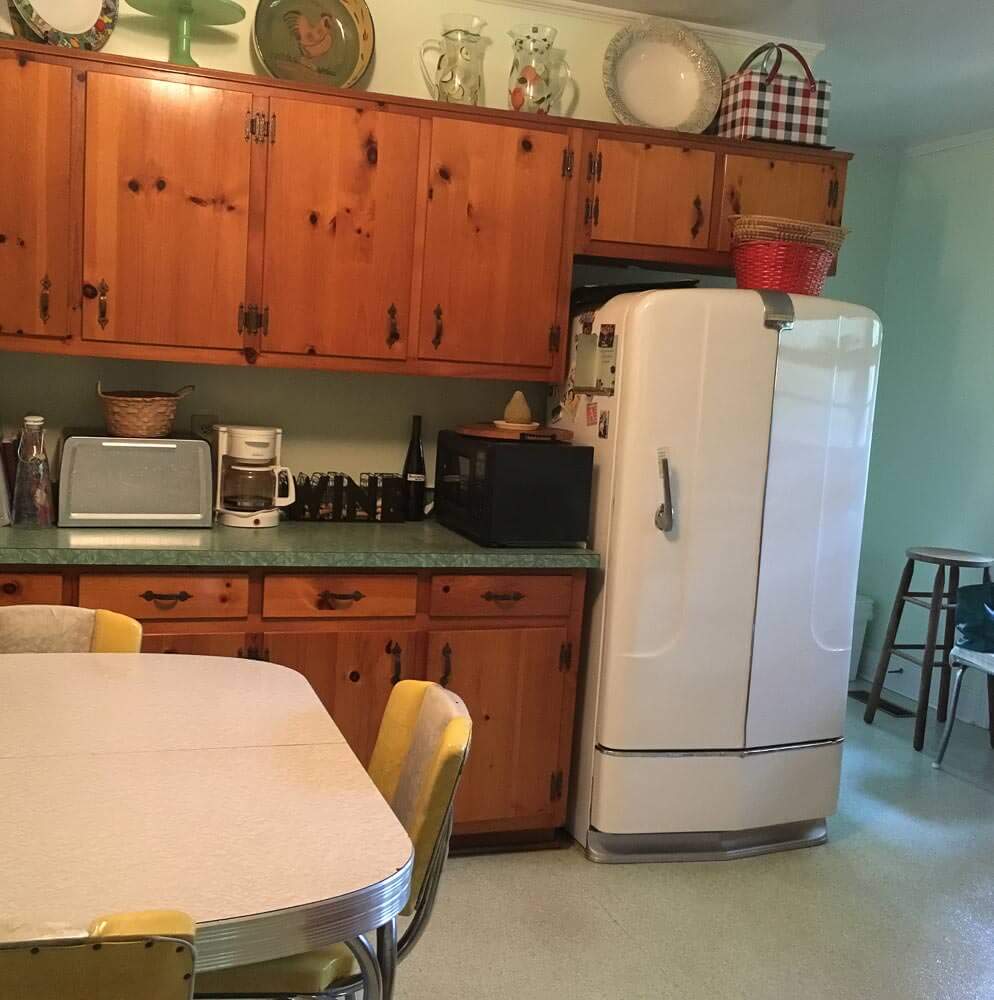
 Do they make things like they used to? I don’t think so. Case in point: Amy’s vintage Westinghouse refrigerator been in continuous operation since 1941 — that’s 76 years — among three generations in one family.
The refrigerator has changed locations three times. It’s now back with Amy in the 1959 time capsule house that she bought from her grandparents.
She told us:
The refrigerator also has a story. This was my grandparents’ fridge (a Westinghouse from 1941, I believe) that is even older than the house! They had this at their farm house, moved with it (I think) to this house, and then when my parents were married in 1969, they took it. After my parents established a household, they used the old fridge as a “second” fridge in the laundry room for extra milk, food, etc. When I bought this house, I got rid of the 1970s avocado green fridge (if only I knew they would come back in style!) and asked my parents for the 1941 fridge for the house. I only needed to buy them a budget new fridge for them to use as their “second.” It was a bargain! My new old fridge only needed a coat of appliance paint as it had gotten a little scratched up over the years. But it has been IN CONSTANT USE SINCE 1941!
Wow! This was so inspiring I put Amy’s story up in my list of 7 ways to get a retro refrigerator — vintage is for sure an option!
Story: Our circa 2006 dishwasher recently broke down. We threw about $200 at it, trying to get it repaired. The repairs did diddly. I went on to Consumer Reports looking for something new. As I recall, they said that if your dishwasher is more than six years old and it breaks down, get rid of it and get a new one. This is so wasteful. Shame on manufacturers and their “planned obsolescence.” For the past four or five months, we’ve been living without a dishwasher.
No, they don’t make things like they used to. Kitchen appliances, at least.
Thank you, Amy. You rock.



ineffablespace says
I wrote a long post that disappeared and then when I tried to submit it, it said it was a duplicate.
One of the factors here is simplicity. Although this refrigerator was state of the art, it is an insulated box with a compressor, an analog thermostat and maybe a household lightbulb.
Today’s appliances all have complex functions and computers. There is much more to go wrong.
In 1941 a refrigerator like this cost between $120 and $150. This was about 11% of the median wage of $1400 odd.
In 2015 the median wage was $56,000. If we were spending $6160, or 11% on a refrigerator now, we would probably have different expectations of longevity, and people who do spend $6000+ on a refrigerator 1) make at least double the median income and 2) tend to service and repair these appliances rather than replace.
We are more typically spending 2% -3% of our income on a refrigerator. So part of the issue is that we are buying cheaper goods than they did in 1941.
Pam Kueber says
Yes, things were very expensive back in the day compared to today. Sofas, too, cost much more in real dollars; they were purchases meant to last a lifetime. Heck, I think most purchases back then were very dear.
Pam Kueber says
This also makes me think of GE Monitor Tops. I think those are super duper energy efficient. Or I recall. Not an expert.
Jay says
I would think so since the heat producing compressor was external to the unit
Mary Elizabeth says
Well, DH and I just had to buy a new refrigerator and learned several things from the local appliance store salesperson. First, our old refrigerator, which was still working but acting a little funny (with Thanksgiving coming, we weren’t taking any chances) was 21 years old. All we had to do was replace the ice maker about 5 years ago. The salesperson told us to expect our new one (which is nearly identical in style and appearance to the old one) to last 10-14 years. Second, the cost for the same cubic feet was $300 more than 21 years ago, which isn’t too bad except when you consider the much lower life expectancy. And third, one company, the Whirlpool Corporation, manufactures Whirlpool, Maytag, KitchenAid, Jenn-Air, Amana, and several other appliance brands.
Jennifer says
I have my Grandad’s 1950’s Sunbeam Automatic Toaster, which I have owned and used continuously since around 1985. Replaced the cord once, but otherwise it’s a complete original. I LOVE my toaster!
Allison says
The whole energy efficiency rating of modern refrigerators is a bit of a scam, anyway.
A good deal of the energy used is keeping the freezer frost free; if you are willing to perform a bit of defrosting once every month or two (and in the process, weed out those mysterious frost covered containers before they become too mysterious) you can enjoy your “energy hog” vintage fridge and still pat yourself on the back for your energy consciousness.
Another thing to admire about your vintage fridge is its smallness. With a small unit, families are less likely to lose food in the back and maintain that collection of mold experiments in the bottom. One of the wonderful things about my 1962 12 cubic foot counter depth fridge is I can see everything easily. And its aqua, so what could top that?
Ethan says
That fridge looks great. Old appliances were definitely made to last longer than today’s appliances. I love seeing old appliances still in use. All of my appliances are vintage, except for my microwave. My avocado fridge was built in 1971 and still works great (and looks great imo). I think true energy efficiency can only be achieved if an appliance lasts long enough to out weigh the energy it takes to create it in the first place versus, replacing appliances so often that any electric efficiency/ carbon output is wasted on producing new ones. The energy an old appliance uses over it’s lifetime has to be less than building and replacing new ones all the time.
G. Davis says
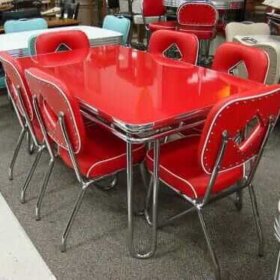
We have heard the same thing about appliances not being made to last for so many years. This frost me as they are not cheap. I will say we have great results with Frigidaire and Maytag. I am seeing more and more younger women getting and collecting Vintage. I have no idea what inspired them, but I, too, love most of it. We are building a new house and our children found a gray and red set like the yellow one in the picture; it took about two years for one to be found. The chairs were “orange” from not being protected from the sun, but we were fortunate enough to find someone to recover them, plus put more padding. My husband found the same identical brads, on the Internet, and they are so pretty. The table has a leaf, which is also hard to find. I will use Vintage Fiesta dishes, collected for years, and incorporate this one area into Vintage. Hopefully, once the house is finished, I can take pictures and post. I will say that Vintage Pyrex and other things are getting harder and harder to find. Rake through your grandparents and elderly relatives cabinets if you want to collect.
Justin says
Nice refrigerator. I myself have a couple vintage refrigerators; 1949 Hotpoint, 1958 Revco wall fridge and freezer, and a 1964 G.E. Americana. The Hotpoint was white when we purchased it, but to match with our kitchen we had it painted by an automotive painter, pink. The Revco are actually two separate units. I pulled them out of the original house, before it got tore down. They are both the brushed steel/stainless steel. The Americana fridge is the one that has the freezer at the bottom and the French door refrigerator above, with a little counter top in the middle.
michelle says
I am getting rid of the dishwasher in the tiny kitchen. In it’s place will be an under counter fridge/freezer. I am also downsizing the stove to an apartment size. There is a washer in the kitchen. Home was built in the 50’s does anyone know if it was common to put a washer in the kitchen? I got rid of the dryer and have an outdoor clothes line. I share my home with pets.
Pam Kueber says
I think it was not uncommon to put a washer and dryer in the kitchen. Not super-common, but done. We’ve seen photos of this in ads.
Llalurie A says
All the houses were identical in the neighborhood I grew up in. Built in the 50s, they had 3 bedrooms, 1 bath and no basement. They all had the washer in the kitchen and the dryer in the garage. And of course everyone hung their clothes out to dry in the summer.
Roseann says
Me, too, a Levitt ranch!
Joe says
My parents bought their craftsman bungalow in 1947. Mom had the kitchen expanded four times its original size in 1954. Bought her first washing machine in 1955 (she actually enjoyed washing clothes by hand!). By then, everyone in the neighborhood had put their washers and dryers down in the basement, because the home magazines suggested that was more modern than the kitchen. My mom said heck no to that – she said it was more efficient to keep it upstairs. Said it saved time, steps and was a more efficient water/sewer connection. I grew up with the arrangement and wouldn’t have it any other way. When I did my MCM remodel of the kitchen 2 years ago, I went to great lengths to make it look “blended” like back in the day when it was common practice. Now fashion has come full circle. Younger folks who only knew laundry rooms in the basement are now seeing my arrangement, and they’re redoing their kitchens to put the washer/dryer in it! I can tell you that today’s washers and dryers are super quiet and don’t vibrate – that’s probably why they originally were isolated downstairs.
Jay says
All the houses in my 1957 neighborhood of ranch houses were built with an alcove open to the kitchen that contained space for the washer and there was a utility tub. The utility sinks were usually removed to accommodate a dryer. Over the years some people have relocated the laundry to the basement but it requires a sump pump to drain the washer to the sanitary line in the crawl space which is four feet above the basement floor. Some added great rooms to the house and created a separate laundry space. There were many postwar subdivisions built outside Phila. that were capes or ranches built on slab with buried hot water pipes for heat so laundry equipment and heaters were in/adj to the kitchen.
Diana says
Yes, my son’s family live in a home built in the early ‘50’s and the washer/dryer was in the kitchen separated by the stove wall. The hot water heater was there as well in a closet.
Holley says
Yup – we bought our dishwasher two years ago — now it’s ‘toast’ — I love the photo you provided – especially with the new ‘fandangled’ microwave snuggled in right next to the old reliable fridge. Old world meets new — I’m sure the microwave will break down before the fridge ever does! ❤️
Steve H says
With appliances nowadays the emphasis seems to be energy efficiency, which is fine and understandable. However I would think that most of the energy usage originates in the initial manufacture of the appliance (and subsequent disposal of the old appliance it will replace). It just seems like in the long run, an appliance that is made to last longer is more energy efficient. Our 1995 Bosch dishwasher still works fine – probably because we rarely use it. I feel that for just two people it’s a lot quicker and easier to wash dishes by hand. Typically I have a pot or pan that needs hand washing anyway, so why not just do it all. Who wants to unload the dishwasher at 9 at night?
Pam Kueber says
Thanks for your comment, Steve. Also re: Energy Efficiency, I have read that “size matters”. I believe what I read is that the EnergyStar ratings are done by size — comparing like with like. So, the larger your appliance the more energy it may use.
Looking at cost of manufacture etc is also important, I tend to think. In the sustainability world, there’s a thing called Life Cycle Assessment (I believe that’s what the A stands for) — that demands the verified measure of start-to-finish energy consumption. My proxy tends to be: cost. Yes, if we need to replace every 5-10 years, how much did it cost overall including initial purchase including tax and delivery, labor, and electricity during use. More cost = more carbon.