

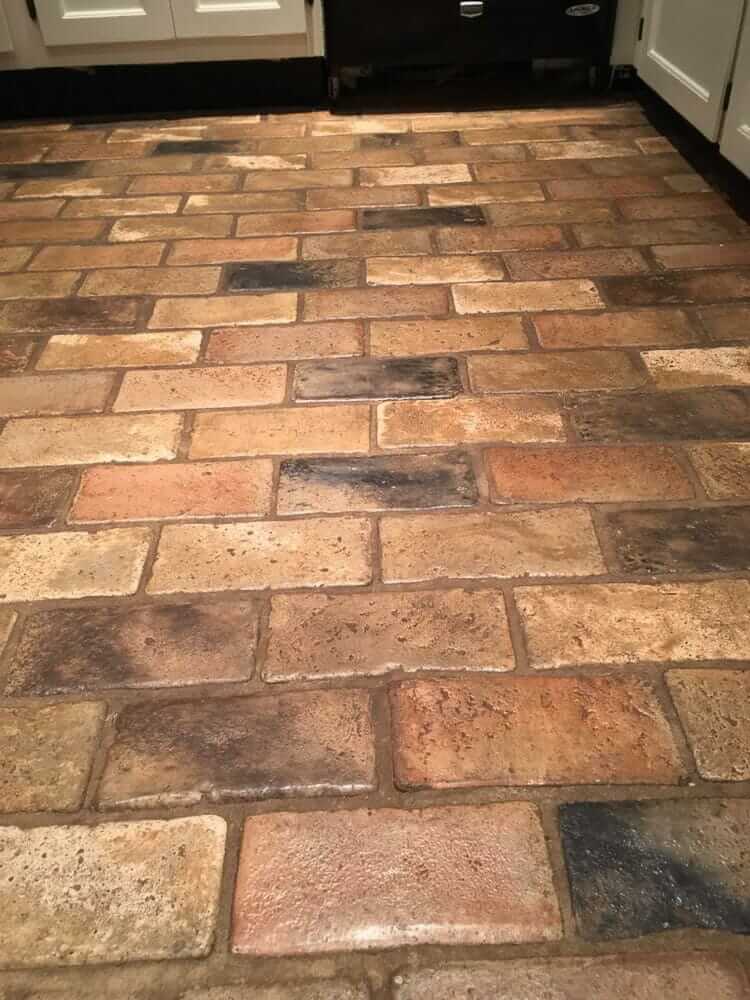
 Brick tile flooring: Is it appropriate for a mid-century home? And… do we like it? Marie writes:
Hi Pam,
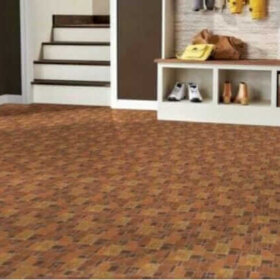
Need to pick your brain. We’re in the process of buying a home from 1950. It’s got a lot of original details. I’m trying to figure out if the kitchen floor is original. It’s a glazed brick tile. To me it looks 90s, and I don’t like it… but maybe it is original? My aunt an uncle live in a house built in the early 60s, and it has a similar glazed brick floor in the entry and kitchen. Was glazed brick a midcentury thing?
Thanks!!
Marie
Congratulations, Marie, on the new/old house, and thank you for sending this question.
My answer:
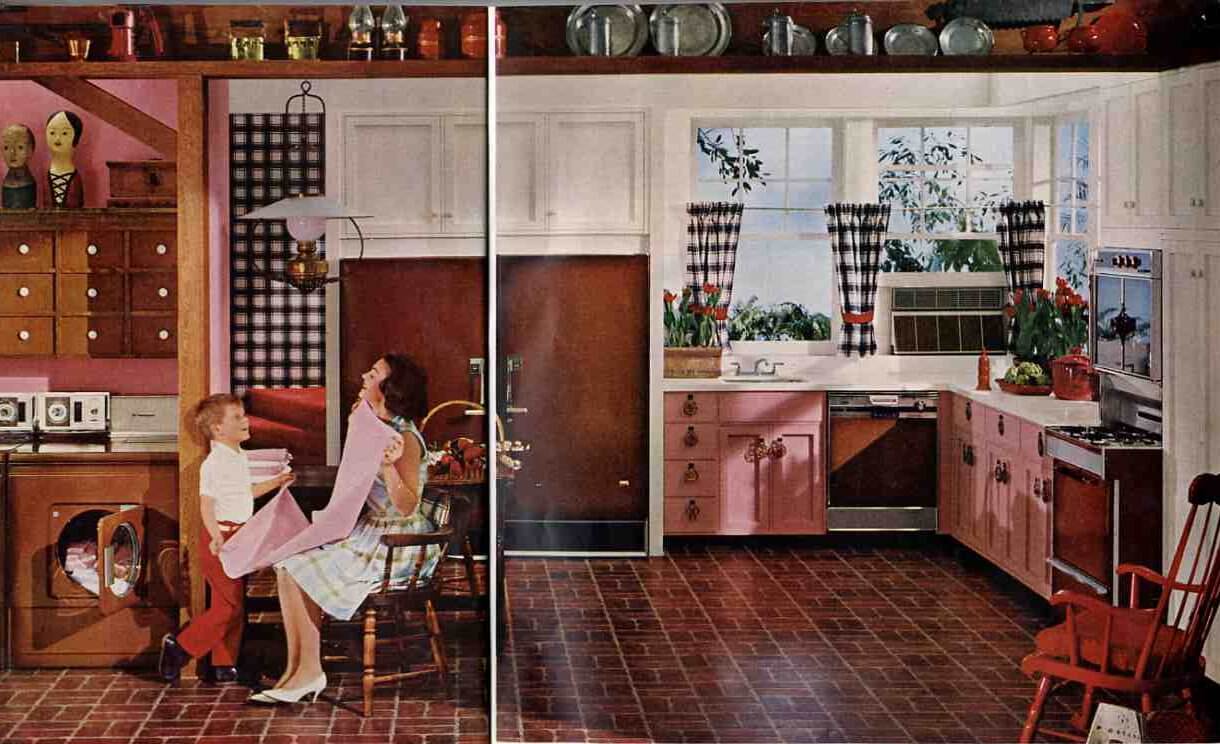
My archives indicate that glazed brick flooring — either with real clay bricks or in a vinyl/asbestos or vinyl/composite resilient floor tile — were used in the midcentury era all the way through to… well, yes, the 1990s. The brick tile flooring in your house could well be original.
Personally, I adore the look. Brick is warm and inviting, and it’s a neutral that can be matched with ‘most any style of cabinetry.
One downside to clay brick flooring would be that it could be hard on the back, like any ceramic tile would be. On the upside, though, real clay brick flooring is virtually indestructible — and golly, why wouldn’t you want flooring that would last forever and save so much money never needing to be replaced. Note, the old vinyl flooring also lasted a long long long time, I think — this stuff was made back in a time when “planned obsolescence” was still not necessarily a manufacturer’s de facto mode of operation. That is: Folks expected quality. Folks expected stuff that would last a long, long time — and were willing to pay for it.
Should it stay — or should it go? Well, here is my regularly repeated answer: Sometimes we get shocked by an old design, an old look, that we’re not accustomed to seeing anymore. It’s not popular today. It may even be “despised” by the mainstream design world (which wants us to tear out everything old and install the new stuff that They Are Selling.) So because we are are unaccustomed to seeing the old, and because the new is so well-marketed, we decide that we, too, h*** the old.

However, if we hit the pause button, and take the time to learn about it, and see how it was used — and loved — historically, we may come to like, or even love, it ourselves. I suggest: Live with it a while before taking costly and irreversible steps. See: Just bought a mid-century house? My 9 tips before you start remodeling + 21 more tips from readers.



Ann says
yes, u should keep it. Anything you get today is not going to hold up like that floor. We have similar, but square poured floor in our 1958, I kept it and love it. Put down padded chefs mats in your standing/cooking areas. Always wait a while before changing things, those overall guttings require a lot of money and often lead to regrets. Spoken from experience…
carolyn says
Ann, I agree – put gel mats down where needed.
My only complaint might be cleaning. Made the mistake of scrubbing a linoleum floor only to find the dirt was filling in the worn-off color in the design. Wash it once and see what you’ve got, then remember for next time.
nutella says
I quite like it, but it would certainly need to inform the design of the rest of the space. It is by no means “quiet”.
Pam, what’s your source for the first image (1949 kitchen)? I am skeptical about the date on it, based on the clothes and hair of the models, and the window AC. It looks much more late 60’s to me.
Pam Kueber says
See caption – that’s a 1964 kitchen.
CarolK says
That 1964 kitchen is fabulous!
Lynne says
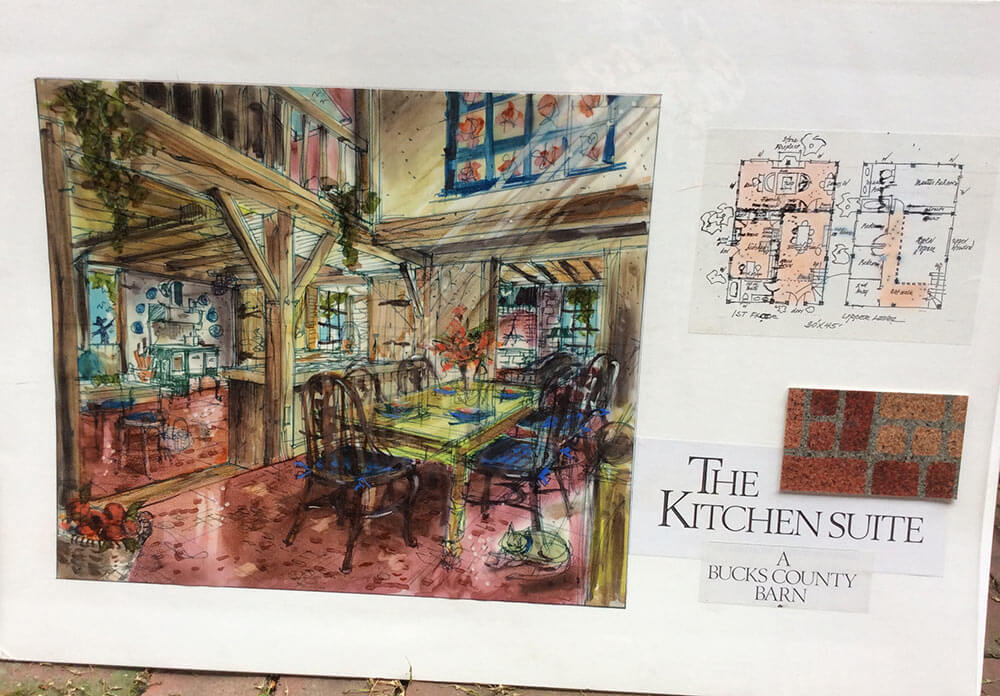
Without even a second of hesitation, I say KEEP IT !!! Pam has shown but two kitchens with brick flooring. In my vintage magazine and book collection, I have seen many brick floors in kitchens. Each one fabulous.
Nina462 says
Same here. It was quite popular in my magazine collections as well. I say keep it – you can always update with a throw rug for color.
Mikey says
If it ain’t broke, don’t fix it- and it looks perfect. That color can go with anything.
ineffablespace says
Without seeing more of the house I can’t say whether it’s original or not, but plenty of midcentury houses had brick or stone floors, and exposed brick walls on the interior. And country or colonial kitchens were popular from immediately after WWII as well.
Ethan says
I say yes, keep it.
Jasmine says
Definitely brick was “in” during the 60’s and 70’s. My mother actually covered our hard wood floors in the upstairs hallway with a faux brick tile. I also lived in a condo that was built in the mid 60’s that had a featured brick wall. Early American and colonial décor was very big then as well at modern so brick would have been a good match.
Beth Pierce says
Brick floors were definitely mid century. Much loved by those who favored Early American decorating style. Live with it, I would love to have something like it, but I don’t think anyone manufactures it anymore.
Genevieve Rainey says
I just saw brick veneer tile being sold at home depot. It has come back into style. I definitely would leave it.
Dan says
Very sensible reply. With any new home, first make sure the essentials – plumbing, electric, roof, drainage, etc. – are in good shape, then live with the rest for a while. Something drew you to this house; maybe that floor was part of the attraction without your realizing it.