

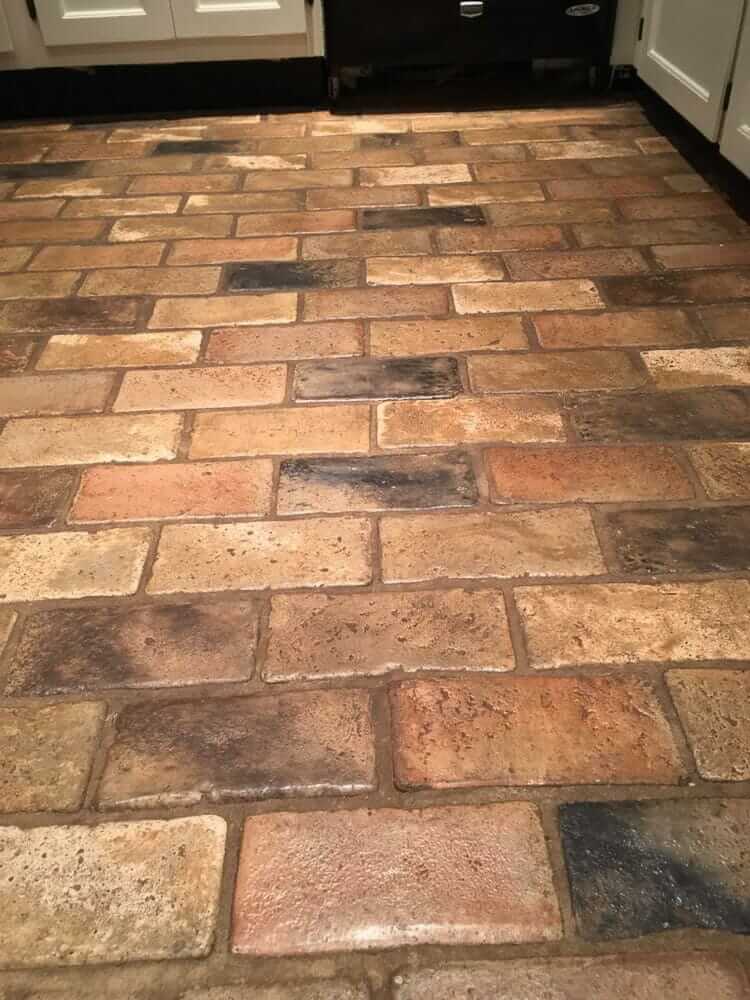
 Brick tile flooring: Is it appropriate for a mid-century home? And… do we like it? Marie writes:
Hi Pam,
Need to pick your brain. We’re in the process of buying a home from 1950. It’s got a lot of original details. I’m trying to figure out if the kitchen floor is original. It’s a glazed brick tile. To me it looks 90s, and I don’t like it… but maybe it is original? My aunt an uncle live in a house built in the early 60s, and it has a similar glazed brick floor in the entry and kitchen. Was glazed brick a midcentury thing?
Thanks!!
Marie
Congratulations, Marie, on the new/old house, and thank you for sending this question.
My answer:
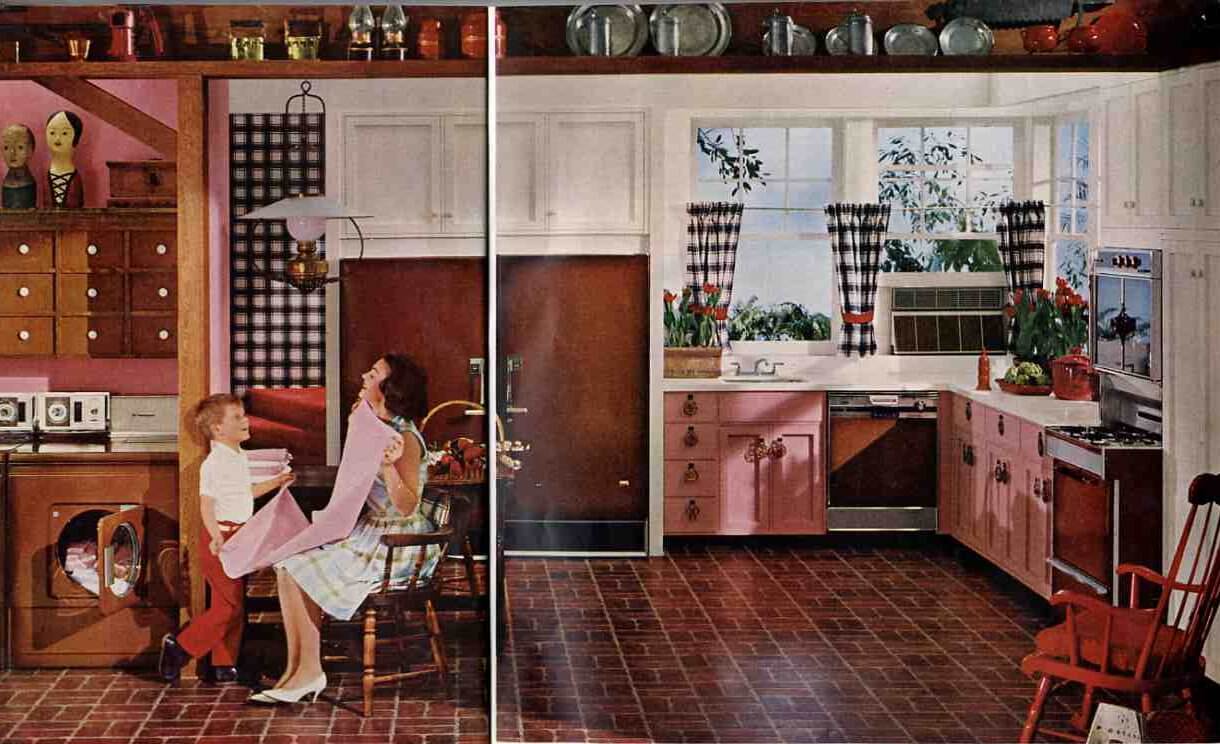
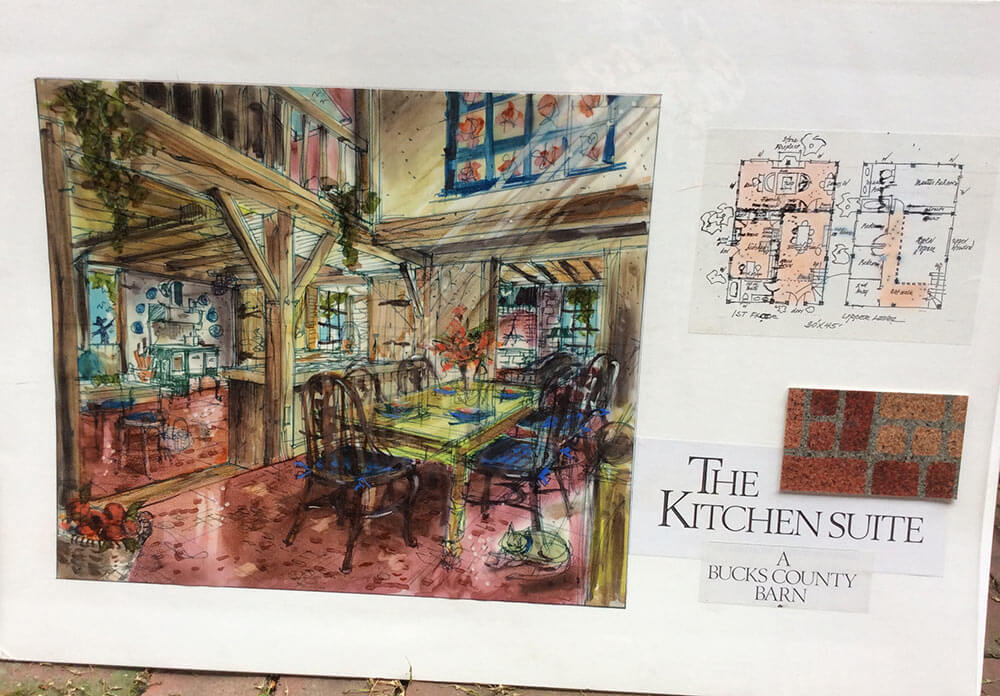
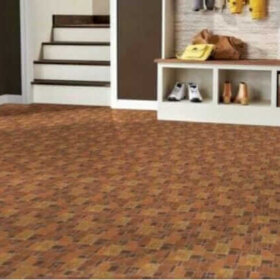
My archives indicate that glazed brick flooring — either with real clay bricks or in a vinyl/asbestos or vinyl/composite resilient floor tile — were used in the midcentury era all the way through to… well, yes, the 1990s. The brick tile flooring in your house could well be original.
Personally, I adore the look. Brick is warm and inviting, and it’s a neutral that can be matched with ‘most any style of cabinetry.
One downside to clay brick flooring would be that it could be hard on the back, like any ceramic tile would be. On the upside, though, real clay brick flooring is virtually indestructible — and golly, why wouldn’t you want flooring that would last forever and save so much money never needing to be replaced. Note, the old vinyl flooring also lasted a long long long time, I think — this stuff was made back in a time when “planned obsolescence” was still not necessarily a manufacturer’s de facto mode of operation. That is: Folks expected quality. Folks expected stuff that would last a long, long time — and were willing to pay for it.
Should it stay — or should it go? Well, here is my regularly repeated answer: Sometimes we get shocked by an old design, an old look, that we’re not accustomed to seeing anymore. It’s not popular today. It may even be “despised” by the mainstream design world (which wants us to tear out everything old and install the new stuff that They Are Selling.) So because we are are unaccustomed to seeing the old, and because the new is so well-marketed, we decide that we, too, h*** the old.

However, if we hit the pause button, and take the time to learn about it, and see how it was used — and loved — historically, we may come to like, or even love, it ourselves. I suggest: Live with it a while before taking costly and irreversible steps. See: Just bought a mid-century house? My 9 tips before you start remodeling + 21 more tips from readers.



Eartha Kitsch says
Since it’s her house, she should only keep what she truly likes – but I love it! Completely period appropriate. It would hide dirt like a champ too. I also agree to that you should live with something for at least a year before you get rid of it either way.
Robbie Kendall says
Sometimes the simplest, most cliched advice is what can be the most difficult to take in – in this case, “Love the house you’re in.”
Pam has given us a great gift with this command.
I bought a house three years ago (designed in 1932, built in 1939) and there is a lot that I would have happily, and expensively, changed when we first moved in. I came across this website before we closed due to a my Google search for “knotty pine” and because of this discovery held off on any real renovating.
I decided to wait for two years and “live” with the house to listen to its needs and become aware of what I could live with and what I *had* to change. I am surprised at how my initial feelings have changed. I have mellowed and what seemed important I can now live with.
In my specific case, the need, now, is to return the house to its roots as much as I can. I am lucky in that the house was designed by a beloved local architect, Benjamin Franklin Olson. My duty, as long as I live in this house is, like a doctor, to do no harm. I am choosing to live with the current kitchen, which was gutted by each of the previous owners; I am only the fourth. Someday, I’ll find original metal cabinets, etc. For now, I have all of the original 75+ year-old plumbing to replace, the gas lines, and later the electrical lines. Currently, I’m starting the work to replace all of the insulation. Pam is quite correct, as pleasing as it is to change/improve the look of a house, it is most important to take care of the infrastructure first.
Ranger says
Sage advice! I too was ready to gut the original bathroom on my 1948 home when I moved in. So glad I saw the light and just restored what was necessary.
Jennifer says
I live in a Southwestern adobe home, built by the (maybe) original adobe-style revivalist, Leon Watson. He built in the 1950s and early 60s. Most of the homes he built were ranch houses with typical ranch stylings blending with the typical adobe stylings. Most of the houses had radiant heating, and nearly all had brick floors. We just had our brick floor deep-cleaned and re-sealed. We love our brick floors, and would not trade them for anything. (These are real bricks, not ceramic.) I tend to go barefoot a lot and I cook a lot, and I personally don’t find them nearly as hard to stand on as tile, which I’ve had in previous homes.
Pam Kueber says
True ranch houses — ranchos!
lynda davis says
Look on Houzz for some ideas. Put in brick kitchen floor in photos to search for pictures. I think a green might go nicely with the brick floor. The Lone Oak House on Houzz shows a kitchen with the green and brick combination.
lynda davis says
From the picture you have shown us, it really looks like it is in great shape. Just do google images of kitchens with brick floors for inspiration. I think you can work with it and you will be happy you did in the end. You know Pam’s saying–“love the house you are in”.
cc says
Another plus to brick is it will pick up and blend into the colors around it. If you don’t care for your floor, you might want to think about changing up the colors of your kitchen first. We had what appeared to be some pretty hideous brown brick on our last house, but painting the house a different color toned down the brown and brought out the other colors. The brick looked great!
Debbie in Portland says
Live with it for a while before you make any decisions. You are never going to find flooring of that quality again. You might grow to love it so much that you design a whole kitchen around it! Then again, you might decide that you can’t tolerate it another minute, and embark on your own Retro Renovation journey. Keep us posted either way!
Karin says
Great advice, Pam. I agree, keep it.
Shelley says
Also here to thank Pam for her reply, both in terms of learning-to- love-it, and the demise of quality, meant-to-last construction. It’s such a bummer to see solid, quality components ripped out of a house and replaced by the (usually) flimsy, poor quality fad of the moment.
Laura's Last Ditch Vintage Kitchenwares says
I love it! If it’s well installed, I’d definitely keep it. If a more modern botch job (we had one of those on our kitchen floor), then out it could go.