

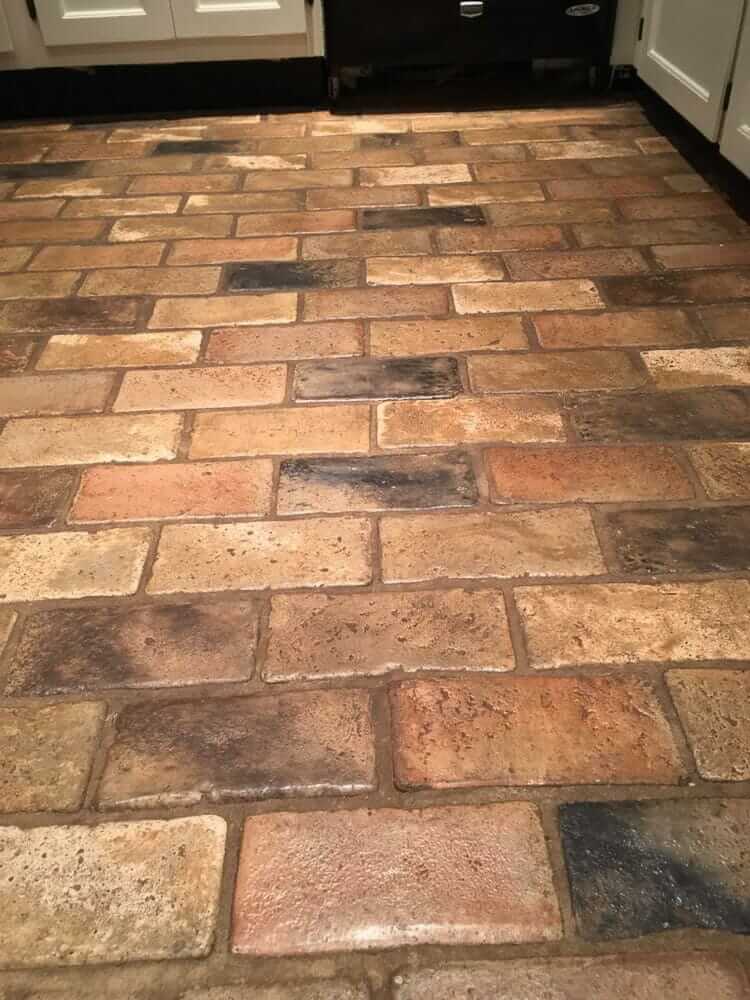
 Brick tile flooring: Is it appropriate for a mid-century home? And… do we like it? Marie writes:
Hi Pam,
Need to pick your brain. We’re in the process of buying a home from 1950. It’s got a lot of original details. I’m trying to figure out if the kitchen floor is original. It’s a glazed brick tile. To me it looks 90s, and I don’t like it… but maybe it is original? My aunt an uncle live in a house built in the early 60s, and it has a similar glazed brick floor in the entry and kitchen. Was glazed brick a midcentury thing?
Thanks!!
Marie
Congratulations, Marie, on the new/old house, and thank you for sending this question.
My answer:
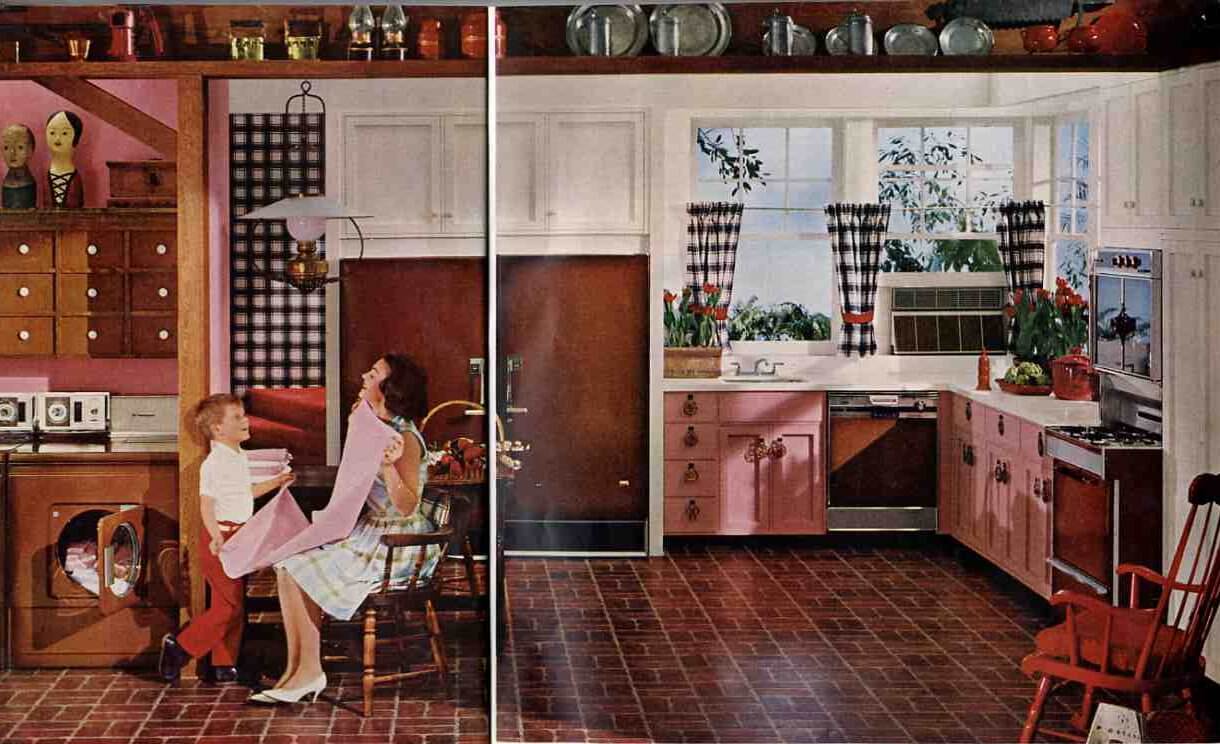
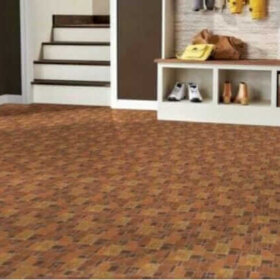
My archives indicate that glazed brick flooring — either with real clay bricks or in a vinyl/asbestos or vinyl/composite resilient floor tile — were used in the midcentury era all the way through to… well, yes, the 1990s. The brick tile flooring in your house could well be original.
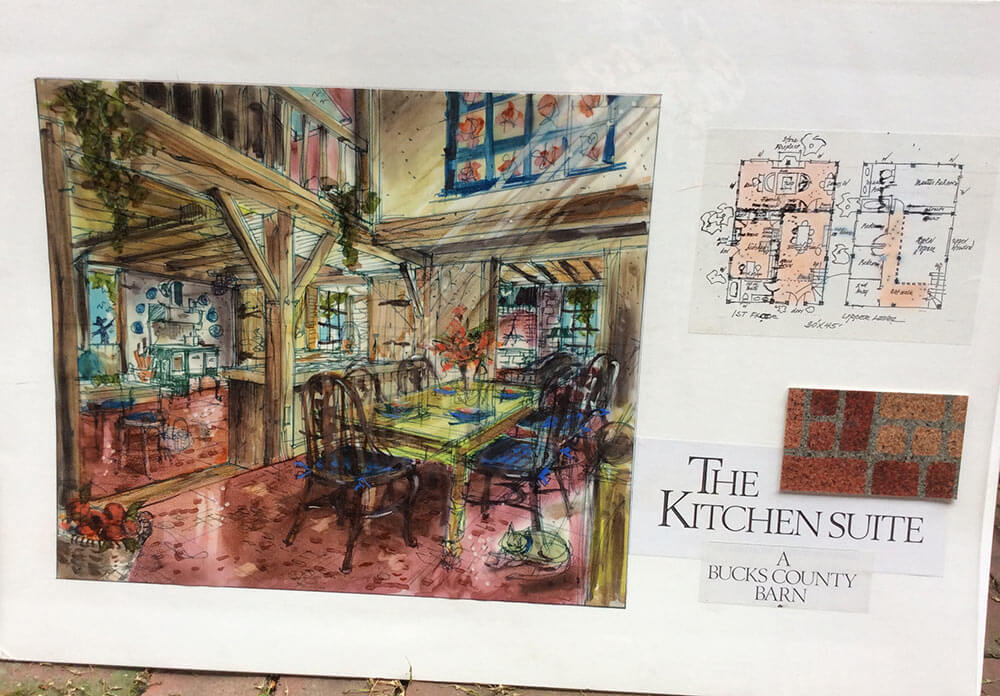
Personally, I adore the look. Brick is warm and inviting, and it’s a neutral that can be matched with ‘most any style of cabinetry.
One downside to clay brick flooring would be that it could be hard on the back, like any ceramic tile would be. On the upside, though, real clay brick flooring is virtually indestructible — and golly, why wouldn’t you want flooring that would last forever and save so much money never needing to be replaced. Note, the old vinyl flooring also lasted a long long long time, I think — this stuff was made back in a time when “planned obsolescence” was still not necessarily a manufacturer’s de facto mode of operation. That is: Folks expected quality. Folks expected stuff that would last a long, long time — and were willing to pay for it.
Should it stay — or should it go? Well, here is my regularly repeated answer: Sometimes we get shocked by an old design, an old look, that we’re not accustomed to seeing anymore. It’s not popular today. It may even be “despised” by the mainstream design world (which wants us to tear out everything old and install the new stuff that They Are Selling.) So because we are are unaccustomed to seeing the old, and because the new is so well-marketed, we decide that we, too, h*** the old.

However, if we hit the pause button, and take the time to learn about it, and see how it was used — and loved — historically, we may come to like, or even love, it ourselves. I suggest: Live with it a while before taking costly and irreversible steps. See: Just bought a mid-century house? My 9 tips before you start remodeling + 21 more tips from readers.



Joe says
Those brick and stone veneer floors were all the rage from about 1963 through the early ’80’s. It came into vogue when kitchen appliances lost their “candy colors” and lasted until “earthtones” were dropped in favor of black lacquer and almond. If the floor is in good condition, you’d be certainly foolish to remove it. When these floors were popular, the appliance colors were in the new earthtones of coppertone, avocado, harvest, and poppy. Unless you have the money to spend on Big Chill appliances in retro colors, you should get a new appliance suite in white or stainless. Keep your white cabinetry, just swap out the hardware for antique copper with white appliances, brushed nickel or black with stainless steel. Heck, if you’re adventurous, consider painting your cabinetry in a colonial blue or a sagey green! If you have an expanse of wall, wallpaper in a vintage colonial motif. Or a border in a colonial/kitchen motif. All you really need to finish it off is a braided runner rug for in front of the sink. You’ll have a nice mix of new and vintage. It’ll suit the age of the house and the floor, yet still feel like it has a foot in the door of the 21st century.
DJ Sparkles says
I love it!!! I’m on the “Oh, please keep it” side! At least live with it for a while and then make a decision.
And I love the kitchen Pam shows in the first ad, with the two-toned cabinets. Funny how that’s now the “big trend”. 😉
I actually prefer my cabinets to match, but I’d take that kitchen in a heartbeat!
Maria says
I think what might be throwing you here is that it’s not a brick floor, it’s a tile floor in a brick pattern. That being said, do you like it? Because that’s what counts. It would be messy and not inexpensive to tear it out, but if you are on a slab could be done without too much trouble (but lots of dust!). Floating a new floor on top would likely cause height problems where it meets up with surrounding flooring and doubt a reputable flooring person would advise it.
Lynne says
I know I commented before, but I’ve had time to ponder. Marie, I wonder if you dislike the floor because it appears to be in sharp contrast with the other elements in the room. The picture is small, but it looks like the cabinetry is bright white. I believe a warm wood cabinet, or even painting the white to a more compatible color would help greatly. A dark honey, or even butterscotch tones would blend nicely.
Jackie says
I completely agree with Lynn – I’ve seen too many mid-mod homes ‘update’ the kitchens to the current popular style of white cabinetry, stainless steel, stark industrial look – and it looks completely out of place in these houses! Keep the warm brick, and bring the rest together to work with it. It is beautiful, indestructible and timeless.
Robin, WA says
Kind of off topic but I was snooping around looking for vinyl flooring with patterns and I discovered a company that has some interesting patterns including some that look like the tile patterns from the 70s. This company also does custom orders including custom color combinations using their patterns or creating a pattern to your specifications (I wonder if they could reproduce the 1950s linoleum in my house). I have no idea what the texture of the product is like but I am intrigued by what they offer. https://www.atrafloor.com/
Bee says
Even if it’s not the original floor, it’s an indestructible and timeless look. The quality looks amazing as well. Keep it for sure!
Amber Rhea says
Definitely keep it!!
Penny in CO says
On an early sixties house we lived in, there were brick-patterned vinyl-asbestos tiles in the kitchen.
In the kitchen of our current mid-fifties house, in 2011 we replaced the 80s blue & yellow sort-of-Indian (maybe Mediterranean?) patterned sheet vinyl with rock & pebble-patterned heavy sheet vinyl. Some of the 80s stuff was damaged, and when it was pulled up, what was underneath but the rock & pebble-patterned original vinyl? linoleum? flooring!!! Maybe even that top-middle sample from the 10 samples above!
Marta says
I want that floor in my kitchen! I have seen this type of floor in houses going back to the early sixties. I don’t recall before that because I was too young! I know of one wonderful sixties time capsule house with that type of floor in the kitchen and other places and it is perfection. As Pam recommends, live with it and then decide.
cathie says
I cannot even imagine the mess that would be involved in ripping this out. On that basis alone, I’d keep it. But I do like it, its unique. If you want it gone, you could easily install a floating floor on top of it. It would first have to be levelled out, but from what I understand that’s quite easily done.