

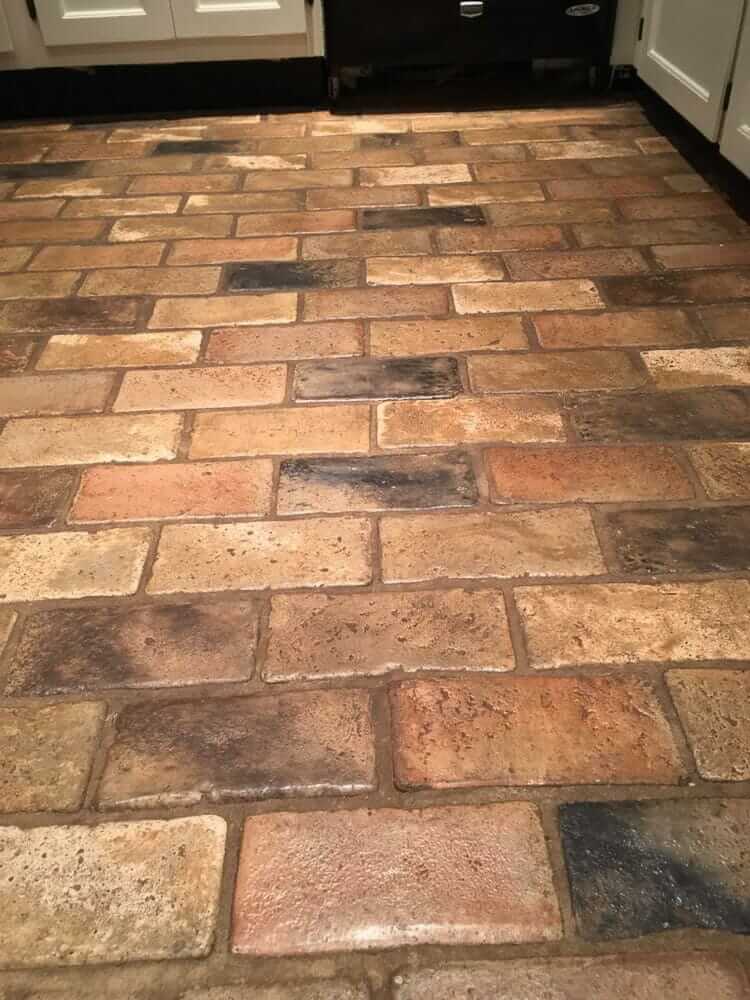
 Brick tile flooring: Is it appropriate for a mid-century home? And… do we like it? Marie writes:
Hi Pam,
Need to pick your brain. We’re in the process of buying a home from 1950. It’s got a lot of original details. I’m trying to figure out if the kitchen floor is original. It’s a glazed brick tile. To me it looks 90s, and I don’t like it… but maybe it is original? My aunt an uncle live in a house built in the early 60s, and it has a similar glazed brick floor in the entry and kitchen. Was glazed brick a midcentury thing?
Thanks!!
Marie
Congratulations, Marie, on the new/old house, and thank you for sending this question.
My answer:
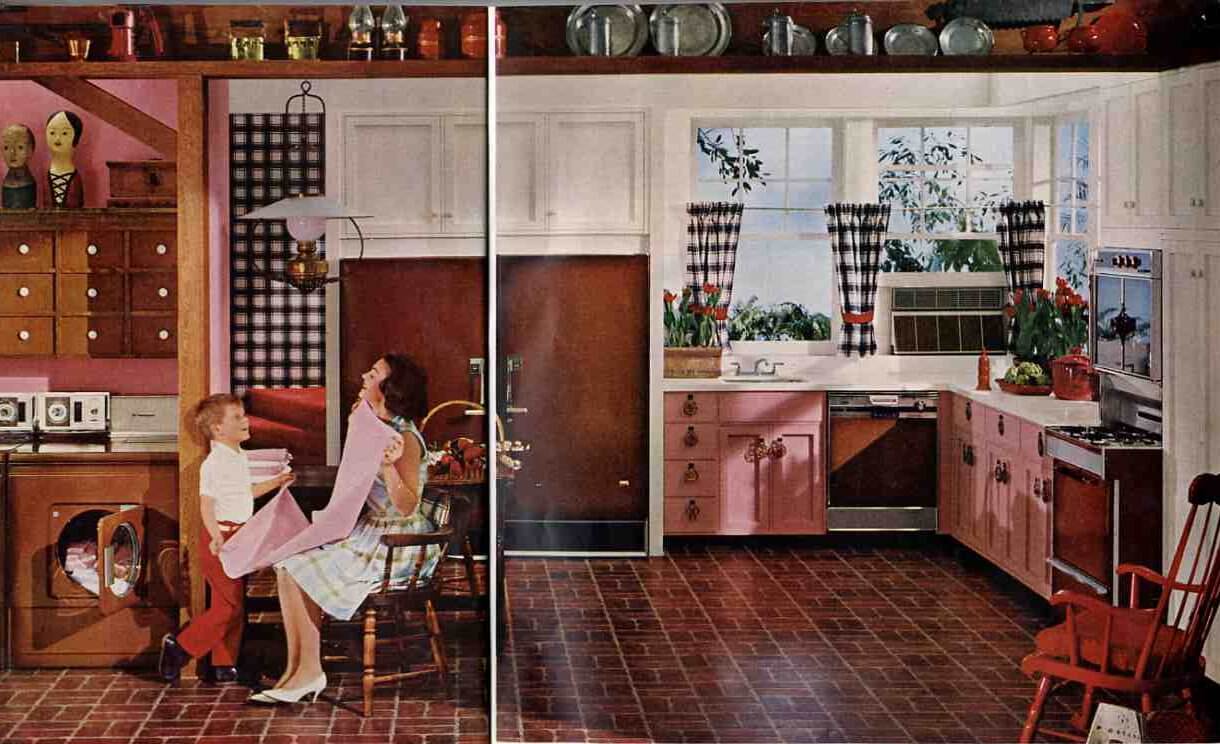
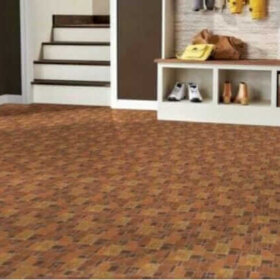
My archives indicate that glazed brick flooring — either with real clay bricks or in a vinyl/asbestos or vinyl/composite resilient floor tile — were used in the midcentury era all the way through to… well, yes, the 1990s. The brick tile flooring in your house could well be original.
Personally, I adore the look. Brick is warm and inviting, and it’s a neutral that can be matched with ‘most any style of cabinetry.
One downside to clay brick flooring would be that it could be hard on the back, like any ceramic tile would be. On the upside, though, real clay brick flooring is virtually indestructible — and golly, why wouldn’t you want flooring that would last forever and save so much money never needing to be replaced. Note, the old vinyl flooring also lasted a long long long time, I think — this stuff was made back in a time when “planned obsolescence” was still not necessarily a manufacturer’s de facto mode of operation. That is: Folks expected quality. Folks expected stuff that would last a long, long time — and were willing to pay for it.
Should it stay — or should it go? Well, here is my regularly repeated answer: Sometimes we get shocked by an old design, an old look, that we’re not accustomed to seeing anymore. It’s not popular today. It may even be “despised” by the mainstream design world (which wants us to tear out everything old and install the new stuff that They Are Selling.) So because we are are unaccustomed to seeing the old, and because the new is so well-marketed, we decide that we, too, h*** the old.

However, if we hit the pause button, and take the time to learn about it, and see how it was used — and loved — historically, we may come to like, or even love, it ourselves. I suggest: Live with it a while before taking costly and irreversible steps. See: Just bought a mid-century house? My 9 tips before you start remodeling + 21 more tips from readers.



SusanG says
Word of caution: LIVE WITH IT…for a while at least. Straying a little, but…when I married my hubby 7 years ago, I moved into his house (circa 1960s) that he inherited from a beloved uncle. Of course, the house was replete with a pink bathroom, a green bathroom, terrazzo flooring, etc., etc. – ALL in various stages of condition (the colored tiles, tubs, sinks, toilets, were in almost pristine condition; the terrazzo, not so much). Upon first moving in, I’m thinking “ugh, all of this will have to be torn out, replaced.” Then…I stumbled upon Save the Pink Bathrooms, and it changed my life. Really. I have come to appreciate the quirky (by today’s standards) look and feel and the QUALITY of the materials and craftsmenship of that time. I have since plunged deeply into everything mid century, retro, etc. and never looked back. I love the connection I feel to my childhood because this home takes me to that time. Hold off a little bit, you can always change it up if after living with it for a little while you still decide it’s not your cup of tea. (BTW, we had the terrazzo floors diamond grinded, and they are beautiful. To think I wanted to cover them up!)
Marie Gamalski says
Susan…..color me pea green w/envy….I’ve dreamed of terrazzo floors FOREVER….sigh…glad you’re loving them?
Bree says
A big NO! It’s stodgy and just plain unattractive.
Ben says
I have been searching for a rich, red, brick-like vinyl/linoleum flooring for my kitchen…color me brick-red (not green) with envy! 😀 Depending on whether it’s real tile or a sheet product, tearing it up may range from relatively pricey to exorbitantly expensive, so I agree with Pam–share the space with your floor until you’ve had time to decide what works (and what doesn’t) in your kitchen…and then remodel it on what you know you want when the time comes. You might decide the floor is worth replacing–or you might decide it’s the only thing you want to keep!
sally costik says
we bought a house with a brick tile floor in the dining room. LOVED it. So cool on the feet in the summer, virtually indestructible with four little kids, easy to clean, and looked great. It had been covered over with a cheap wall to wall rug – what a great surprise when we tore that rug up. Our home was built in the mid 1960s.
Annette says
Keep the floor! If it’s bothering you, get a long runner to cover parts. I bought a 2×8 ft braided runner, jute and denim, because my 1960’s kitchen floor was jarring to me. It does the trick. Way less expensive than tearing out and replacing.
Rebecca says
Our 1973 (later than your period, but definitely looks mid-century) living room addition has a floor made of salvaged bricks–irregular but a gorgeous look. However, the bricks were never glazed but left original, making the floor REALLY hard to clean; a brush is necessary to get into all the nooks and crannies, and this is a large room. Had not thought of glazing the brick.
People who live with glazed brick: how difficult is it to clean?
Mary Elizabeth says
I love the look of the floor–which I believe is real brick, not tile, because of the texture and irregularity of the surface. I agree with some who say that the contrast with the cabinets is part of why it looks odd. I would paint the cabinets an historical colonial color, such as Benjamin Moore Saybrook sage or Jamestown Blue or Salisbury Green. The only thing that would stop me from keeping or installing such a floor in my home is the very irregularity of the surface that gives it its charm. I am too clumsy not to trip on it. As for wear and tear on the body from standing on it, well-placed mats at the sink and wherever else you stand would help that.
Barbara says
I love the floor. The colors are so warm and it is so durable and easy to maintain, unlike many contemporary kitchen flooring choices (I had to get rid of hardwood in my kitchen because it wouldn’t stand up to four kids, two dogs and snow tracked in.) I would work around it from a decorating viewpoint.
Jukesgrrl says
My parents built our family’s Cape Cod house in 1952. A sheet vinyl in a dark red brick pattern was the second kitchen floor they installed after a different pattern original to the house wore out. My mother was big on the 1960’s style known as “Colonial.” She had things like benches, pottery from Williamsburg, and milk cans in the kitchen. There was a convex mirror and a big gold eagle on the walls in the family room. She favored flax-type fabric for curtains and braided rag rugs on the floors. Furniture was either maple or she painted it with a technique called “antiquing” which was a medium-toned color with a dark glaze over it to make it appear old. She had several friends who also adhered to this style so it must have been popular.
Sully says
Brick floors are DEFinitely period-correct. I have them in my house (1964), as do many of my neighbors. Marie’s bricks in particular are Chicago Antique bricks. As buildings in Chicago have been demolished over the last 100 years, the bricks were chipped and reused in houses all over the country, and were very popular in the 60’s and 70’s. There’s a good chance that these bricks are 100 years old or more. The floor has to be lowered for their installation, so replacing them would be a serious job that would require a framer.