• 16 vintage Kohler kitchens — and an important kitchen sinks still offered today

    Let me take you on a little stroll though kitchen design history from the 1930s though the 1950s — with this terrific series of images from Kohler. Vicki Hafenstein of the media relations team at Kohler is really helpful and responsive, and quickly supplied these vintage kitchen photos and illustrations to help with the etsy.com video. She is also hunting some pink bathroom illustrations for my talk in Charlotte. I really appreciate your help, Vicki!  I also wanted to take this opportunity to remind everyone that Kohler makes two hudee-rimmed porcelain-on-cast-iron sinks still available today — they would be my top choices for a Retro Renovation kitchen. Oh, and have I ever mentioned that when I found my 67 vintage Geneva steel kitchen cabinets, the former cooking-school set also came with four vintage, 42″ wide, double-bowl, hudee-ringed Kohler sinks? One is now installed in my kitchen.

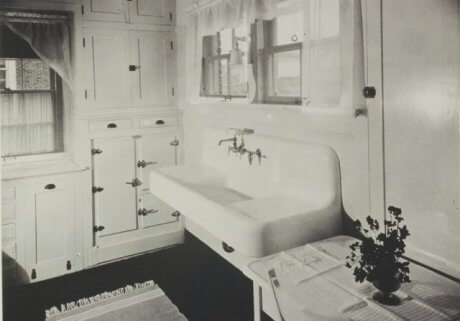
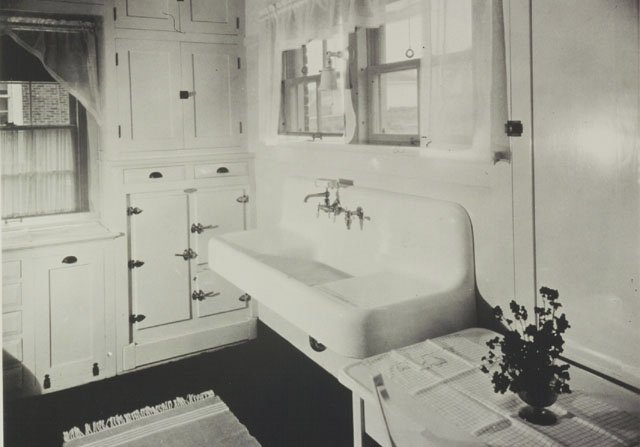
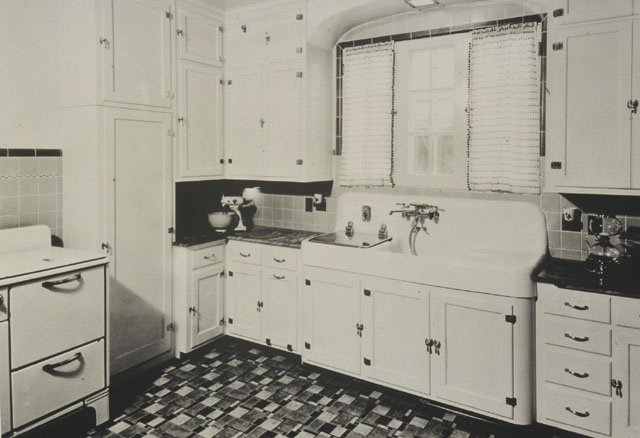
    These first three images show old, farmhouse style sinks. I don’t really understand the design evolution of sinks. I am pretty sure they were all heavy cast iron, because that was the dominant metal-making technology. Honestly, these have kind of a “trough” feel to me, I am guessing they are in fact derived from designs originally used on farms. I need to do more research… The design above shows how the sink was not necessarily integrated with the cabinets.

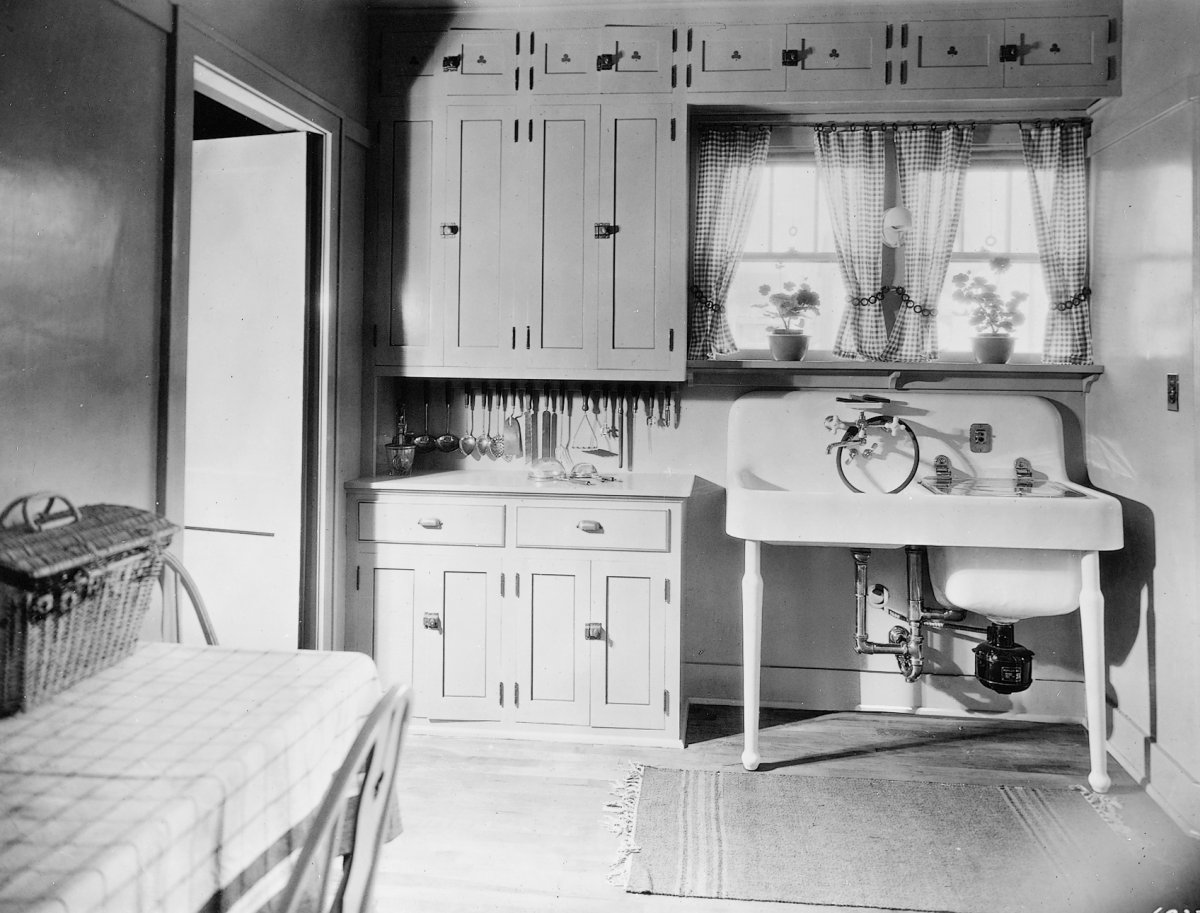
    Here we have a little evolution – the sink at least is tucked along the same wall as the cabinets, and it has legs. Look at the deep bowl, which also has a hinged top.

    This looks like a bungalow kitchen. You see further integration of the sink into the cabinetry — a clear line in the evolution of “fitted kitchens.”
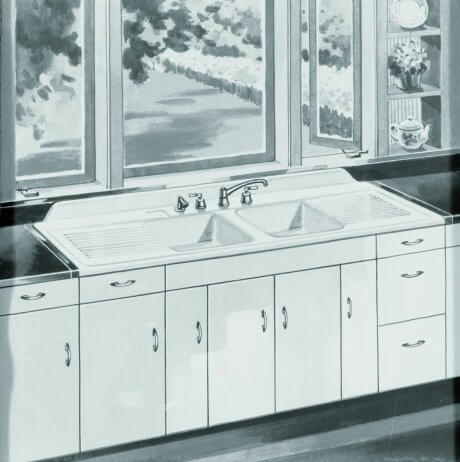
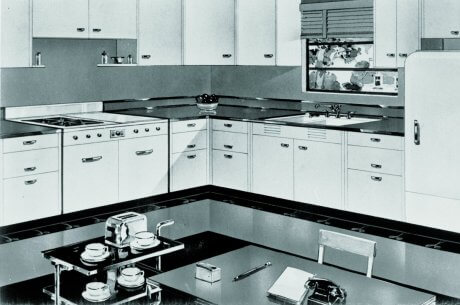
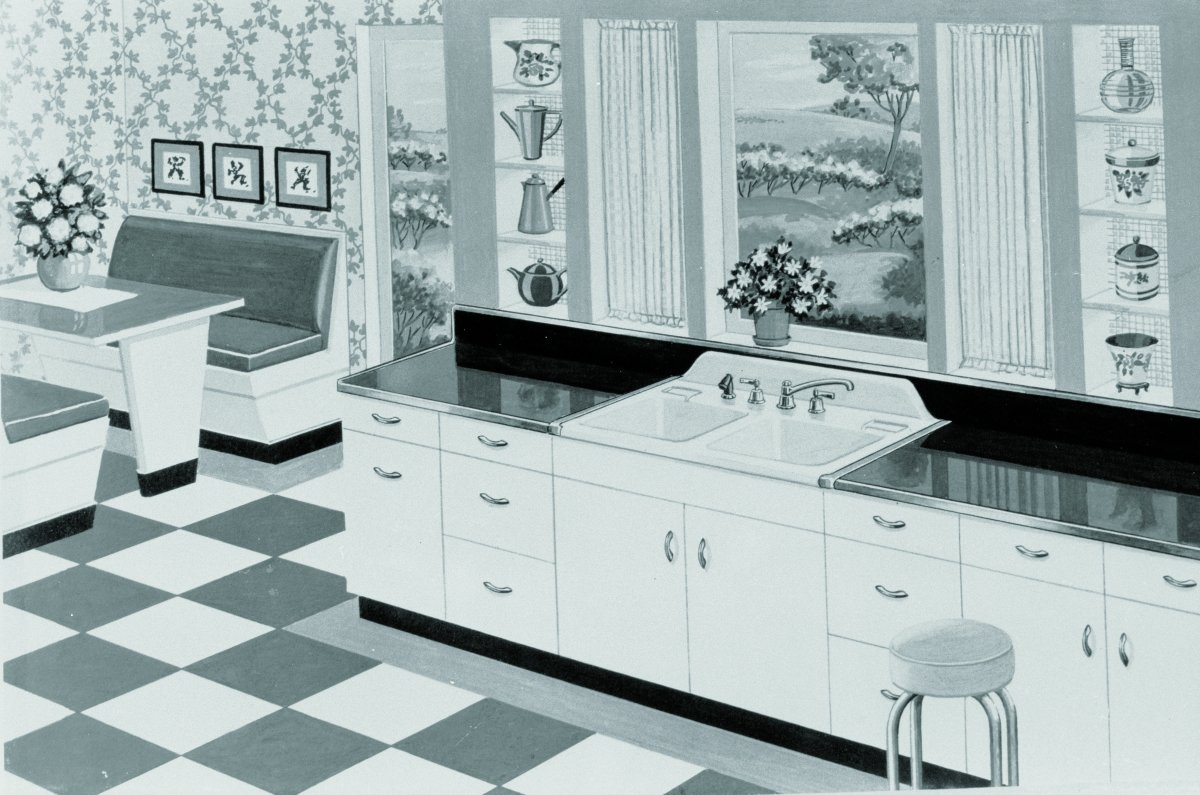
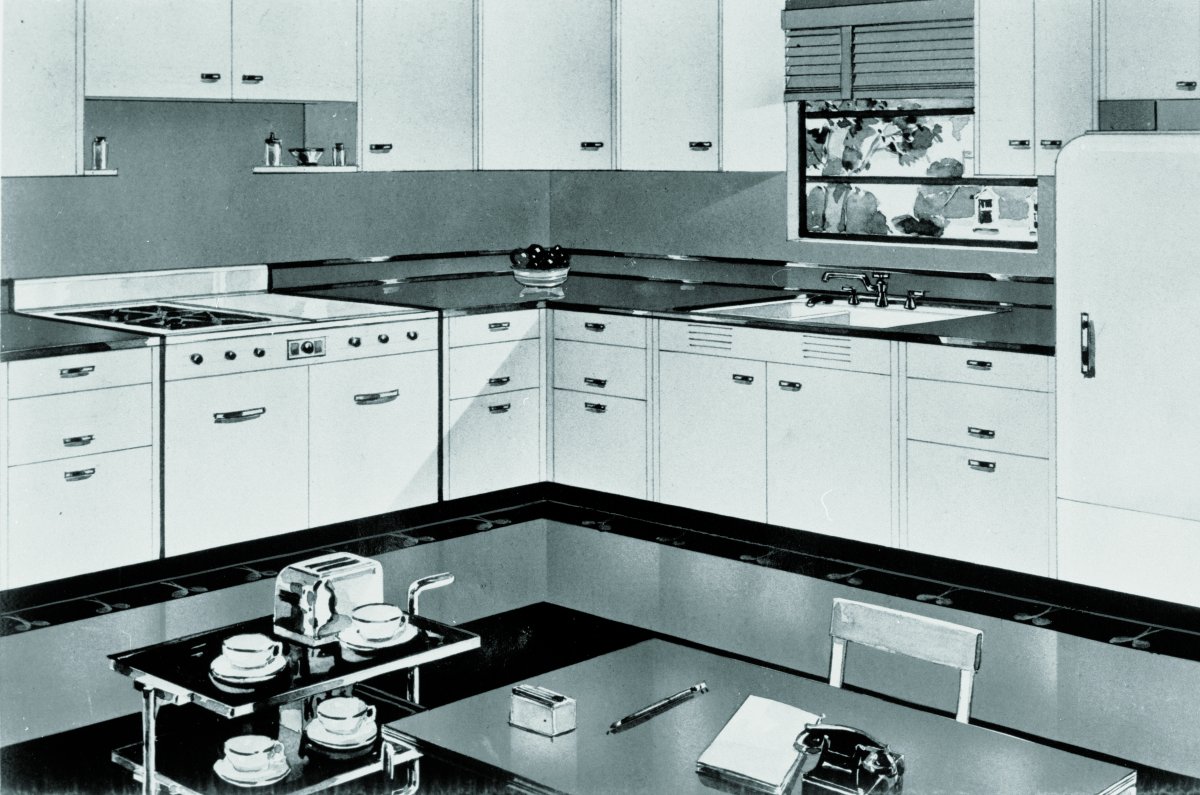
    I love this illustration, which I am guessing comes from the 40s, I’d say. The way the linoleum (probably) counter is fitted to the sink — with that stainless steel strip — is a giveaway that this is an earlier-postwar-era kitchen. Did you know that Kohler also made steel kitchen cabinets at one point? I am pretty sure these are theirs.
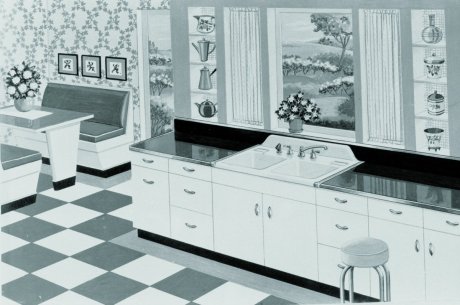
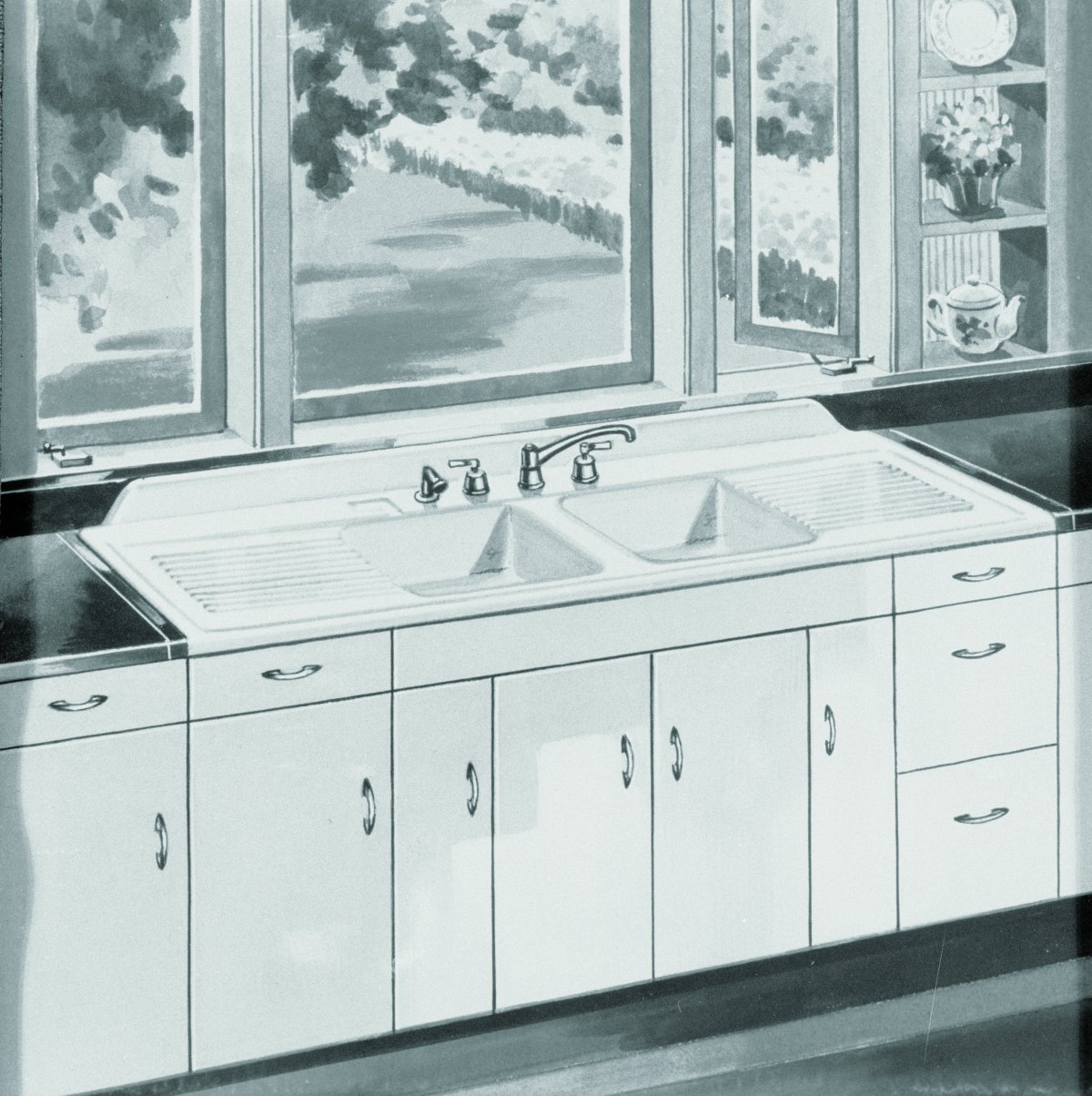
    This looks to be the same sink as the one above – without the drainboards. Late 40s and early 50s kitchens were much more likely to have built-in banquettes or dinettes and such. Kind of a carryover from bungalows. As kitchen design progressed, it seems we moved to stand-alone dinettes. Maybe this derives from the fact there could be less craftsmanship as housing construction boomed. Bungalows were part of the “arts and crafts” era — a return to hand-made and craftsmanship in a backlash response to mass industrialization during the Victorian era. With the etsy.com handmade movement today, I think we are seeing a bit of this same sentiment.
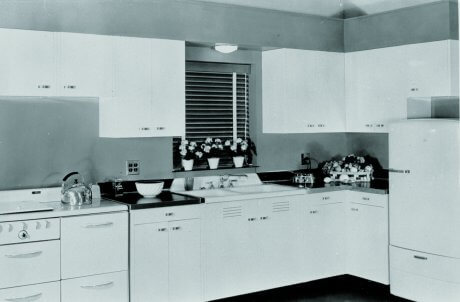
    The same kitchen, perhaps — but in a real-life installation (as opposed to an illustration).
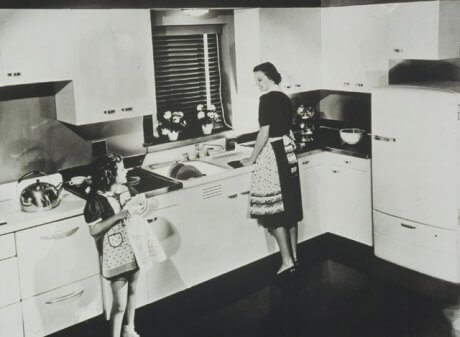
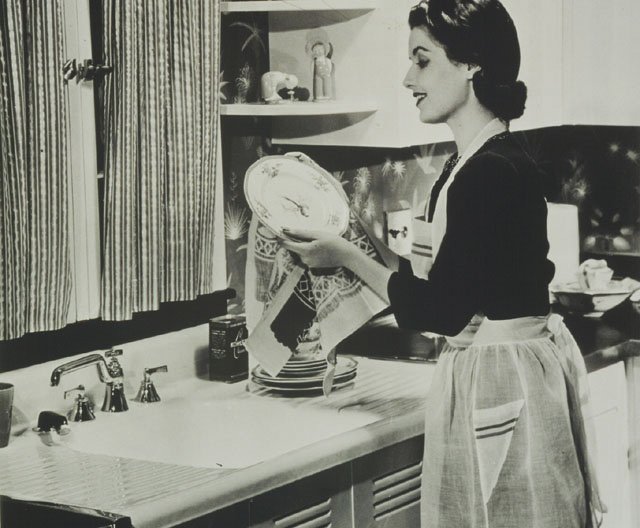
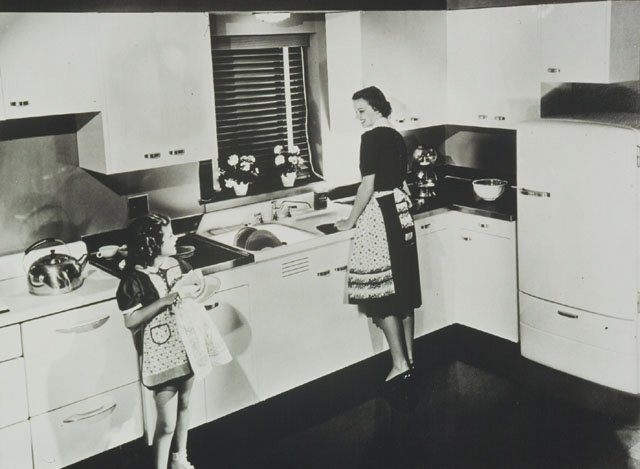
    Same kitchen as above, it appears – with Shirley Temple lookalike. Hey, and notice all the mid-century modern geraniums. :)

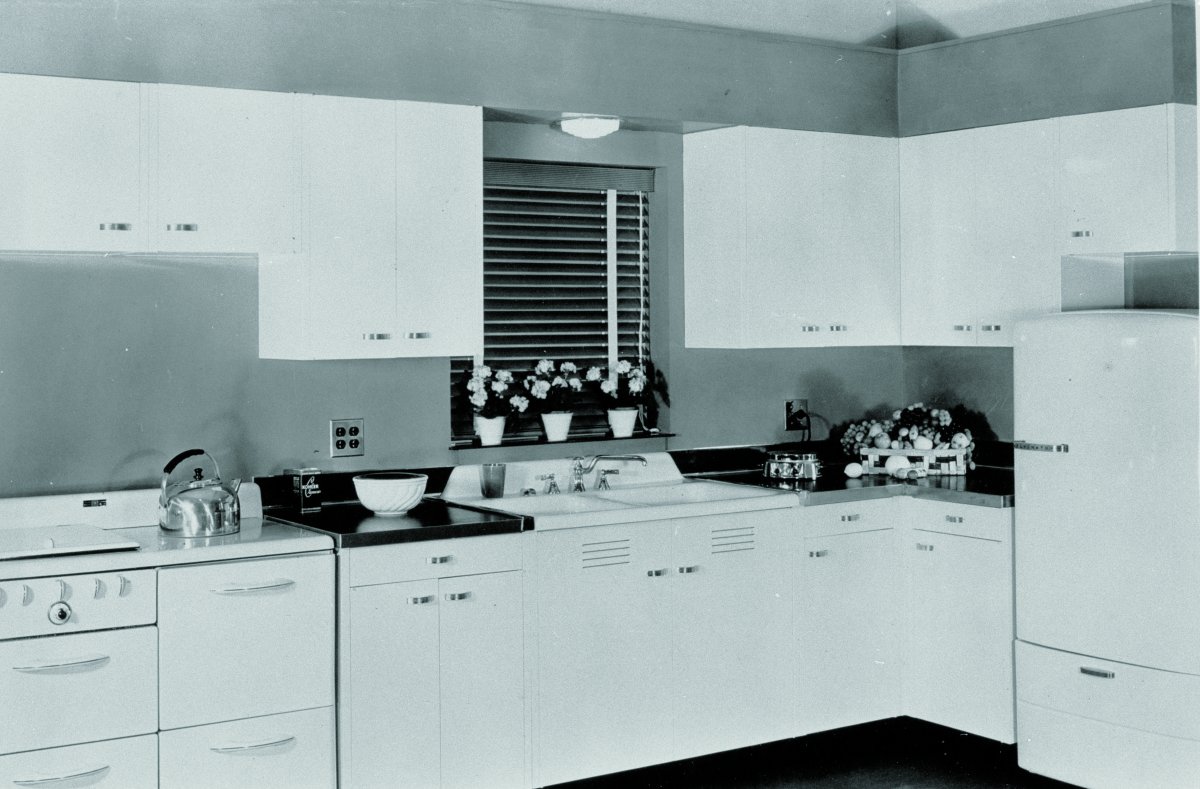
    Ahhhh, notice that the sink has “lost” its integrated backsplash, and it’s set into the laminate countertop with its metal hudee ring. More design evolution. It’s like… monkees losing their tails and becoming… human!
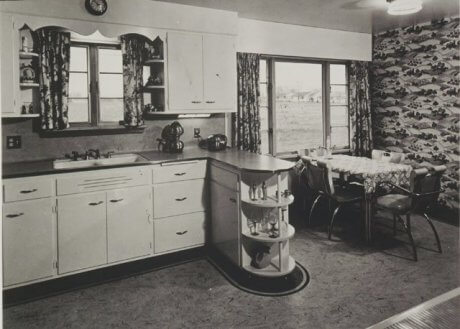
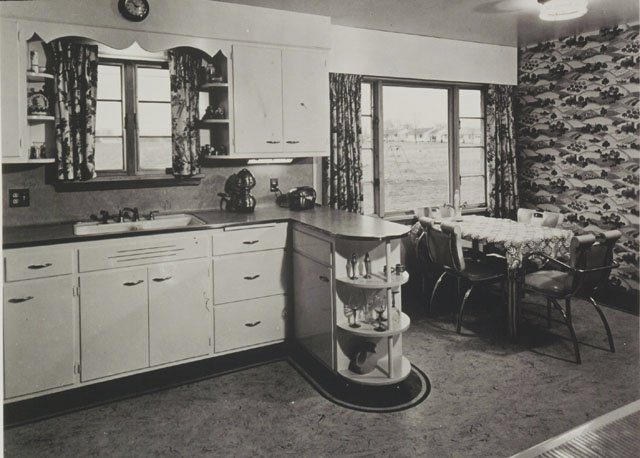
    We are into the heart of 1950s kitchens now, I think.
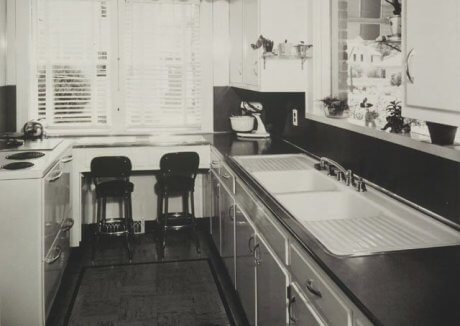
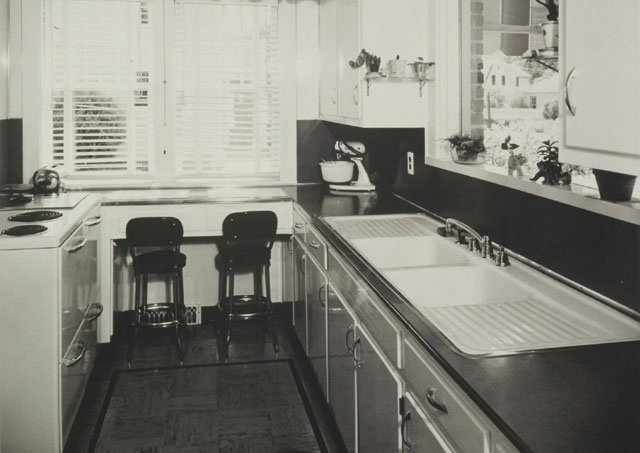
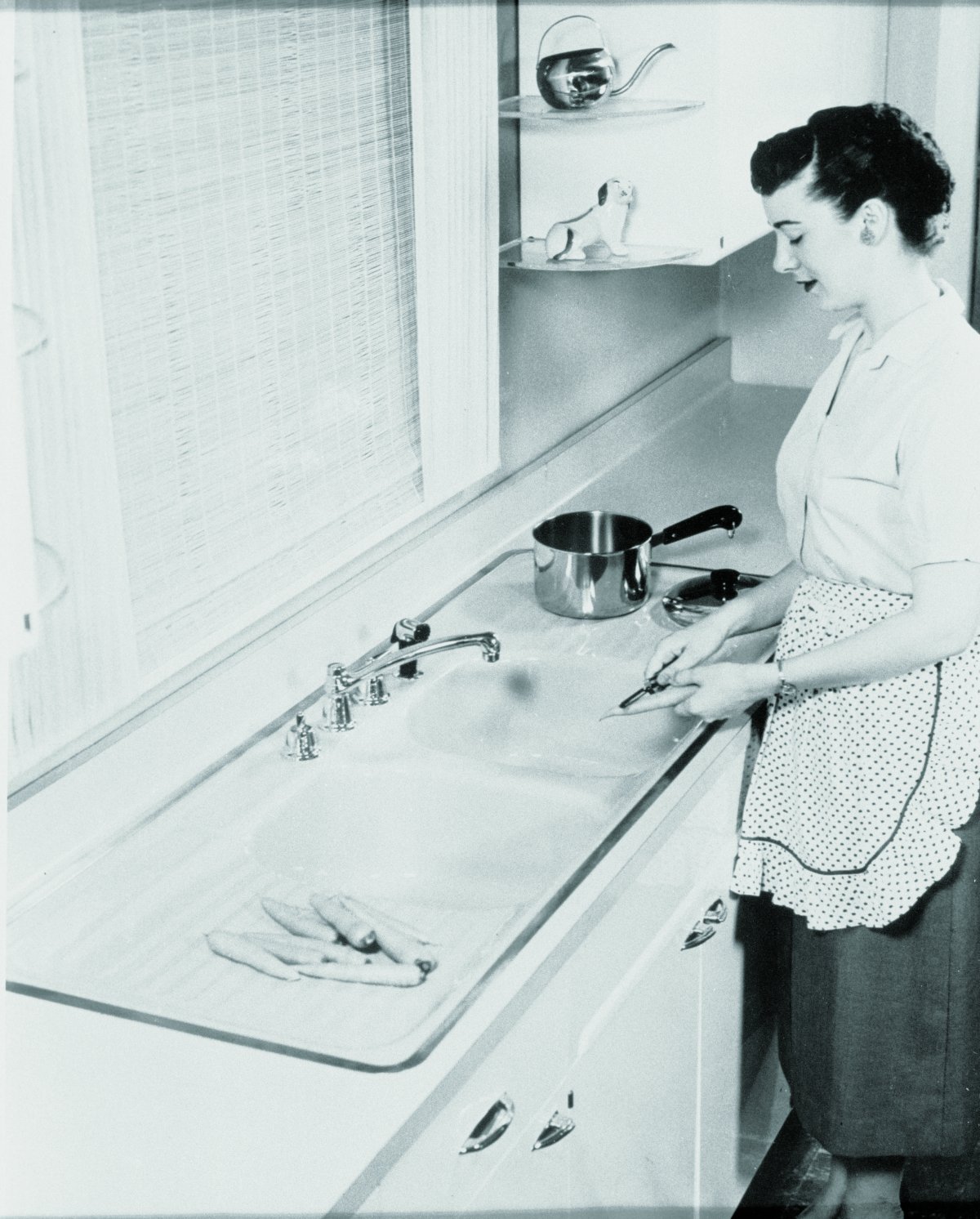
    Woah, look at this beauty! Early 50s? Honestly, I don’t cook much, BUT it still seems that I am doing dishes all the time. I would REALLY love to have drainboards like this to the left and to the right. So practical for managing the dishes piling up, going through production, then over to drying.
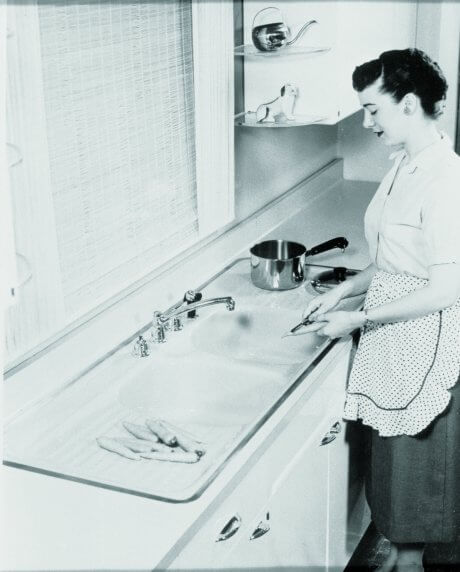
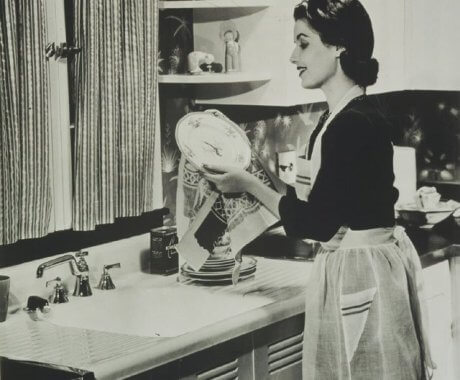
    Like this! Except that today, we compost all of our carrot peelings. Right, people?! Obviously, it’s impossible to say because this is a black-and-white photo, but: That sure looks like a colored sink to me. Let’s guess.
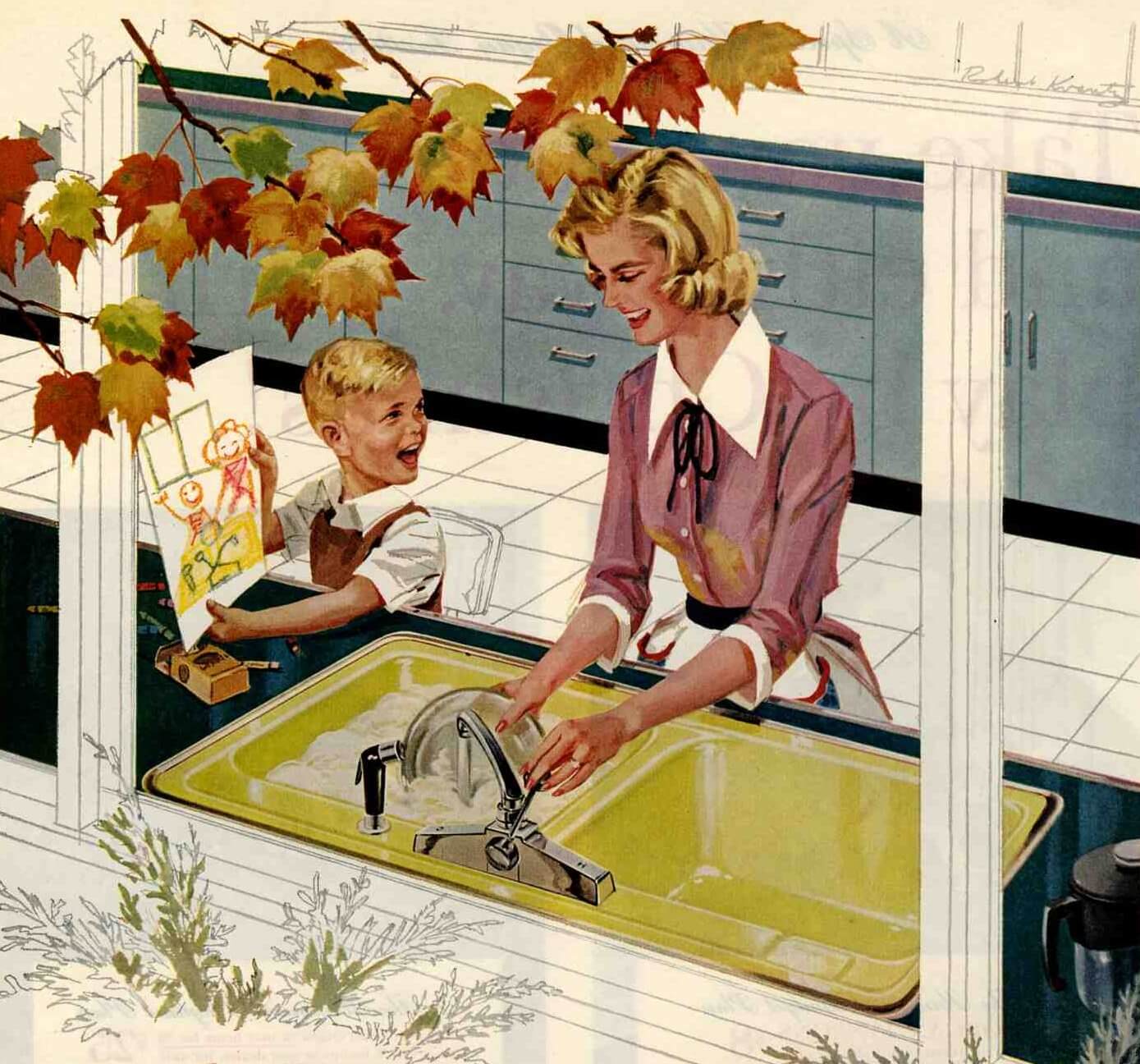
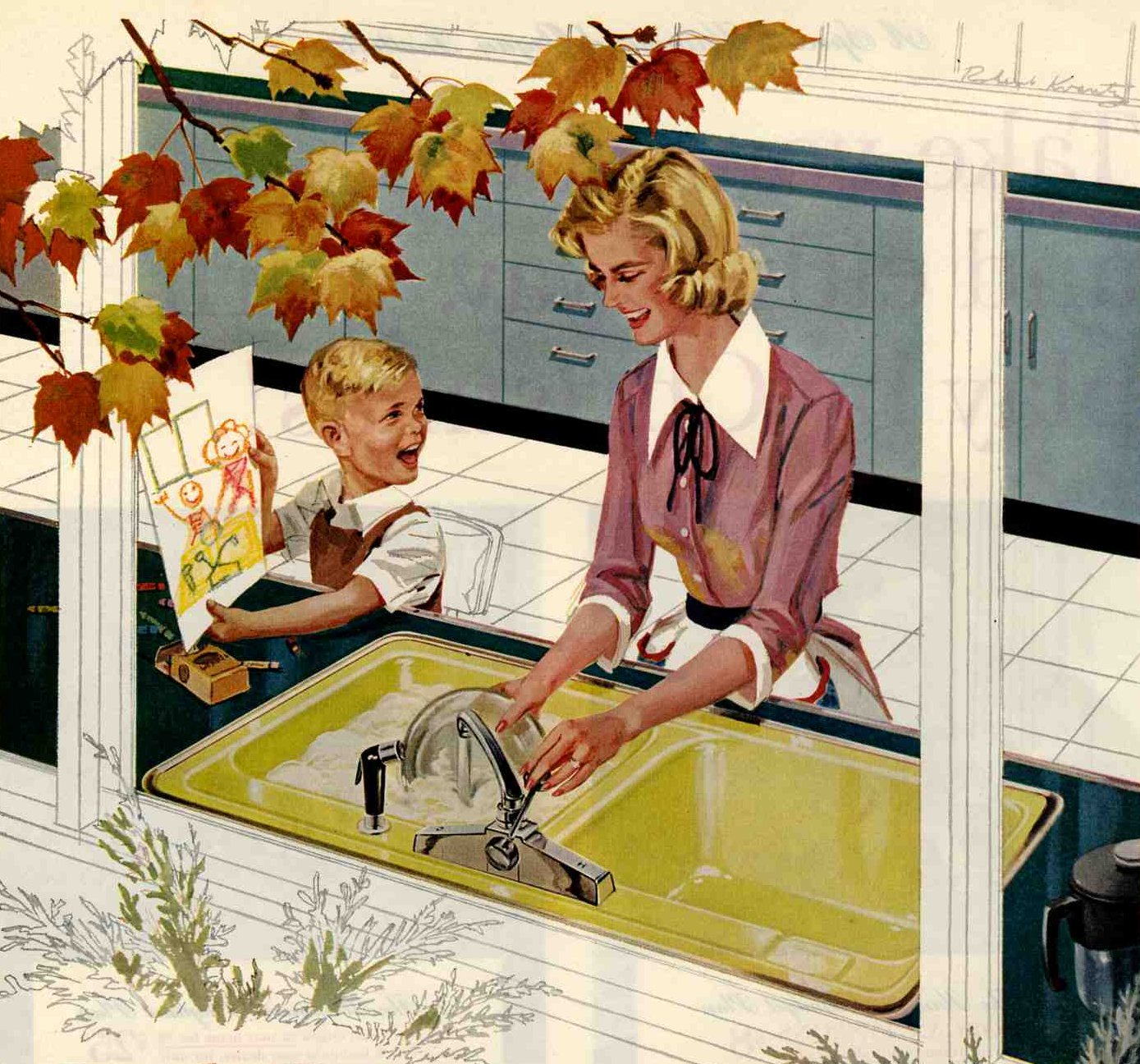
    This is one of the two images from my collection of vintage Kohler ads. Gorgeous mid-century kitchen, isn’t it?

    And this colonial modern Kohler kitchen (also from my collection) — one of my favorites of all time, truly.
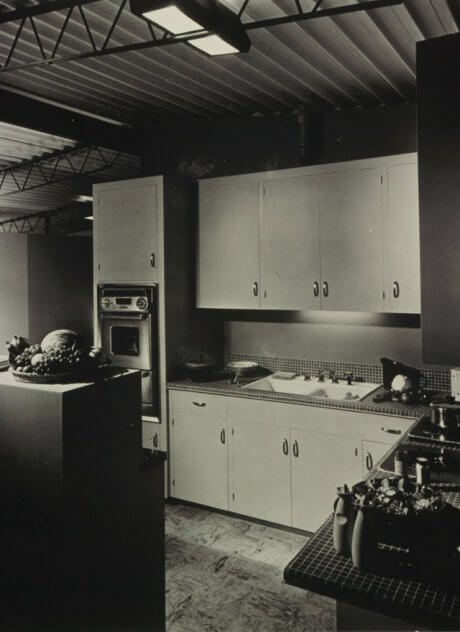
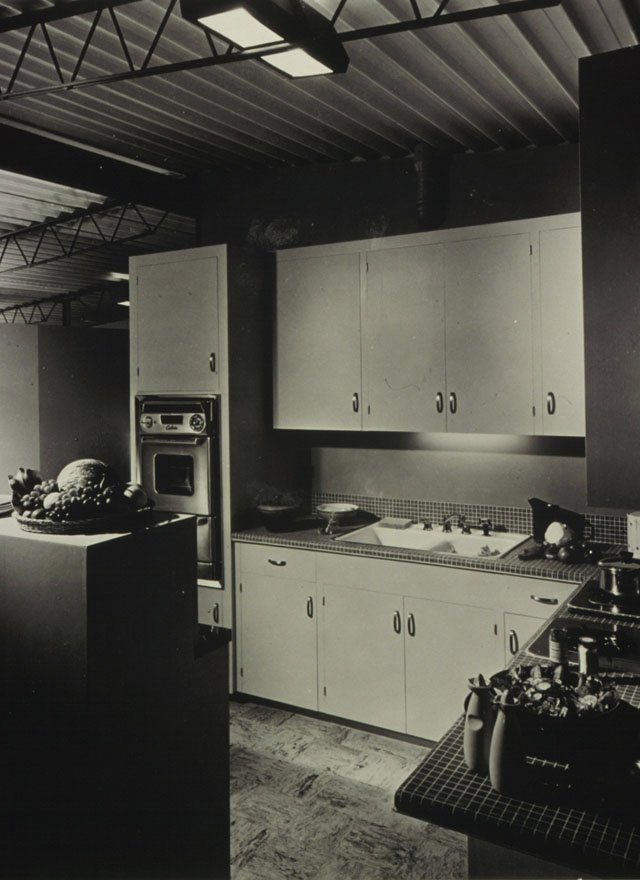
    Modern! Can anyone give me a date based on the oven?

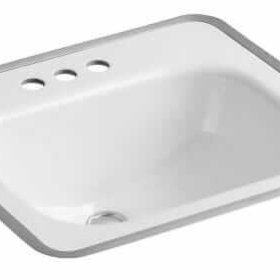
    Finally, I want to remind everyone that Kohler still makes ONE metal-rimmed, cast-iron-on-porcelain kitchen sink available today — The Delafield sink with two bowls. (The single-bowl Bakersfield is discontinued.) The list price from Kohler’s website is shown in the images above — but talk to your local retailers, I bet you can do better. You can see all my product finds to design a mid century kitchen over on my Kitchen Categories.
  • Get our retrolicious free newsletter.

    Newsletter-sign-up-2NMAS

    Comments

    1. sablemable says:

      Wonderful pictures! When I was little, we lived in a house that had a sink like the first picture.

    2. Maria Stahl says:

      That wall oven looks like the same model as the GE in my mom’s 1957 kitchen, so I’m gonna go with late ’50s.

    3. helaine says:

      Fantastic photos showing time ‘s changes in kitchens and their designs.I always notice kids smiling,helping out mommies ,wearing their little aprons,smiling daddies,smiling happy mommies in kitchens,wearing pearls and high heels i could never even stand on!!!Kind-a like today’s scenarios!!!!!Have a nice day!

    4. John says:

      Hi Pam, great pics and advice. You could mimic the practical use of drain boards on either side of your sink using the rubbermaid ones you can still buy today. They are even slanted for drainage. I use one to the right of my sink to drain and air dry my dishes. You can find black and red ones at Target.
      Have fun in Charlotte.
      John aka AtomicHipster

    5. Those are some really great pictures!
      We have an original,porcelain sink in our home and while I love it, it’s so very difficult to keep clean. It seems to get scratched very easily. any tips?

    6. Rebecca Prichard says:

      This is great! And, yes, I DO compost all of my carrot peelings! :)

    7. Nice roundup, Pam. I would say the last image is mid-to-late 50s, but based on the salt and pepper shakers. The oven is similar to ours in our 56 ranch: its narrow width also makes me think mid-fifties.

    8. 52postnbeam says:

      i did a bunch of sink research last night, and posted more than 20 listings in one post in the forum here:

      http://retrorenovation.com/forum/showthread.php?tid=4017

    9. gavin hastings says:

      The story of the kitchen sink is directly related to food:

      Up until the First World War(1917) kitchens were part food factory and part slaughterhouse. It was modern food production which spured the “Streamlined Kitchen”. Until the ’30′s; and in some places, the 1940′s, that an item such as chicken arrived de-feathered and cut into parts. Frozen vegetables did’t hit until Birdseye in the late 20′s….but most refigerators only had a little section that did not actually “freeze” food, but only kept it colder than everything else. Imagine feeding the family with only “fresh and unassembled” or canned!

      During these years, many kitchens were retro-fitted with the sinks shown at the top of this chapter. They were a huge improvement over previous sinks which many times included water pumps.

      Two other considerations are cleanliness and servants. Every early (1920′s) ad I have ever seen incorporates a maid…and the word SANITARY at least half a dozen times.

      So- it is the availability of “standardized” food, what we have to do with it upon arrival and by whom, that created the kitchen we know today.

      There will be a test on Friday. Class dismissed.

      • pam kueber says:

        Yes, Gavin, I agree: Design very much moved ahead hand-in-hand with food “technology”, plumbing, and shifts in domestic roles. It’s all very, very interesting.

    10. gavin hastings says:

      I have seen many homes from 1900-1920 with NO cabinets or countertops-just like Alice and Ralph Kramdens’: Just a room with a sink and stove..maybe a pantry.

      The first three decades of the last century moved at an incredible pace.

    11. K Elaine says:

      Me again! I took your pink bathroom pledge yesterday.

      Wow, I have always dreamed of having a sink with a drainboard. This new house that my husband and I bought does not have a dishwasher, and I thought, now, this must be why I had an inclination to the drainboard, although I didn’t know at the time what it was called.

      Well, thank you, Pam, for all the beautiful pictures and place for me to continue to get excited about moving into my first home. All the possibilities. It’s going to be fun to work on!

    12. midmodms says:

      I love sinks with built-in drainboards and back-splashes. They are one thing I think was the perfect idea for a kitchen sink. No worries about splashing, mold around the edges, or under plastic drainboards. “Progress” in this case went backward. IMHO of course. ;-)

    13. KC says:

      Based on the original kitchen cabinetry which was re-used in the garage (to hold the water heater of all things) I believe my 1952 house had a drainboard sink. “Progress” removed it in a 1970′s kitchen renovation, more’s the pity!

    14. Mark says:

      I might be crazy but I think the two pics of the early sinks, with the covers over one side, those might be early dishwashers.
      The first pic that shows the underside, that big black thing might be a motor or possibly a garbage disposal?
      On the back splash of those two sinks is a panel could be switches?
      I’m guessing here.

      • Shari D. says:

        Mark – you’re right. They are early model dishwashers. If you go to this link –

        http://www.antiquehomestyle.com/inside/kitchen/1920s/gallery/gallery-2011.htm

        and check out the photo of the kitchen maid loading up the dishwasher, you’ll find it’s almost identical to the photo under discussion. The caption of the photo says

        “Dishtime drudgery was eliminated by the Kohler electric sink, which functioned in a much smaller footprint than today’s dishwashers but worked essentially the same way.”

        So – mystery solved!
        Shari D

      • Shari D. says:

        The photo I’m referring to is the one on the right hand end of the second row of pictures, image 12.

    15. Kathy says:

      Could you tell me what the purpose of the deep bowl with hinge-top seen in the second and third sink images? I tried a quick google search but found little info. Thanks!

    16. Jeff says:

      What a superb set of photos!

      Am having a time deciding what to replace my late model stainless, totally wrong sink with- love the farmer’s sinks with drainboards, but only have 30″ to work with.

      Our local salvage yard has farmer’s sinks regularly, but would have to get any of them re-enameled.

      Ikea had a farmer’s style sink which has the midmod look- that combined with my new Dishmaster (thanks Pam, for the links!) could do the trick.

    17. gavin hastings says:

      Mark- I think that the motor looking thing is part of the plumbing. Under just about every drain in America, there is a sort of swan-necked piece of pipe. This holds just enough water to stop sewer gasses from entering the home. The one pictured I think is the older “drum” type: Waste water flows from a drain into the side of this drum, fills this little drum-and escapes into a second pipe placed opposite and a few inches higher. Two or three inches of water always remains “undrained” in this “coffee can” sized drum to seal out the fumes. I have them in my home, 1939.

      It might also be a pump….which leads me to Kathy’s question: I really think that the deep, deep sink and lid may have something to do with laundry. Wringer washers came with wheels on the legs for a reason!

      • Shari D. says:

        Gavin – Mark was right when he speculated that device was an early model dishwasher, by Kohler, no less. The link here -

        http://www.antiquehomestyle.com/inside/kitchen/1920s/gallery/gallery-2011.htm

        and go to Image 12 will take you to a photo/illustration of it being loaded by the soon-to-disappear kitchen maid. The caption reads – “Dishtime drudgery was eliminated by the Kohler electric sink, which functioned in a much smaller footprint than today’s dishwashers but worked essentially the same way.”

    18. gavin hastings says:

      Duh!
      After really studying the photo: I think it is a pump…and I have one on my set-tub downstairs next to the washer! It also looks as if hanging though that jungle of pipes….is a cord and electrical outlet.
      If the drain of the plumbing was higher than the depth of that deep sink-a pump was needed to push the water up to the height of the drain.
      It also seem that there are TWO sink units here. Before automatic washing machines, people reused the wash water for loads of clothing (which is why set-tubs are usually in pairs-one for clean rinse water/one for the soap-y water.

      Mark-household garbage diposers didn’t hit the average home until the late 1950′s. Prior to that, there was Trash Day and a few days later, Garbage Day.

    19. Frank says:

      My favorite is the color photo titled “Beauty and the Best”. This is Madison Avenue at its best. Mom, posed at the kitchen sink in a Doris-Day-like stance, imagining her world is complete in her picture-perfect kitchen, donning pumps and an apron, presumably fixing dinner for Dad who has put in a long day at the office. And then there’s Dad, who as he is lifting little Jane in the air is wondering if the scent of his mistress’s perfume is still lingering on this coat. . . oops sorry, I guess I’ve watching too many episodes of Mad Men.

    20. Sara in WA says:

      You’ve given me a great idea for my Montgomery Wards sink cabinet with double drainboards. We plan in about 2 years to be building a “new” ranch style house behind the old farmhouse and I could use the top from the cabinet and have it refinished in white for the new house. We had a tub refinished for a flip we did and it turned out amazing. I absolutely love the drainboard function as I can set a hot pan on them directly from the stove plus can leave a little dish drainer to the other side for those hand wash items. Note: for us 5’4″ and shorter cooks, a sink that’s too deep can cause a backache. If I need the function of a really deep sink there’s the utility sink around the corner from the kitchen.

    21. Jeff says:

      Thanks Pam!

      There are some super stand-ins at Ikea for midmod design, not always preferable to the originals, but in my case, it’s a mod-update that combined with my 1949 Roper Town & Country gas range (yes, I’m bragging!) and my 1955 GE wall mounted refrigerator in turquoise, and cork flooring, I’m in business!

    22. Kathy says:

      Pam’s right about doing better on the price for the Kohler Bakersfield sink. I paid $308 for ours. And by the way, I just love it!

    23. Carolyn says:

      We have a 1930 double sided drain board sink with the original support cabinet. The original cabinet is falling apart and must be replaced. I seem to be having a problem finding a replacement cabinet. Does anyone have any ideas? The sink and drainboard are so heavy and everything seems to be geared to drop in sinks. Thanks. Carolyn.

    24. gavin hastings says:

      Carolyn- Call a good carpenter if the cabinet is wood. Many of the cupboards in homes of the period were crafted “on-site”.
      You should be able to find someone that can duplicate the section that you need. Best wishes!

    25. Alison Marie says:

      My sink (and my entire kitchen) are just like the 40′s ones in the 4th & 5th photos….I love my double drainboards, but the shallow sink depth means I splash myself a lot when washing dishes by hand (no automatic dishwasher in my kitchen.) Has anyone here had their original sinks reglazed successfully? The company I called refused to do it!

    26. Zane Barlow Coleman says:

      We have that pennisula thing in the 12th photo, the one with the little shelves at the end, except ours has a space underneath it for stools… like a little breakfast bar. 1957 Ranch.

    27. Ann Hilmanowski says:

      That last photo with the oven/broiler in the wall looks like the late half of the 1960s to me. My Mom and Dad (an architect) built a new house in the late 1960s, and they had a wall oven/broiler unit similar to what’s in the photo, installed. The rangetop was mounted into the countertop seperately.

    28. Lynn Purl says:

      We have that “peninsula thing,” too, Zane! I was so excited to see it. Ours has space underneath for stools, as well. We’re using ours as an island on top of the Marmoleum floor in our renovated kitchen. Thanks for the fun photos and info, as always, Pam!

    29. Jean says:

      I loved my “real” drainboard sink from the old farm house the kids grew up in. It would go so splendidly in my current 1943 house!
      That two drain board single sink type was in my grandparent’s Victorian. The large sink on legs is the same as the one in an illustration from my mother’s School and Home Cooking book, cir 1920!
      Thanks for the great 1940′s pics!

    30. david Goularte says:

      Pictures 3 and 4 (covered deep side) are dishwashers. The racks lifted up and out for loading. Our 1914 house had the first dishwasher in our town installed in 1927 and it was this type.

      Before electricity, there were hand operated dishwashers…..all it took was the electric motor to turn many hand cranked machines into what we enjoy today.

      you can see a 1949 version on You Tube:

      GE Electric sink dishwasher first ever full operation

    31. burlyn barnes says:

      I am replaceing a cast iron sink that is 40 years old and would like a few tips onreistallation thanks

    32. David Goularte says:

      The third picture down…..the hinged cover part is an early dishwasher. The trays lifted out.

      My 1914 house had one installed in 1927, also continuous counters. They were the first dishwasher and continuous counters in Olympia, WA.

      Previous were stand alone sink and drain with separate cabinets. I will guess the new kitchen was for the owner who was probably starting to find the help she was used to harder and harder to find. She was forced to actually use her kitchen!

    33. burlyn barnes says:

      would like some info.on how to reistall a sink that has a ring and must be put in from the bottom

      • pam kueber says:

        burlyn, we don’t typically offer this type of DIY advice here. not sure where to send you — best to find a plumber perhaps who has seen this kind of sink install before??

    34. Katie says:

      I have a metal-rimmed PINK Kohler sink in my 50s kitchen. And I love her! ;o) Along with my pink stove, pink oven, and pink countertops with gold flecks. I didn’t even know it was Kohler until I discovered the word “KOHLER” on the back of it a few days ago. Mine looks identical to the yellow one in these ads! So fun to see those!!

    35. Jay says:

      Pam, great photos of the evolution of kitchens. I’m guessing the last picture dates from the 60s because of the mod accessories. It resembles my Westinghouse oven from 57. So far as I know, Hotpoint is still a division of GE. Don’t know what became of it but I had a small promotional Hotpoint brochure from the 40s extolling all the available appliances and it showed a great centerfold of a kitchen with metal cabinets that contained what they called an “electric” sink. The double porcelain sink unit housed a disposer and dishwasher.

      I also remember that one of the houses in my childhood neighborhood of 20s row houses still had the original wall hung porcelain double sink and very few cabinets.

    36. Tammy says:

      These are really nice to see. i have a youngstown cabinet and sink with a cover that slide from one side to the other. I’m thinking of repainting it. But we are using it now so not sure what we will do until it is done. But, we have a log home so I think when we get ready to finish the kitchen we will be very happy with this sink. PS( We got this for my boyfriends Aunt. She had it outside and in the tree’s.) But, it’s still in good condition. Luck us.

    Leave a Comment --

    If you are under 14 years of age you may read this message board, but you may not participate.
    Here are the full legal terms of use you agree to by using this comment form.

    (required)