

 |
 |
 |
 |
 |
 |
Don’t we all want a diminutive pink refrigerator (in one of our fantasy retro kitchens, at least)? I think the idea is particularly appealing, today, because most refrigerators are just so honkin’ big: Silver, black or white elephants drawing too much attention from our beautiful kitchen designs. This is why built in refrigerators are so popular — they make the darn fridge disappear. Cabinet-depth, too, eliminates the protrusion, at least. A curvy pink lollipop refrigerator puts the perfume on the pig, sad metaphor, I know. (This reminds me: My grandma Agnes had this toy pig thing inside her refrigerator. Every time you opened the fridge door, it oinked at you. This, from a woman who never met a full-fat dairy product she didn’t try to wedge into every recipe possible.) So, where can you get a pink refrigerator? I did some research and came up with seven places or ways to get one. Read on…
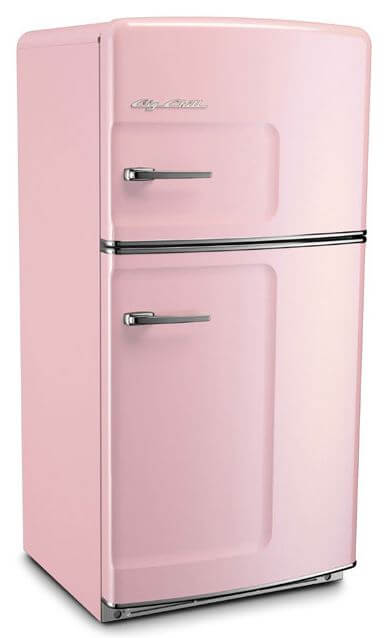
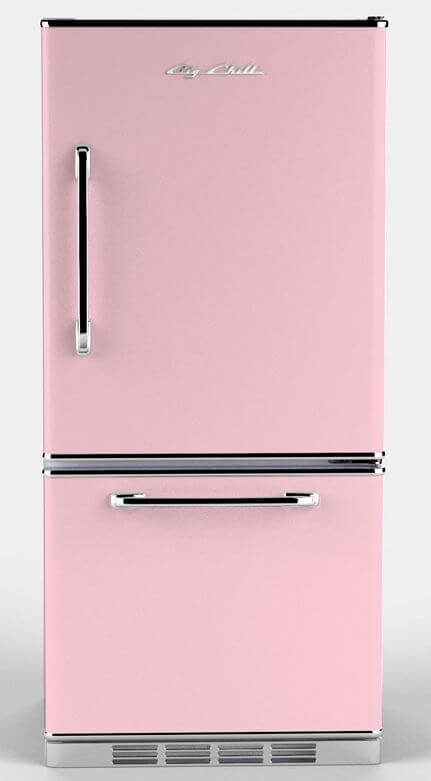
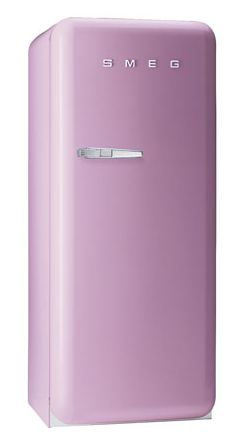
Following along with my photo spread, above, starting at the top and moving left to right:
- #1 — Big Chill’s classic retro refrigerator comes in two sizes, a 20.9 cu.ft. unit and a 14.4 cu.ft. unit. They also have an undercounter fridge that you can get in their complete color palette, including pink. Link: Big Chill refrigerators.
- #2 — Big Chill’s Retropolitan refrigerator has more of a Jetson’s look and the freezer on the bottom. It is 18.5 cu.ft in size– and it is 2″ less deep so sticks out less. Link: Big Chill refrigerators.
- #3 — The Northstar refrigerator by Elmira Stove Works comes in three sizes and variations: The 19 cu.ft. model has the freezer on the bottom, while the freezer is on the top in 18.2 cu.ft. and 11 cu.ft. models. You can also get the 11 cu.ft. model with a built-in kegger. Link: Northstar refrigerators.
- #4 — The Smeg ’tis a baby doll, coming in at just 9.2 cu.ft., but she is oh so cute. Remember Laura’s? Link: Smeg refrigerators.
- #5 — Take your plain-Jane refrigerator to an auto body shop or industrial painting place — Professional painting joints can consult online paint color guides to match or help get you the color you want. The advantages of professional painting include (1) they have access to very durable automotive paints, (2) they use dust-free booths to avoid itsy bitsies ruining your smooth glossy finish, and (3) someone else does it. However, you will have to get your fridge there and back, and this will cost you, of course.
- #6 — Spray paint your existing fridge yourself. The only spray paint I could find close to a retro Mamie pink is Rustoleum’s Candy Pink spray paint. Rustoleum has an epoxy spray paint specifically for appliances — but it does not come in pink. So, I asked Rustoleum if they could advise on how to use this less fancy pink spray paint to do a fridge, either metal or vinyl/plastic. Here is what they said: “Painter’s Touch would work fine on the fridge. We also have a spray paint called Painter’s Touch Ultra Cover 2X that also comes in Candy Pink. The real advantage of using Ultra Cover 2X is that it offers twice the coverage of general purpose spray paints. It also has distribution at The Home Depot and many hardware and paint stores, so it’s easy to buy anywhere in the US. According to our brand management team, before painting the vinyl/plastic parts of the fridge, prime them with Specialty Plastic Primer. For metal, you can prime with a Stops Rust Clean Metal primer for added durability. You could use Painters Touch Ultra Cover 2X Clear over the Candy Pink, but priming would be the most important step. If you topcoat with the Clear, apply it within 1 hour after painting or after 48 hours.”
- #7 — Stalk craigslist and Re-Stores for a vintage pink refrigerator. This will take time. But once you send your vibes out into the universe, the Retro Decorating Gods may reward you sooner than you think. I am not an expert on what to look for in a vintage fridge. See this post for some links and such if you are serious about pursuing this option.
- Update March 2019: I did a lot of new research on where to buy a retro refrigerator — I have seven ideas — see them all here.




ChrisH says
IMO the problem with modern ‘fridges isn’t their color (or lack of color) after all the overwhelming majority of vintage appliances were white (that’s why they got the name white goods). The problem is the angularity. A few bends and curves in standard production ‘fridges would be of more use to most of us doing a “retro” kitchen than high priced ‘fridges with color options.
Ann-Marie Meyers says
No, the real problem with modern fridges is they don’t last! my 1962 GE is still humming away after 50 years. Can anyone with a unit less than 25 years old claim that?
ChrisH says
You have a point there. They did last.
Lisa says
Um, no. No one with a 25yo or younger fridge can claim it has been working for 50 years!
However, my very basic Kenmore fridge from1992 was still working just fine when we moved out of the house this fall. Never had an issue at all, though perhaps changing out the door seal would be a good idea. I don’t have such high hopes for my new Samsung. It has an electronic panel inside where you can set the temperature and such. I doubt that will last over 10-12 years. Automatic ice makers and water dispensers are also prone to failure.
Woody says
Also remember, if you go the vintage fridge route you are going to spend more on electricity due to modern advance in compressor and motor technology.
pam kueber says
Not necessarily, Woody. I would like to see someone put a meter on an old fridge – one with no defrost cycle – and then provide electric cost data.
ChrisH says
Not as accurate as a meter, but a good general idea can be had by plugging in the info at this website.
http://www.energystar.gov/index.cfm?fuseaction=refrig.calculator
Looks like a new one would pay for itself in less than 6 years, compared to anything made prior to 1980.
ChrisH says
I wasn’t thinking clearly. The new ‘fridge wouldn’t pay for itself in 5-5 years -it depends on purchase price. But you’d save about $200 a year in electric costs.
pam kueber says
I still challenge this. I need to do a story – chase the data. I have always heard that if that it’s the defrost cycle that is the energy hog…
ChrisH says
I know you’ll do a very thorough job of researching this topic. I’ll be happy to accept your findings.
I’m going to hazard a guess that you’ll find the energy star models are actually way way more efficient, due to better insulation, more efficient compressors, and micro-chip controlled defrost -as opposed to timer controlled defrost.
But I could be wrong.
From what little I’ve read, an old monitor top made in the ’30s is reasonably efficient -but tiny in size. ’60s-’70s units are about the most inefficient available, and post 2001 energy star models most efficient.
Of course pains must be taken to compare apples to apples. It will be hard to find a modern ‘fridge w/o auto defrost. But things like ice makers use a lot of energy and don’t have to be included in comparisons because vintage ‘fridges didn’t have ice makers.
OTOH, the old ones last, and don’t have to be replaced as often. Though this says nothing about energy efficiency it does affect total cost of ownership.
We’ll look forward to your findings.
Jason says
They used to make a device that you plugged in between the fridge and the wall that “modernized” the electrical pull. Don’t know how it worked but remember my mom and I considering it for a 50’s era commercial fridge we used to have. Unfortunately it died beyond realistic repair before we had a chance to try it. This was like, 10 years ago so I don’t know if it’s still made but a little googling may turn up something.
Flowergal says
Actually we have an old GE from the 50”s..That nice rounded style with the itty bitty two shelf little freezer box in the right upper corner. I ended up with this little beauty when we merged households. We use it for our second fridge on the back patio. It’s plugged in all the time. Believe it or not it only costs just under $4.00 extra per month:-)
Patrick Coffey says
Flowergal if it cost you ANYTHING EXTRA to be to be running that vintage fridge it probably indicates the need of a new door seal. If you do not mind myself asking how often do you have to defrost the freezer unit in that fridge?
Patrick Coffey says
OOPS disregard my post above……I thought Flowergirl meant it was costing $4 more a onto to run the vintage fridge than a modern one. I did not realize that she meant it only added $4 to the electric bill as a second fridge…my bad
Flowergal says
Hi Patrick:-) Your right on the needing a new seal. Its a bit funky for sure. I have to defrost about every 3 to 3 1/2 months.
Patrick Coffey says
Flowergal here is how you can test your GE’s door seal to see if it truly needs replacing……open the fridge door and stick a business card or piece of paper that thick in between the body of the fridge and the door seal and shut the door. If you can slide the business card around with very little or no resistance at all then you do need a new door seal. Do this in different places around the door to see if there are cold air leaks. If you do truly need a new door seal Modern Parts in Parma Ohio can most likely have one made for you like they had one made for my 1957 GE fridge if you are interested in contacting Modern Parts let me know and I can give you their phone #
Nicole says
Hi, Patrick.
I bought an an aqua blue GE fridge on craigs list and it worked great until about three months ago. It still works, but I am constantly having to defrost the thing. I think it just needs new seals, but our local appliance men won’t even look at it because “there aren’t parts for that anymore”. One person told me that they’d charge me $400 just to come to my house, let alone any repair they might need to do. But every vintage fridge website I visit says the parts are out there, inexpensive, and repairs are simple. What’s the deal?
Anyway, I live not too far from Parma, so was hoping to get that Modern Parts info from you. How long ago did they make yours? Was it very expensive?
Chad L. says
Hi Patrick,
Wondering if I could get the number for the spot where you got new seal for a 50s frig? I am desperately trying to keep my frig but the seal has gone awry and I can’t find anyone who can offer a solution for replacing this!
Thank you so much,
Chad
Flowergal says
Hi Pam:-) Accidently posted my response under Chris…Awesome site by the way!!
Woody says
Pam, what you need is something like a Blu-line power cost meter: http://www.powercostmonitor.com/
The kill-a-watt plug in meter will give you near instant readings for $39: http://www.powercostmonitor.com/p4578/kill-a-watt_ez.php
pam kueber says
Thank you, Woody!
Patrick Coffey says
The only time vintage fridges are less efficient than modern ones is when you have a vintage fridge that has a fan to push the cold air around the food (Westinghouse introduced that in 1958 as the Cold Injector) or frost free models that use electric heaters to keep themselves frost free. The fan and defrost heaters in the early units are what make them less energy efficient and the fan also makes the fridges noisier and make the condenser coils get dusty quicker as well. Basically if you stick to a model with condenser coils on the back of the fridge the and that have the cooling coils in the ceiling of the fresh food compartment model prior to 1958) you will have a very quiet and economical fridge. Oh and btw I speak from the experience of having had a pink 1957 GE Fridge in my kitchen for over a year now
pam kueber says
Thank you, Patrick. Now, can you see the post about the time capsule kitchen today? What year did we start to get Harvest Gold appliances?
Patrick Coffey says
No I did not see the time capsule house yet Pam…I am gonna go look right now though…..and according to a brochure I have from GE, Harvest (as GE called it) was made available for the first time in the Spring of 1968.
pam kueber says
THANKS!
ChrisH says
What we need is hard data, not opinion and anecdotes.
It will be difficult to compare apples to apples. Vintage ‘fridges are usually much smaller than modern models. So even if the old ‘fridge uses slightly less energy (which I suspect is not the case) it will still be less efficient in terms of energy used relative to amount of space being cooled.
Then there is the no-defrost vs. timer defrost vs microchip controlled defrost.
Then there is the fact that if you don’t defrost the old models in a timely manner, their efficiency goes down.
Then there is the problem of location. Your kitchen may be 3 degrees cooler (or warmer) than mine. We can’t test a new ‘fridge in my kitchen vs a vintage model in your kitchen, or vice versa. Even at the same temp, your kitchen may provide better circulation around the ‘fridge than in my kitchen. Basically tests need to be conducted in the same spot – or conditions need to be uniform, as much as possible.
We can’t really even use standard electrical calculations,such as Watts = amps x volts, because the ‘fridge has on/off cycles. How many times per hour does your vintage ‘fridge run, and for how long? How about a new ‘fridge.
We can use a Kill-A-Watt meter, but we still have to have the same environmental conditions to test all ‘fridges.
Then there are definitions – what’s vintage? what’s new? Does vintage include the ’70s? Does new include the ’90s?
Then there is energy star vs “standard”. Why anyone would buy a new (manufactured this year) ‘fridge that was not energy star rated, I can’t imagine.
I await Pam’s in depth study on the subject. I’m going to go out on a limb and say that any energy star rated ‘fridge built in 2008 or later is WAY more efficient -when tested under controlled conditions with verifiable numbers, comparing apples to apples – than anything made prior to 1992. But I could be wrong. Let’s see what Pam comes up with.
One final thought – If you put a 1955 Chrome-O-Rama ‘fridge in your vintage kitchen, and it has a capacity of 9 cu. ft. then do you also have to count the energy consumption of the “extra” ‘fridge in the basement? Or do you get to pretend that you aren’t really running two (or even three) refrigerators because the vintage one doesn’t really hold enough to keep up with modern lifestyles?
pam kueber says
Yup, Show me the Data.
ChrisH says
It was my understanding that you were going to “chase the data”. But here is something to get you started –
http://www.nicholas.duke.edu/thegreengrok/bignow
The 1950 ‘fridge is 9 cu ft and uses 360 kWh. That’s 40kWh for each cubic foot of refrigerated space.
The 2000s ‘fridge is 20 cubic feet, and uses 420 kWh. That’s 21 kWh for each cu ft of refrigerated space. Plus the new one probably has automatic defrost. It’s twice as efficient as the 1950 model.
pam kueber says
Thanks, I’ll take a look. Yes, I have this on my list, but my list is long, lord knows when I will get to is! Thanks!
pam kueber says
Yikes! The bigger story from that link is refrigerator improvements notwithstanding, the average household today consumes 6 times more electricity than in the 50s! Fridges are the LEAST of our worries!
pam kueber says
plus, Source page links broken. never easy!
ChrisH says
Yeah, I was shocked by that also.
Jacquie Y says
Amen Pam, I totally agree. If you really want the older model, you can find ways to cut back in other places on energy. I have a lovely 1962 aqua GE fridge with the freezer on the bottom. It has a fan and it defrosts…I don’t see any difference in my costs, in fact, it seems to be a little less, maybe because the other “newer” one I removed to put my GE in was a big double door model and consumed a lot even though it was supposed to be an energy conserve model. I also find my older appliances seem to have more insulation and the new ones, not so much. Hmmm….
pam kueber says
I think the key is to look at your overall energy footprint — yes.
Woody says
I love the new retro fridges, but they are just too expensive for me. I have been considering getting one in a “stainless look” metal and refinishing it myself. It would take some experimentation, but I would think a matte finish stainless or stainless look would be easier to paint than one that is already a gloss enamel finish
Kate says
PINK Fridge = LOVE!
:)Maybe someday!
Trina Bobrowski says
Great topic, I want to spray paint my fridge so bad but my husband doesn’t want to do it.
Victoria says
If I had not been on the cusp of having to replace my old fridge when we redid the kitchen, I would have entertained the autobody shop idea. We have original pink stovetop, oven and sink, but couldn’t afford the Big Chill option and missed getting a working pink fridge from another house in our neighbor hood when they sold it (doh.)
A resource that I DID tap into was an auto chroming shop. We had diamond shaped backplates on the cabinet handles, but they were gold and didn’t go with the chrome we were introducing. We had them chromed perfectly and inexpensively. They said they could chrome almost anything — so keep that in mind!
pam kueber says
Good idea, thanks, Victoria!
Stephanie Tate says
I had the Big Chill refrigerator in my last house and it was fantastic. The guys at Big Chill provide an excellent product and customer service. I highly recommend them. Personally regret not shipping it when I moved across the country.
wily darling says
i completely agree with you, pam! i sent my retro fridge vibes into the universe about three months ago. before i knew it i had myself an amazing GE fridge from the 50s. just make sure you are prepared for some heavy lifting if youre buying vintage. and hopefully you dont live on the 3rd floor like i do!
Elizabeth Bowling says
I love kitchen porn!
This one is great, o Retro Queen.
Thanks so much for sharing.
St. Louis Elizabeth
philq says
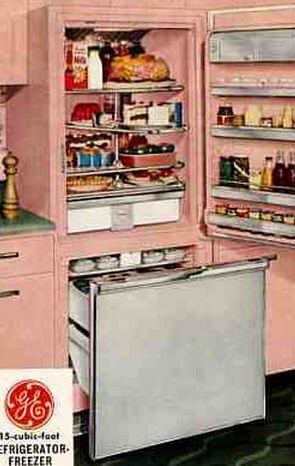
I LOVE my GE Combination Wall Mount refrigerator/freezer. It’s still working – only had to have the termostat replaced (by a GE tech, no less!). A novel idea that has gone it’s way. I guess those drawer or under-counter custom refrigeration units are the “modern” version.
Jeff says
I am so happy for you! I have this same wall mount fridge in aqua with a pink interior, and need a coil fixed or replaced- can’t find anyone to do it! Compressor and everything else works fine, just won’t hold charge.
Maybe I’ll check a GE tech as well in my area, I am determined to get this thing working again, the case inside and out is just about perfect, and it’s built in, as you know, and it ain’t going anywhere!
Wayne says
How do I uninstall a General Electric Combination wall mount refrigerator?
pam kueber says
Wayne, this is not a DIY site. This story has some suggestions for other places that might be about to provide assistance — https://retrorenovation.com/2011/08/29/parts-service-and-advice-to-fix-old-stoves-and-other-vintage-appliances-a-list-of-9-online-resources/