

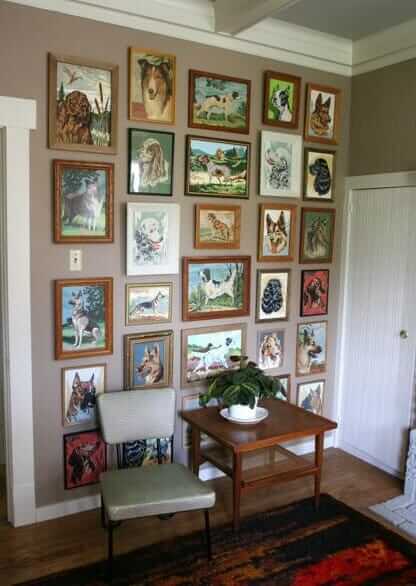
 Vintage Paint By Number paintings are an ironic — and iconic — midcentury modern art form. They are really “low brow” — anyone can do one… But, they also fascinate us — there is something “elemental” about their beauty and “democratic” about the fact they even exist. Simple, graphic — and rendered by a normal person, like us!, back in the day when mass prosperity was emerging across America. They were… lovingly crafted… and as a result, they are easy to love, 50 years later. Over the past several years, I’ve seen vintage PBNs become more and more collectible. And on occasion, we see folks get epic with the art form and create their own Paint By Number murals, which are pretty darn groovy. For this story, I found several great resources detailing the history of Paint By Number paintings — including important social history… and we’ll talk about how best to display paint by number art. Actually, display tip #1 and only, IMHO: As Troy has done with PBN dog collection (above) — group your PBNs for maximum impact.
Read on for the fascinating history of Paint by Number kits –>
The history of Paint By Number Kits:
Paint By Number kits were so common, so popular, such a part of the American decorating scheme, that the Smithsonian created a whole exhibit around them in 2001. Their accompanying educational website, still online today, is an awesome resource for Paint By Number history. Their introduction gets right to the point and says that, while Americans loved their PBNs, critics had a snit fit:
Paint by Number: Accounting for Taste in the 1950s revisits the hobby from the vantage point of the artists and entrepreneurs who created the popular paint kits, the cultural critics who reviled them, and the hobbyists who happily completed them and hung them in their homes. Although many critics saw “number painting” as a symbol of the mindless conformity gripping 1950s America, paint by number had a peculiarly American virtue. It invited people who had never before held a paintbrush to enter a world of art and creativity.
The Smithsonian explains who invented the kits — go, Detroit! — and how quickly the phenomenon took hold:
The making of the fad is attributed to Max S. Klein, owner of the Palmer Paint Company of Detroit, Michigan, and to artist Dan Robbins, who conceived the idea and created many of the initial paintings. Palmer Paint began distributing paint-by-number kits under the Craft Master label in 1951. By 1954, Palmer had sold some twelve million kits. Popular subjects ranged from landscapes, seascapes, and pets to Leonardo da Vinci’s The Last Supper. Paint-kit box tops proclaimed, “Every man a Rembrandt!”
Interestingly — and not surprising to me, at all — the Smithsonian says that Dan Robbins wanted the first kits to be exploration of modern art, cubism and the like. No way, said America! Folks wanted cozy landscapes and such. Yes: Colonial and Early American, not those hi-falutin modernist things.
The Smithsonian exhibit also explored the growth of leisure and how that helped fuel pursuits like PBN painting. Paint By Number gets “deep” when considered in the context of the continuing growth of democracy and meritocracy in America. I love this aspect of American culture. Love love love it. The Smithsonian says:
Writing in Life magazine in the late 1950s, cultural critic Russell Lynes set out to describe the popular pastimes of the “new leisure.” He observed that the usual markers of class-education, wealth, and breeding-no longer applied. The one thing that mattered was something that everyone had. That something, Lynes explained, was free time. In postwar America, class had become a matter of how one spent his or her free time.
Over the decades, the Smithsonian curators say, the Paint By Number aesthetic became so ingrained in our culture that other artists began to use it as a political launching point for their work. Kind of Andy Warhol-esque stuff. By around the year 2000, vintage PBNs started become collectible. Today in 2012, I’d say they are super collectible — although prices are still “affordable”, especially if you find these at estate sales where I live, because everyone did PBNs! There are 12 million Craft Master PBNs out there!
According to Wikipedia:
Following the death of Max Klein in 1993, his daughter, Jacquelyn Schiffman, donated the Palmer Paint Co. archives to the Smithsonian Museum of American History.
The Palmer Paint Co. is still in business, and in 2011, they introduced two, 60th anniversary prints, which are still available for sale today. Update: In 2021 I could no longer find Palmer Paint Co. online.
Read the entire Smithsonian history here. It’s a quick read, very entertaining, and lots of photos you can click on and see bigger.
Yes, there is even a book (affiliate link above) written to go with the Smithsonian exhibit.
Dan Robbins website
Update: When I originally wrote this story, Dan Robbins has his own website, book and video. Now I can’t find them; the url I previously had now goes to paintbynumbersonline.com, and I can’t see any association with Robbins on it. Dan Robbins also used to sell giclee prints of important PBNs — including the first Paint By Number design he ever created, Abstract #1. Very cool.
The Chicago Tribune interviewed Robbins in 2005. He explained the genesis of the idea for PBNs:
“The idea was an evolution,” Robbins said. “It was a gradual process of exposing this idea, then that idea, then another. I recalled reading about Leonardo da Vinci, and when he got large and complicated commissions, he would give numbered patterns to his apprentices to block in areas for him that he’d go back and finish himself. From there, it was a matter of proving the concept to see if it could be done.”
In the Tribune article, I learned that the company Craft Master was sold in 1959, and over the years passed through a number of hands. Today, the brand and designs are owned by Craft House, the 1995 article said, and indeed, I found some Paint by Number kits — including some vintage-y looking ones for sale at CraftHouse.
The Paint by Numbers Online Museum
AND, woah Nelly: There is even an online Paint By Number Museum — an amazing archive created by a collector in Massachusetts who wiki says has assembled some 6,000 PBNs. The PBN Museum is darn impressive — you can search and see all the kits and catalogs. There’s a great library. And, there’s a page on artist Dan Robbins with more history, pointing out:
Who is the most exhibited artist in the world? The work of paint by number designer Dan Robbins has been displayed on more walls than that of any other artist. This was true in the past, is still true today and is most likely a record that will stand in the future.
Collecting and displaying vintage Paint by Number paintings
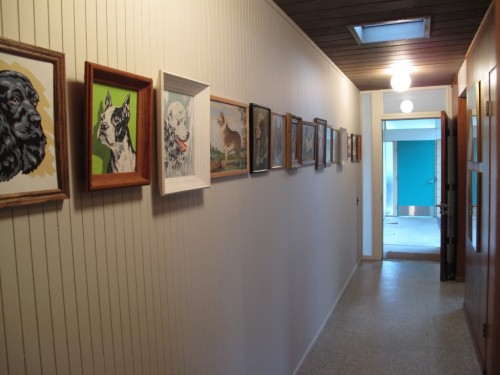 As I mentioned at the top of this article, I am a 100% believer in grouping small painting collections like this, for maximum decorative impact. When Todd lived in his first place, he had the dogs in a grid on one wall. When he moved to his Eichler, Troy came up with another variation on the “grouping” idea: Arranging the collection of dog paint-by-number paintings as a gallery along the hall.
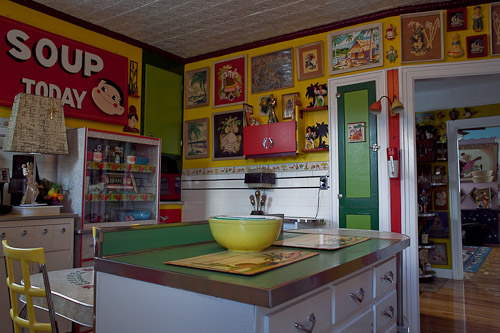
Above: Crown Prince of Kitsch Cullen‘s kitchen — I’m not sure if he really has a many PBNs up on that wall, but this is a great shot to illustrate two ideas. (1) Again, the effectivess of creating tight groupings to display your collections of like-pieces. And (2) While Troy collects just dog PBNs — which makes for a fun collection, Cullen collects pieces according to a theme that includes other varieties of art and collectibles.
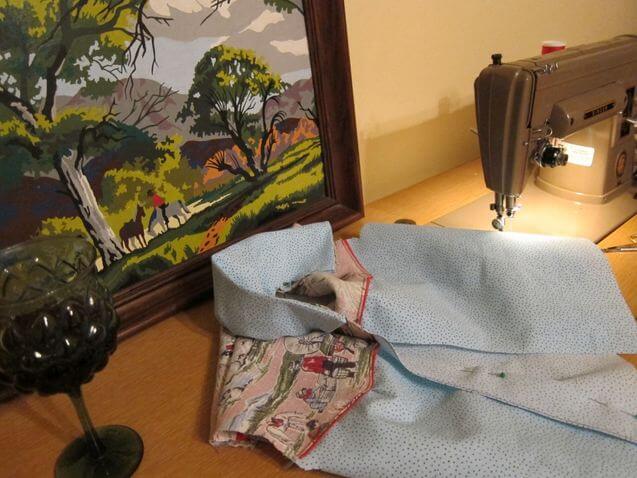 Above: Collect cowboy stuff? Add a cowboy PBN. That Betty Crafter knows how to stage a photo…
Finally, how is this for “some therapy”: Apartment Therapy profiled two people who created paint by number wall murals onto their walls — entire walls. The stories are now gone, but Wow. Atomic Ranch also had a story in a recent issue about someone doing this. Seems like the basic how-to is: (1) Find a PBN you like, (2) Scan it in very high resolution, (3) Print onto a transparency, (4) Project the transparency onto the wall, (5) Outline the colors and as you go, write in the color numbers, (6) Figure out which colors go where, (7) Drop out of civil society as we collectively know it and paint until your eyes bug out of your head, (8) ta da, celebrate your epic achievement, but don’t look too closely at your errors. Not Perfect is the New Perfect.


Starr Lockhart says
I bought two pbn’s at an estate sale for $1.00. The woman who had owned the paintings had died and her children were selling everything she had and her house. The pbn’s are of roses and are beautiful. She had made frames for them.
Karen says
I love PBN…but my real LOVE is vintage gravel art. I have been collecting for many years.
Amy says
Karen, do you have any gravel-art Siamese cats in your collection? I’d love one – please post a pic of one if you have it!
Madelon says
http://www.ehow.com/how_8702683_flatten-bowed-canvas-panel.html Instructions for flattening a canvas. If it is old PBN it is probably oil. You have nothing to lose by trying if it isn’t usable in the present condition.
margaret donohue says
My PBN experience ended as fast as it started as a kid. In the 60’s I got a kit, painted, put it on the ironing board to dry. Along comes Dad, throws his crisp white shirt on the ironing board…on the PBN…to wear to work …..yep, he was major p.o’d. End of my PBN days. But I made up for it and have purchased 4 at thrift stores, and my friend gave me 5 and I proudly display them in my house…the same one I grew up in…
Fred says
The breakfast joint “Hot Plate” in South Minneapolis has PBN paintings covering every single wall.. It’s truly a fabulous sight to see! They also have tons of other fun kitsch packed in (awesome food, too!).
Elizabeth A says
I did many as a child, loved doing them. The one I most remember was a black velvet dimensional paint by number collie, it was like a hanging sculpture of the face. I would still do them today for fun!
Kimberlee says
Does anyone remember the gravel art kits? LOVED making those & velvet paint by numbers when I was a girl…
Amy says
YES! I so remember those “gravel arts” kits! I remember Siamese cats – elongated – in elongated frames – I’d LOVE to score one of those at a yard sale! Thanks for this great memory!
CarolK says
I had a gravel art kit of a dachshund. I’m not sure if I got it back when we kids went through my mom’s things after she died. I did get a figurine of a doxie I put on my hearth. I don’t know if my real doxie knows it’s supposed to be one of her own kind or not.
Charlotte says
I have sold a handful of vintage, new-old stock pbn kits on Ebay. I always make a disclaimer that I don’t know if the paint inside is any good or not. I would think it doesn’t matter since you can buy new paint that closely approximates what’s in the kit. I say go for it and use the old kits…have fun using them.
Shawn says
I love paint by numbers! I collect vintage deer figurines and paint by numbers. I was so excited to find an unused pair of deer pbn. Just waiting for a quiet rainy weekend to paint them.
jennifer says
Have a PBN set still in box from the 60’s. How bad would it to open it and paint it?? Value wise? I guess thats why I’m asking. Thanks!