

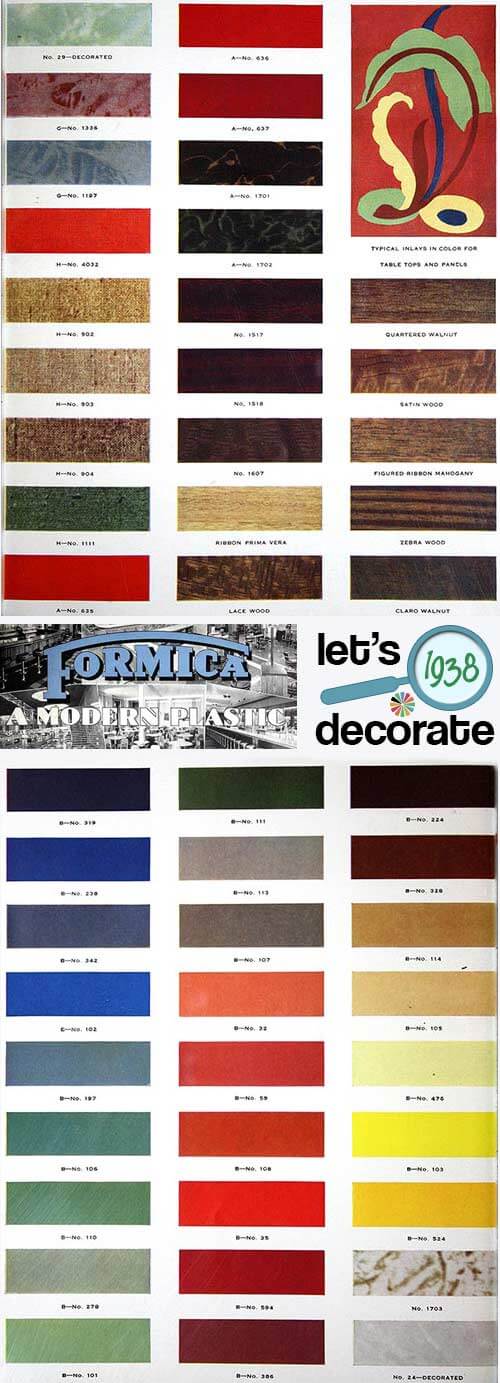
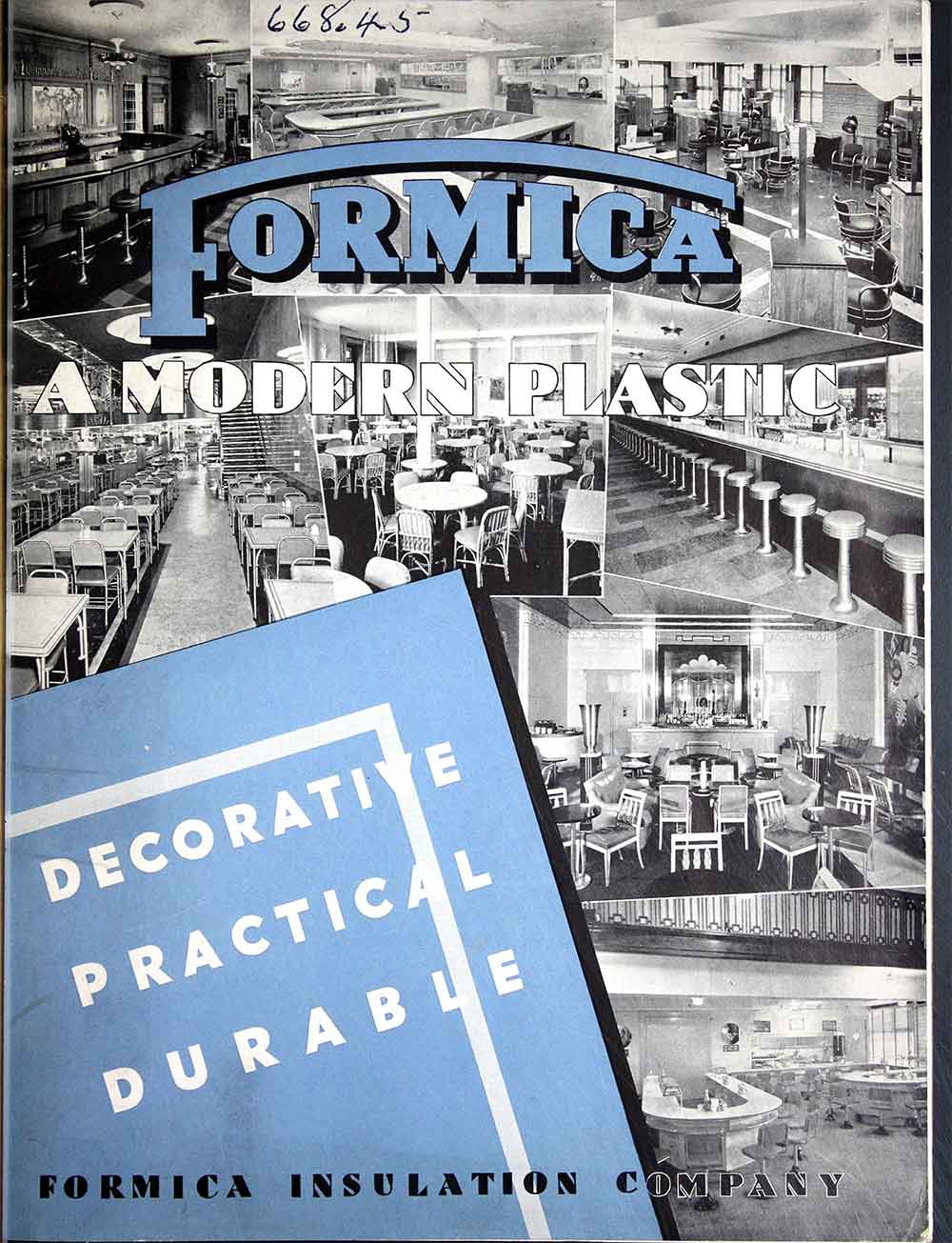
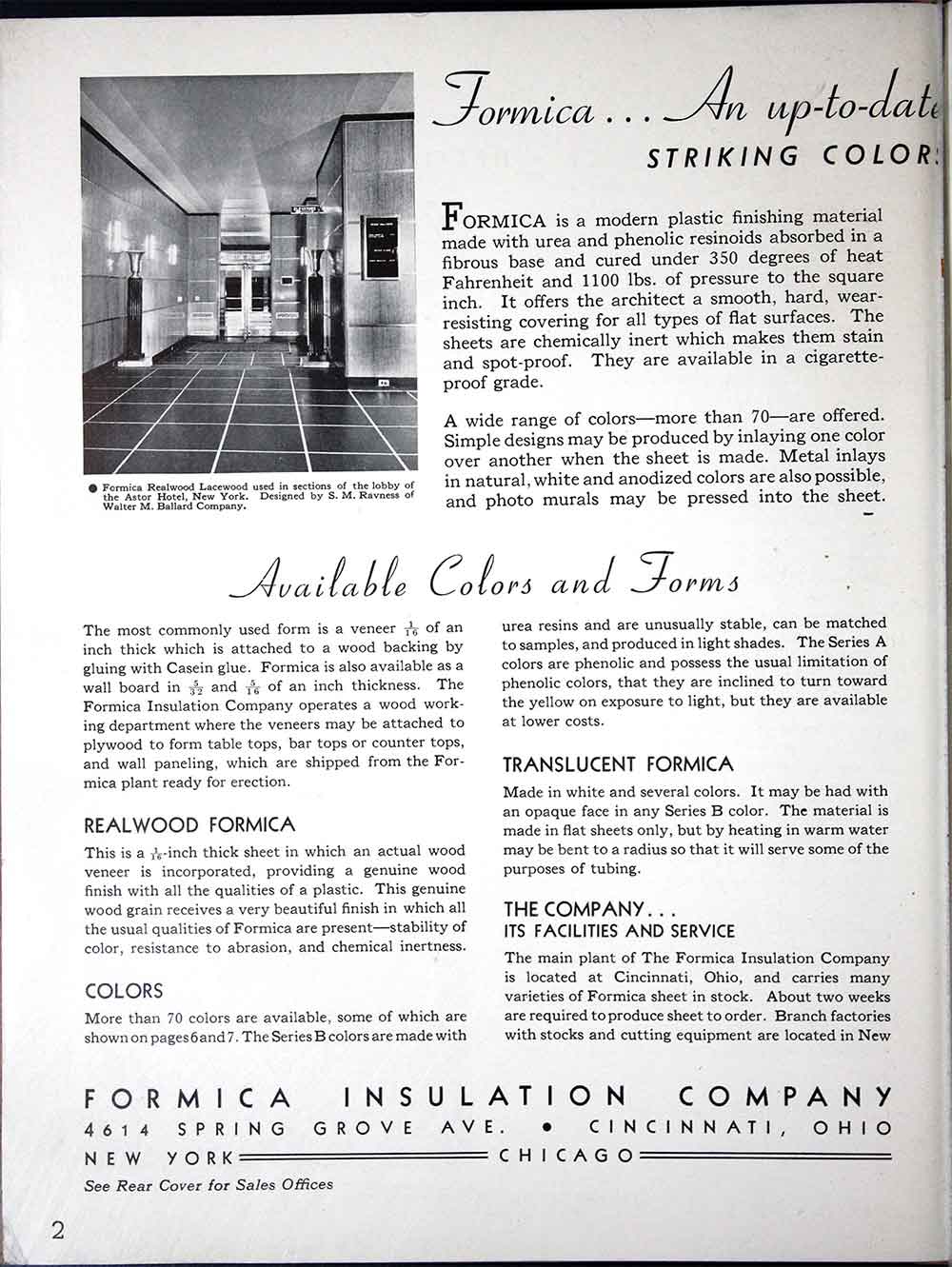
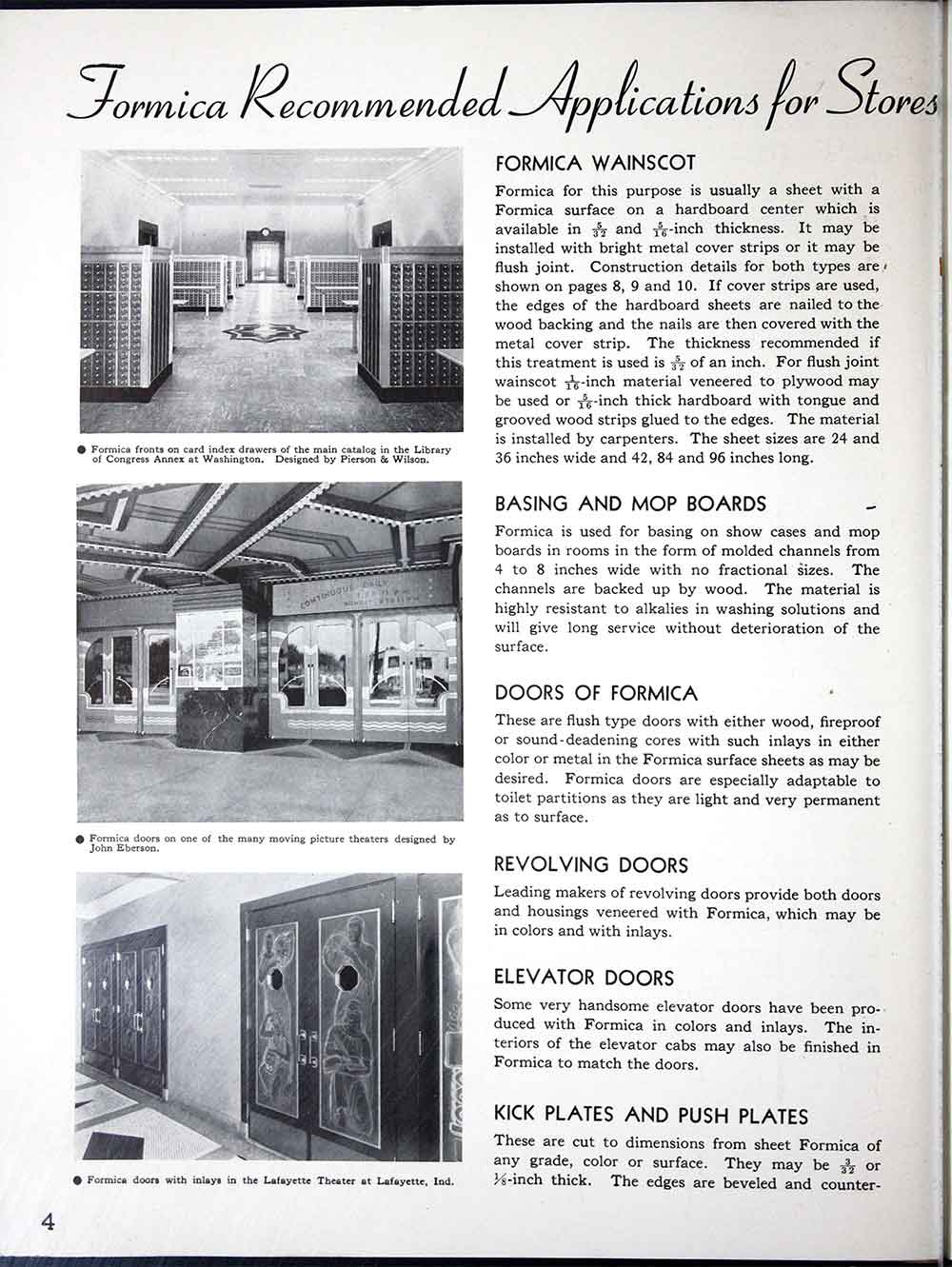
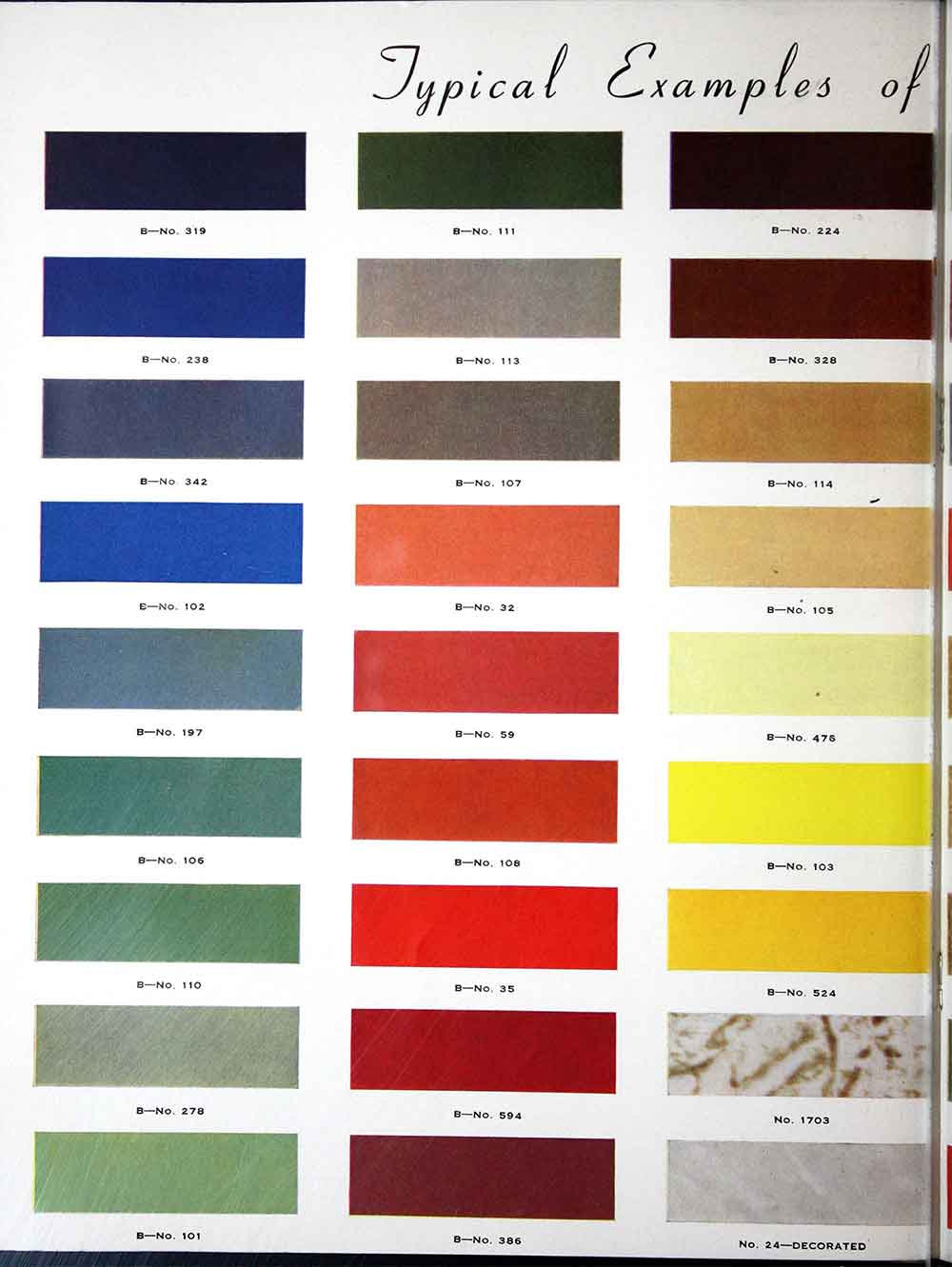
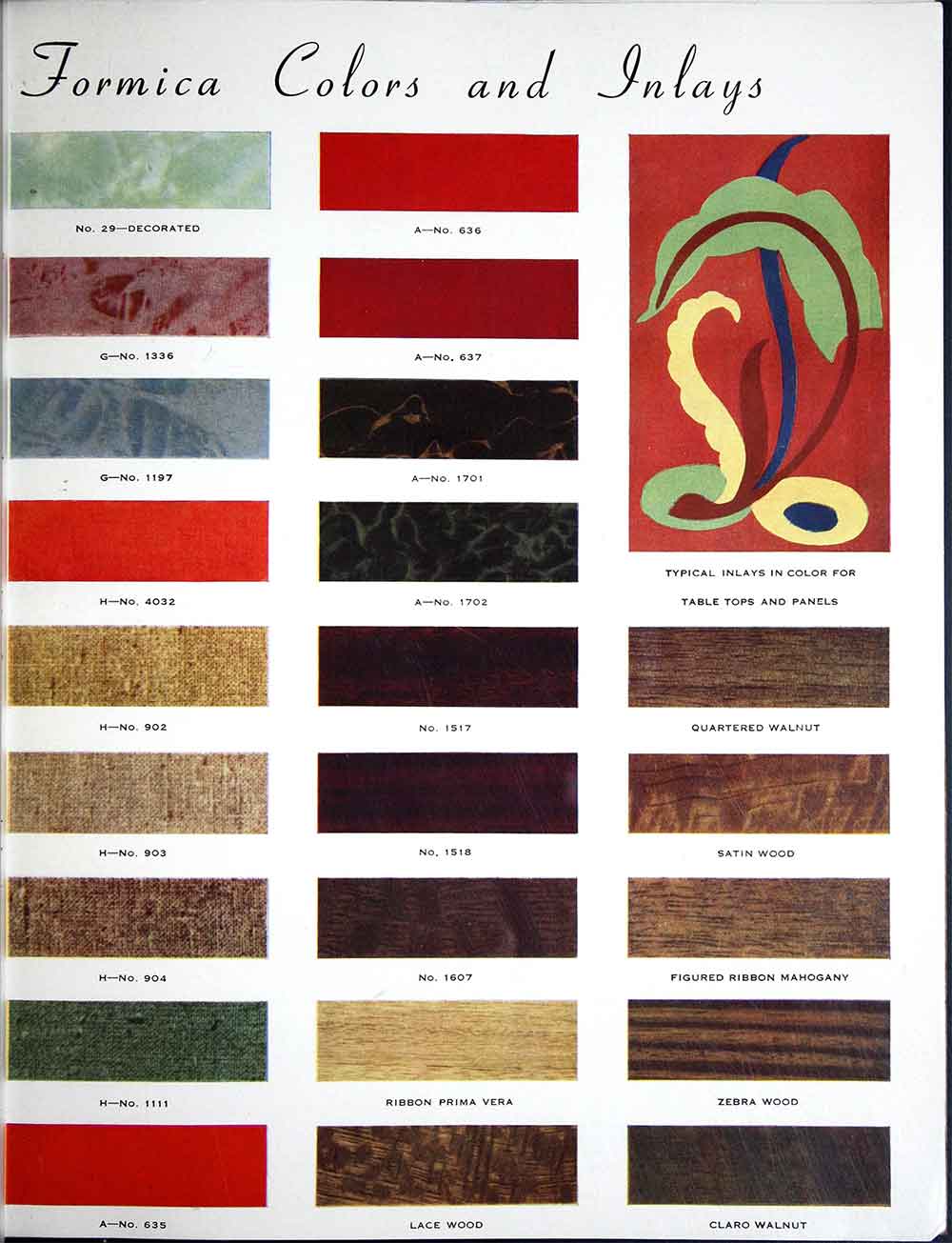
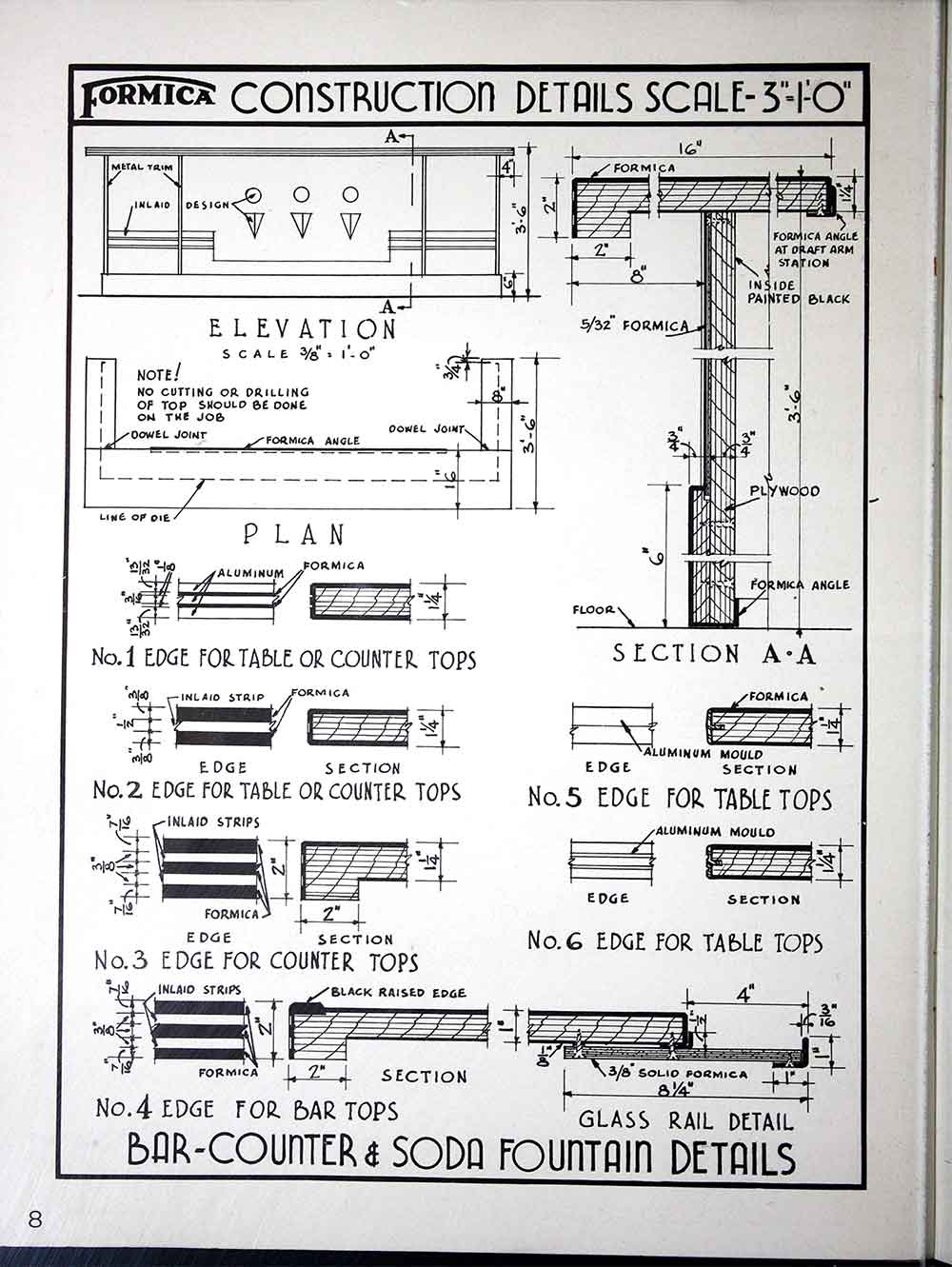
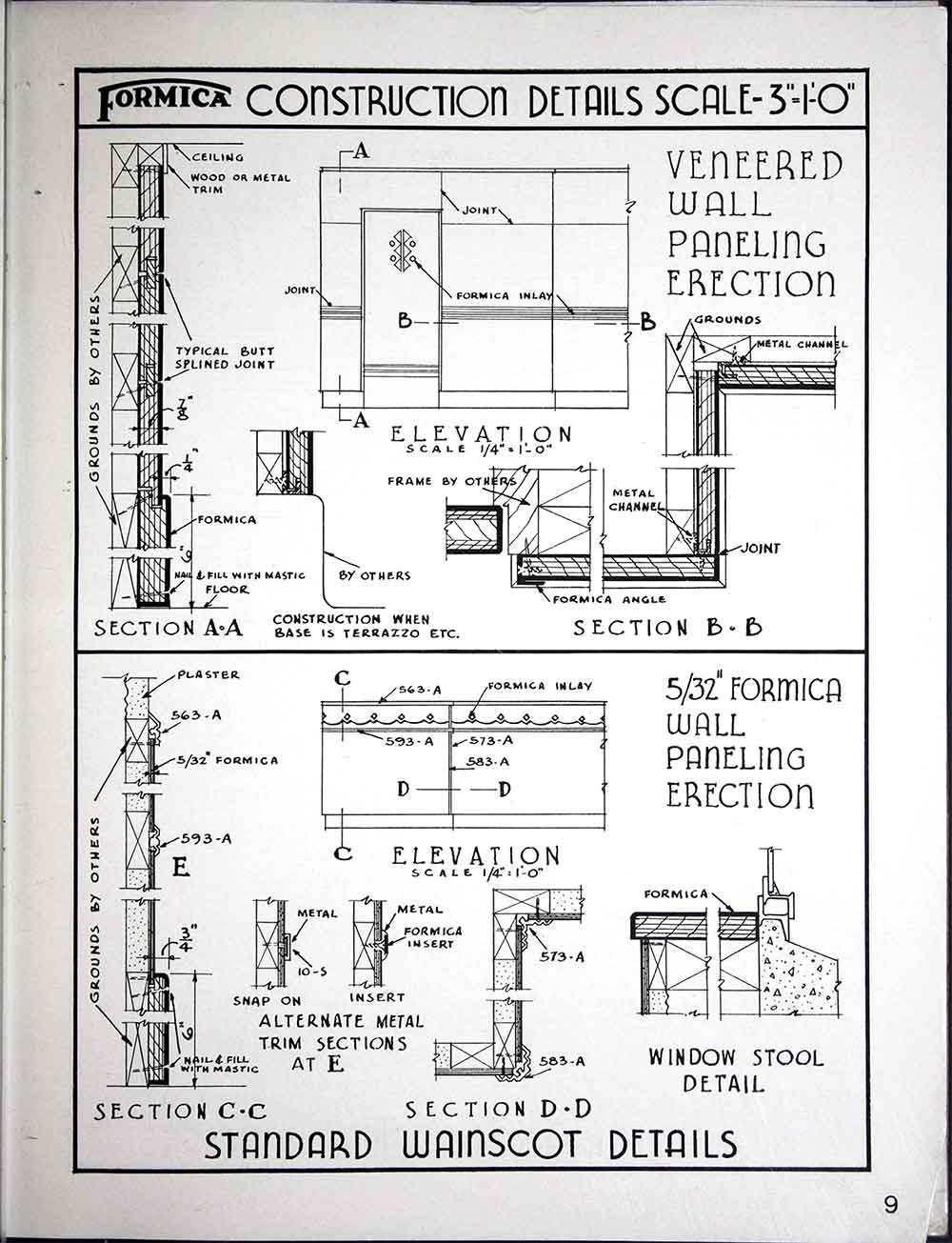
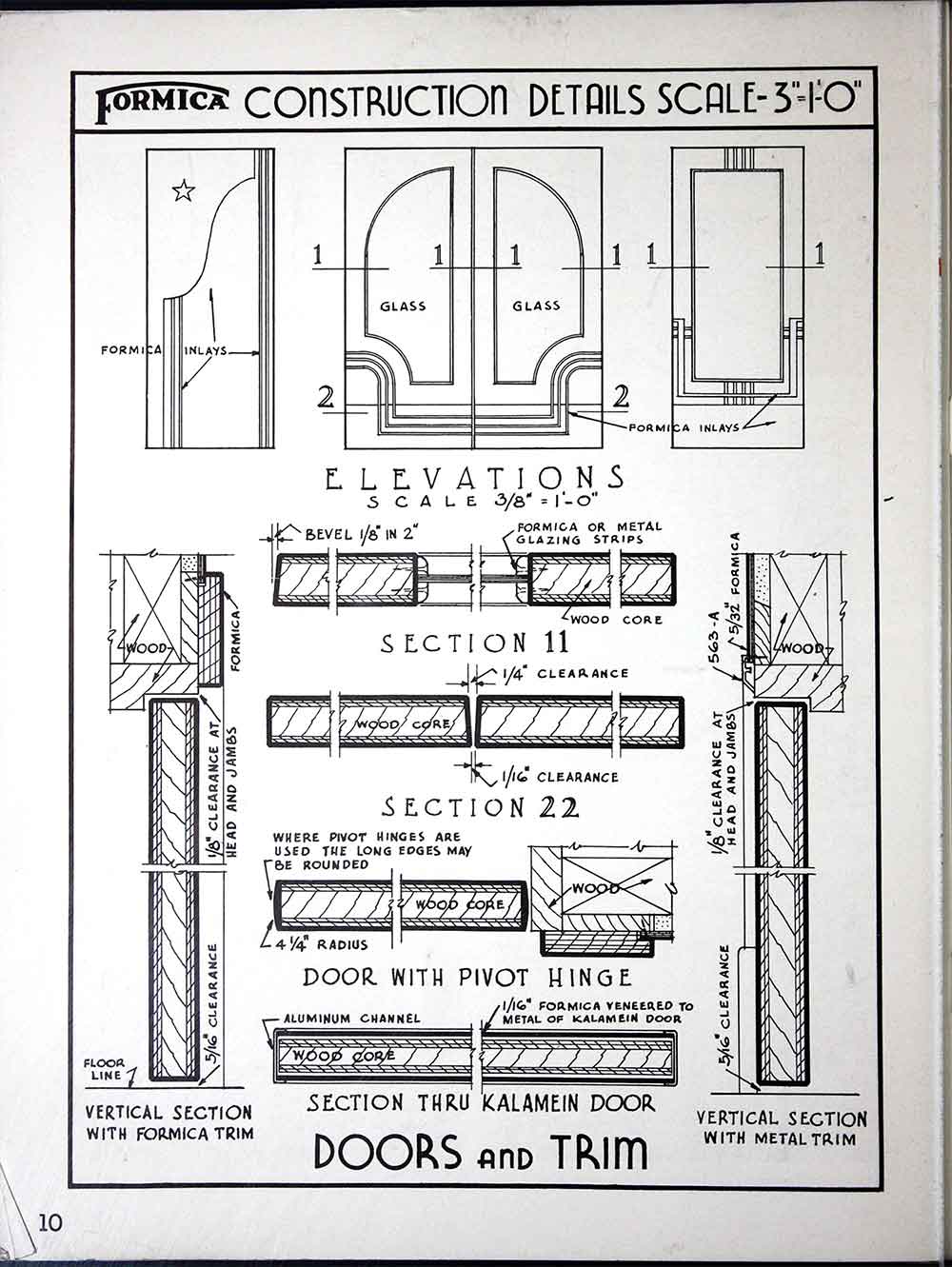
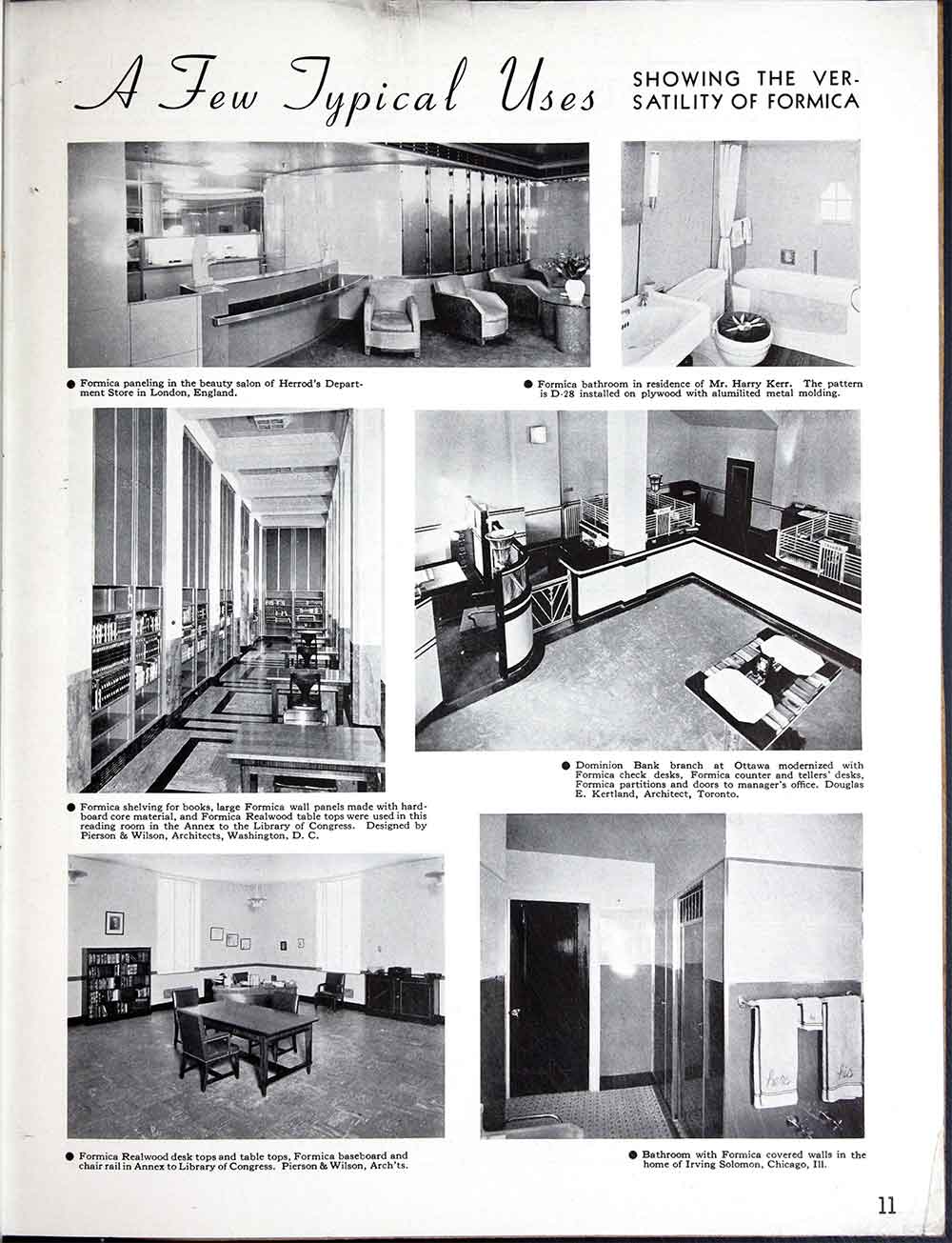
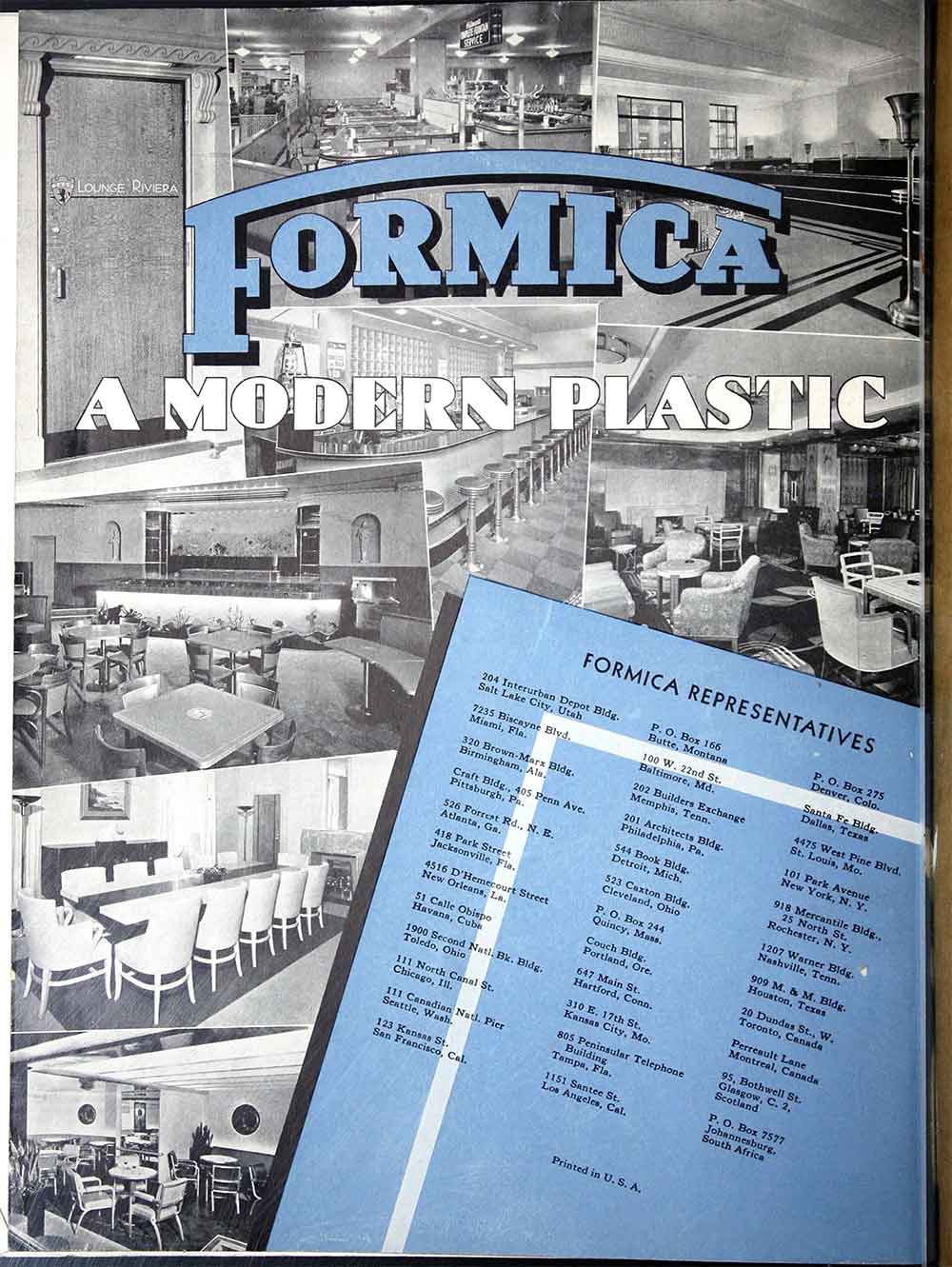
 Since we’ve focused our spotlight on Formica lately — with our stories of Formica’s 100th Anniversary collection — and revisiting the 24 styles of boomerang laminates that are available today — we thought this would be a good time to immerse ourselves in this vintage Formica catalog from 1938. Its 12 pages are packed with historic information — capture 50 historic Formica colors — and showcase possible uses, construction diagrams, available colors and forms, and even technical illustrations for both home and commercial uses.
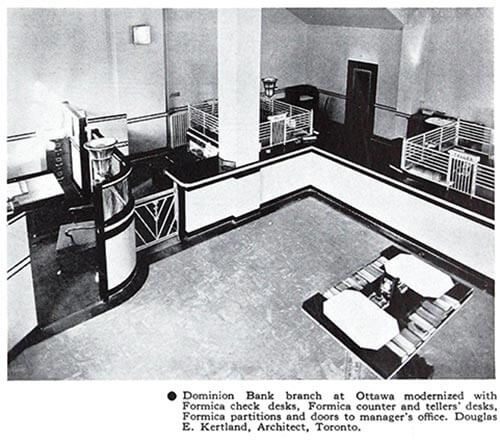 In 1938 — when this catalog was published — Formica certainly seems to have been promoting itself a a Thoroughly Modern Material. The catalog celebrates the range of color and design that could be fabricated, the ease of cleaning and durability. The company wanted builders and designers to know: You could put Formica on just about any surface. Take a look at the photo of the deco-style Toronto bank, above — Formica all over the place.
The catalog promotes Formica’s use on:
- Table and counter tops — including a special sheet designed to be cigarette-proof to guarantee against burning.
- Counter panels — which can be fashioned to include elaborate decorative inlays using color or metals
- Wainscot — installed with bright metal cover strips or flush joints
- Basing and mop boards — listed as able to provide long service due to high resistance to alkalies in washing solutions
- Doors — for adding a decorative touch to entry doors, revolving doors, elevator doors or use in restrooms as toilet partitions
- Kick plates and push plates — take much abuse, easy to keep clean and polish free
- Window stools — made with molded Formica that is fabricated in the factory

- Kitchen counter tops and wall coverings
- Bedroom furniture — for hotels, steamships and clubs they suggest using the cigarette-proof Formica
- Ornamental signs — made by inlaying contrasting color and metal — or by using special translucent Formica which can be illuminated from behind
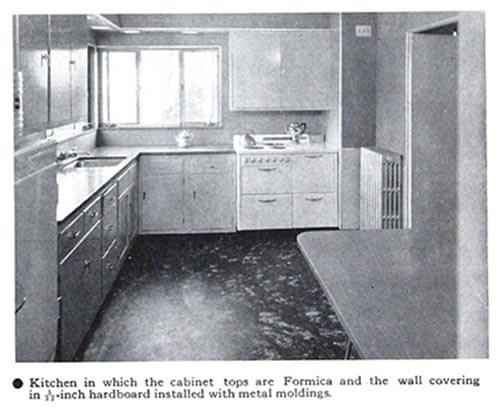
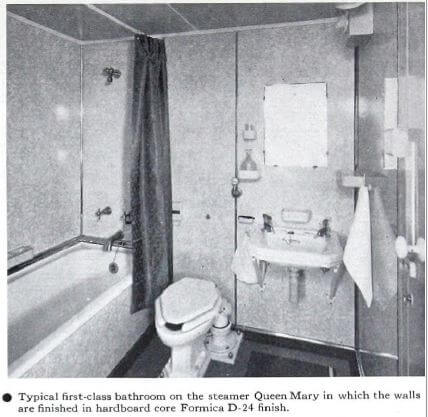
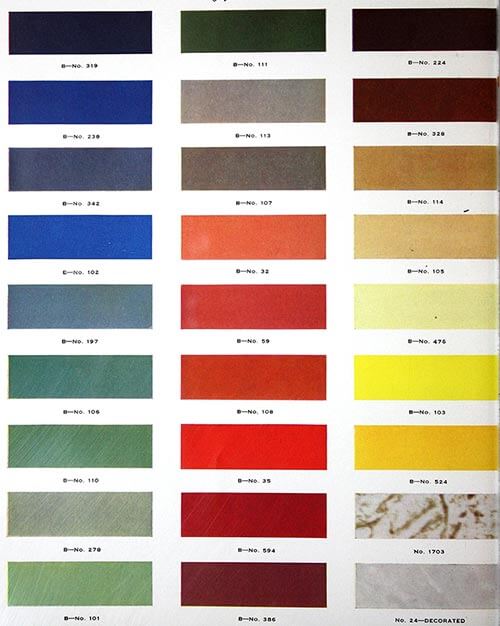
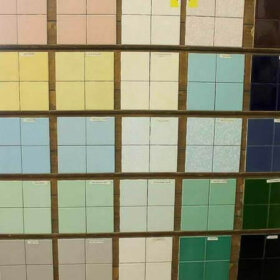
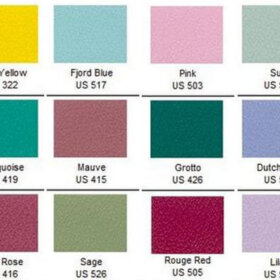
According to this catalog, there were more than 70 colors available. 50 swatches are shown in the catalog. It seems though the possibilities were endless — any colors could be combined through inlays (we LOVE vintage dinettes with inlay designs!) or with metal — to create an infinite variety of looks. 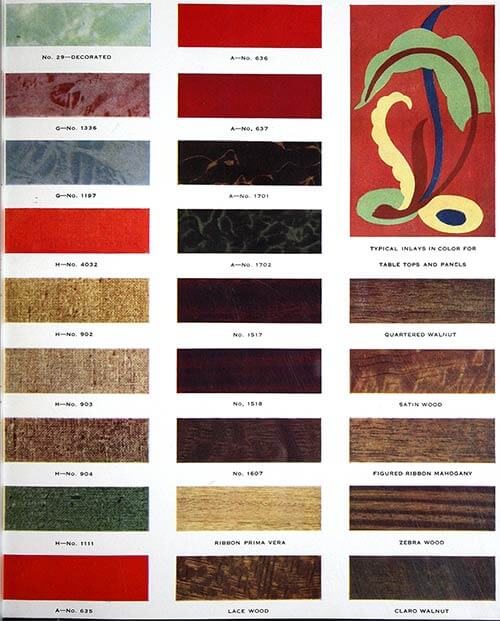
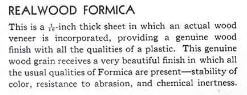 The catalog tells us that Formica was also available in Realwood — a sheet in which wood veneer (rather than the more commonly used decorative later of “kraft paper”) was laminated — combiningthe beauty of a real wood finish with the durability of Formica. Perhaps when we see vintage furniture with laminate that “looks like wood” — it really IS wood in that laminate sheet???
The catalog also mentions a translucent Formica — available in several colors — that can be made with an opaque face. It could only be fabricated in flat sheets, but could be coaxed to bend by heating in warm water.
Today, we are so … bláse … about plastic. It kinda has a bad name in the mainstream home design world… we take it for granted. But when it was first introduced — it was transformational. It solved so many “problems”, and it was affordable to the masses. So cool to get a glimpse of the early days of laminate and the seeming excitement about its transformational design opportunities.
Special thanks to The Canadian Centre for Architecture via archive.org for making this catalog available; it is featured here via Creative Commons license: Attribution-No Derivative Works 3.0.
Would you like to view these images larger? Use this gallery:
Tips to view slide show: Click on first image… it will enlarge and you can also read my captions… move forward or back via arrows below the photo… you can start or stop at any image:




Jean Avison says
Where can I find these retro Formica to purchase for a kitchen remodel? I am looking for a red linen…..I believe it is H No 4022?
Pam Kueber says
See this story: https://retrorenovation.com/2011/09/19/8-places-to-find-retro-laminate-for-kitchen-or-bathroom-countertops-my-researchtips/
I don’t know of anyone making the old style linen anymore, but there are proxies, and there are several other designs that are retro-authentic.
Maggie says
I found a very large (20″ diameter) lazy-susan at the thrift store last week and it has 2 very unique laminate patterns. The surface of the plate is a wide yellow and cream stripe and the edge is what looks like a flower or ice crystal pattern in gold on a white background. Any thoughts on who manufactured it or what the pattern names are? I can send pictures if you want. Thanks!
Maggie
Jim says
I think the best design use of Formica was chrome legged kitchen tables. No other material seems as design compatible with chrome legs as Formica if you think about it. This is probably why vintage kitchen tables are still so popular while Formica counter tops fell out of vogue.
Janice says
Wow what fabulous colors and patterns! I find it interesting how revolutionary Formica was when it first made its appearance and now, so many years later, it’s really kind of snubbed for being what you do when you can’t afford granite or some other natural stone for your countertops. I intentionally installed Formica when I did my kitchen retro remodel and am doing the same in my master bath retro remodel. However, I find myself explaining to my friends why I would do such a thing and not use granite. It’s like they’re saying, “I’m sorry you can’t afford granite like all of us.” Of course, my answer is always “no one knew about granite in the 1950’s. Formica WAS the granite back then.” I still don’t think they get it and that’s why I love this blog so much because I know everyone on here gets it.
RetroGal says
Great comment! If it were on Facebook, I would have “Liked” it! 🙂
Sometimes people just don’t get the love of retro!! But that’s ok… makes the stuff still cheap (sometimes!) at estate sales!! 🙂
Tracie@MiddleClassModern says
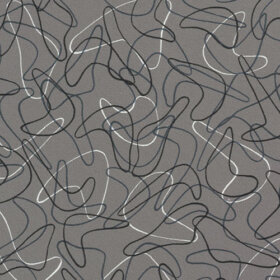
I’m pretty sure I have No. 29 Decorated in my kitchen! The countertops are pretty destroyed by decades of renters, but it was also used to line the cabinets and THAT’s in pretty fantastic shape.
I always wondered what the pattern was.
Scott says
Wow, what an eye-opener. Who woulda thunk the 1938 color palette would have been so exuberant? And the thought of translucent Formica makes me positively giddy.
I also noticed in that Queen Mary shot they even applied Formica to the side of the tub! My 1954 tub sides are probably a tad too curvaceous for that, but the thought of using Formica as not only a workhorse countertop surface but also as a decorative element is sort of making me have an out of body experience.
Hillary says
Are three of those metallic? I’m still trying to figure out when gold-fleck came into being.
Chad D says
I love old, hand-lettered architectural drawings, but the part about using asbestos board as a substrate for countertops, not so much!
pam kueber says
Good catch! Peoples: Here’s the speech again: Vintage nastiness like lead and asbestos can be lots of places in our old houses — consult with a properly licensed professional to know what’s in your house, including when you go to uncover/demo old layers!
Jay says
Oh yes! The wonder material, used in all manner right up through the 70s. They didn’t know then when this was published what a nightmare it would become 50 years later. Anyway I like these patterns better then the anniversary patterns. I guess I’m too much of a traditionalist.