

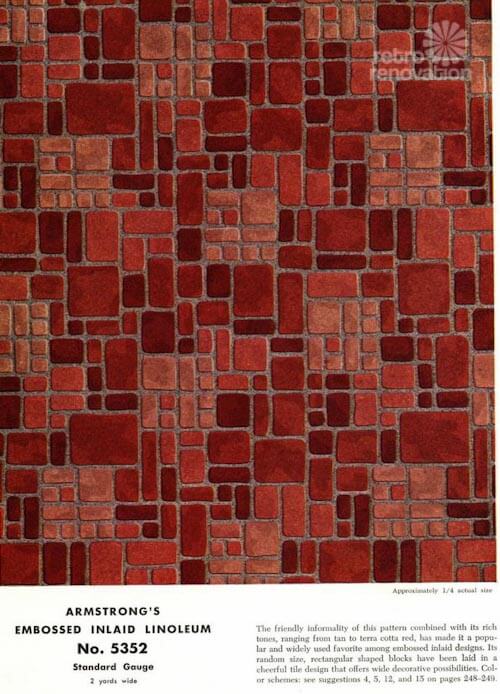
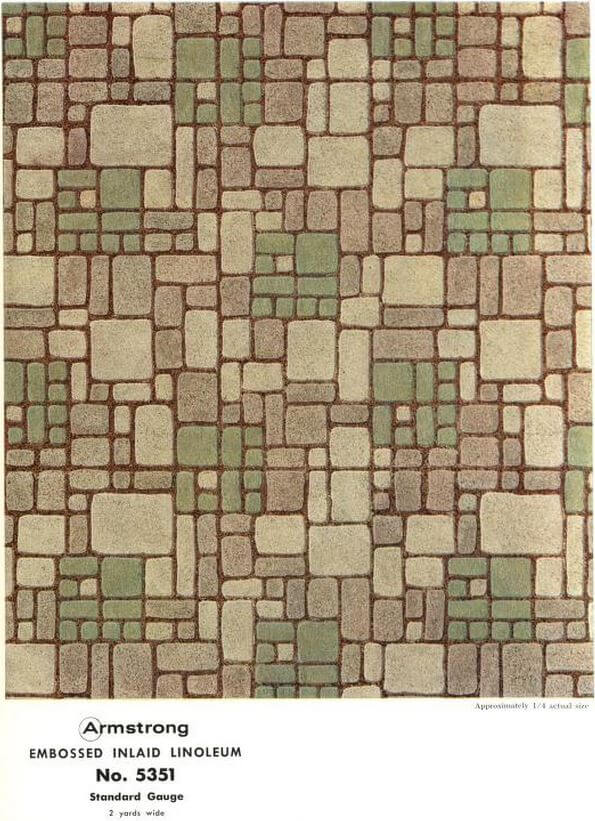
 A short pause today, to reflect upon and ogle the linoleum pattern that we believe was The Single Most Popular resilient floor pattern in midcentury American houses: Armstrong No. 5352. So far in my research, I have found No. 5352 in Armstrong catalogs as early as 1935 and reader Scott says that it was still being sold at Sears in the mid-1990s! That is quite a run!
March 2020 update: Armstrong Flooring is reintroducing the 5352 design — dubbed Heritage Brick — this year. Read the full story here.
- Also read my 2020 story on the history of this pattern — from my interview with Mark Zeamer of Armstrong.
Originally, Armstrong No. 5352 was available as real-deal “Embossed Inlaid Linoleum”. Mark Zeamer told me (in interview story listed just above, “The 5352 pattern lasted a long time in many different commodities, starting out in linoleum to Coronelle to felt-backed Imperial Solarian and then jumped to vinyl into the 1970’s. It was in the 70’s that it was revived as a Rotogravure printed product in Sheet Goods and Tile.”
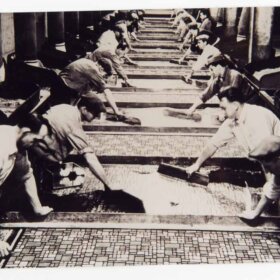
I have been reading Jane Powell’s excellent book, Linoleum (affiliate link). “Inlaid” means that workers actually sifted different color mixtures — up to 38 different colors per design! — onto the linoleum-sheet-in-progress. “Embossed” means that the entire piece was then pressed to create texture — in the case of No. 5352, the divits suggesting grout. Incredible workmanship required for such a “humble” material.
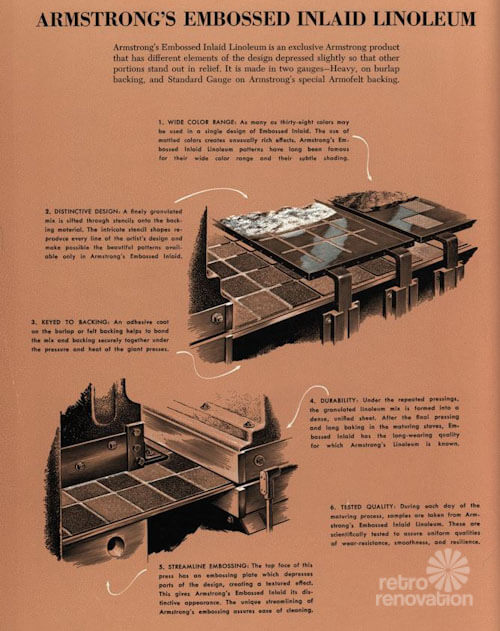 Here’s more detail on how embossed inlaid linoleum was manufactured, as described by Armstrong in 1949 (above):
- WIDE COLOR RANGE: As many as 38 colors may be used in a single design of Embossed Inlaid. The use of mottled colors creates unusually rich effects. Armstrong’s Embossed Inlaid Linoleum patterns have long been famous for their wide color range and their subtle shading.
- DISTINCTIVE DESIGN: A finely granulated mix is sifted through stencils onto the backing material. The intricate stencil shapes reproduce every line of the artist’s design and make possible the beautiful patterns available…
- KEYED TO BACKING: An adhesive coat on the burlap or felt backing helps to bond the mix and backing securely together under the pressure and heat of the giant presses.
- DURABILITY: Under the repeated pressings, the granulated linoleum mix is formed into a dense, unified sheet. After the final pressing and long baking in the maturing stoves, Embossed Inlaid has the long-wearing quality for which Armstrong’s Linoleum is known.
- STREAMLINE EMBOSSING: The top face of this press has an embossing plate which depresses parts of the design, creating a textured effect…. The unique streamlining of Armstrong’s embossing assures ease of cleaning.
Precautionary Pam notes: I also want to relate that in her book, Powell says that while linoleum is known today for its use of renewable resources (cork, linseed oil, namely), heavy metals such as lead may have been used in the manufacturer of old linoleum. In particular, she points out that lead and other heavy metals such as cadmium and chromium may have been used in the pigments used for coloration. Resilient flooring made from other materials may have contained other hazardous materials such as asbestos; check adhesives, too. So — Precautionary Pam repeats: Be sure to test the materials in your old houses for vintage nastiness like lead, asbestos and more — get with your own properly licensed professional to determine what’s in your house and its layers, so that you can make informed decisions about how to handle. For more info and links see our Be Safe / Renovate Safe page.
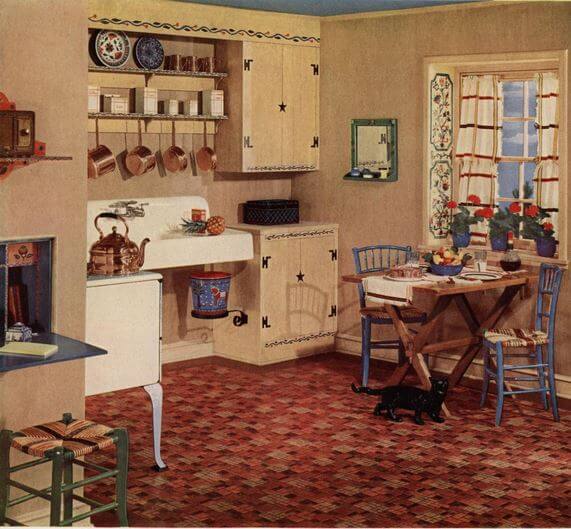
Armstrong 5352 — why was it so popular?
 Back to Armstrong 5352: Why was it so popular? I will theorize that 5352 resonated for decades because so many American kitchens were “traditional” in overall character, year in and year out. This floor design — with its warm, essentially neutral colors — and with its evocation of timeless brick flooring — would have fit into many a kitchen.
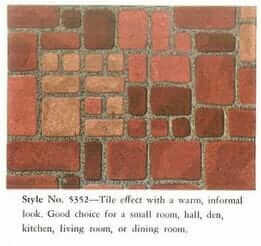
Armstrong pointed to its versatility, describing it as a “Tile effect with a warm informal look. Good choice for a small room, hall, den, kitchen, living room, or dining room.”
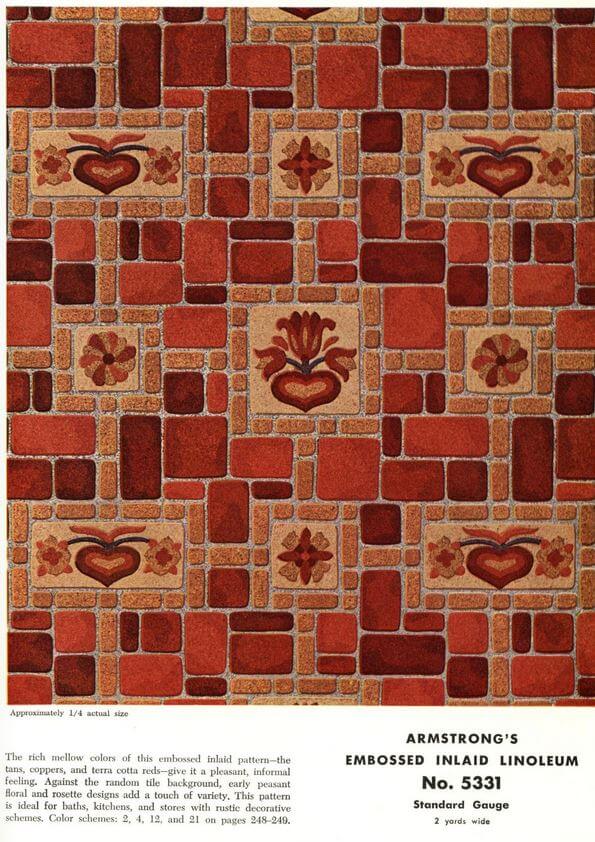
I am pretty sure that 5352 lasted well into the 1970s, at a minimum — see the photo below, Jon & Trixi found it in their 1960s house, covered up. By then, the material likely changed to vinyl or some sort of vinyl composite; test this old stuff and adhesives underneath for vintage nastiness such as lead and asbestos, too, please.
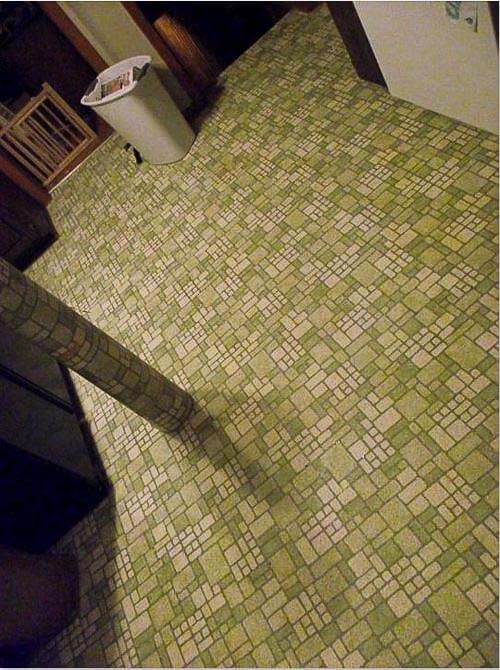 To be sure, I can envision it successfully complementing dark wood cabinets and avocado and harvest gold appliances, too. Armstrong No. 5352 had legs. Oh, how it wish it were still available today!

These old linoleum floors — amazingly amazing.
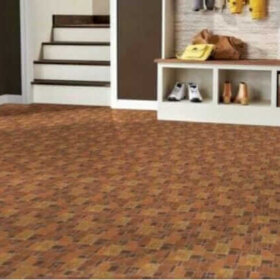
 UPDATE: Reader Hannah sent this photo of vintage Armstrong linoleum in the 5352 pattern and left this comment on the Retro Renovation Facebook page:
I have two partial rolls down in the basement a friend gave me. It was left in HER basement when the original owners sold them the house. Not sure what I want to do with it though. It’s not enough to cover any floor we have. I just knew I WANTED IT!


Brian Pohl says
I would like to bring back many memories by replacing my kitchen floor with this pattern (5353). does anyone know where this can be found? 12×14
pam kueber says
Not available any more. Ask Armstrong to bring it back!
Vickie Davis says
To: Hannah who found a couple of rolls in aunt’s basement
Are you willing to sell some of it? We had a flood in our kitchen and they cut a piece out. I need about a 4′ by 7′ piece. I refuse to tear out the rest of the kitchen floor. I would rather hide the spot with a rug. Vickie Davis davis5968@mediacombb.net
Leslee says
Browsed a bit on your site but looking for cleaning help. I bought a one owner 1965 ranch and my flooring is this but beige/tan/yellowish. Everything was original (even the paint I think) but she was a very very clean lady, I lucked out! Almost mint condition on everything. I love the floors but very dingy. I’m pretty sure these are the waxed kind. I’ve tried many cleaners and bought Holloway House quick shine deep cleaner. This is the only thing that worked but Holy Cow the mess! Definitely stripping all the old wax. I’m not kidding it took my hours to do a 2×2 section and they don’t look less dingy just less shiny.
My hardwood floors are waxed and I do them about every 6 months. So I own a buffer. I guess my question is…. Should I try to get all the old wax off first before I try to wax them or just give up and wax them as is? Can you just keep applying more wax? I never de-wax my hardwoods. Thanks for any help!
pam kueber says
Leslee, I don’t know the answer to these questions.
Linda says
Years, and I mean decades, ago I came across a method for stripping multiple layers of wax off floors. It worked so well for friends of mine that they kept the floor they had planned to replace. I would give credit, but I have no idea where I read it so long ago. You need a scrub brush, squegee, clean rags, dustpan, and 3 buckets – one empty, one with warm water, and one filled half way with hot water, a cup of tide detergent, and a cup of ammonia. Working in a 2ft x 2ft or 3×3 section, use the brush and spread the mixture generously and lightly scrub. Leaving that section to soak and soften the old wax, move on to a different section and repeat. After than, return to the first section and scrub in earnest. Using the squegee, scrape up the goop into the dustpan and dump in the empty bucket. Using clean rags and water, rinse then dry that section. Keep moving on to a new section while the previous one soaks (I’d give it at least 10″-15″ depending on how much wax buildup). When all is stripped you’re ready to re-wax or polish however you like.
Linda says
*squeegee! I knew that wasn’t right, lol.
John says
The original Armstrong pattern number was 75352; produced in embossed inlaid linoleum until 1974 when Armstrong stopped making linoleum. Thereafter, the pattern was produced in vinyl flooring; the photo that a reader sent in of remnants in her basement is actually of Armstrong Designer Solarian (note the shiny finish). [EDITED: Precautionary Pam here — I edited this part of the comment which discussed potential for this flooring to include asbestos — which indeed it may — but I edited because it got into how-to-handle advice. PEOPLES: Yes, there may be vintage nastiness in the old materials in our houses and their layers — get your own properly licensed professional to help you assess what you have so that you can make informed decisions how to handle].
The artist who created the original pattern in 1927 left Armstrong after nine months because he did not see a future in it. His design became the longest running pattern in the company’s history.
Rachel says
I remember my dad coming home from one of the Armstrong shows, singing “This is the dawning of the age of Solarian . . .”
A decades old earworm!
KTheo says
Hi, does anyone have any of this in green? We recently had a flood at my Mom’s house and serve pro ripped it out. It was installed in 1974 and it was in great condition, Unfortunately, the subflooring absorbed the water so it had to go. It matched everything in the place so if we could replace it, our life would be so easy… Does anyone have any? Thank you!
pam kueber says
KTheo, over to the Forum, please: https://retrorenovation.com/forums
1963 Jack-in-the-Box House Kali says
My grandmother’s house had the red-toned version in the back bedroom! She and my grandfather bought the house in the mid-1940s, and I’m pretty sure it was there long before they came along!
Jessie says
I would love to have this (the orangy/brick color) in my house. I always loved it in my aunt’s old farm kitchen and agree with comments that the manufacturer would make money bringing this pattern back! I can’t find anything I like nearly as well.
Randerson says
We put the linoleum version of 5352 in our first house in 1974, the no-wax Solarian version (more expensive) in our second house in 1990, and again in our 3rd house in 1995! When we moved again in 1999 we looked for it for our kitchen reno, and it was gone!! Given the huge popularity of this floor, can’t believe Armstrong wouldn’t make money bringing it back…we Boomers are still out there buying stuff, and nostalgic for our childhoods!!
pam kueber says
I AGREE! I am going to write them today to encourage them to bring it back! What a livable, versatile pattern!
Argon says
My dad had a long career with Armstrong. This was in our kitchen, and every kitchen in Lancaster County owned by an Armstrong worker. Good stuff! A heckuva lot better than what’s in my kitchen today.
David A. Levy says
Where can I purchse Armstrong 5353 ?
david
pam kueber says
not made any more…