

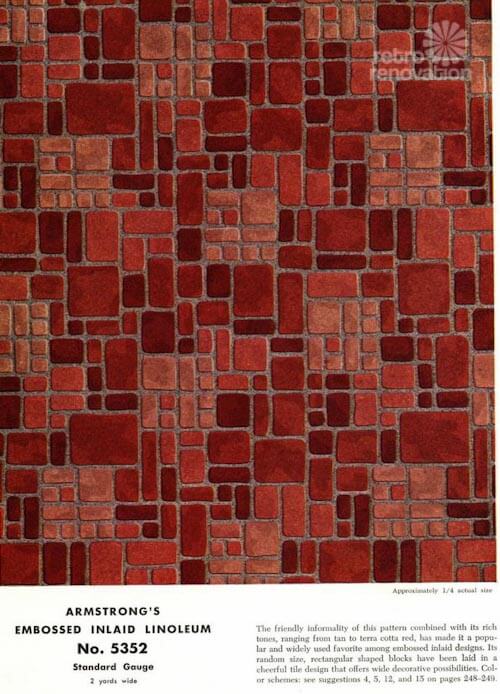
 A short pause today, to reflect upon and ogle the linoleum pattern that we believe was The Single Most Popular resilient floor pattern in midcentury American houses: Armstrong No. 5352. So far in my research, I have found No. 5352 in Armstrong catalogs as early as 1935 and reader Scott says that it was still being sold at Sears in the mid-1990s! That is quite a run!
March 2020 update: Armstrong Flooring is reintroducing the 5352 design — dubbed Heritage Brick — this year. Read the full story here.
- Also read my 2020 story on the history of this pattern — from my interview with Mark Zeamer of Armstrong.
Originally, Armstrong No. 5352 was available as real-deal “Embossed Inlaid Linoleum”. Mark Zeamer told me (in interview story listed just above, “The 5352 pattern lasted a long time in many different commodities, starting out in linoleum to Coronelle to felt-backed Imperial Solarian and then jumped to vinyl into the 1970’s. It was in the 70’s that it was revived as a Rotogravure printed product in Sheet Goods and Tile.”
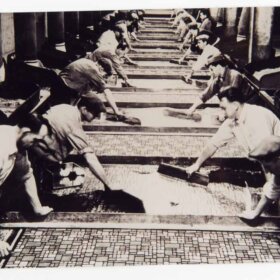
I have been reading Jane Powell’s excellent book, Linoleum (affiliate link). “Inlaid” means that workers actually sifted different color mixtures — up to 38 different colors per design! — onto the linoleum-sheet-in-progress. “Embossed” means that the entire piece was then pressed to create texture — in the case of No. 5352, the divits suggesting grout. Incredible workmanship required for such a “humble” material.
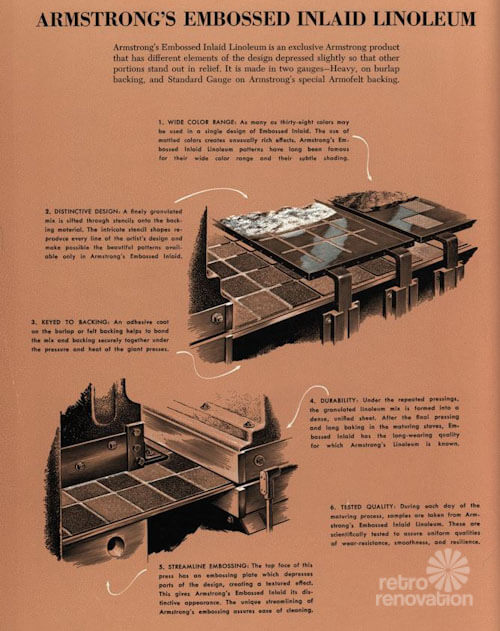 Here’s more detail on how embossed inlaid linoleum was manufactured, as described by Armstrong in 1949 (above):
- WIDE COLOR RANGE: As many as 38 colors may be used in a single design of Embossed Inlaid. The use of mottled colors creates unusually rich effects. Armstrong’s Embossed Inlaid Linoleum patterns have long been famous for their wide color range and their subtle shading.
- DISTINCTIVE DESIGN: A finely granulated mix is sifted through stencils onto the backing material. The intricate stencil shapes reproduce every line of the artist’s design and make possible the beautiful patterns available…
- KEYED TO BACKING: An adhesive coat on the burlap or felt backing helps to bond the mix and backing securely together under the pressure and heat of the giant presses.
- DURABILITY: Under the repeated pressings, the granulated linoleum mix is formed into a dense, unified sheet. After the final pressing and long baking in the maturing stoves, Embossed Inlaid has the long-wearing quality for which Armstrong’s Linoleum is known.
- STREAMLINE EMBOSSING: The top face of this press has an embossing plate which depresses parts of the design, creating a textured effect…. The unique streamlining of Armstrong’s embossing assures ease of cleaning.
Precautionary Pam notes: I also want to relate that in her book, Powell says that while linoleum is known today for its use of renewable resources (cork, linseed oil, namely), heavy metals such as lead may have been used in the manufacturer of old linoleum. In particular, she points out that lead and other heavy metals such as cadmium and chromium may have been used in the pigments used for coloration. Resilient flooring made from other materials may have contained other hazardous materials such as asbestos; check adhesives, too. So — Precautionary Pam repeats: Be sure to test the materials in your old houses for vintage nastiness like lead, asbestos and more — get with your own properly licensed professional to determine what’s in your house and its layers, so that you can make informed decisions about how to handle. For more info and links see our Be Safe / Renovate Safe page.
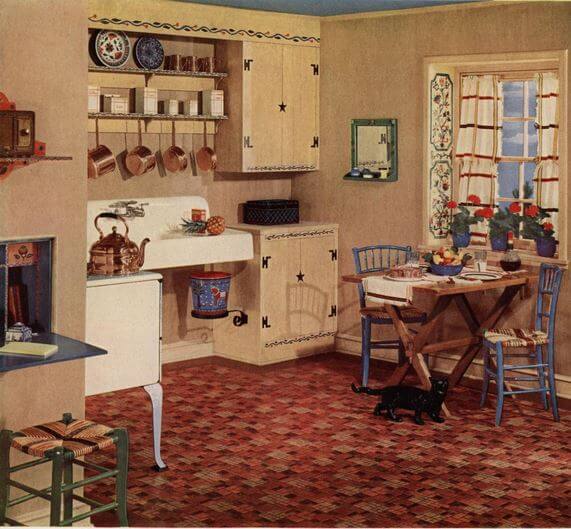
Armstrong 5352 — why was it so popular?
 Back to Armstrong 5352: Why was it so popular? I will theorize that 5352 resonated for decades because so many American kitchens were “traditional” in overall character, year in and year out. This floor design — with its warm, essentially neutral colors — and with its evocation of timeless brick flooring — would have fit into many a kitchen.
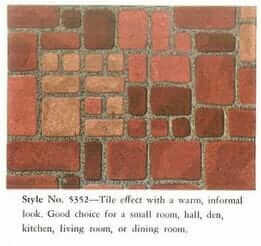
Armstrong pointed to its versatility, describing it as a “Tile effect with a warm informal look. Good choice for a small room, hall, den, kitchen, living room, or dining room.”
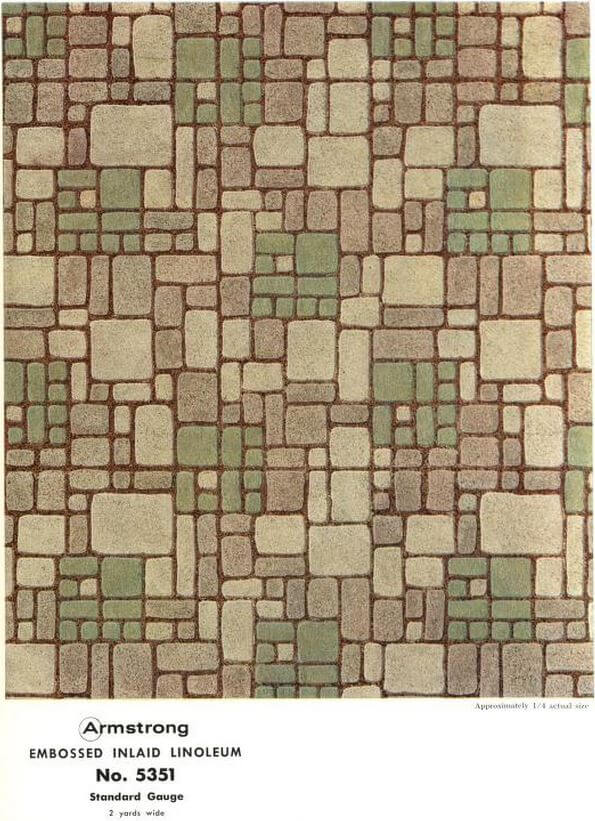
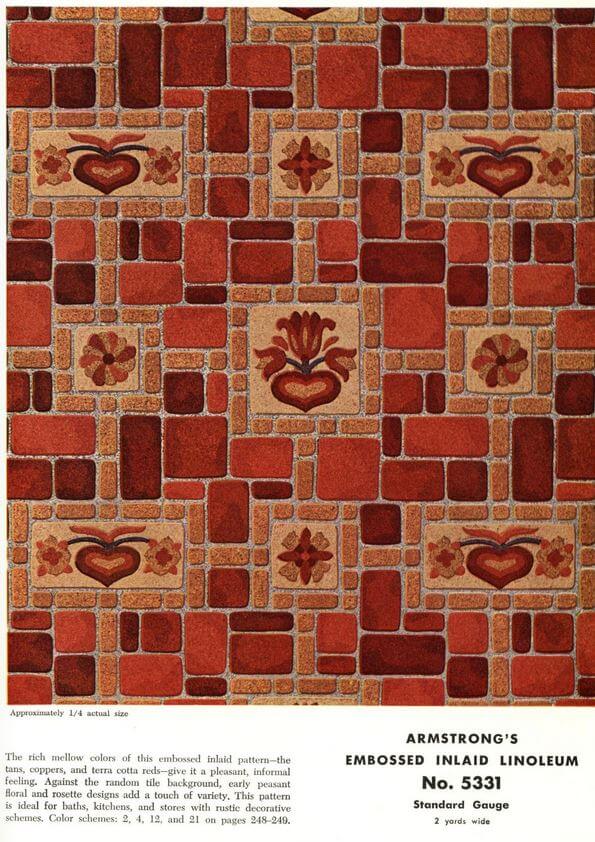
I am pretty sure that 5352 lasted well into the 1970s, at a minimum — see the photo below, Jon & Trixi found it in their 1960s house, covered up. By then, the material likely changed to vinyl or some sort of vinyl composite; test this old stuff and adhesives underneath for vintage nastiness such as lead and asbestos, too, please.
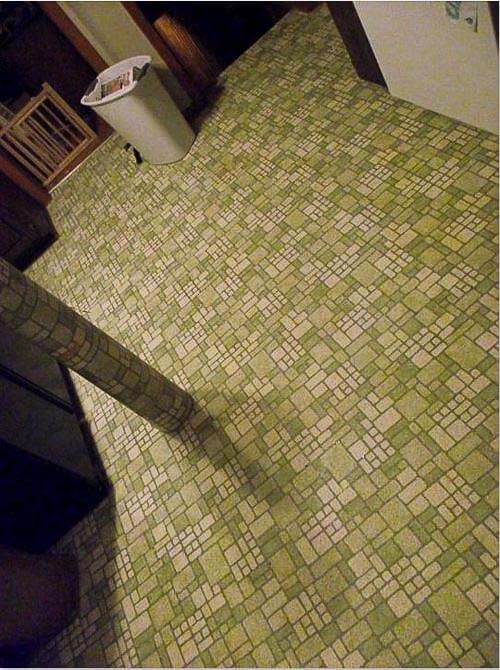 To be sure, I can envision it successfully complementing dark wood cabinets and avocado and harvest gold appliances, too. Armstrong No. 5352 had legs. Oh, how it wish it were still available today!

These old linoleum floors — amazingly amazing.
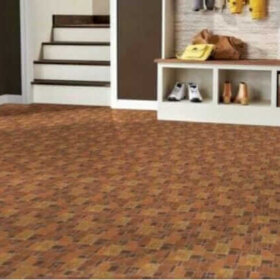
 UPDATE: Reader Hannah sent this photo of vintage Armstrong linoleum in the 5352 pattern and left this comment on the Retro Renovation Facebook page:
I have two partial rolls down in the basement a friend gave me. It was left in HER basement when the original owners sold them the house. Not sure what I want to do with it though. It’s not enough to cover any floor we have. I just knew I WANTED IT!


Robert Lothrop says
I sold flooring for color tile in the early 90’s in Capitola, Ca, and we had 4 colors available then- the original, an off white, a tan and a blue-ish, I think, and we had samples of it, too. An Armstrong Wall and a Tarkett wall
pam kueber says
Thanks, Robert, for that update!
R. Rudolph Van Dyke says
My Wife (Christine) and I are doing a retro rehab of sorts on the home I grew up in from 1961. We have the Armstrong 5352 in our kitchen and plan to keep it along with the dutch style wood cabinets. We do plan to update in other areas but are looking at retro appliances.
Thanks for all of the information.
Brenda says
GaCk!~ my husband and I owned a flooring store, we saw LOTS of this pattern down, and as ugly as it was, it wore like CRAZY! You could NOT wear it out! We joked that He%% was paved with the stuff. LOL
pam kueber says
Not ugly — WE LOVE IT! One of our top-three product we wished they’d bring back today! https://retrorenovation.com/2015/01/13/3-midcentury-home-design-products-bring-back-now/
oceana says
Well this is just the reassurance I was looking for! I feel a little better about the butter-orange-cream version in our kitchen and office now! It has a slight variation in the pattern from the 5332, but I am sure it is very closely related. I was feeling like it wasn’t “mid century” enough, as the kitchen was remodeled in the early 70’s. Now I feel like it has a bit more “provenance” : ) We do have dark wood cabinets and harvest gold accessories, like you mentioned in the article, so even though I was hoping for more of a 50’s kitchen, there is still some fun to be had with what we got.
pam kueber says
I LOVE the sound (errr, the colors) of your floor!
Marjorie says
This was the linoleum pattern on my Grandmother’s floor. I’ve seen it only a few other times in my life, and on each of those it has evoked happy memories of her warm heart and home, and the magic she created by allowing her young grandchildren to explore and become independent.
Alison Hardy says
We owned a house in NJ that had the yellow orange version not only on the floor of the bathroom but about four feet up the wall too. Wainscot-ish? It was quite a look.
Kurt says
They used to use this material as floor covering in the patient compartment of Cadillac ambulances!
EMandranis says
The most wonderful flooring. After 30 years, two kids, and many dogs, ours is finally finished. Cannot find anything remotely as good. The tiny brick floor pattern was SO good because it hid the dirt, scuff marks, and felt warm and rich. Everything we are looking at now is just so wretchedly “neutral”(-the curse of the modern age decor)!
Duke Romo says
I saw Hannah’s reply about the Armstrong 5352 “brick pattern” linoleum. In that post she stated she had two rolls, our Historic Society “Upland Heritage” would like to see if she would part with one? We have a member with a mid century modern that has three floors of the old Armstrong flooring and is need of a patch of about 2×2 square feet.
Duke Romo
Upland Heritage
d.dukeromo@live.com
Barb says
My family has an old house with this linoleum in the kitchen. Any idea how to rejuvenate it? It looks a little tired.
Barb says
House was built 1918, I think my grandparents put the flooring in the late 60’s and it’s still going strong.
pam kueber says
I would probably just try putting a floor polish on it and buffing. Note: Take care because the vintage materials in our vintage houses can contain vintage nastiness such as asbestos, lead, etc. Consult with your own professional to assess what you have so that you can make informed decisions how to handle.
Stephen Ritchings says
Love this pattern ! I too saw it a lot when growing up in the ‘fifties. Thanks for telling us more about it.
[Publisher Pam intervening here: I edited the continued comment/discussion, which included opinions on asbestos issue. READERS: Please do your own research — get with properly licensed experts — to assess your situation and how to deal. More info — https://retrorenovation.com/renovate-safe/ ]
Jane says
Use the Armstong cleaning products on the floor.. First strip it with floor stripper, then coat it with Shinekeeper. Several coats work best. Keep clean with The Armstring Once ‘n Done. Regular cleaning products dull the floor. And no, I do not work for Armstrong!
Jane says
My floor is Armstong embossed Solarian. No wax. The original shine has worn off, but doing the above makes it look new again. ( after 3 boys and countless dogs and we do not require shoes come off at the door.) it was installed in the 90’s and is a very unusual quilt pattern that is very busy. But I have a white kitchen.