

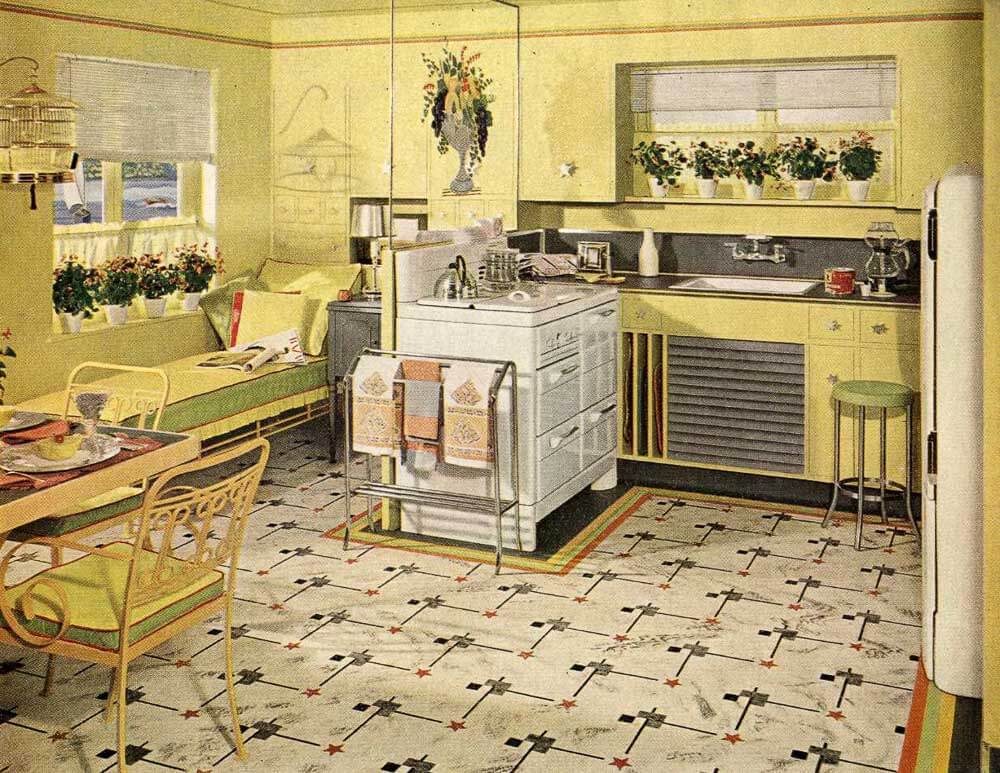
Here’s some more whimsy-doodle — and gorgeous patterned linoleum, too — from Hazel Dell Brown circa 1941. I’m not sure that painted (fun ideas with Meyercord decals, *affiliate link, anyone?) glass- paneled divider behind the stove is truly very practical, but… Hazel was sure having some fun: “… a spot for a nap while the bread bakes” — indeed! I even love how, in this one, there’s a ‘shadow’ of the bird cage apparently penciled in. Or maybe that’s penciled into my brochure only? Bizarre.
Other interesting tidbits from this one: Very controlled color palette, built round the colors in the flooring.
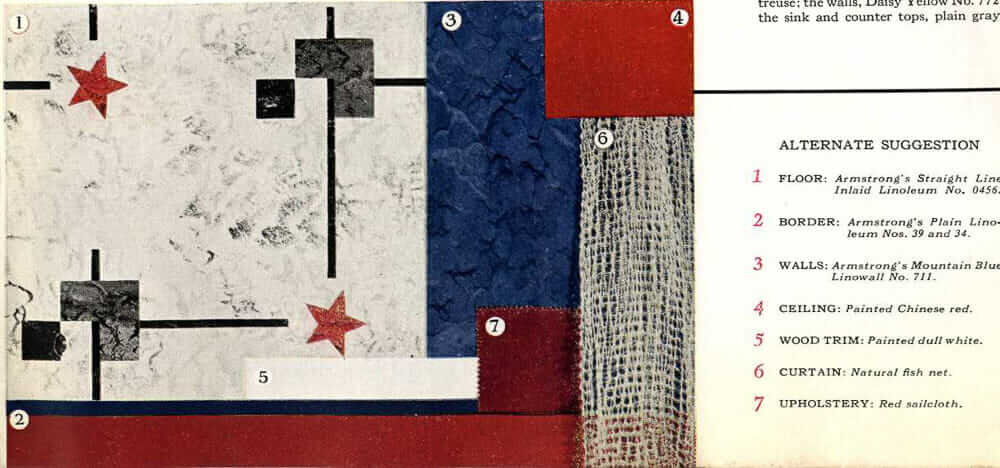 Above: The alternate mood board, including: Ceiling painted Chinese red… and fish net curtain! Nautical c. 1941 is … nice!
- All my stories mentioning Hazel Dell Brown — the most influential residential interior designer you never heard of — here.



Dan Hoyer says
What is the gray panel under the sink?
Pam Kueber says
Look like louvers. Viewing tip: If you are on a laptop or desktop computer, wait until the page is fully loaded, then click on the photo and it will enlarge on screen up to 1,000 pixels wide.
Charles says
I don’t think the birdcage is penciled in, I believe it’s a shadow on the wall. If you look carefully, there are several other shadows in this kitchen, all coming from the sun, very, VERY low on the horizon behind and to the left of our point of view.
lynda says
I wonder if the little nap area was for the cook that might just come to the home for the day? It is hard work, and a nap was perhaps necessary to get through the dinner hour and clean up.
I think that would have been a pretty nice kitchen for 1941. It is very fun to look at.
Lynne says
In the last kitchen the color Delphinium Blue was used. Just out of curiosity, I went and looked at my big Sherwin Williams book. Chinese Red, from the alternate color scheme, was in the same color line as the blue. So, we at least know where she’s pulling her paint colors from. I didn’t find the Daisy Yellow, though.
Kitty says
The SW name for “daisy yellow” is Sunbeam – a color that’s been in production since the 1930s. It’s still available (though in a new formulation without lead or cadmium) – SW 0078. Hope this helps!
Eliza says
It reminds me of Laura Ingalls Wilder’s house in Missouri. Laura and Almanzo’s bedroom was basically a doorway off the middle of the kitchen with their beds right there. I’ve often thought that was so odd to have the bedroom attached to the kitchen, but maybe that was a thing back in the day.
Allison says
Lots of farm houses had a bedroom off the kitchen, including the one I lived in for many years and in my own grandparents’ house.
It was designated as a sickroom, back when warmth was mainly from the cookstove and tender nursing care was all that was really available for illnesses, as a room for the elderly members of the family or for a pregnant Mom, who didn’t want to climb the stairs to the other bedrooms.
Highly pratical
Laura's Last Ditch Vintage Kitchenwares says
My sister had a red, white, and blue star linoleum in her original 1940s kitchen. It was the most delightful, charming kitchen I’d ever seen in person. Then, when the sold the house, I found out the new buyers tore it out to put in granite and particle board. Now, whenever I pass the house, it makes me sad. What I would give to be the caretaker of a kitchen like that!
Janet in ME says
I would love to have this kitchen! Why can’t anyone make a vinyl floor like that now? That is my favorite part, with the inlaid borders. I was surprised to see that towel bar next to the stove. I have one not quite as wide that I bought when we got married in 1972, in my bathroom now. Whoever manufactured it must have made it for a long time. The daybed in the kitchen for a sick child makes sense. The Amish home I visit has cribs in the kitchen for the children whether or not they are sick, so they are near the wood stove which provides the heat in the house. And this is the second kitchen with a sewing machine in it. Everyone did a lot of sewing back then. I always wonder if kitchens like this survived?
Bunni says
Agree about the flooring. It’s fabulous. Would love to put that in my kitchen.
vikki says
Vinyl Hell! I would love it if they still made linoleum in those beautiful patterns. Lino is environmentally sound, lasts forever and takes a beating… sigh!
Carolyn says
That would be a shadow from the birdcage. Although she says the daybed is for napping, it might be for keeping a sick child close by also? I would venture to say the painting/decal on glass is on the daybed side although that little whimsical detail might just be that – whimsy. You’d want the stove side smooth to wipe off grease but then the colors would be muted or patchy. The first layout I had an issue with the sewing/crafts center too near the stove (well, in the kitchen, period) because of airborne grease.
Because of these kitchens you’ve been showcasing, I’ve figured out that, while I grew up with the Jetsons, I feel the designs of the 1950’s and later were for “fancy” people. (“Rich” people had fireplaces.) For me, they’re nice places to visit.
I joined RR in Feb 2015 and it’s only taken me this long to “feel at home” in the era of homes Hazel Dell Brown is designing for. More “modern” conveniences than the 1930’s but still not moving to the “space-age”.
I get a kick out of the exuberance of the post-WWII to 1970’s but, to me, this kitchen says “I’m home now”.
Question – these are kitchens that were actually fabricated for the brochures? Not renderings?
Pam Kueber says
The rooms were built out, I believe. Renderings from Dell Brown’s protege, Louisa Kostich Cowan here >> https://retrorenovation.com/2015/07/28/armstrong-advertising-louisa-cowan/
and here >> https://retrorenovation.com/2015/08/26/sketch-advertisement-bedroom-design/
kddomingue says
I believe it’s a shadow from the hanging birdcage on the left side of the photp?
Jennie says
The bird cage may be a subtle symbol of women who felt confined in their homes. The designer was a career woman after all. Or she just liked the pattern of the shadow!
Lynne says
Did you notice the cabinet knobs are stars?
Pam Kueber says
Fabulous! Great catch!
Ken Buzzell says
The placement of the vintage stove off the wall with a backing is a great idea. Nice way to use the open floor space especially if one does not have enough practical wall space. The backing hides the rear of stove and provides many ways to utilize that area with shelves etc.
Pam Kueber says
Yes, but looking closer I am reminded to remind: check local building codes!
Rita Vasak says
My 50s kitchen is actually designed this way – although the wall is laminate-covered wood, not glass, and on the other side is a little foyer and the front door.
vikki says
It’s a brilliant idea, except that that stove MUST have ventilation to the outside… its a gas stove with a continuously lit pilot light. A modern down-vented stove would be able to use a glass panel behind it and it is a fabulous way to open up the space and its easy to scrub down. Super thick tempered glass would need to be used… but it is a lovely idea!