

Popular from 1928 through the 1950s
Also known as Glitter Houses, Christmas Villages,
Christmas Gardens and Train Gardens
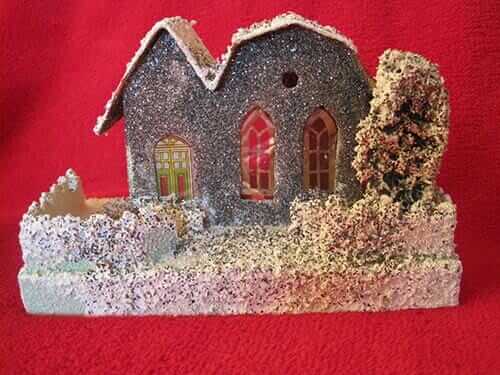 Setting up tiny, glittery houses during the Christmas holidays became widely popular in 1928 and continued for about a decade after World War II ended. But because these kinds of ornaments hold so much sentimental value, they often get passed down for generations to come. (Even if the kids don’t want mom or grandma’s furniture, we want those beloved Christmas ornaments!) These historic vintage villages are particularly sweet: Whether they were arranged as small neighborhood on your mantel, part of a train set scene under the tree or set up in conjunction with a nativity scene — these diminutive buildings allowed both young and old to play as they decorated. Today: The history of what we have been calling “putz” style houses, but which have been sold under a variety of names for — more than a century!
We have several different designs — get to our first tutorial and from there, the various designs.
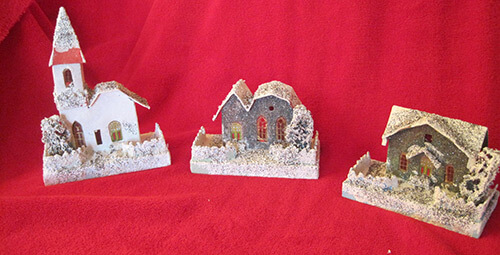 At our house, we always set up the three tiny structures that were given to us by my grandmother (pictured above) as part of a scene on top of the TV cabinet. They went between the nativity scene that I made out of clay and the Snoopy and Charlie Brown holiday figures we had collected over the years. It was perhaps a strange combination — but one that always delighted my brother and me: our own miniature world.
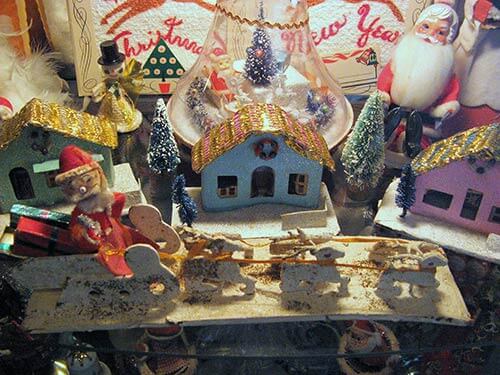 These small houses — such as the ones above from reader RetroChase (notice the “basket weave roofs) — have been called by a variety of names: Christmas Villages, Glitter Houses, Christmas Gardens, Train Gardens and Putz Houses.
Where does the term “Putz House” come from? Wiktionary says that it comes:
- From Pennsylvania German putz; compare archaic German Putz (“ornament, decoration, finery”), putzen (“to clean; decorate”).
The story seems to be that, in Germany, families would create little holiday scenes — often nativity scenes — in their homes to celebrate Christmas. They would collect the bits and pieces for their tableaus for weeks… hence putzen=”decorate” became putzing=”taking your time to decorate” became putzen=”taking your grand ole time”. [ — Pam’s shorthand, hope I got this right.]
The global expert in Putz house history seems undeniably to be Ted Althof, who began collecting this little houses in the 1970s, and who since then has created an amazing, detailed online history of Putz houses. Seriously: Wow!
We won’t try to replicate his history — it goes on for pages — minutiae about the minute! But in short: These glittery little holiday houses date to 1928 — invented by the Japanese, likely building on the concept of the similarly small “candy box” houses that they had been making for the American market. Their “golden years were from 1928 through 1937, when the looming war discouraged consumption. They saw a dime store revival after World War II — when Japan began making and exporting them. Their popularity waned by 1960, as consumers turned to other holiday decoration fashions.
Again: Check out Ted’s site, it’s amazing.
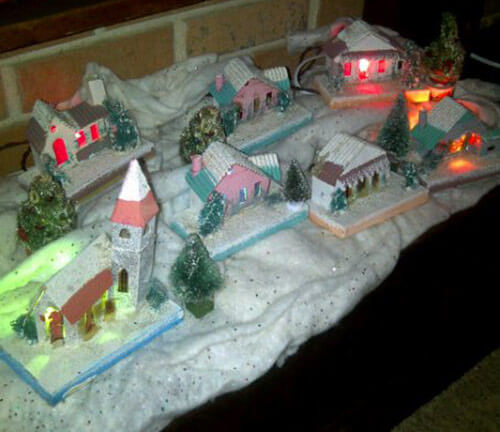 Above: Reader Mary affectionately refers to her village as “Blinkaville.”
There is a wealth of information available online — photographs and information about Putz houses, patterns and instructions to make your own, people who will build them for you, information on how to make repairs to your vintage houses. And, they seem to be pretty abundant — and a relatively *cheap thrill* on etsy and ebay.
Putz house links
- Cardboard Christmas — Building your own glittered putz houses
- Papa Ted’s Place — History, online museum and more
- Collectors Weekly — History of putz houses
- Christmas Notebook — A step by step guide to building a traditional putz house from a pattern
- Little Glitter Houses — History, photos, parts, patterns, kits and links to more fun
- Antionette’s Christmas Site — photos and info about her putz mantel displays dating back to 2006
- Family Christmas Online — A brief history of Christmas villages
- Big Indoor Trains — Everything you need to build a putz village with trains
- About.com Miniatures — Make a traditional putz or glitterhouse
Get our tutorial and patterns:


Mike says
Yep, we had them, but I didn’t know they were Putz houses. Each had a hole in the back for a single Christmas bulb. We had the Santa sleigh, too. Santa was in sorry shape, as were his reindeer: their cardboard antlers gave way to the ravages of time and the occasional knocking around by us kids on Christmas morning. They smelled of the attic, just like everything else!
Mr Kim says
It looks to me like those Putz Houses were the inspiration for Lilliput Lane. A series of collectible miniature cottages which have been collected for years in the UK. They normally go up on the mantelpiece all year round. Though there are Christmas editions too which get lighted up in the inside. Do take a look on the Internet, they are very pretty (and, yes, kind of pricey). As you might expect they morphed into bucolic rather than Mid Century style -chocolateboxy British style, you know- 🙂
normadesmond says
Putz may mean “ornament” in german, but in yiddish it means penis. Easy to see how that definition jumped languages.
I’m sure you’ve heard people saying they were just “putzing around.”
That’s right, picking around.
Becky says
Thank you so much for all of these patterns. I love them so much and intend on spending the next month making these beauties for my home.