

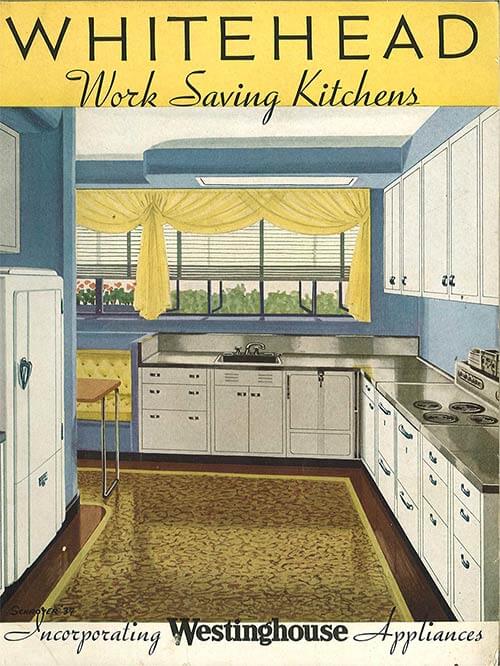
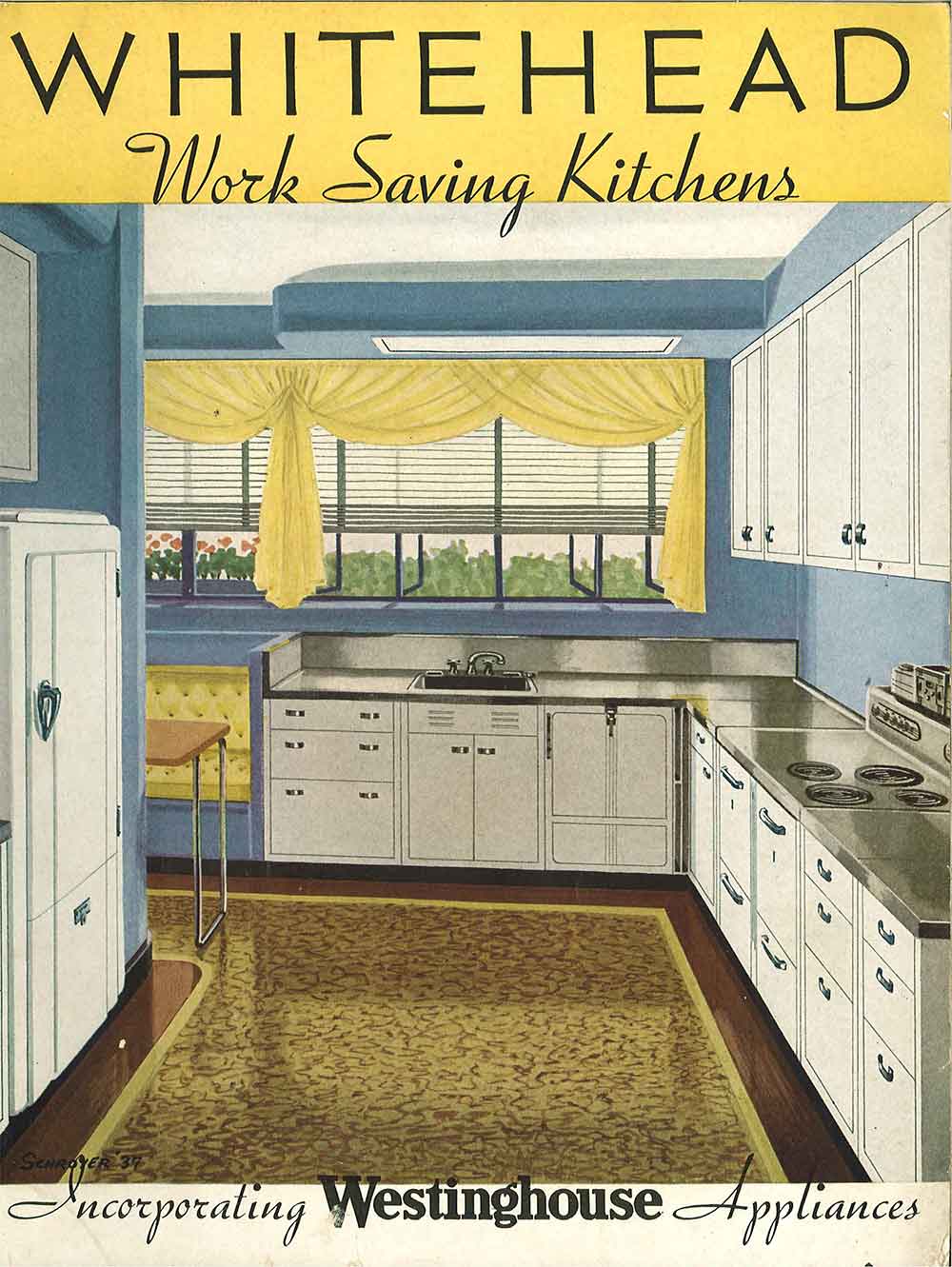
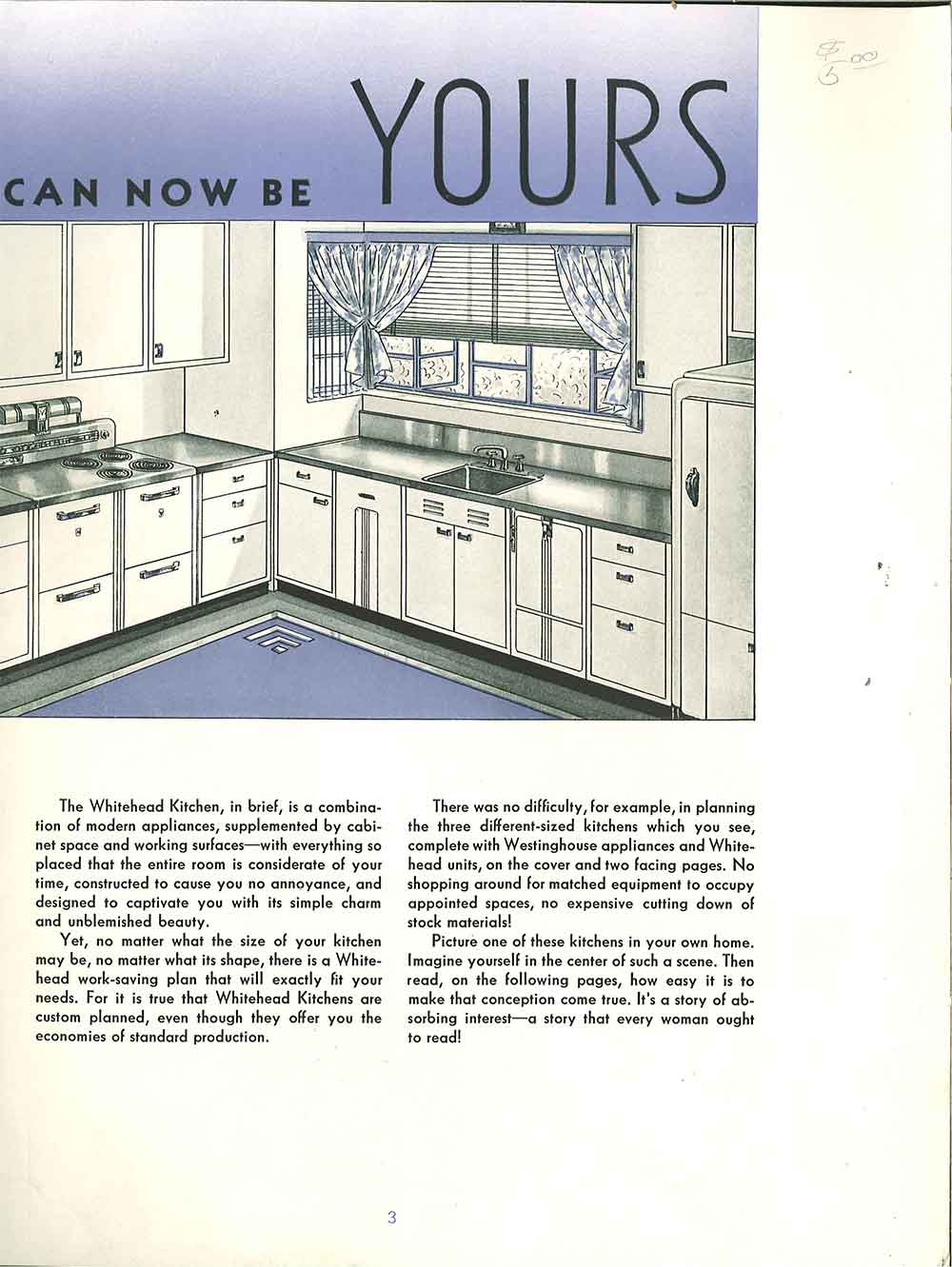
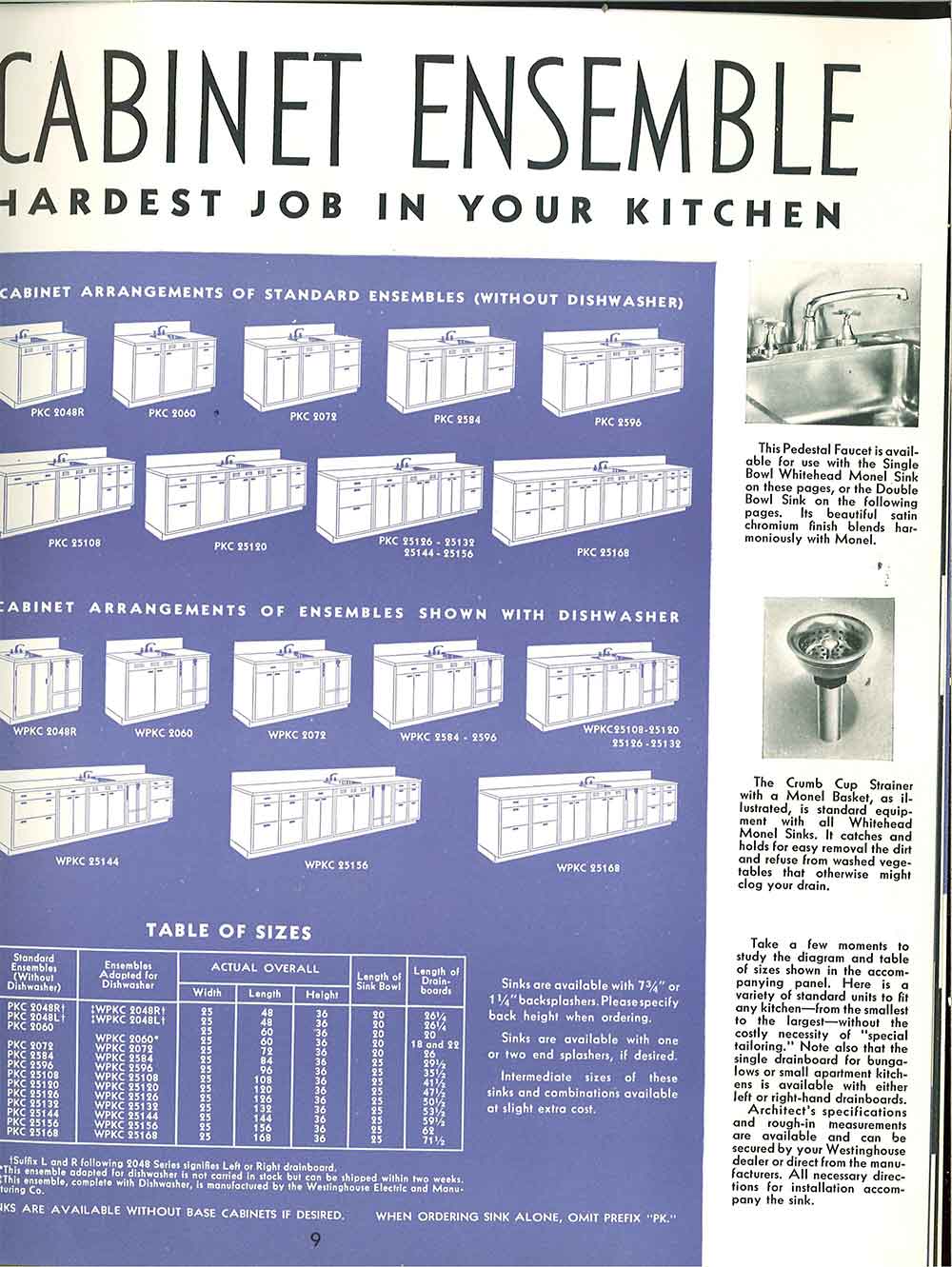
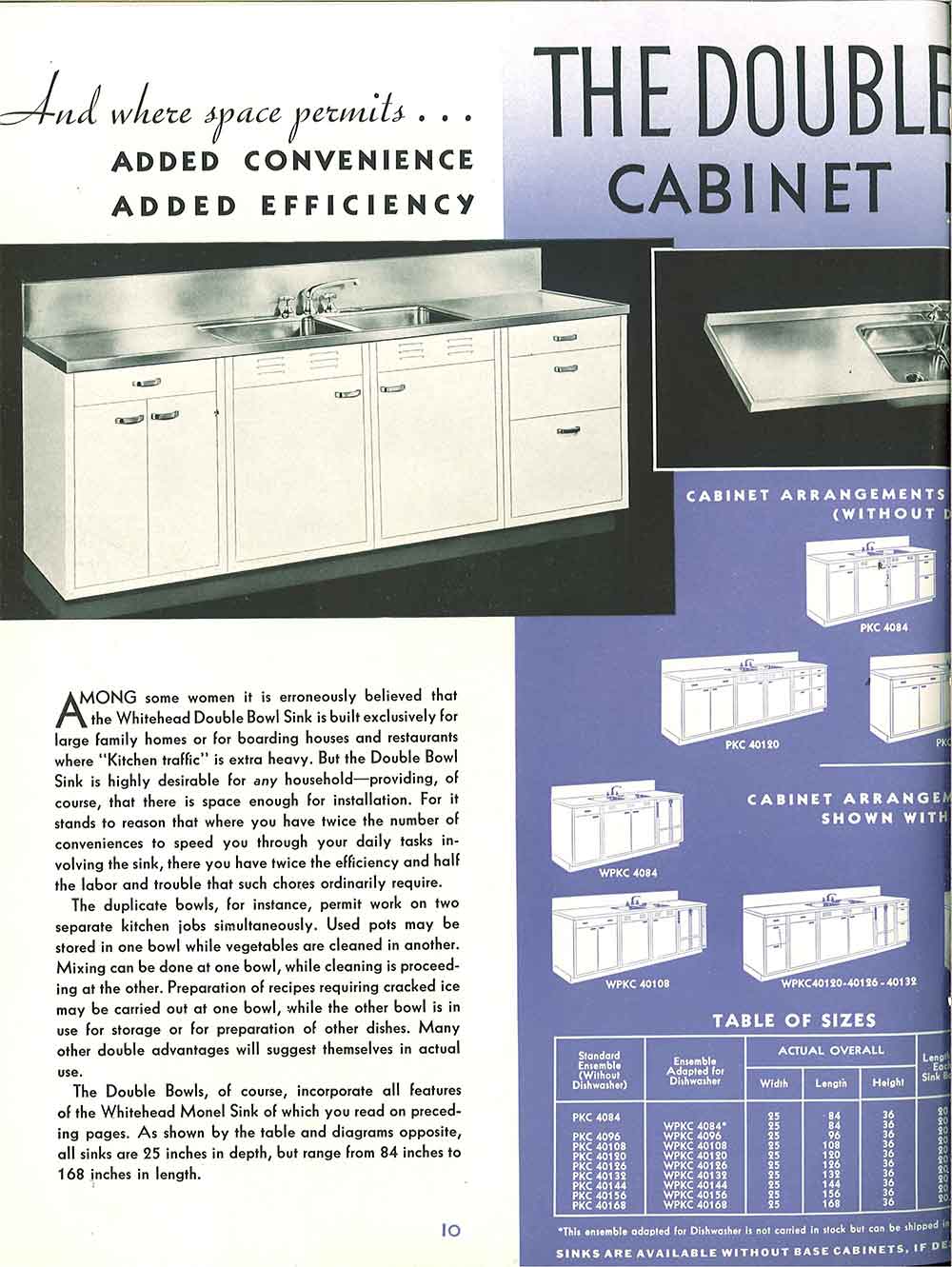
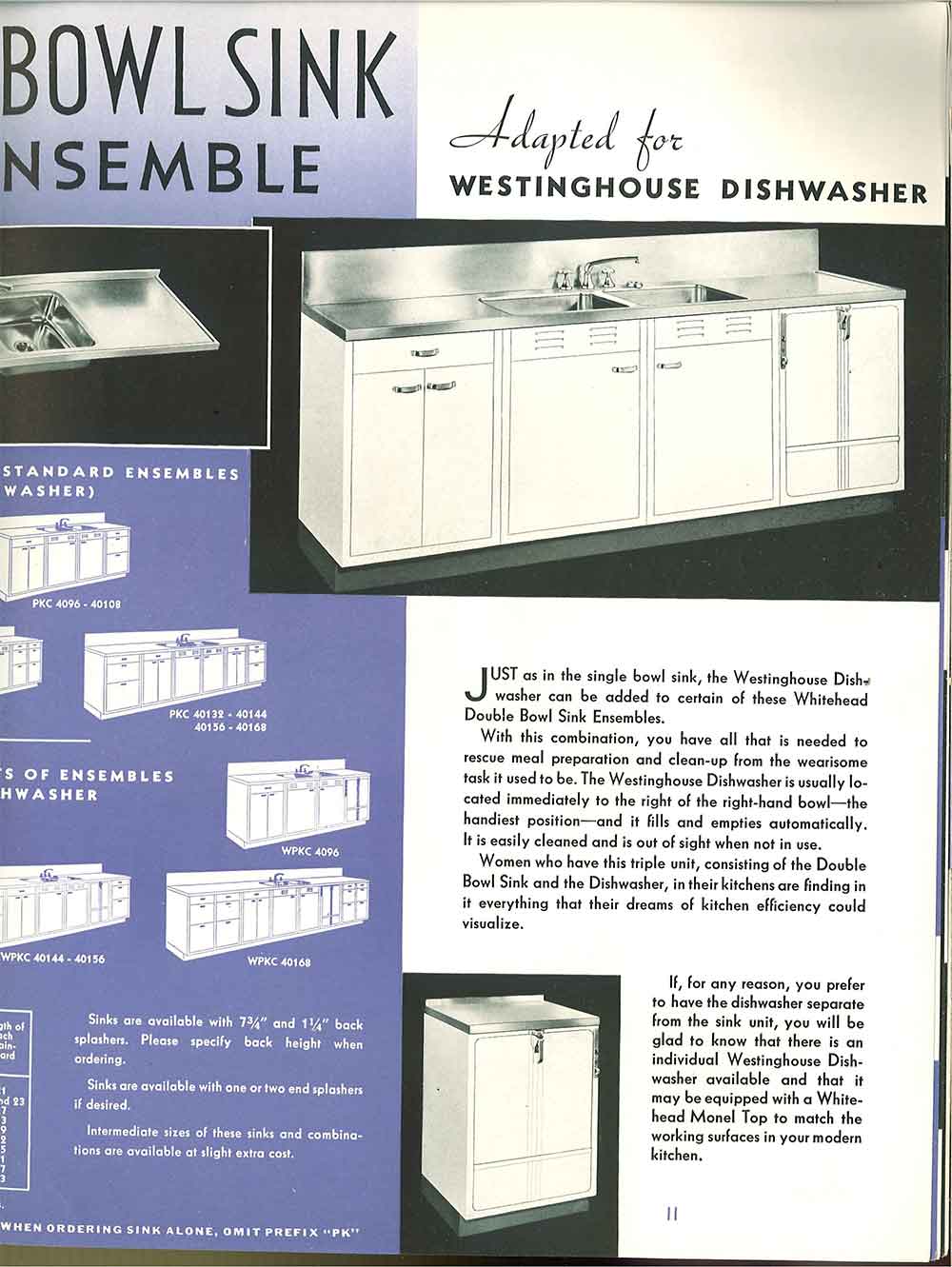
 In the early days of steel kitchen cabinets — the 1930s — the cabinets had a “deco” or “streamline” look… they were always white… and there were only a few brands that we know of so far — including Whitehead Among the very early brands were Whitehead/Monel, Servel, Elgin, and Dieterich. It’s not easy to find examples of these old originals any more, so it’s very exciting to discover and be able to archive this vintage Whitehead catalog from 1937… so that we can ogle late 1930s kitchen design ideas… so that we can identify these rare birds when spotted in the wild… and to add as another wonderful piece of archeology to our short history (3,000+ words, gulp) of vintage steel kitchen cabinets.
 Whitehead steel cabinets were made by Whitehead Metal Products Co. of New York, Inc. The company lists there address as 304 Hudson Street, New York, N.Y. Yes, steel kitchen cabinets made right on the island of Manhattan — imagine that. Looking at this story, Pam said that she *thinks* we may have seen a set once a few years ago — for sale in New York City. But doggonit, no photo can be found. 52PnB, you remember it???
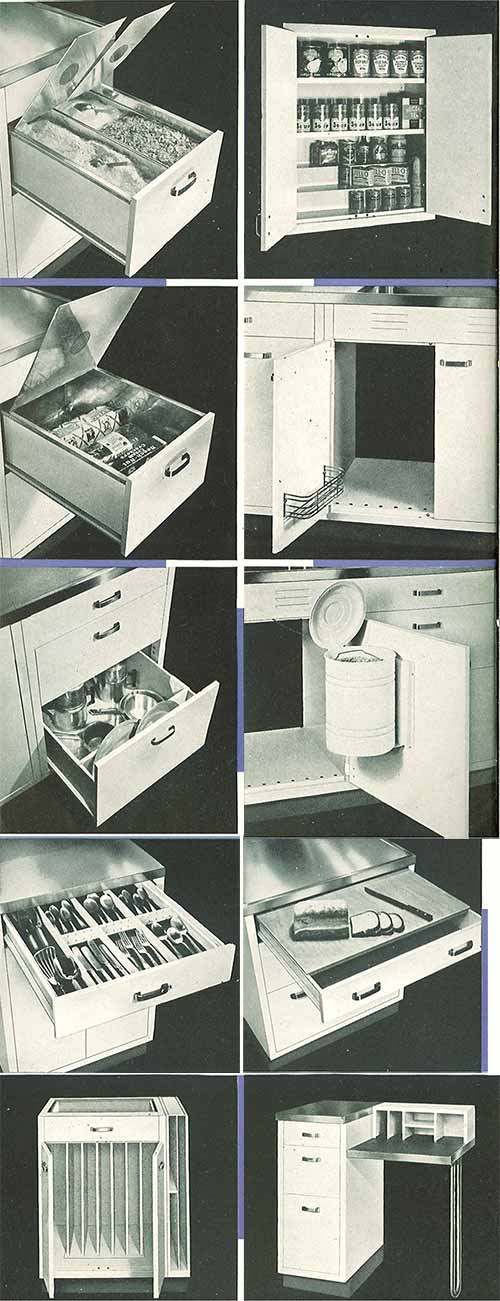
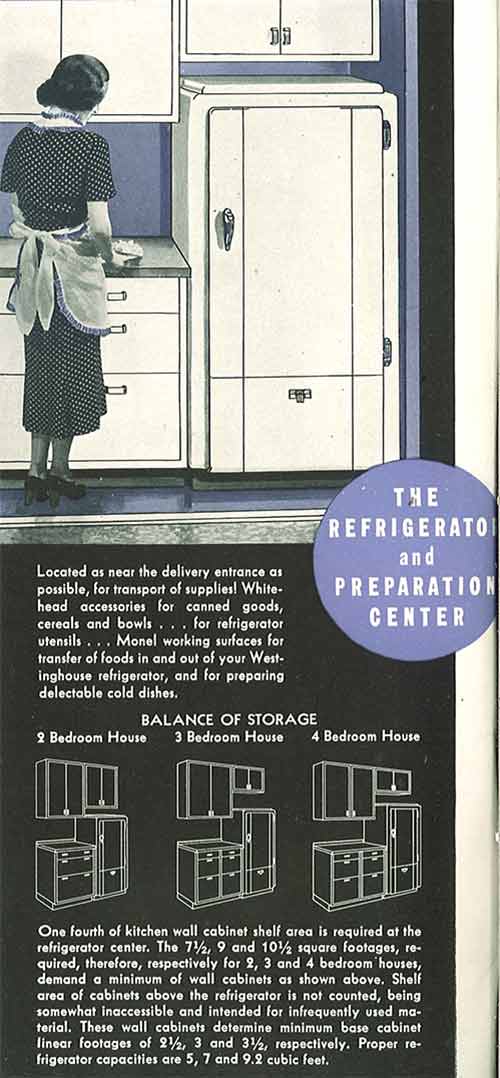
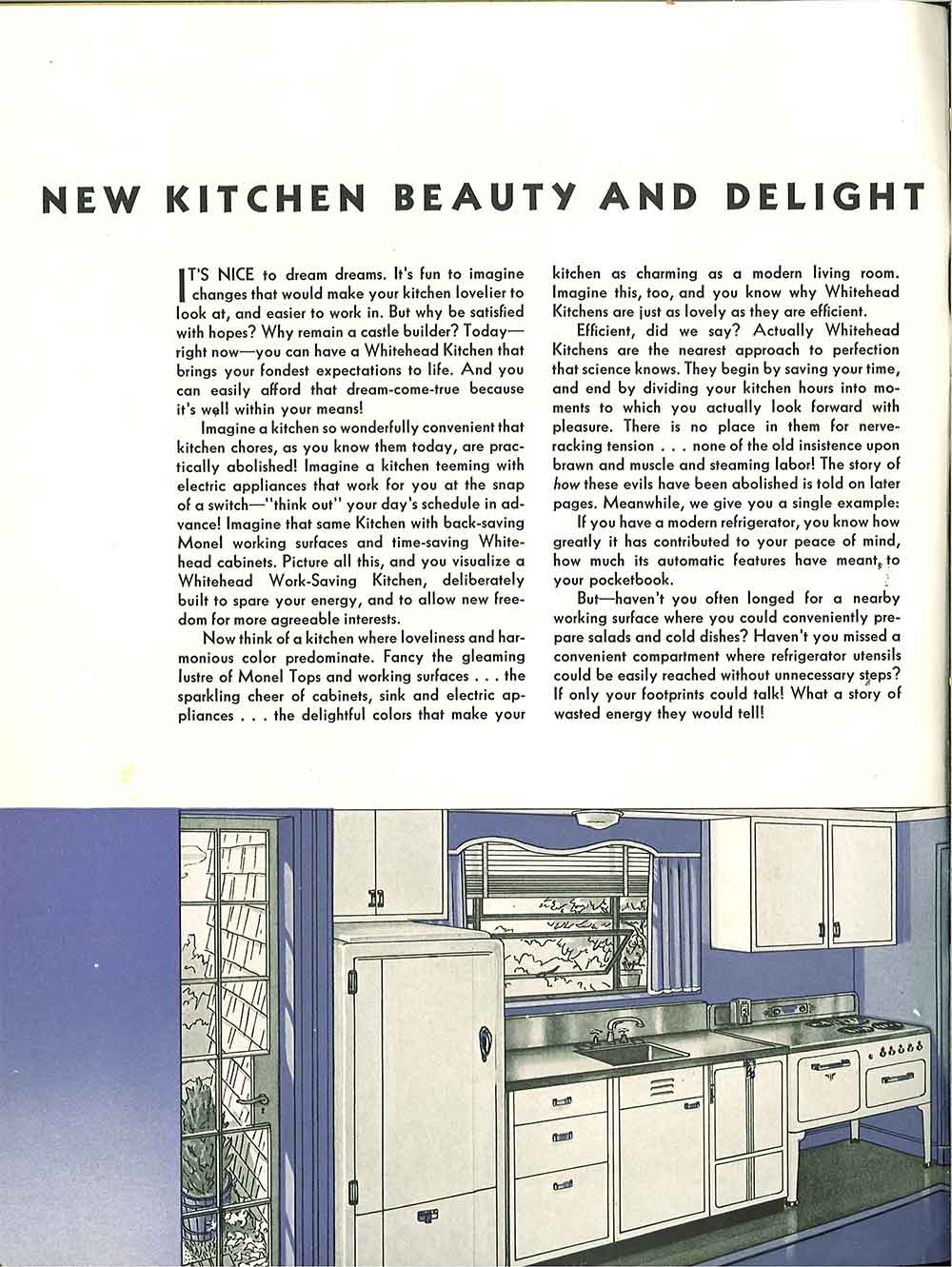
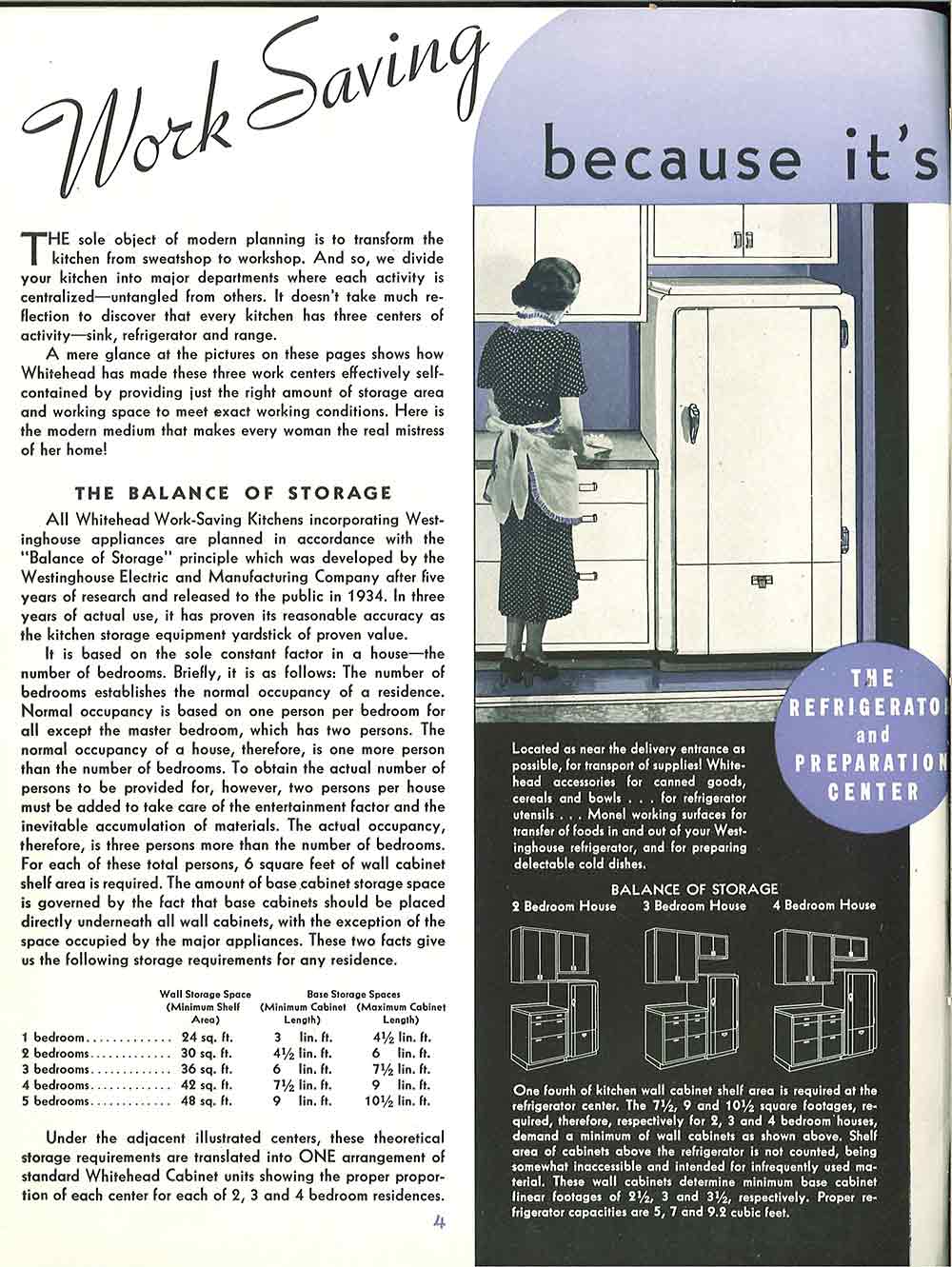
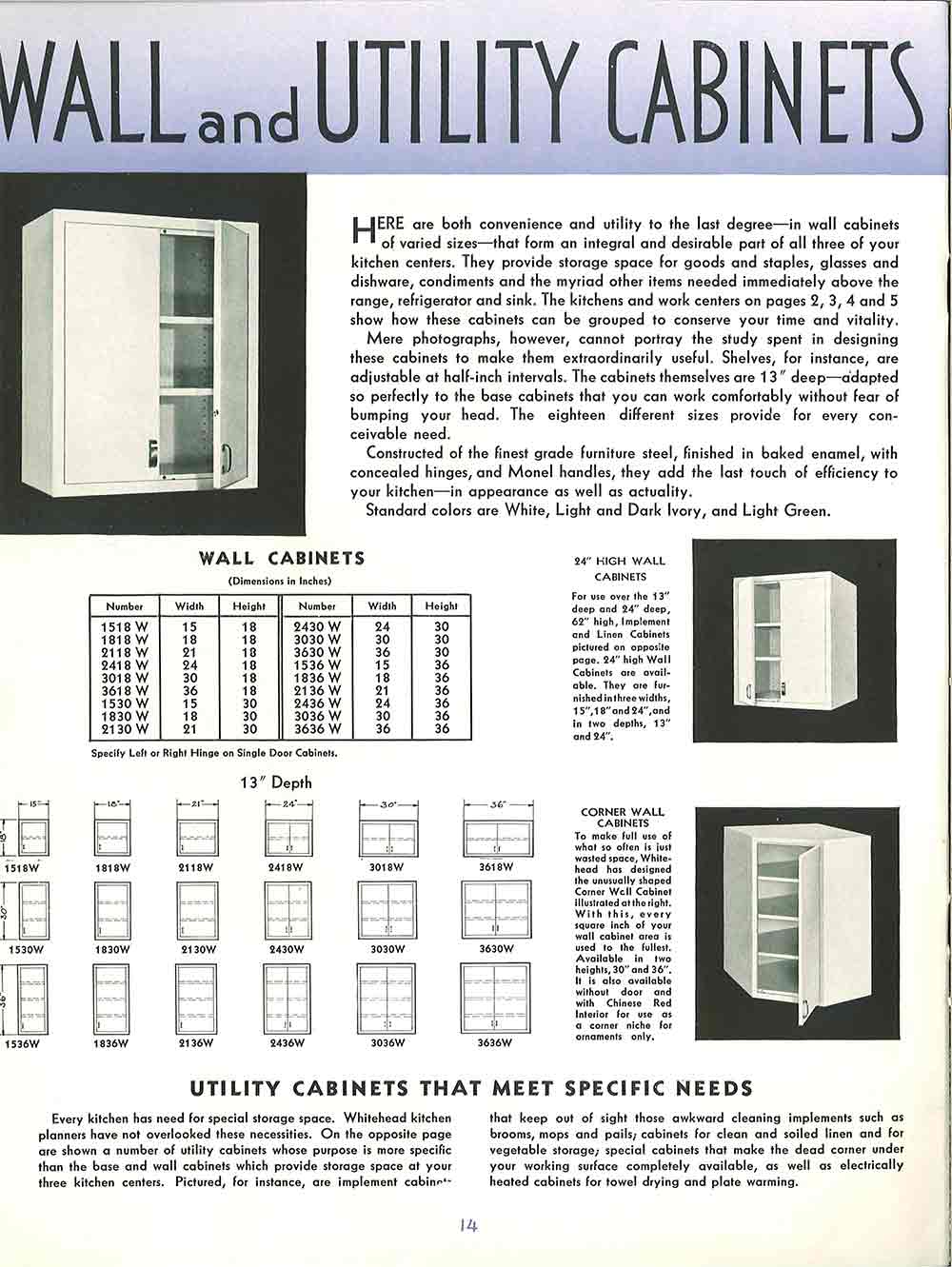
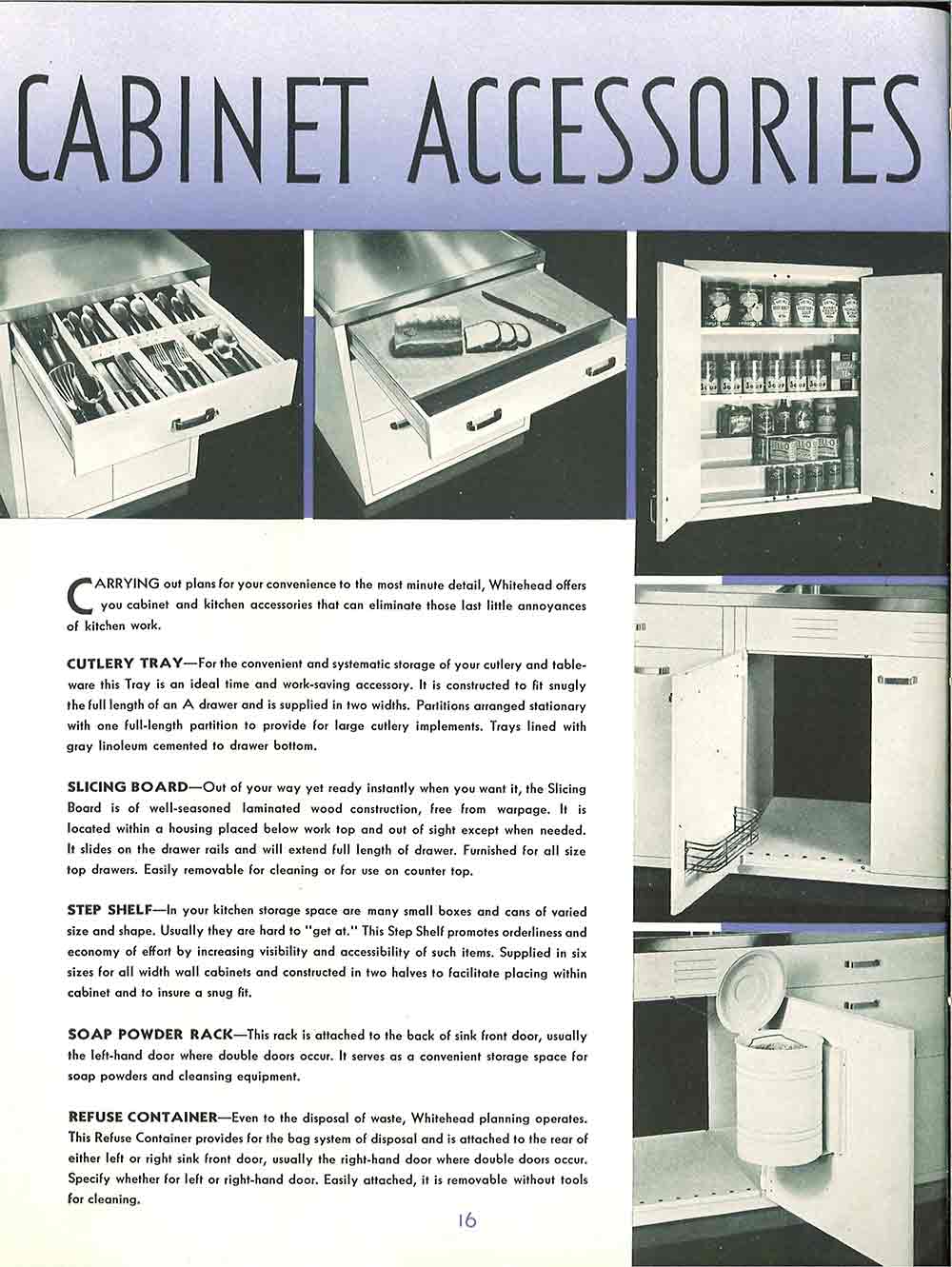
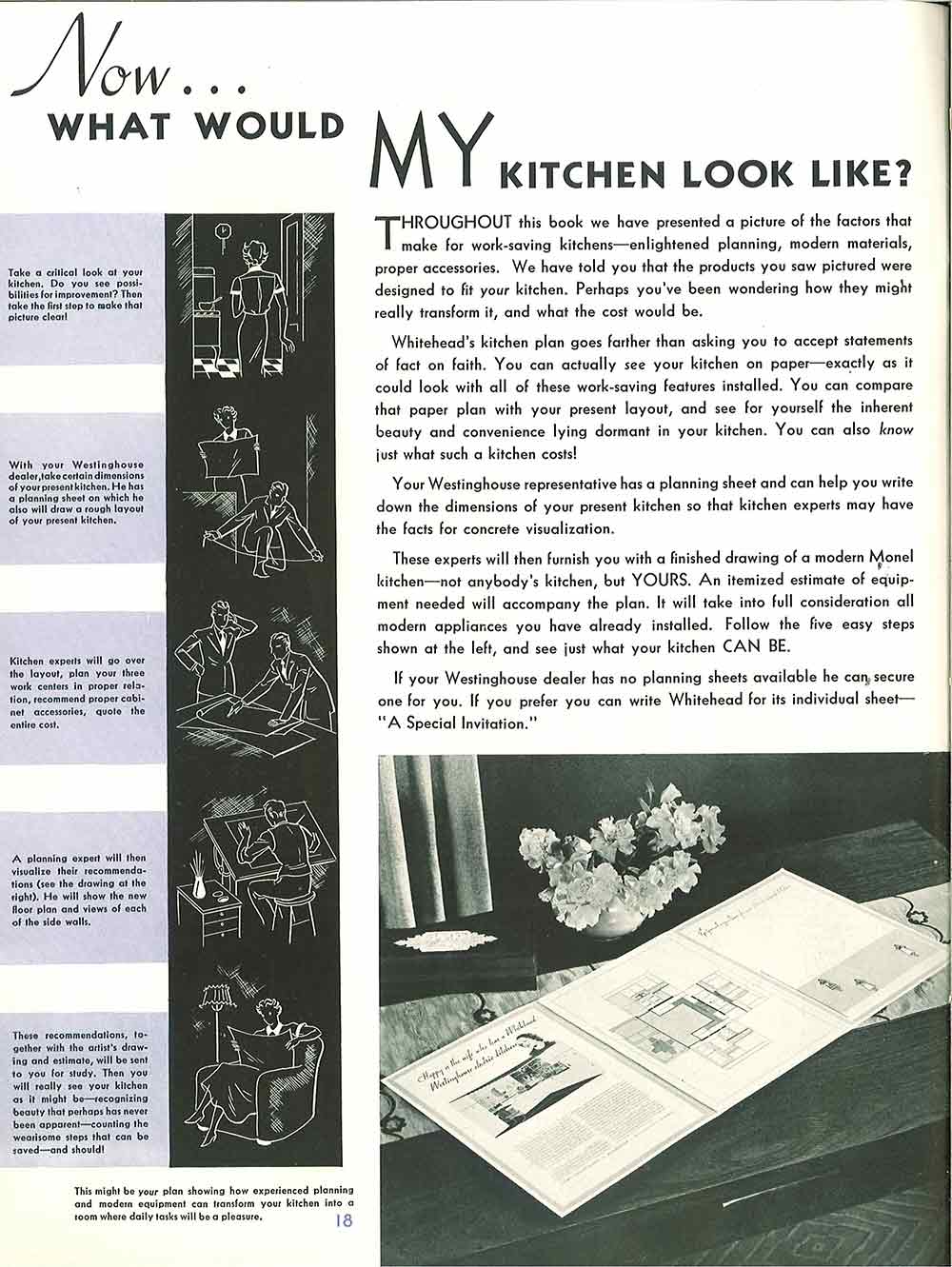
In this catalog, Whitehead puts an emphasis on smart design. Very interestingly, the company even calculates how much space is needed for any one type of cabinetry based on how many bedrooms are in the house. And, there was lots of focus on efficiently organizing all the work elements in the kitchen. With this in mind, Whitehead created a whole line of specialty cabinets and inserts — all with organized and useful components (shown left to right above):
- Bulk storage bins
- Step shelf
- Bread bin
- Soap powder rack
- Lid rack
- Refuse container
- Cutlery tray
- Slicing board
- Tray racks
- Planning desk
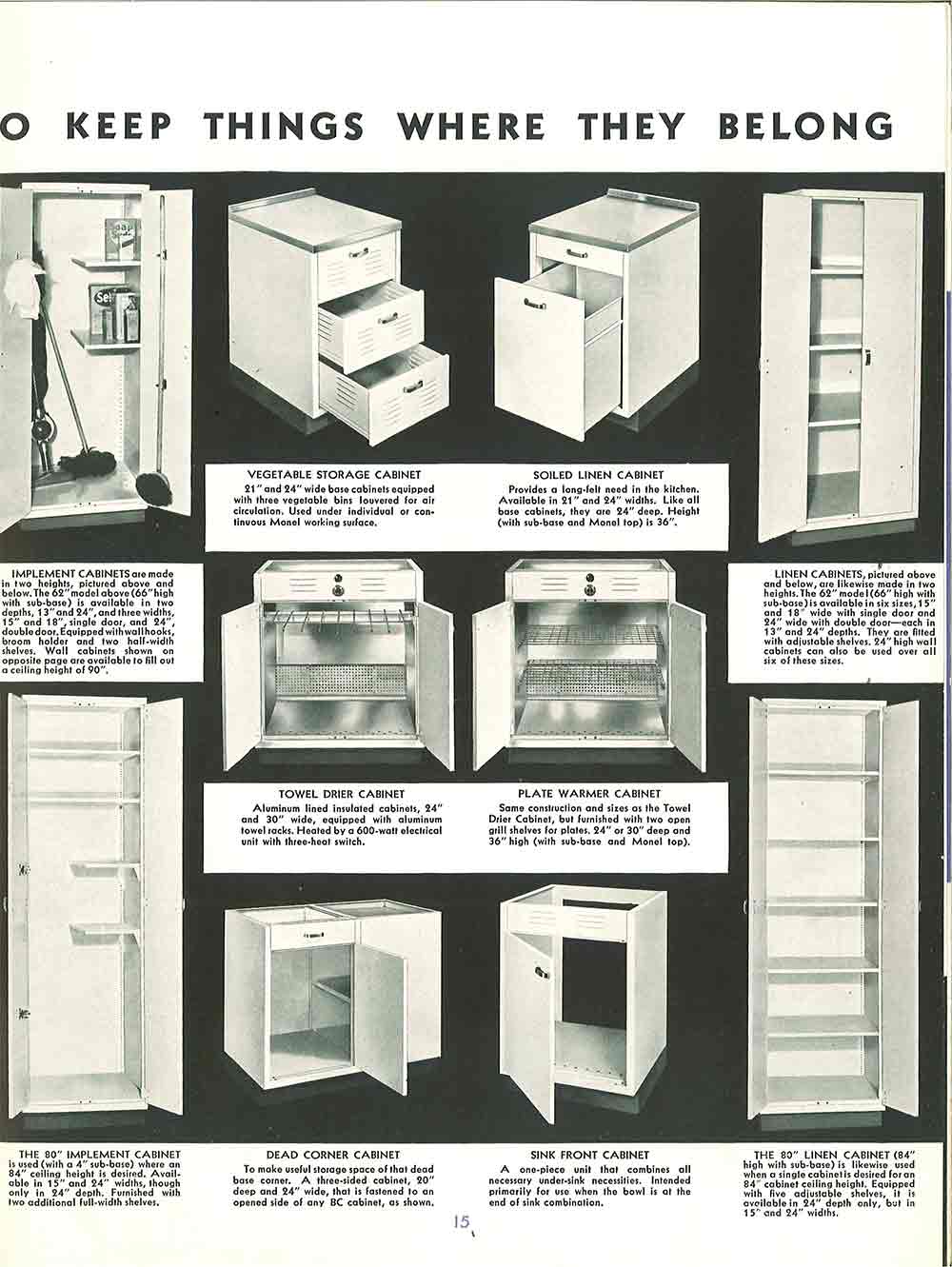
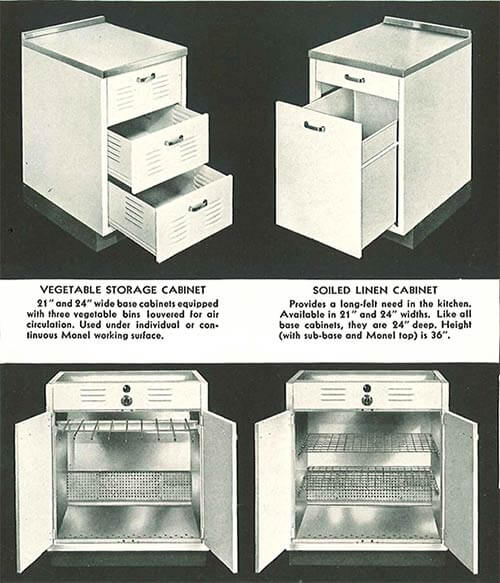 Some of the other and more interesting specialty cabinets include the vegetable storage cabinet, soiled linen cabinet (laundry basket for the kitchen), towel drier cabinet and plate warmer cabinet (shown above).
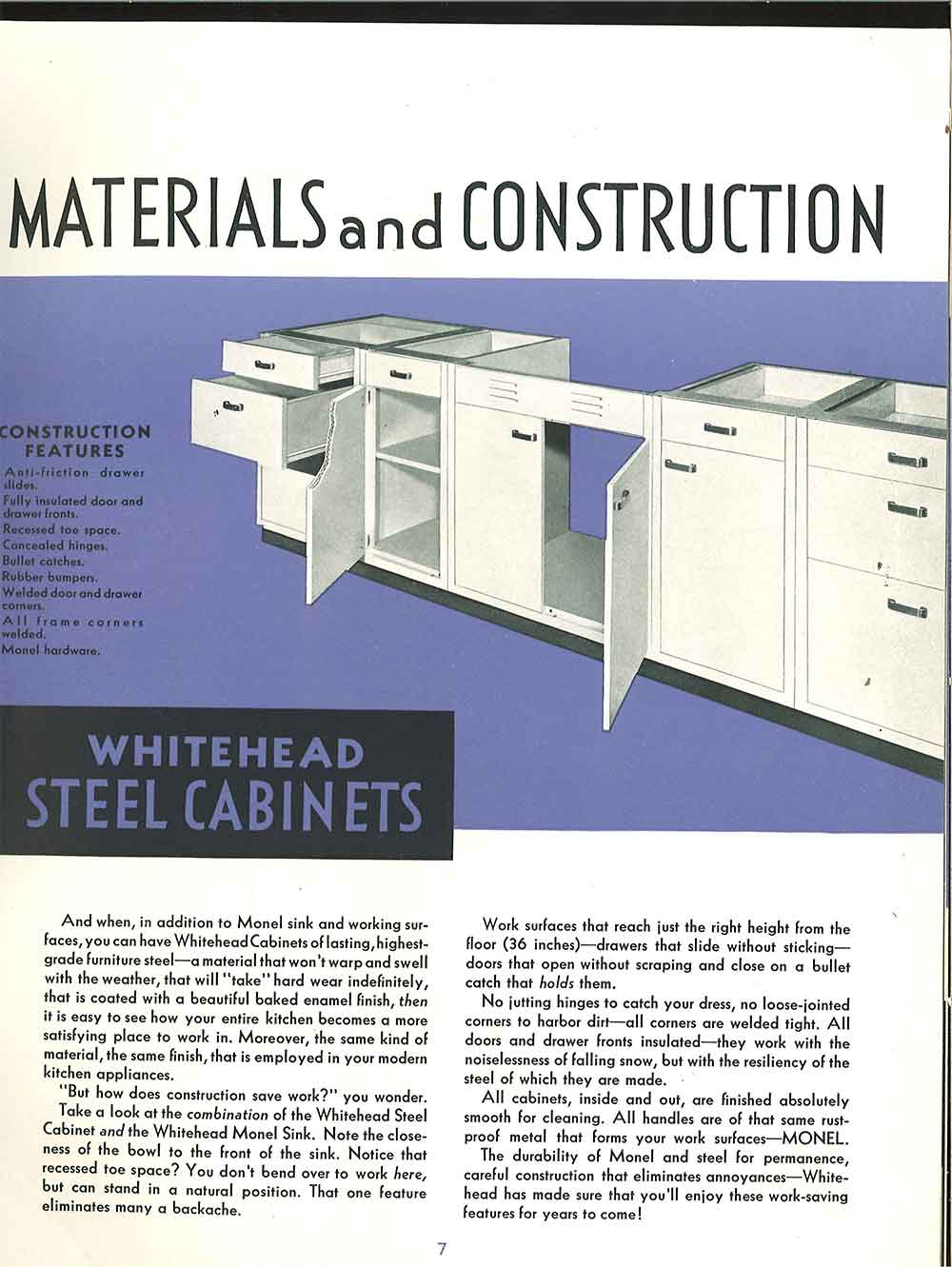
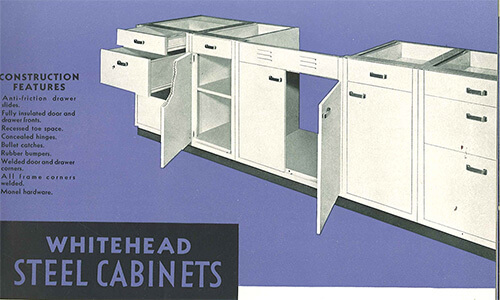 The steel cabinets themselves had several features that ensured ease of use and the well-built longevity that was expected back then. Construction features include:
- Anti-friction drawer slides
- Fully insulated door and drawer fronts
- Recessed toe space (to minimize uncomfortable bending)
- Concealed hinges
- Bullet catches
- Rubber bumbers
- Welded door and drawer corners
- All frame corners welded
- Monel hardware
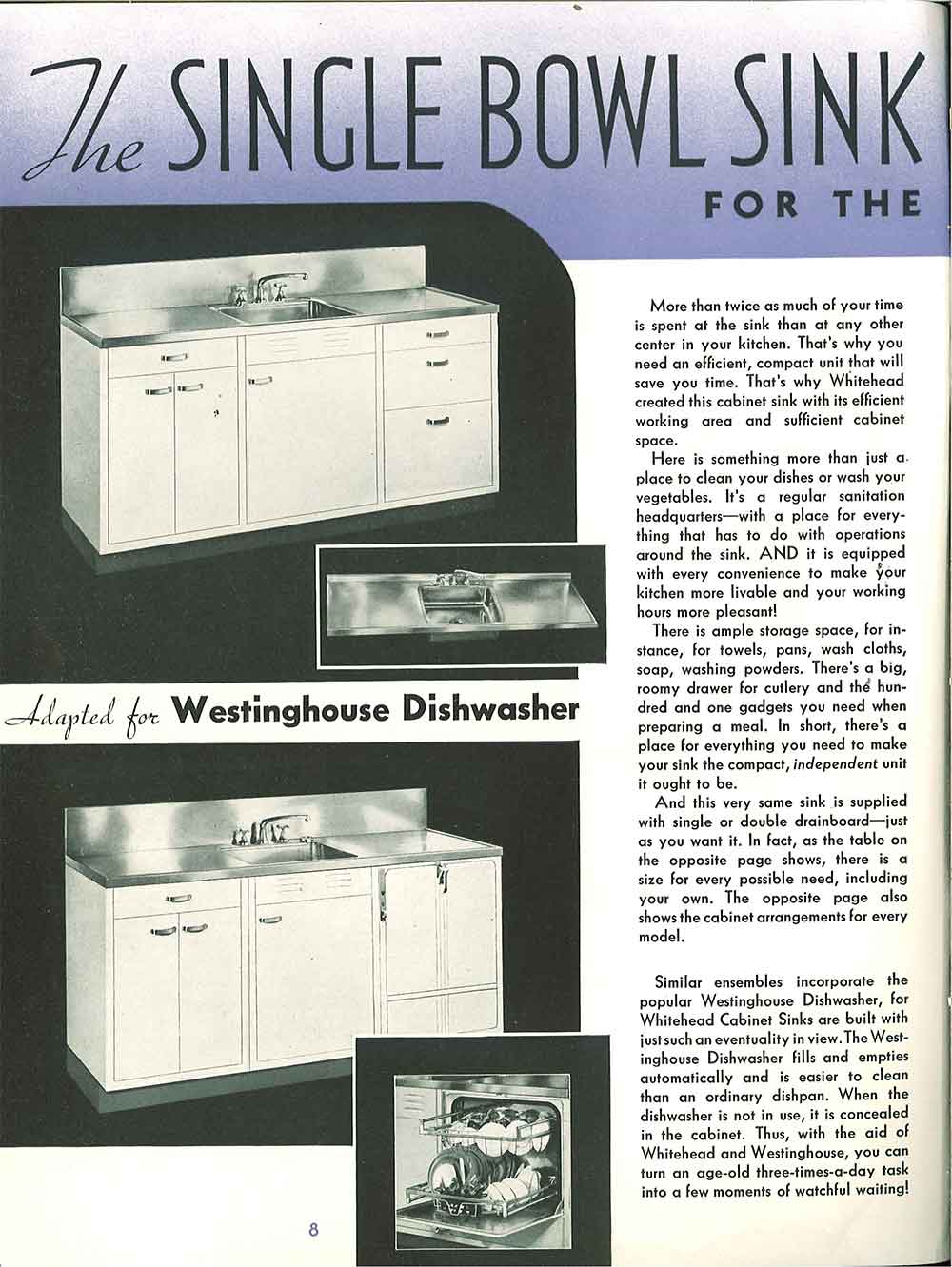
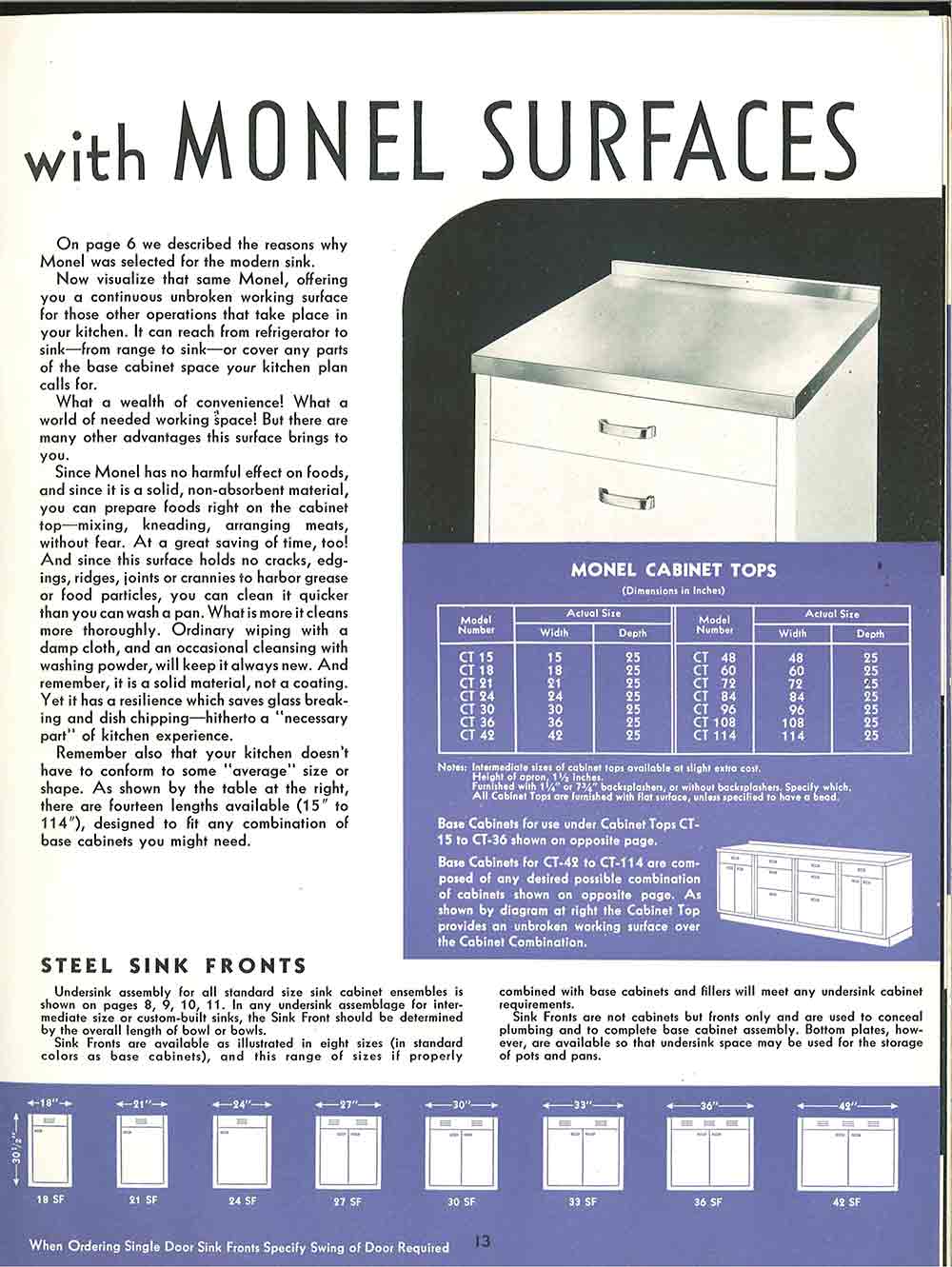
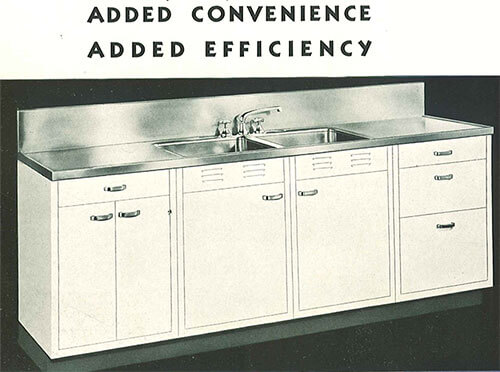 The counter tops are made of Monel. And, the touts the benefits of having an integral sink, counter top and back splash, which will not collect grease or allow water to penetrate the drainboard. So, this is how far back — at the least — that we can see examples of stainless steel(like) counter tops. See our helpful story — 5 ways to do stainless steel sinks and counter tops.
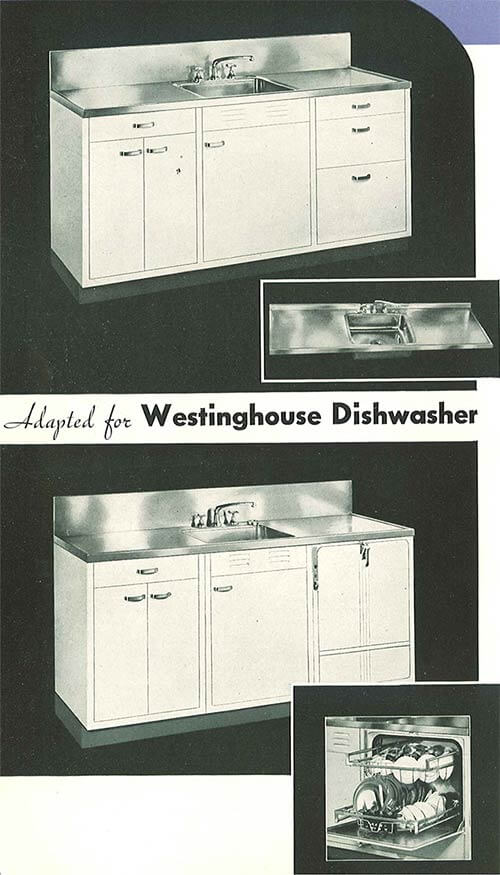
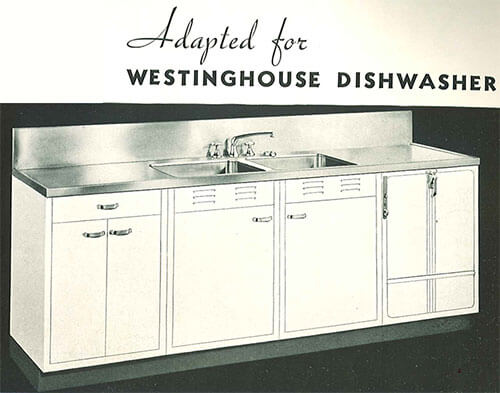 Another exciting component of a Whitehead steel kitchen was the availability of the integrated dishwasher. We need to do research to identify when the first built-in dishwashers were installed in American homes.
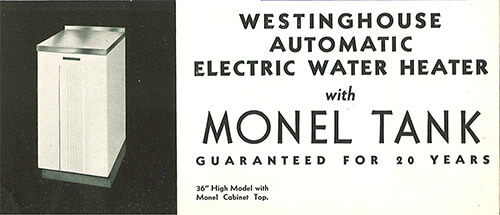
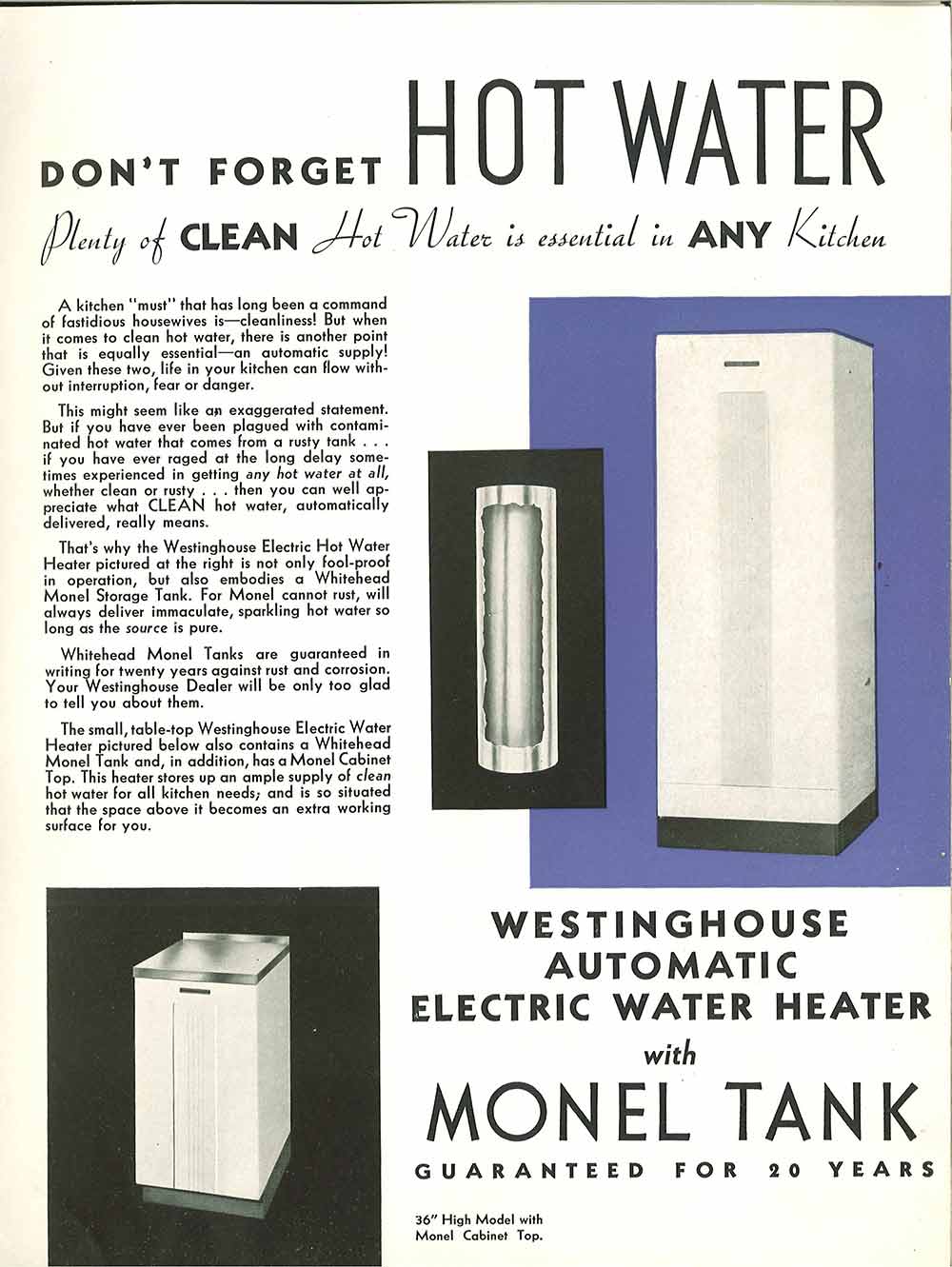
Of course, an important fact to consider — especially when a dishwasher is involved — is where the hot water will come from. In this case, Westinghouse has a solution — the automatic electric water heater — that fits seamlessly into a kitchen cabinet, even providing extra counter space above the unit. The catalog advertises this unit as rust proof — and mentions that you will never again have to worry about contaminated hot water from a rusty tank.

In 1937, this kitchen surely must have been very high end — well out of the reach of most Americans. But surely, designs like this set the stage for the big boom in steel kitchens after World War II. Very cool.
Thanks to archive.org and the MBJ Collection for making this vintage catalog available.
Tips to view slide show: Click on first image… it will enlarge and you can also read my captions… move forward or back via arrows below the photo… you can start or stop at any image:?






Jay says
Very nice! I seem to remember that a form of elec. dishwashers were available in the late 20s. The 39 NY Worlds Fair had a Westinghouse pavillion and kitchen innovation was a feature – how electricity would make housework easier – the fair was all about the future. You can probably see the video “The Middletons visit the fair” online and see Mrs. Drudge wash dishes by hand. There was just one problem, WWII interupted domestic life so all these neat ideas were put on hold for several years.
Robin, NV says
What struck me most is how modern the kitchen layout and cabinets are – and geez, a refigerator and dishwasher?! My grandmother was married in 1937 and her house didn’t have electricity, water, or sewage. The big wood stove in the kitchen did everything – cooking, heating, and provided hot water. The bathroom was an outhouse in the backyard. I believe most kitchens at the time might have had an ice box, a hoosier cabinet, and sink. The concepts of “countertops” and “cabinets” were still fairly new in the 30s. The kitchen in the movie “A Christmas Story” would have been what most people had. Whitehead must have been very innovative or very high end – or both. Very, very cool catalog, I had no idea this type of kitchen was available in the 30s.
pam kueber says
Yes, Robin, I agree that your grandmother’s kitchen was way more typical than this high-end kitchen. But yes, what is interesting is that this Whitehead kitchen — and a few other, similar manufacturers at the time — were indeed pointing toward the future for all “modern” kitchens to come.
Robin, NV says
I also wanted to point out that “Work Saving” existed purely in the imagination of the company’s marketing department. Yes the kitchen would have been great as far as organization and probably made work more efficient but it didn’t cut down on the amount of work that needed to be done, in fact it was probably just the opposite. For one thing, consider the size of the kitchen – all those countertops and the big floor require more cleaning than a smaller kitchen. You’ve also got a big fridge that needs to be defrosted and cleaned out periodically. All those cabinets can be filled with more dishes, pots and pans, and gizmos that need to be cleaned, organized, and dealt with. There are studies that show “time saving” items like vacuums, dishwashers, and washing machines actually increase the time spent doing chores. The reason – these items make it easier for us to have cleaner, more hygienic living conditions, so we do certain chores more than people did 75-100 years ago. There are other factors involved, obviously (mass consumerism, marketing, etc) but I always thought it was ironic that we’re not really saving ourselves any time at all with our “time saving” modern conveniences.
Lauryn says
Oh my goodness, I love this catalogue! I came across Monel when I was doing research for our 1939 kitchen and considered using stainless steel counters because of it.
My favorite part, though, is the soiled linen cabinet … my “soiled linen cabinet” is a pile at the top of the stairs to the basement that I theoretically grab whenever I go downstairs (ha)! Thank goodness I have a door between the basement and the kitchen.
This might also be the first example of a dishwasher I’ve seen in anything from the 30s. If I recall, a lot of kitchen designs well into the 40s didn’t even have them. Thanks for sharing … I love looking at these catalogues and it’s especially cool to see earlier ones.
Andrea says
Love all the features! We’re about to move into a home with 50s era cabinets that still have intact bulk storage bins, a bread bin, and a vegetable drawer!
mary Tatum says
As refrigerators grew, the phenomenon of the “free floating refrigerator” was born. I see so many older homes where the kitchen has been updated, with no thought to the location of the fridge. So it just hangs out, gigantic, on a wall with nothing around it to help it make sense in terms of the entire room. Makes my design sense go a little bit crazy.
Janet in CT says
Mary, I am SO with you! That is a real pet peeve of mine! One house we looked at in Maine was built when there weren’t any fridges and probably had an ice box in the shed. They remodeled in the fifites and put the fridge right in front of one of the windows! I also h*^% (edited) it when, like you said, there is nothing around it, not any kind of table or counter where you can set things when you take them out. That drives me crazy, as does the door opening being against the wall rather than towards the counter tops. These Whitehead kitchens do seem to be really nicely designed and had alot of options for storage.
pam kueber says
hahaha, I love how you edited your own comment. Good girl, gold star!
Janet in CT says
Ooops, sorry, wasn’t me so maybe it was Kate who did the editing? I forgot about that!
Kate says
Yep, it was me who edited the comment. the-he-he 😉
pam kueber says
ohhhhhhh, I thought Janet wrote it that way!
Nutella says
There’s no detailed shot of the handles, but I think these are a pretty close match to the original steel cabinets in the Greenbelt, Maryland homes (circa 1937). I’d never been able to ID them before. Great find, I may point some folks from the Greenbelt museum to this post….
Nutella says
Here’s a link to an image of the original kitchen at the Greenbelt museum. I emailed the museum director a link to this blog post:
http://greenbeltmuseum.files.wordpress.com/2011/06/101_0941.jpg
Lisa Meiman says
My kitchen is Whitehead and those are the right handles. They are monel just like the countertops.
Patty says
I lived in an apartment that had a hot water heater under the counter for all the water in the place. The counter top was great for drying sweaters and nylons. I wonder if they still have them. This place was Tiny Tiny with no where else for a water heater. I wonder if this size is still sold or else that place would have a real problem providing hot water for a shower.
Robin, NV says
I lived in a fairly modern apartment (built c. 1995) that had a 30 gallon hot water heater. It was in its own little closet but it was such a pain. I had to really plan things out – can I run the dishwasher or do I need to take a shower? When I wanted to take baths, I had to supplement the bath water with water I heated up on the stove top and then lugged upstairs to the bathroom in pails. I felt like I was living in the 18th century. The apartment was 1000 sq. ft., surely they could have figured out a spot for a bigger water heater.
Sandra says
Now, they’d go tankless. My tankless water heater freed up a closet in the house for other uses when I replaced the tank and re-located to the garage. It’s up on the wall above the utility sink, so it doesn’t even take up any floor space in the garage, either.
That’s the beauty of tankless: frees space, and never runs out of hot water.
Janet in CT says
This is the cabinet pull I can just picture with Whitehead cabinets.
http://www.ebay.com/itm/Vintage-NOS-1950s-1960s-DRAWER-Pulls-BLUE-Plastic-Chrome-Strip-Art-Deco-/190802665663?pt=Architectural_Garden&hash=item2c6cb9a0bf#ht_5535wt_687
Awfully long link that maybe won’t work, or just search for 190802665663
Janet in CT says
I love the classic lines of these cabinets! One thing that jumped out for me was how great the countertop looked with the stainless range top. I wondered what Monel was but it appears that it was an early stainless developed by Whitehead. I thought it hilarious that how they determined how much food storage space you needed by how many bedrooms were in the house! What if you had four kids in one bedroom and three in another, as was the case of a friend’s farmhouse! Just this past week while looking for cabinet hardware, I spotted some great vintage or vintage style colored handles very much like the style in the photos of available inserts. I can really picture those cabinets with those handles! I was going squinty reading the fine print but I did want to find out if these cabinets came only in white. That’s what comes to mind when I think of early metal cabinets of the thirties and forties. This is a terrific article!
lynda says
Probably if you were rich enough to buy this kitchen, you were rich enough to have a bedroom for each child!!
Kelly Wittenauer says
Janet,
Yes, Monel is a type of stainless. Still sold today, Monel staples are recommended for applications like porch screens & boat upholstery.
Lisa Meiman says
Monel is not steel at all. It is a Nickel and Copper alloy that will never rust.
Shari D. says
After reading through numerous catalogs for vintage kitchen cabinetry and basic design, both of my own hard copy collection, and what I can track down online, I have come to the conclusion that their designating kitchen cabinet storage space based on the number of bedrooms was based on a couple of factors.
One, was that it was primarily intended for installation in new construction, and in the relatively smaller homes that had become popular and prevalent with the advent of the smaller bungalows in the teens and twenties. This came about primarily due to the scientific discoveries made in the end of the Victorian/Queen Anne period, identifying actual germs as the cause of so many of the diseases that ravaged families, whole communities, entire cities, etc., stealing children from their previously helpless mother’s arms. Plus, the ways to eradicate them blossomed into whole new industries, making the germ-laden and difficult to clean Victorian manses and “nick-nack,” carpet- and drapery-laden Queen Anne’s fall from favor with a resounding thud, to the favor of smaller, simpler, easier-to-clean bungalows, and the English, Spanish and Colonial-Revival styles that came along with and after them.
The “servant problem” helped that along when those three story monstrosities requiring a whole staff to maintain became completely impossible when WWI took away the men (aka gardeners, handymen, and chauffeurs) to War and the women off to much better-paying War Industry work in factories with much more regular schedules, no social restrictions on who sees who after hours, and nobody getting you out of bed in the middle of the night to wait on them for some trivial thing just because she was “the hired girl.”
SO, enter the smaller home, and the smaller, more efficient kitchen for the “wife who does all her own work.” I’ve run across that phrase numerous times! Primary to the concept was being attractive to the eye and the sensibilities, whereas nobody “showed off” their kitchens before to anyone except the new cook and housemaid; and efficiency, since the housewife was now the one and only “employee” outside of older daughters later, and perhaps a cook for the more affluent, who now had a bigger hand to play in the hiring process than ever before.
Kitchens were filling up with much smaller appliances now, thanks to the introduction of electricity and municipal gas supplies for electric ranges, gas ranges, and electric refrigerators came in off the back porch, or out of a corner of the pantry where the icebox formerly lived. Kitchens became much more of a food cooking center than the butcher shop and garden produce processing centers they had once been, thanks to the advent of frozen foods introduced by Bird’s Eye, and canned and boxed foods in new types and flavors and more variety on almost a weekly basis. Daily shopping was no longer required as it was before more reliable refrigeration came on the scene, although old habits die hard for many, and cabintry expanded rapidly to accommodate all that storage space needed to hold the new processed canned and boxed items.
The other factor involved in calculating kitchen storage by number of bedrooms, was the generally held, but frequently inaccurate, assumption that each bedroom was occupied by only one person, except of course for the master bedroom, which was assumed to hold two people. So, a three bedroom home was assumed to be for four people – five at most.
Farm homes were not part of this equation, since the only bigger ones with many children to share the bedrooms were older and already filled with cabinetry of varying ages, sizes and types, as well as most of them also having fairly large pantries, a feature not generally shared by the newer housing of the day.
Of course, there are always exceptions to every rule, but from all the information I have come across in quite some time from many sources, those seem to be the general ideas behind what they were doing, and why.
Lisa Meiman says
Monel is not steel at all. It is a Nickel and Copper alloy that will never rust.
lynda says
Goodness, can’t you just imagine the excitement a housewife would have with this new kitchen! Reminds me of Poggenpohl cabinets with all the details.