

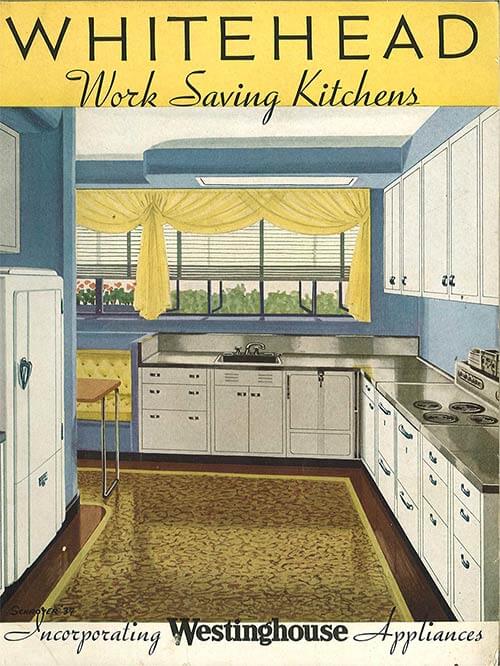
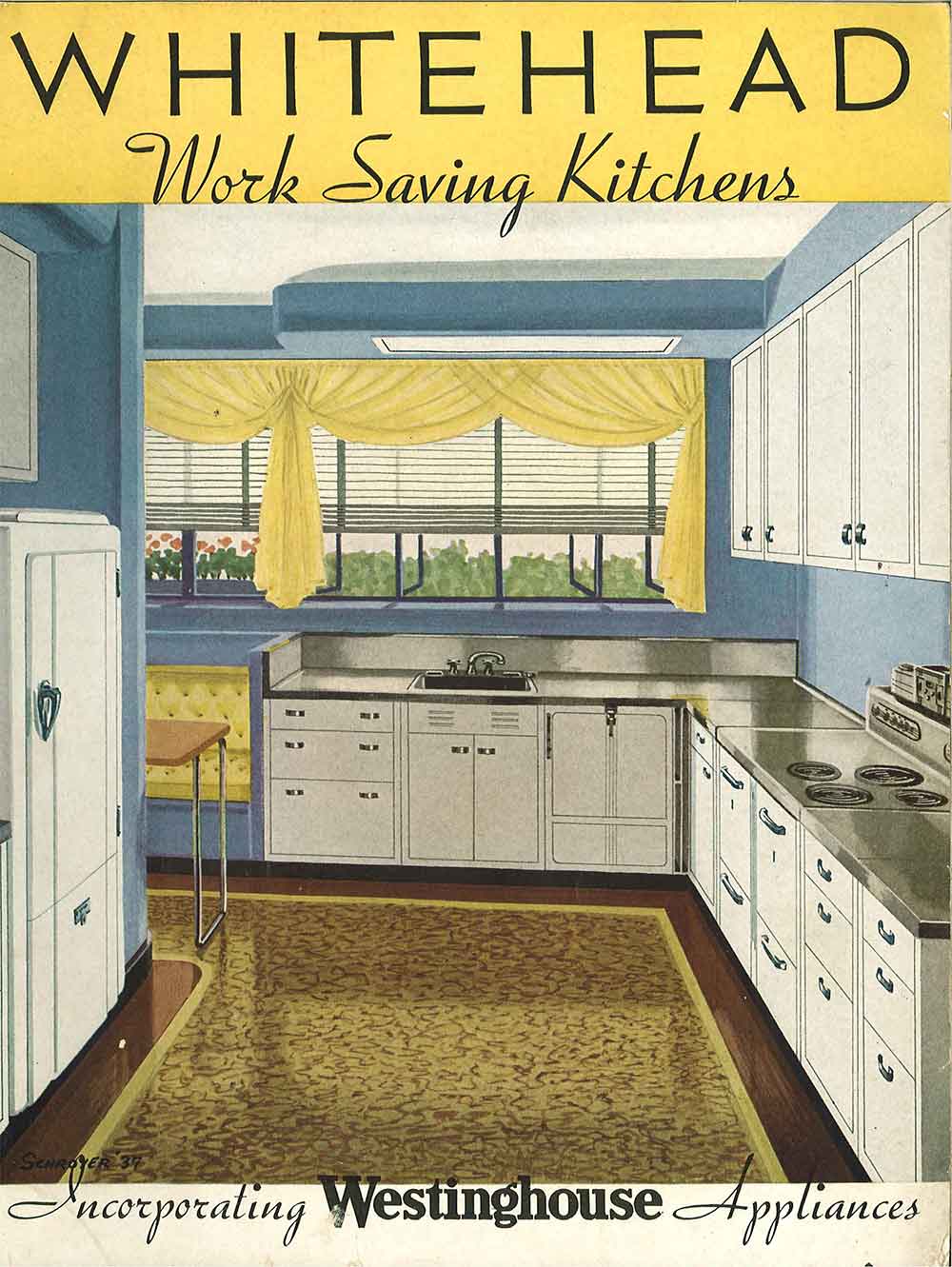
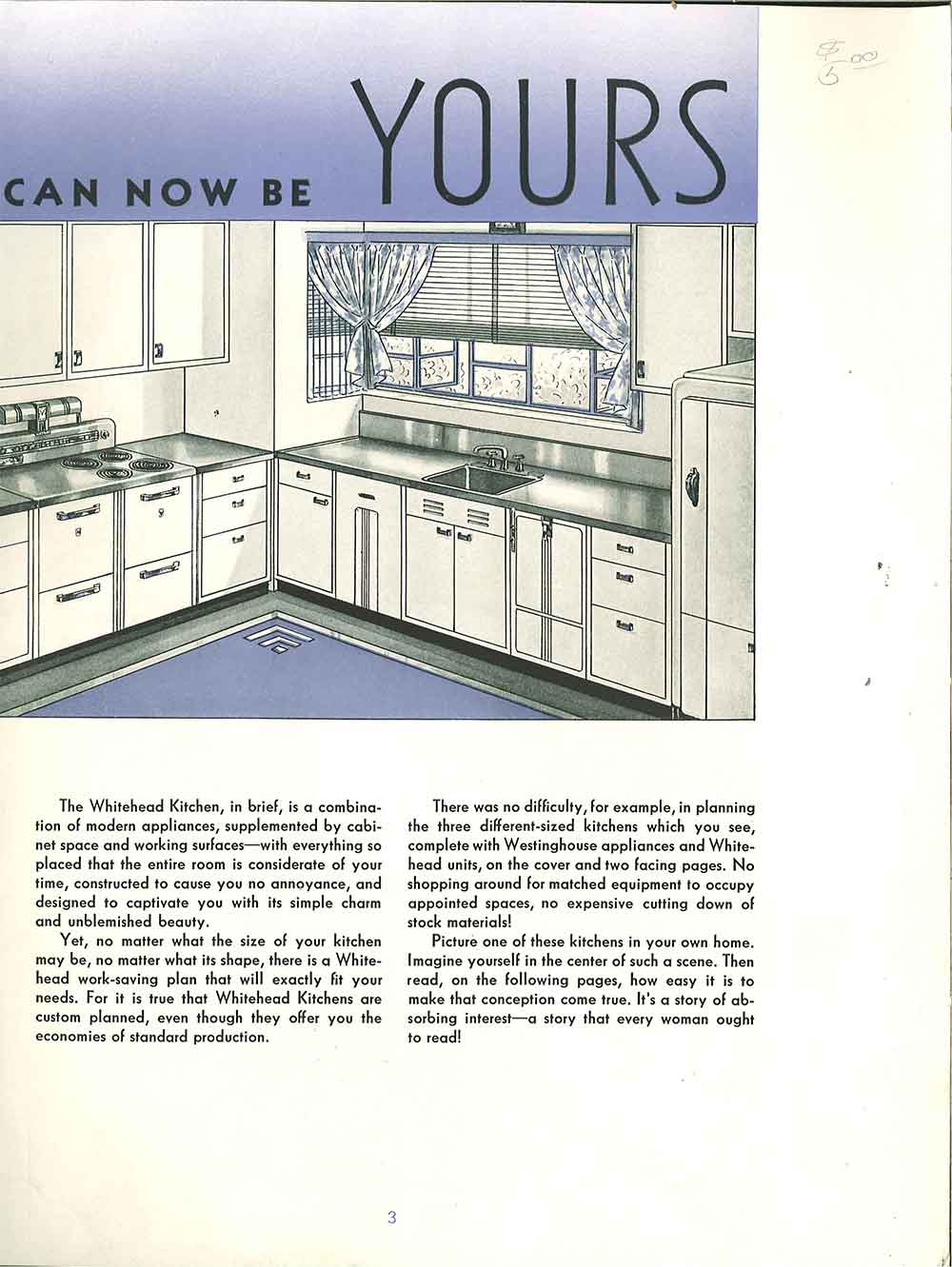
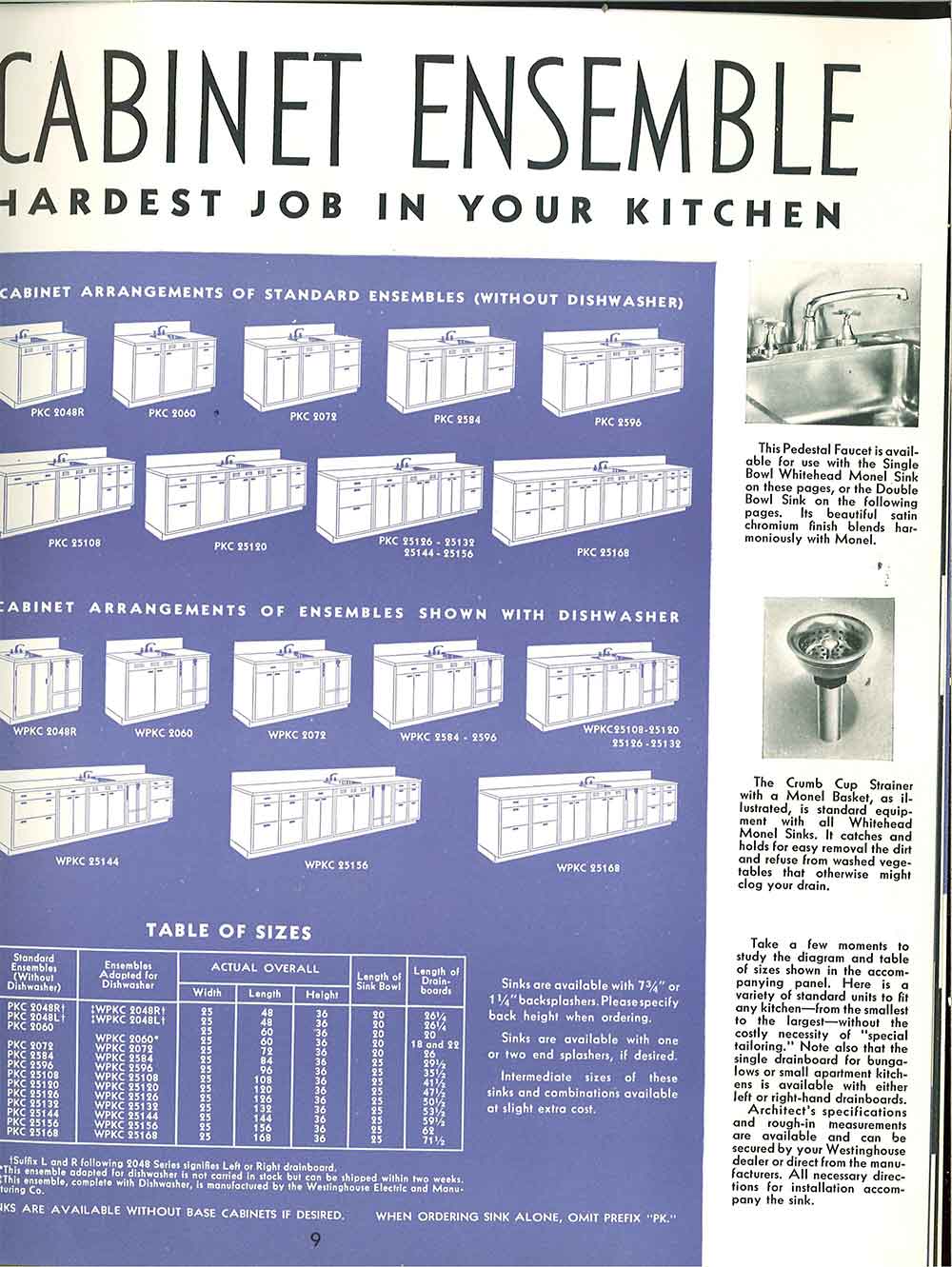
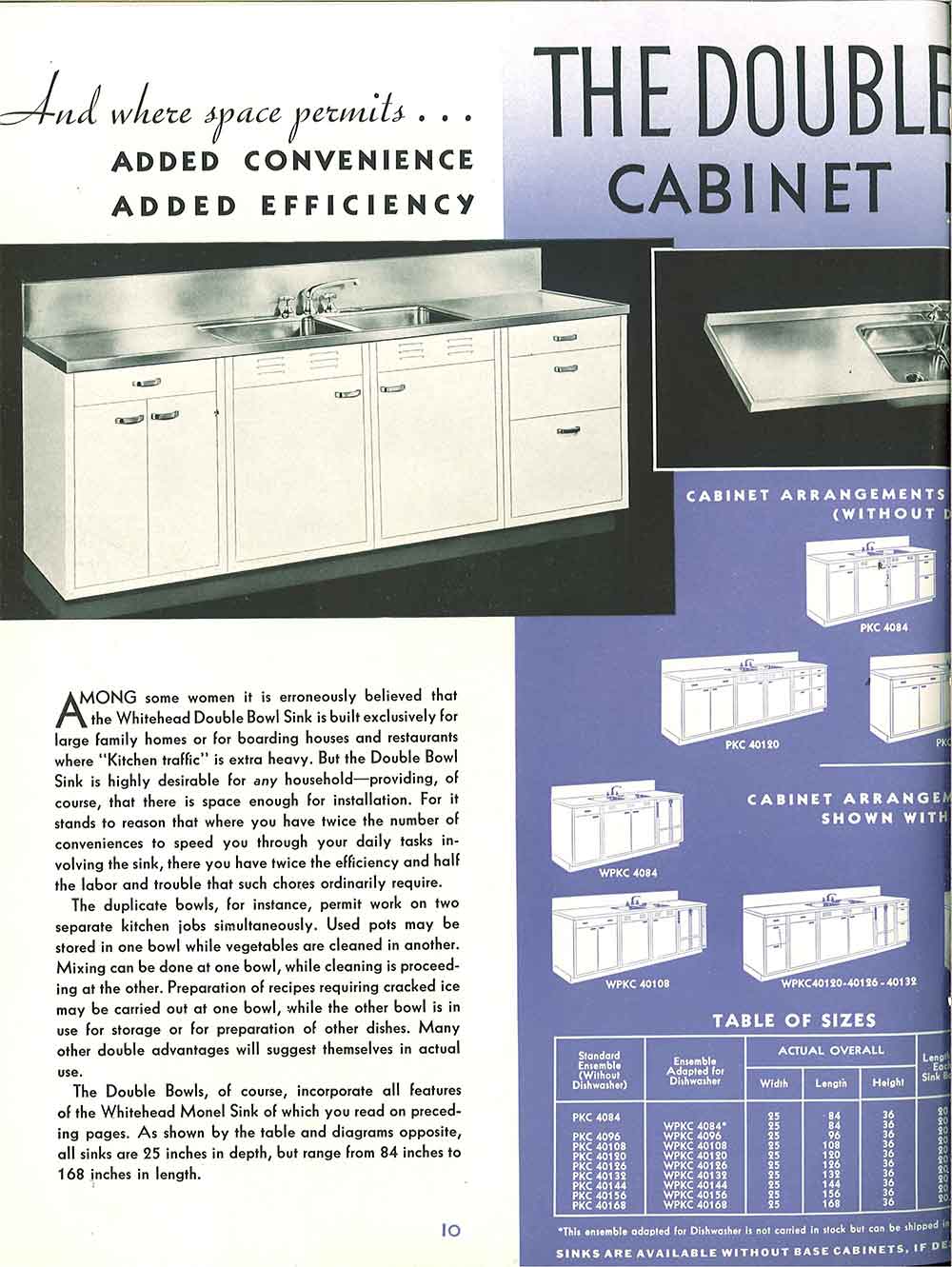
 In the early days of steel kitchen cabinets — the 1930s — the cabinets had a “deco” or “streamline” look… they were always white… and there were only a few brands that we know of so far — including Whitehead Among the very early brands were Whitehead/Monel, Servel, Elgin, and Dieterich. It’s not easy to find examples of these old originals any more, so it’s very exciting to discover and be able to archive this vintage Whitehead catalog from 1937… so that we can ogle late 1930s kitchen design ideas… so that we can identify these rare birds when spotted in the wild… and to add as another wonderful piece of archeology to our short history (3,000+ words, gulp) of vintage steel kitchen cabinets.
 Whitehead steel cabinets were made by Whitehead Metal Products Co. of New York, Inc. The company lists there address as 304 Hudson Street, New York, N.Y. Yes, steel kitchen cabinets made right on the island of Manhattan — imagine that. Looking at this story, Pam said that she *thinks* we may have seen a set once a few years ago — for sale in New York City. But doggonit, no photo can be found. 52PnB, you remember it???
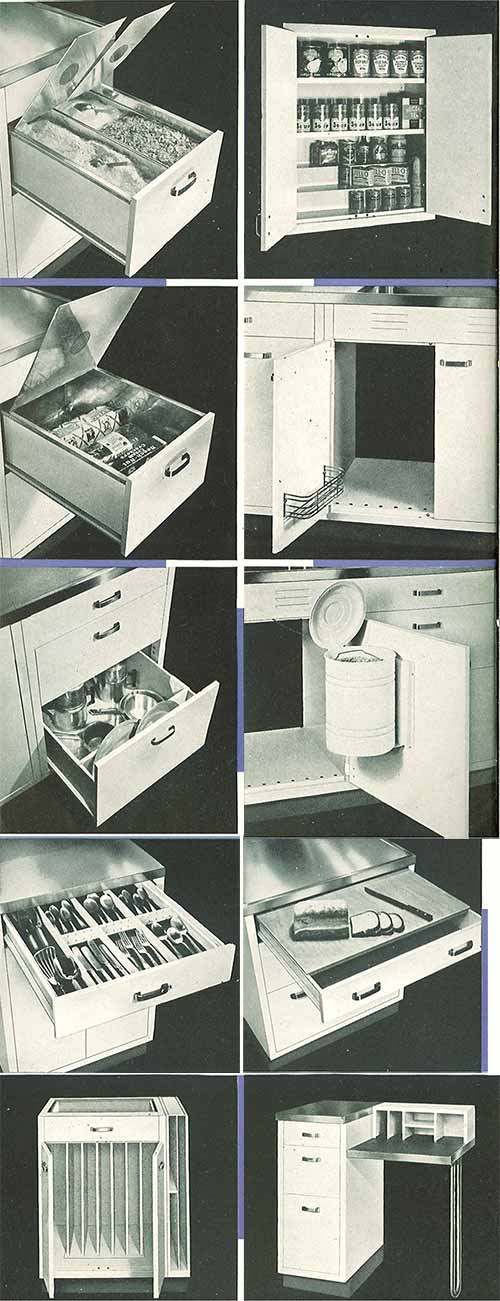
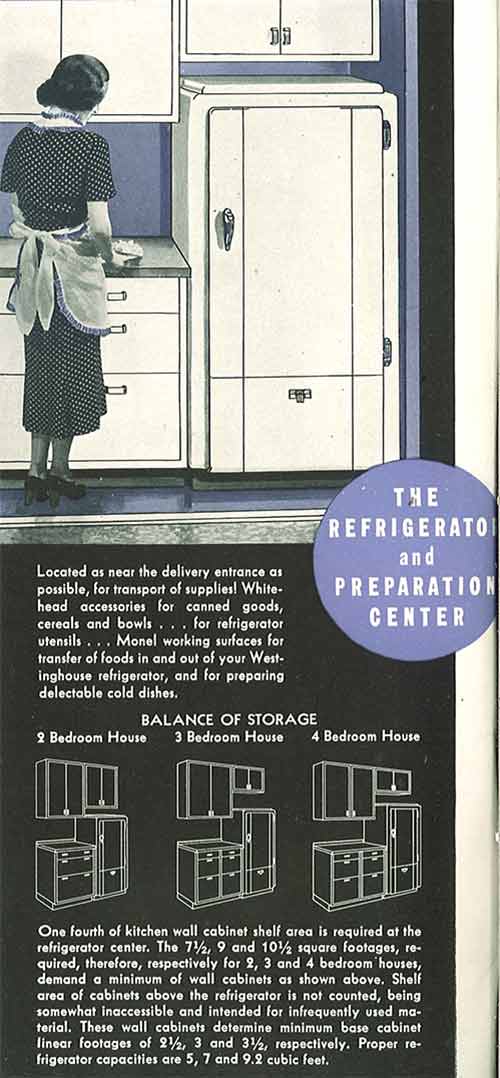
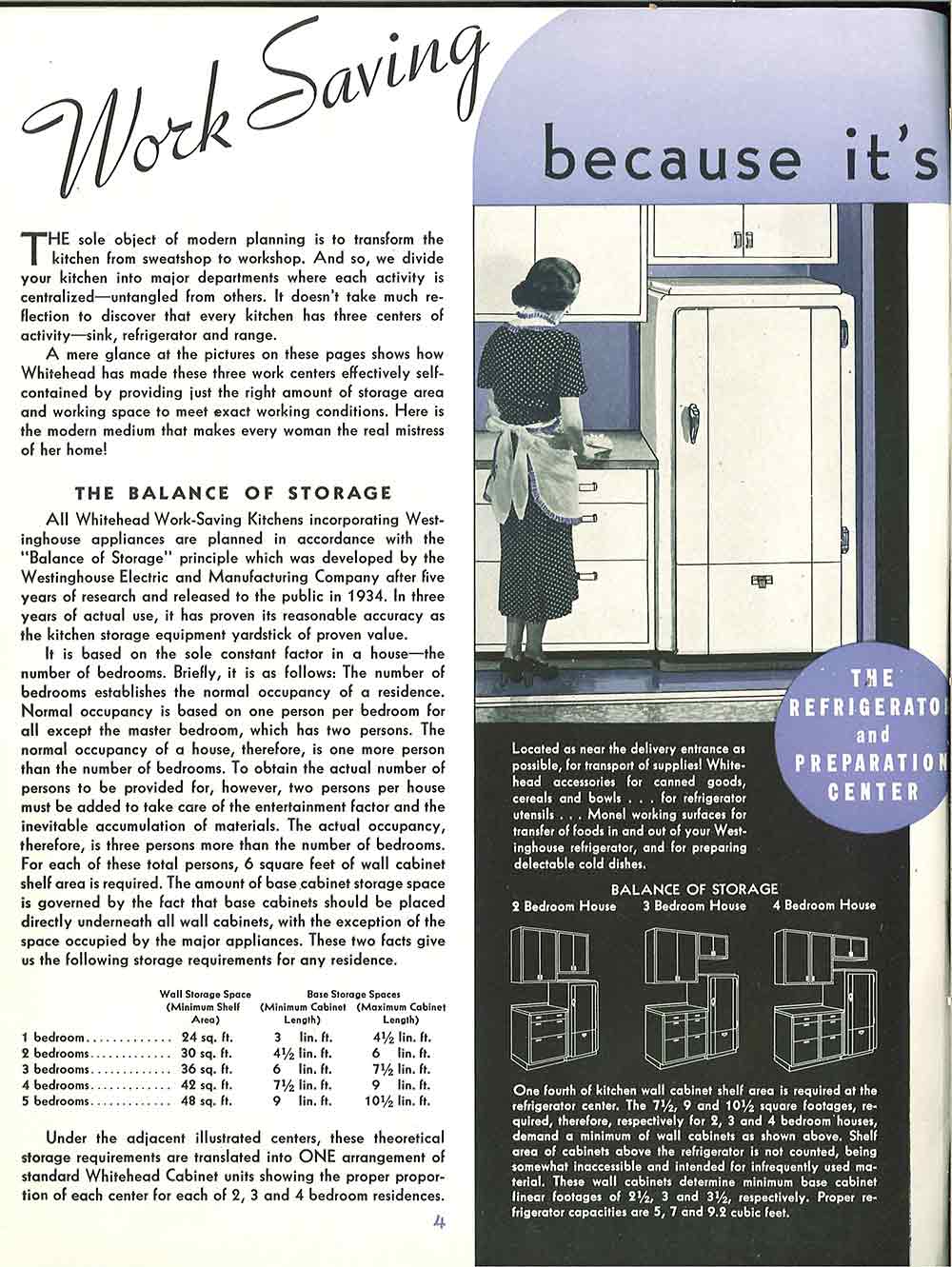
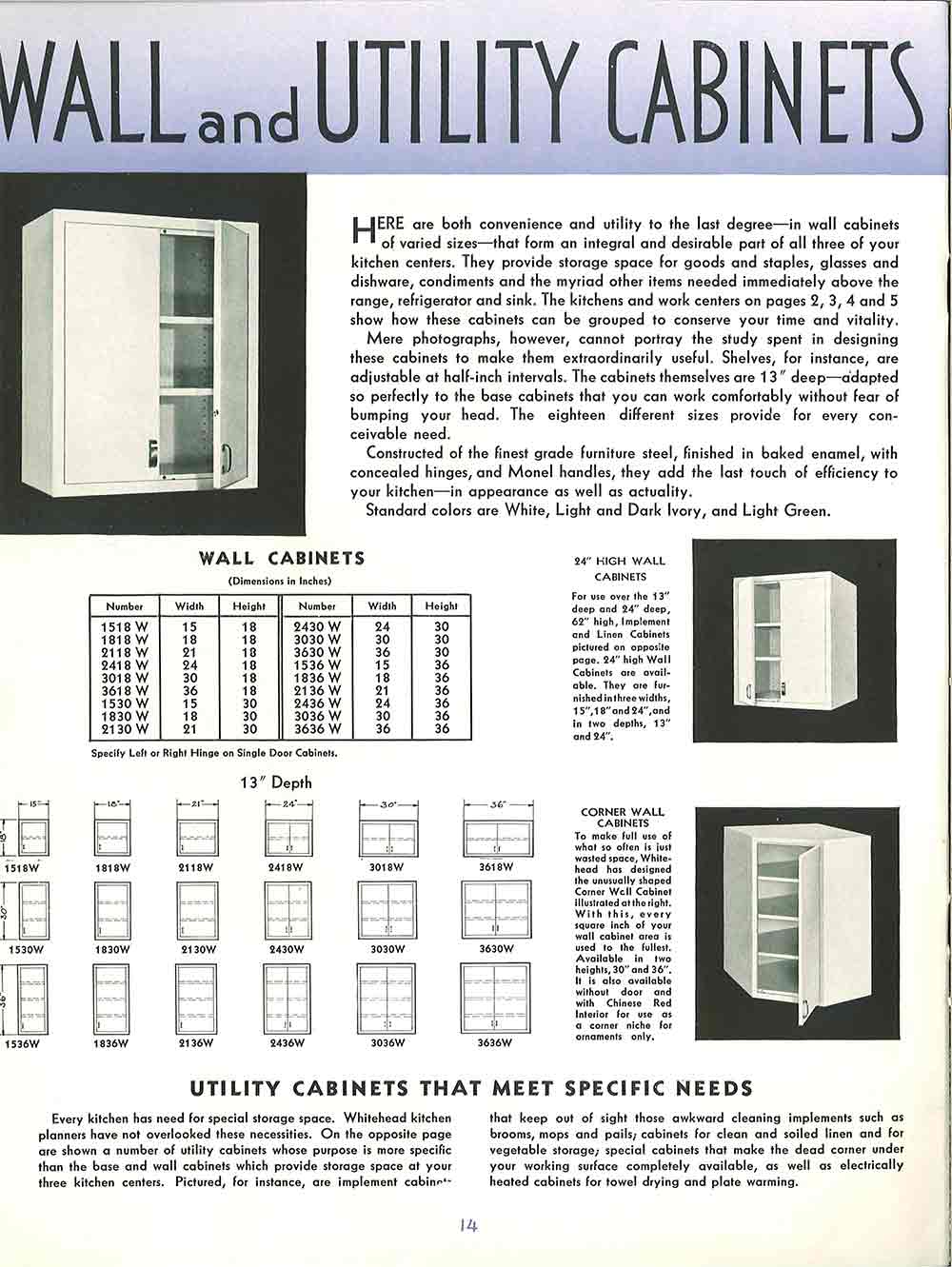
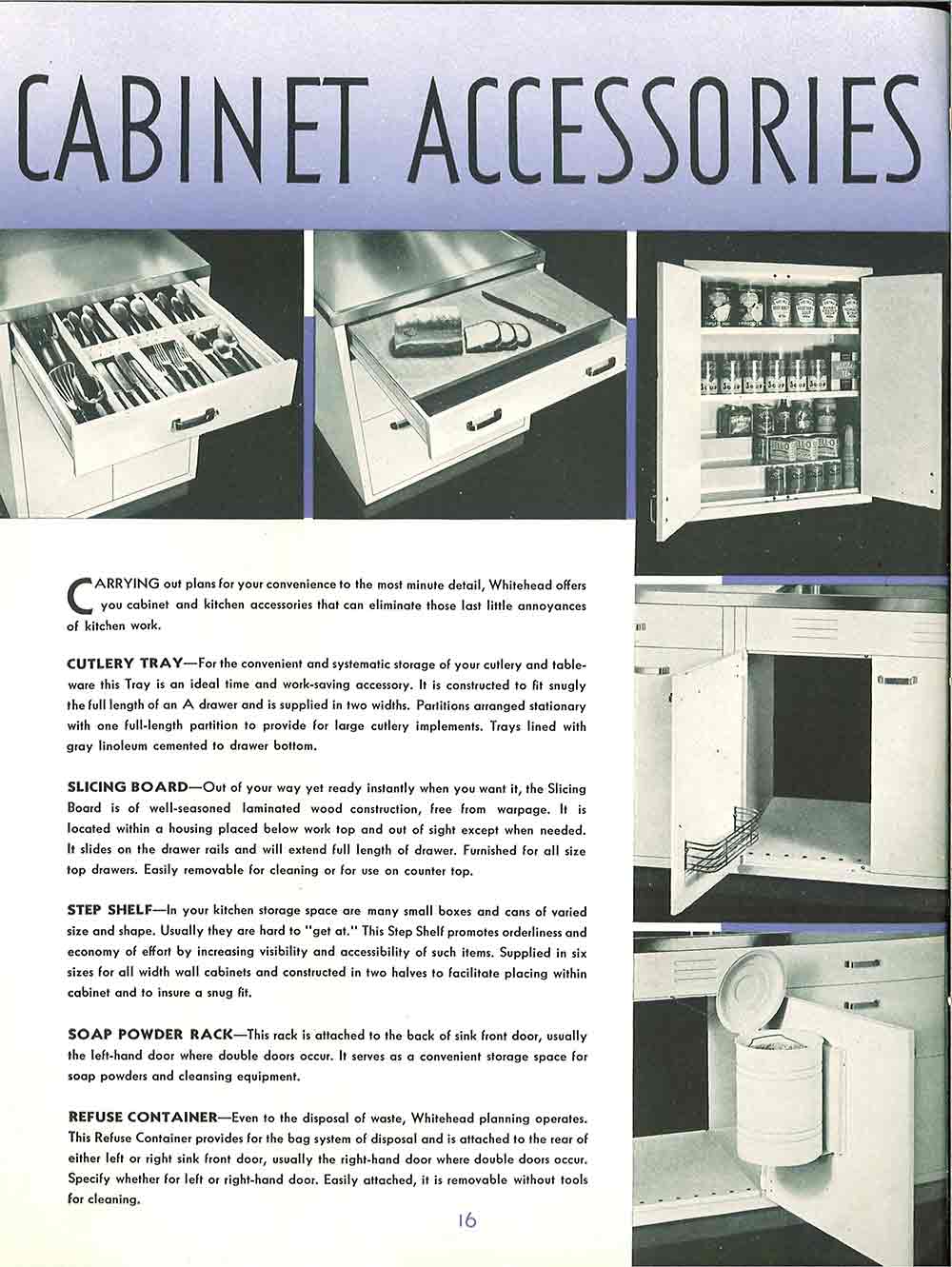
In this catalog, Whitehead puts an emphasis on smart design. Very interestingly, the company even calculates how much space is needed for any one type of cabinetry based on how many bedrooms are in the house. And, there was lots of focus on efficiently organizing all the work elements in the kitchen. With this in mind, Whitehead created a whole line of specialty cabinets and inserts — all with organized and useful components (shown left to right above):
- Bulk storage bins
- Step shelf
- Bread bin
- Soap powder rack
- Lid rack
- Refuse container
- Cutlery tray
- Slicing board
- Tray racks
- Planning desk
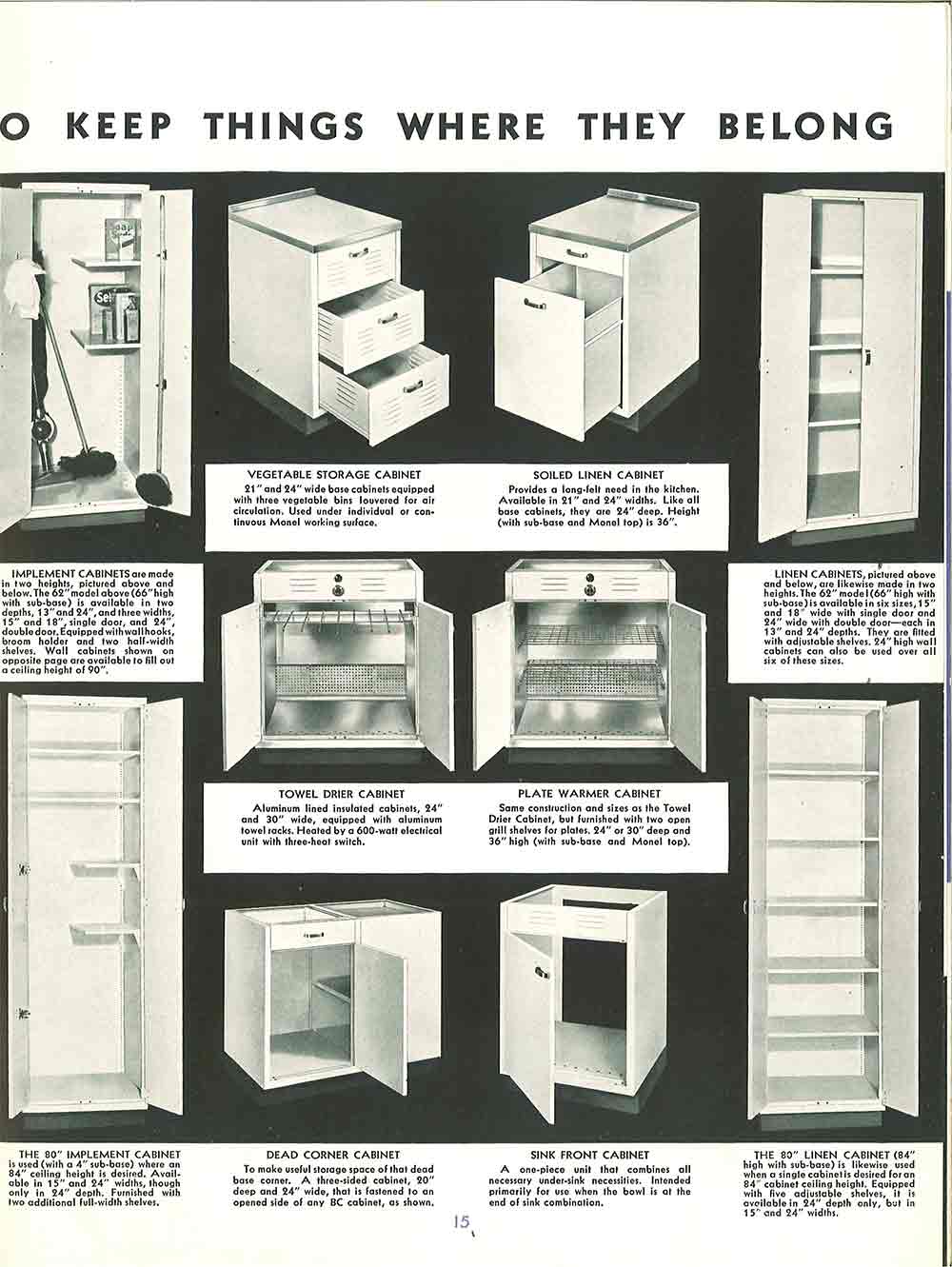
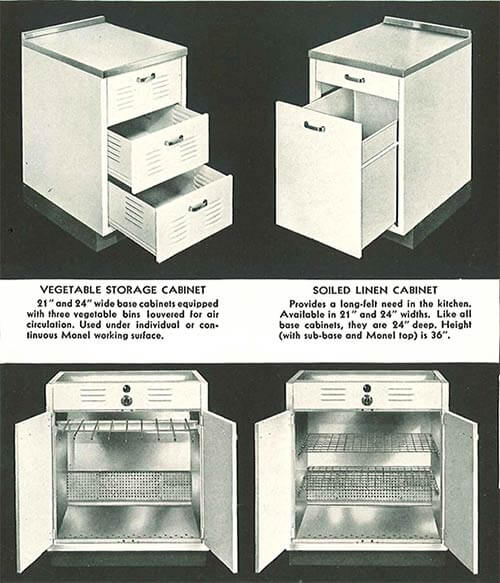 Some of the other and more interesting specialty cabinets include the vegetable storage cabinet, soiled linen cabinet (laundry basket for the kitchen), towel drier cabinet and plate warmer cabinet (shown above).
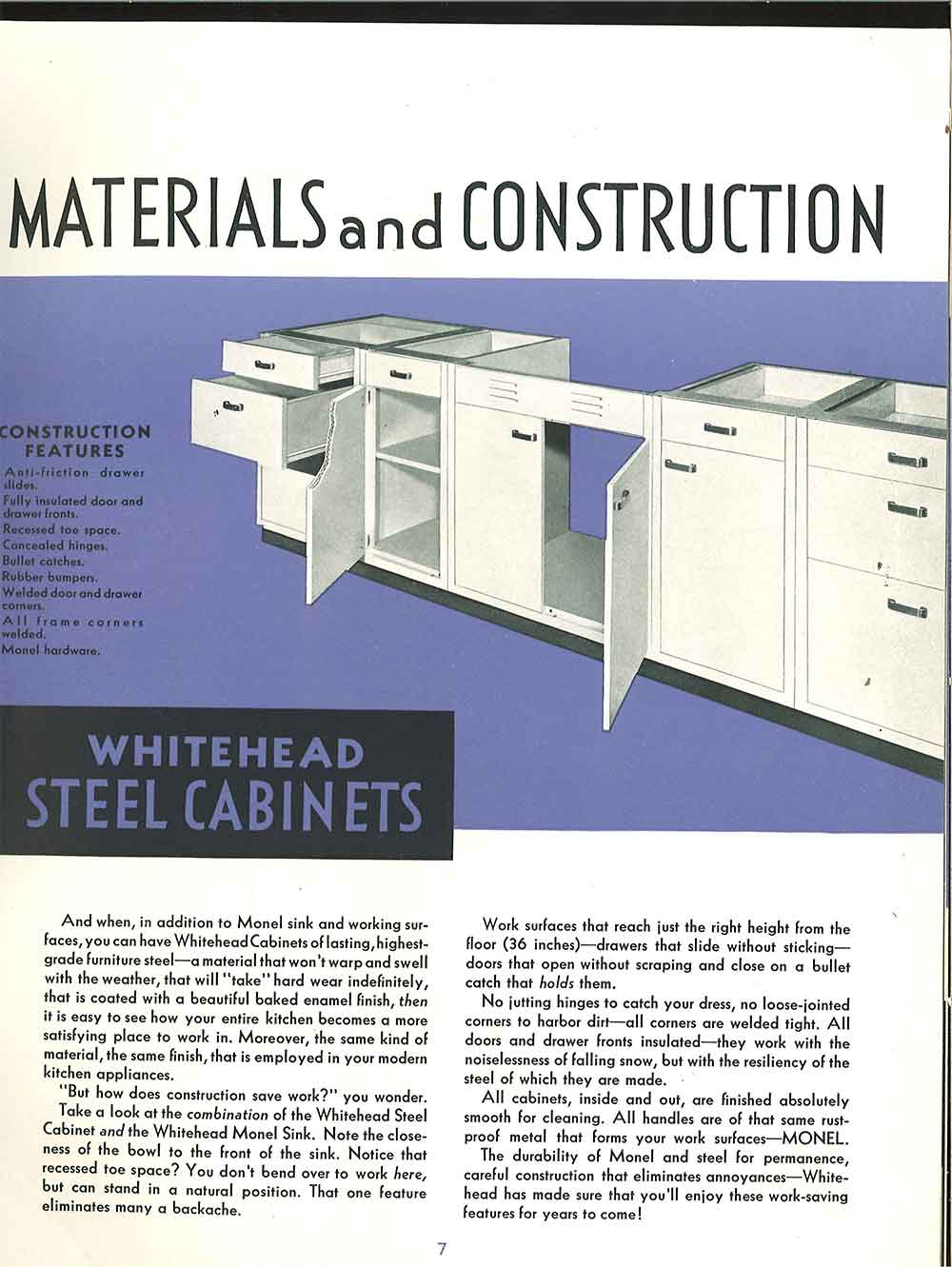
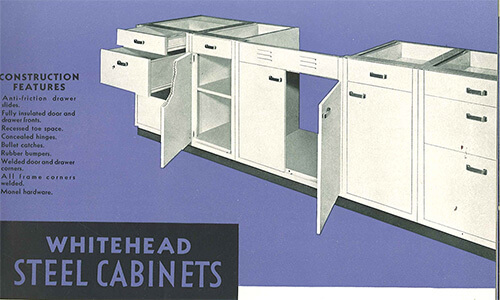 The steel cabinets themselves had several features that ensured ease of use and the well-built longevity that was expected back then. Construction features include:
- Anti-friction drawer slides
- Fully insulated door and drawer fronts
- Recessed toe space (to minimize uncomfortable bending)
- Concealed hinges
- Bullet catches
- Rubber bumbers
- Welded door and drawer corners
- All frame corners welded
- Monel hardware
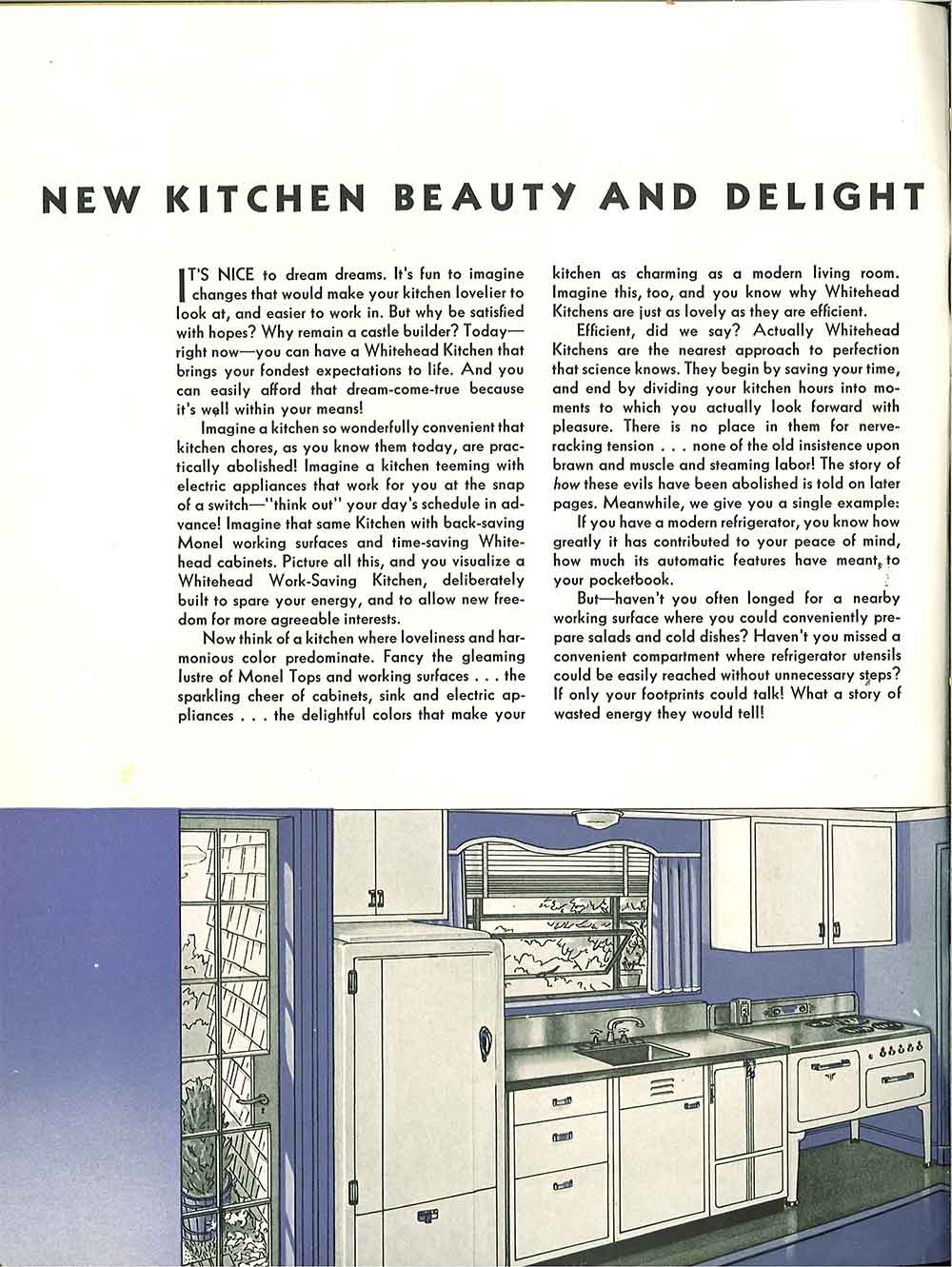
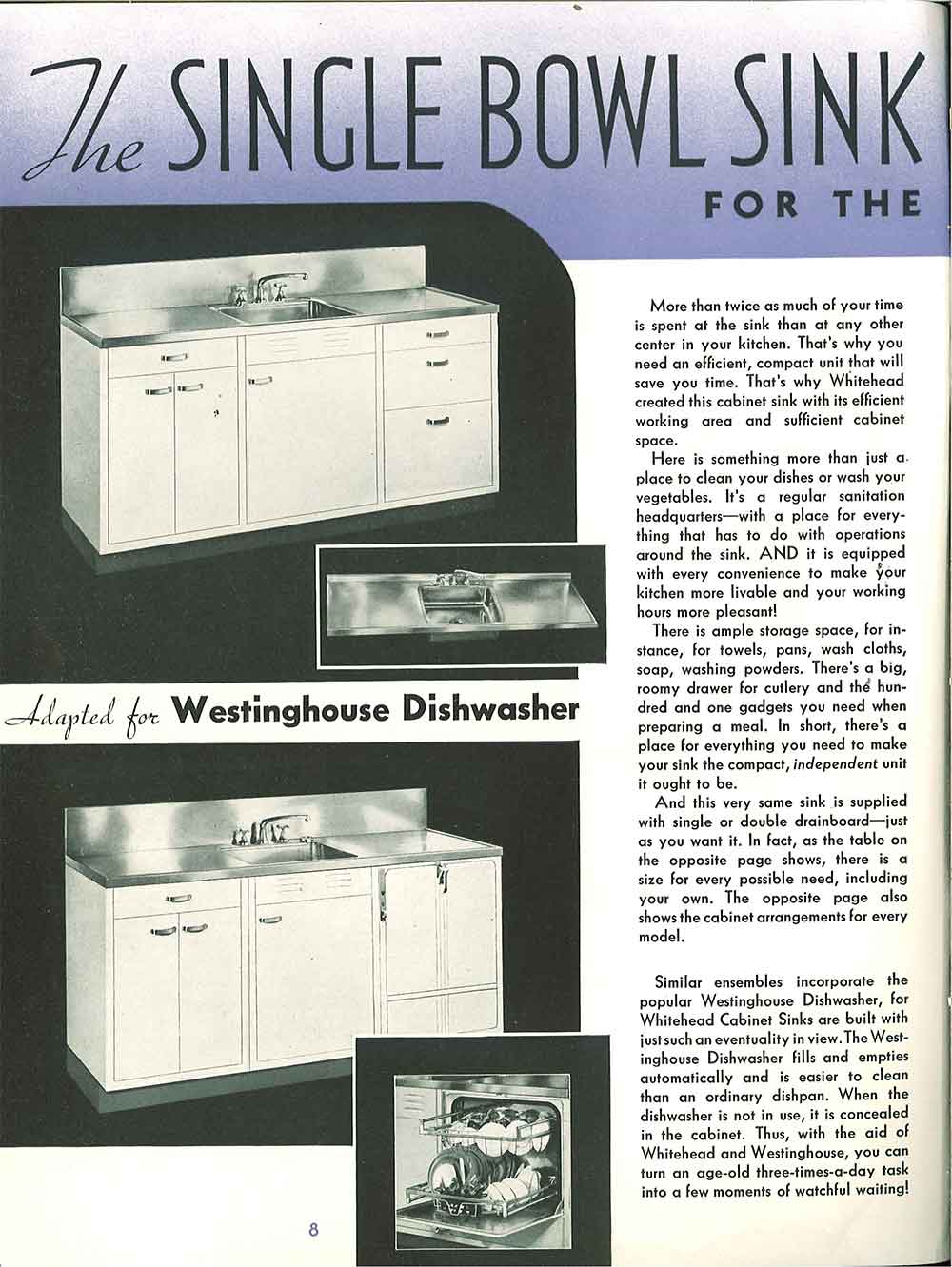
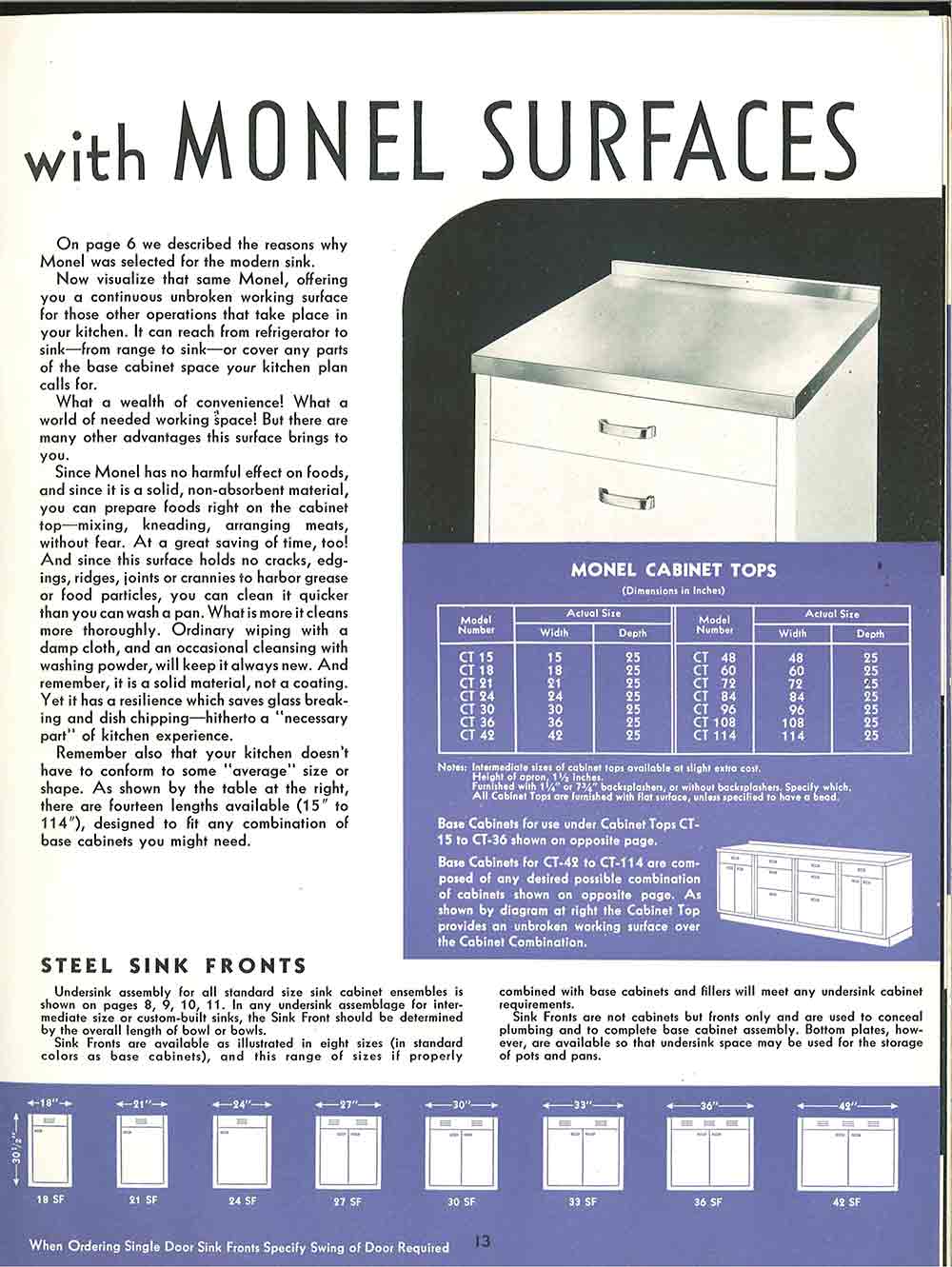
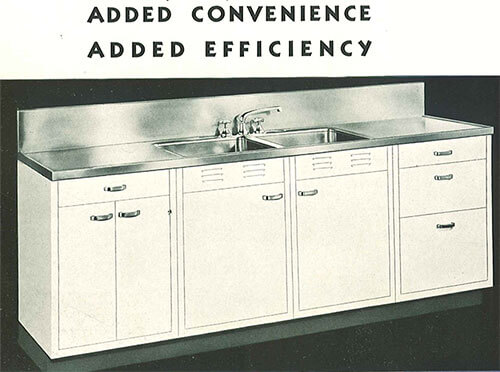 The counter tops are made of Monel. And, the touts the benefits of having an integral sink, counter top and back splash, which will not collect grease or allow water to penetrate the drainboard. So, this is how far back — at the least — that we can see examples of stainless steel(like) counter tops. See our helpful story — 5 ways to do stainless steel sinks and counter tops.
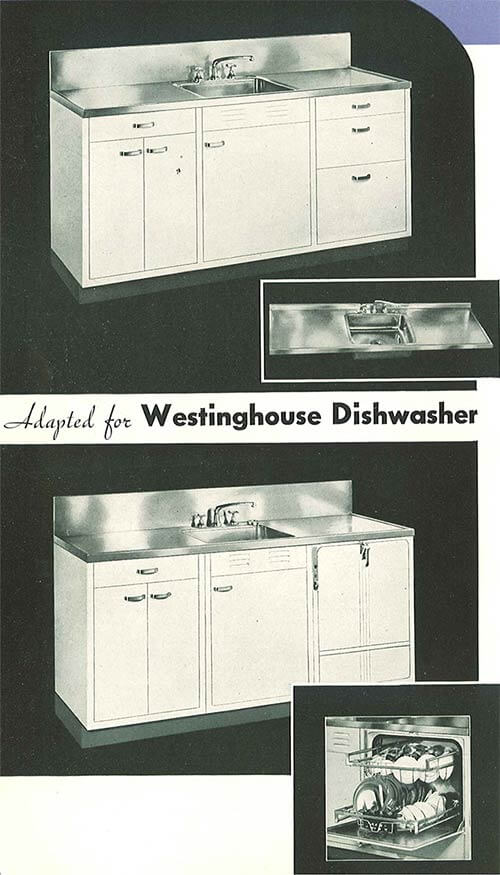
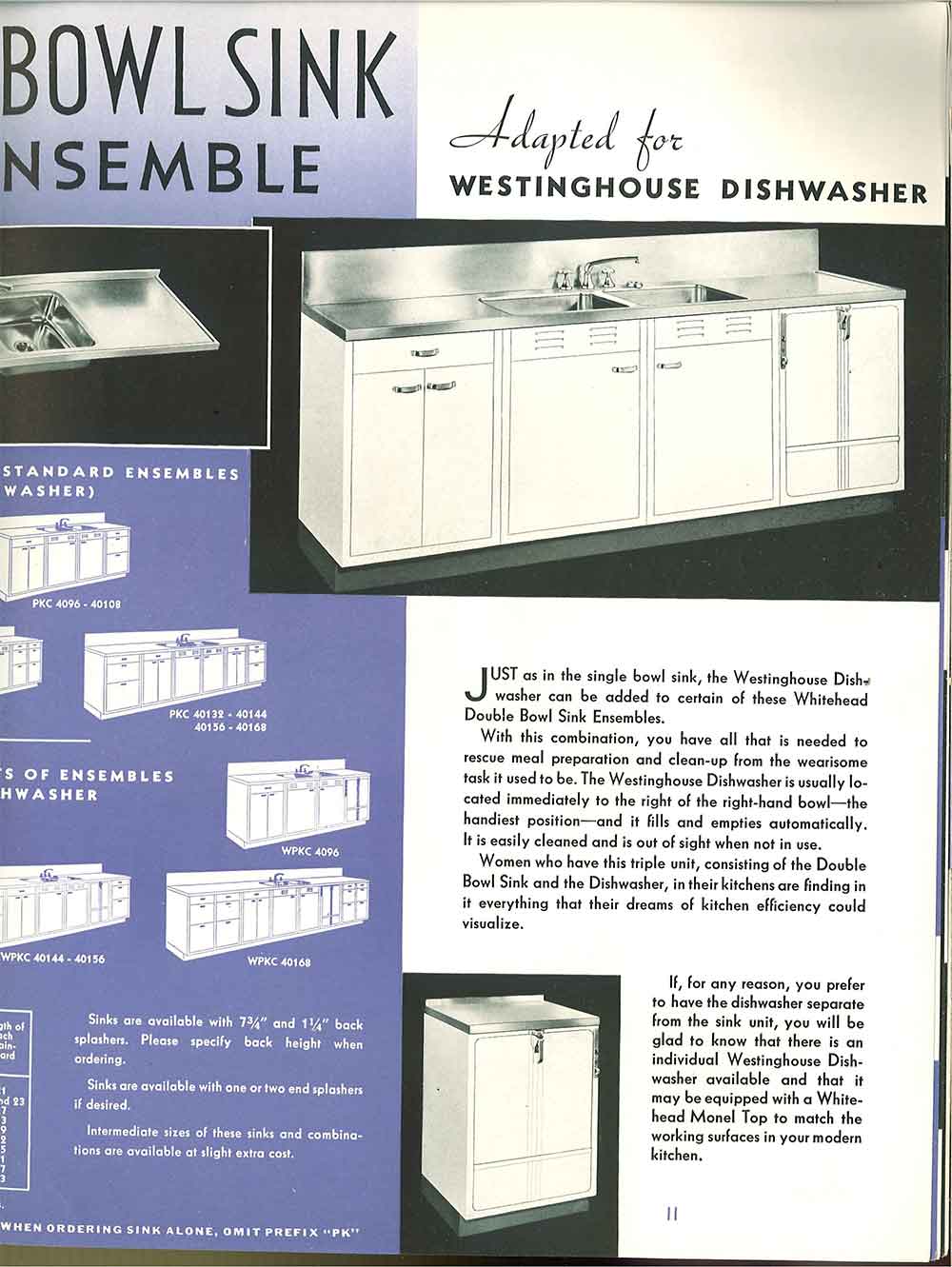
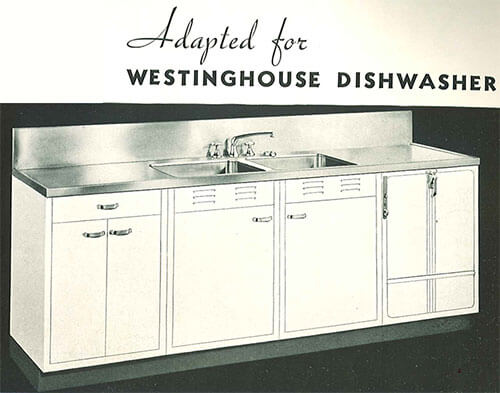 Another exciting component of a Whitehead steel kitchen was the availability of the integrated dishwasher. We need to do research to identify when the first built-in dishwashers were installed in American homes.
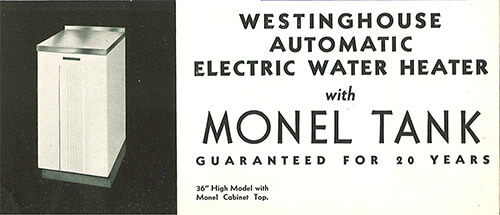
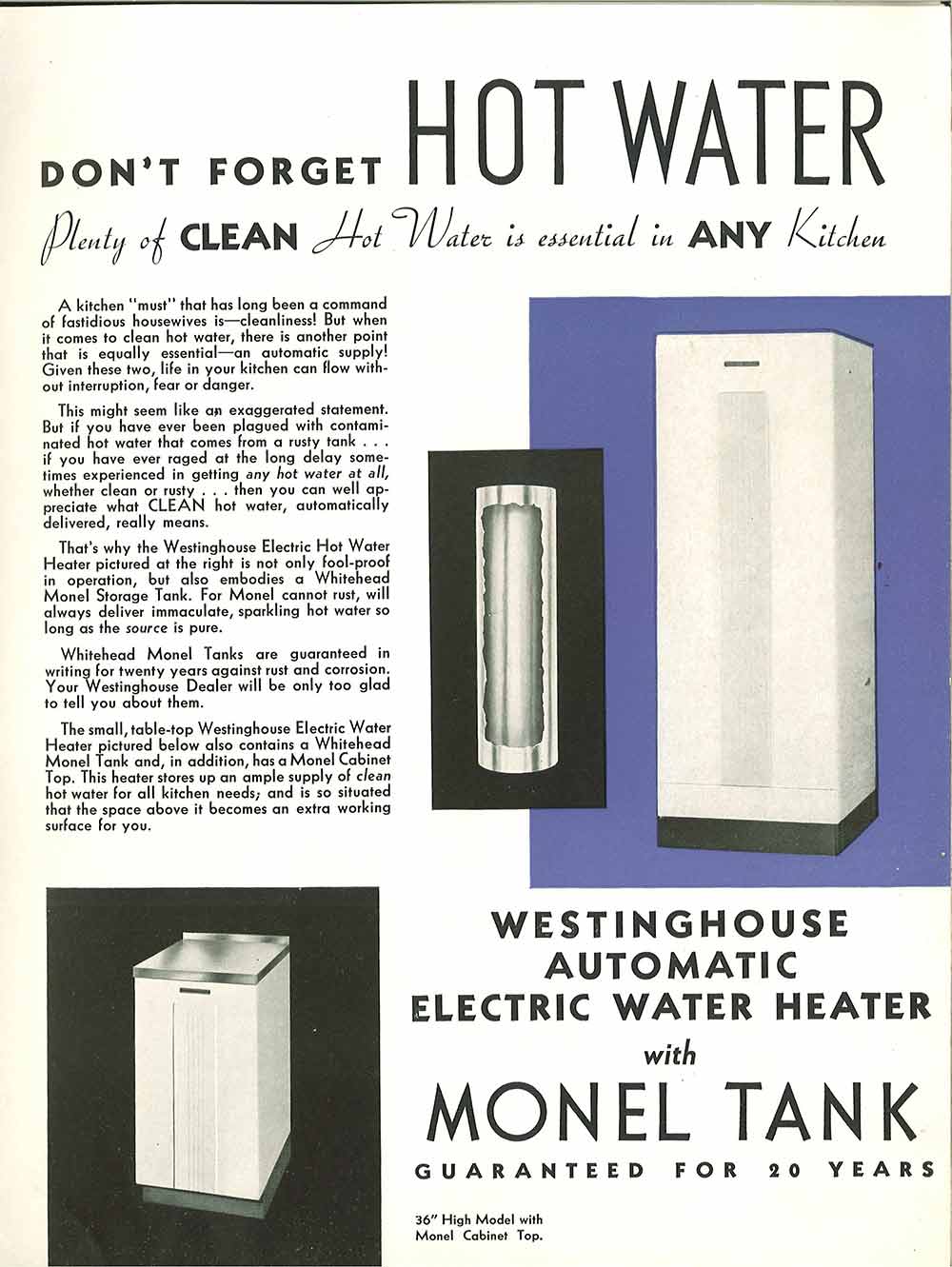
Of course, an important fact to consider — especially when a dishwasher is involved — is where the hot water will come from. In this case, Westinghouse has a solution — the automatic electric water heater — that fits seamlessly into a kitchen cabinet, even providing extra counter space above the unit. The catalog advertises this unit as rust proof — and mentions that you will never again have to worry about contaminated hot water from a rusty tank.

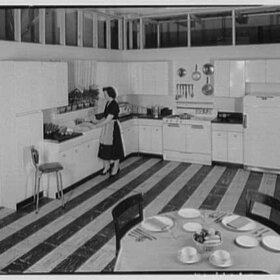
In 1937, this kitchen surely must have been very high end — well out of the reach of most Americans. But surely, designs like this set the stage for the big boom in steel kitchens after World War II. Very cool.
Thanks to archive.org and the MBJ Collection for making this vintage catalog available.
Tips to view slide show: Click on first image… it will enlarge and you can also read my captions… move forward or back via arrows below the photo… you can start or stop at any image:?






chris says
I recently remodeled a multi unit apartment building constructed in 1955. The building contained 12 galley kitchens manufactured by the St. Charles (kitchen) manufacturing company located in St. Charles Illinois. All the cabinets were double wall steel construction complete with all the amenities shown in your catalog from White Head and more. In fact the kitchens were so well constructed and organized they were in excellent condition up to the day we de-installed them. The designer (worked for St. Charles) utilized SS. trip on all the edges of the counters, sinks, backsplashes, under cabinet lighting, doors handles, concealed hinges for all doors, integrated counter-top built in blender. In short unbelievable design. They kept their modern appearance and functionality to date. It is a shame I did not know of your site. I dumped them for scrap only last week after keeping them in a warehouse for 4 years.
Christina M. says
These are the metal cabinets in our kitchen! We live in a 1937 ranch house in So. Cal. I have been trying to find out what our kitchen cabinets were for a long time now! We have the Monel counter tops and the storage bin! Ours were painted green in the late 1940’s, but were originally white. Our kitchen needs cosmetic work but I do love the cabinets and would like to keep them if possible. Thank you for a great article!
pam kueber says
I would say you have very historical cabinets and counter tops!
Shari D. says
Regarding the history of automatic dishwashers, I don’t have any specifics – yet – but I do have photos bookmarked online that show a maid loading dishes into a top loading dishwashing device that is integral to the kitchen sink, which is more like the big enameled steel job on legs than the kitchen cabinet style, shown in kitchens of the 1920’s. Since electricity in homes wasn’t very prolific until the 1920’s, that was most likely the first one available. Of course, if you could afford the dishwasher, which was likely incredibly expensive for the times, you could also afford the household help to load and unload it!
Toni says
There’s one on display at our historical society. If I remember -yeah, right- I will take a picture next time I’m there.
Andy A. says
Not sure about those “bulk storage bins”. Did they illustrate them with sugar and flour? Seems they would lump up in humid weather, and I’m guessing a nightmare to clean out.
Love the streamlined, perfectly matched look. The kitchens of yesterday in many ways seem more efficient than the kitchens of today. Everyone wants a big kitchen now, which means extra steps between sink, refrigerator, oven, etc., which to me seems like a step backward. Then, there’s the center island that has to be walked around. Give me a mid-century serving bar or peninsula island instead.
To think folks with new houses and kitchens think they’ve got it all! Next time, I’m going to ask where they put the soiled linen cabinet, the plate warmer, and the towel drier cabinet! “You mean you warm plates in the oven?” That ought to fluster them!! 😉
Shari D. says
The first thing that came to mind when I saw those bulk storage bins, was not only keeping them clean, which probably wasn’t too difficult because they were most likely removable, but how to keep little household “invaders” from dining on your supplies! Even the most fastidious housewife would be hard pressed to keep little ants and such out of sugar stored in such a manner. The only thing I can hope for is that it got used up quick enough to make that a non-issue.
Janet says
I asked my sister who has lived in NYC since 1970 if she ever saw one of these kitchens “in the wild”. She said she has never seen one. I often look at craigslist ads for vintage appliances in NYC and I swear I have seen this kitchen in a couple of them. I sure would love to see one some day! I think the word “streamlined” so well describes them. I did finally squint my way through most of the text and found they came in white, light green, and dark and light ivory. I would love to know what light and dark ivory look like. I do think I have seen their pantry type cabinets around. They might survive alone better than an entire kitchen full of them.
pam kueber says
Oh my – I need to go read that text, too. Colors that early, wow!
Shari D. says
To read at your leisure and viewing comfort, click on the link up under the kitchen photo, which says “archive.org and the MBJ collection” and when the next page opens, look to the upper left, and find the first link for reading the catalog now, with the PDF link. When you click on the PDF link, you can adjust that new view to either one or two pages at a time with the controls at the bottom – I suggest one for the best enlarging purposes – and then click on the magnifying (bottom right) icon that enlarges the pages to suit your viewing needs. You can read everything clearly, one page at a time, or two if you don’t need to blow them up very large to read clearly, and you get all the details, clear illustrations and the like – gotta love it!
And I LOVE reading these old catalogs. Makes me wonder what it felt like reading them when they were new, and dreaming of these nice new, efficient kitchens for my home!
Scott says
I guess this catalog proves Stainless can be our friend as well as an instrument of mass destruction.
Kim says
I want to move directly into this catalogue! And oh, OH, that under-cabinet “Refuse Container”–the lidded trash can mounted to the cabinet door itself! The spring-loaded lid flips open when you open the cabinet, closes as the can swings back underneath. My great aunt had one of these in her late-30s Cape Cod bungalow and it MESMERIZED me, as a little girl. Heh. I don’t think her cabinets were steel, though. I still want one. Get on that, Simple Human! 😉
Carole says
Look at all of those ‘modern’ storage ideas that some designers of today call ‘new’ – the vertical and other storage racks, wire bins, roll out drawers…Not so much ‘new’ as redesigned ideas that have always worked well.
I love the whole design of this kitcehn. It’s fabulously modern and retro at the same time. And that deco style fridge! Wow.
I now have my dream kitchen (it’s mostly finished), which came about after an extensive gutting and remodel. The previous kitchen was a very poorly designed galley and dining area with a ‘dropped’ ceiling that left my husband and I both feeling claustrophobic. I’ve never seen a ceiling lowered like that before. As for the galley, I’ve lived with, and worked in galley kitchens, but at this point in my life I prefer lots of open work space. I cook too much and too often to work in a cramped area. This vintage kitchen would have been a dream for any woman who wanted streamlined elegance and lots of space!
pam kueber says
And the olden day ones were made of STEEL, not plastic!
Anna says
Loved this article–more 1930s and 1940s information please! I feel like it gets dwarfed in all the (great) mid-century info.
Chris says
I second that!!!!! I LOVE reading all the midcentury stuff, but my house was built in 1934. I am always completely tickled to read something about homes in the 30s!
Toni says
Me, TOO!! The 60’s aren’t nearly as fascinating to me as the 30’s. Maybe because I was there the first time around. I still cringe when I see avocado, harvest gold or that orange color. And the wildly flowered wallpaper makes my head hurt. What were we thinking! I had a kitchen full of it. My appliance color was brown.
Ranger Smith says
I had a house built in 1940 that still had metal inserts in the wood drawers for bulk food storage, similar to the 3rd picture from the top. They would have held at leat 20 pounds of flour/sugar or whatever. I think we cooked and shopped differently back then.