

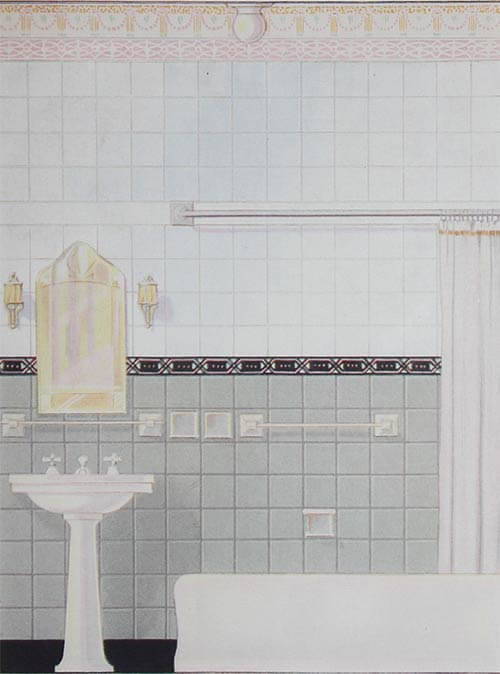
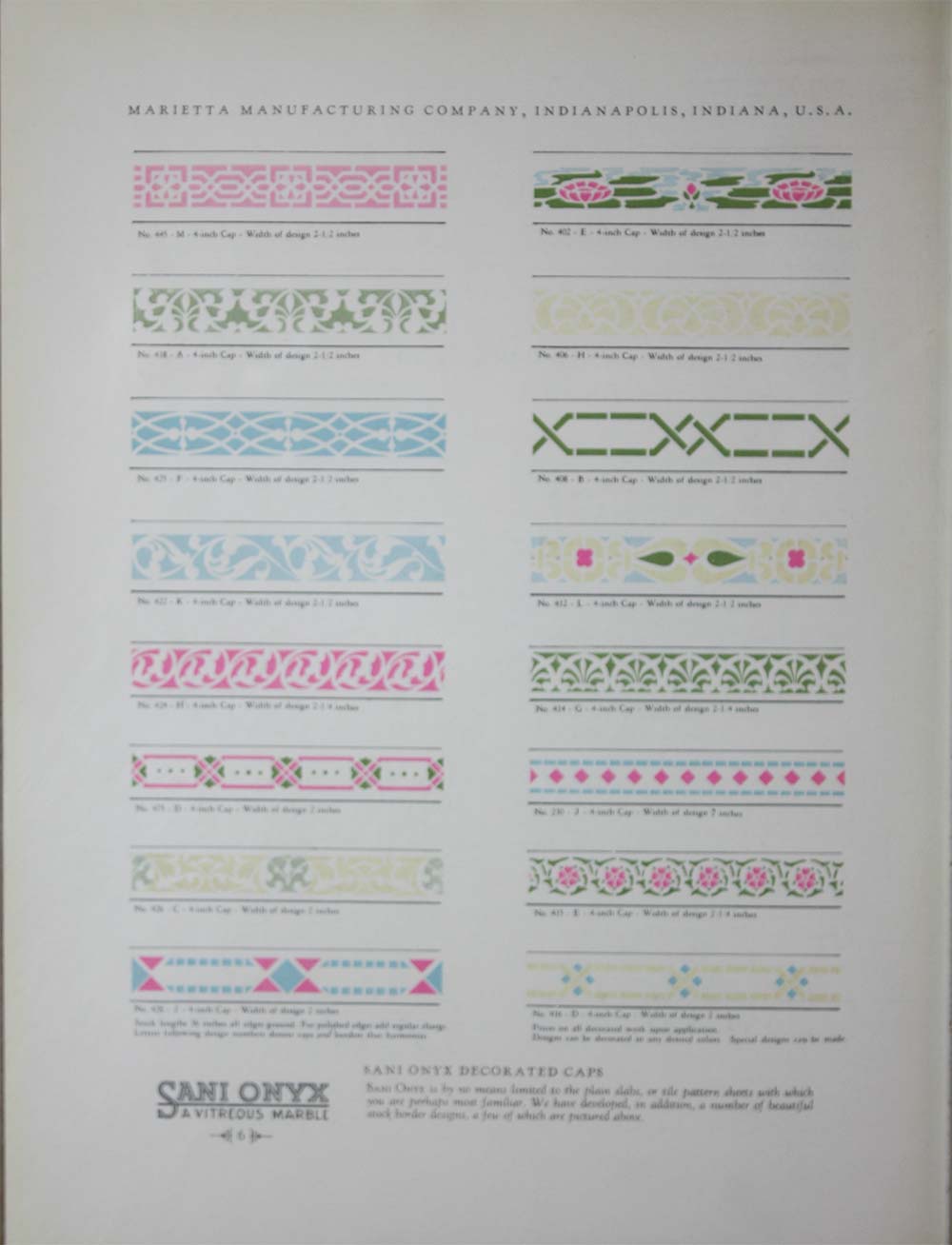
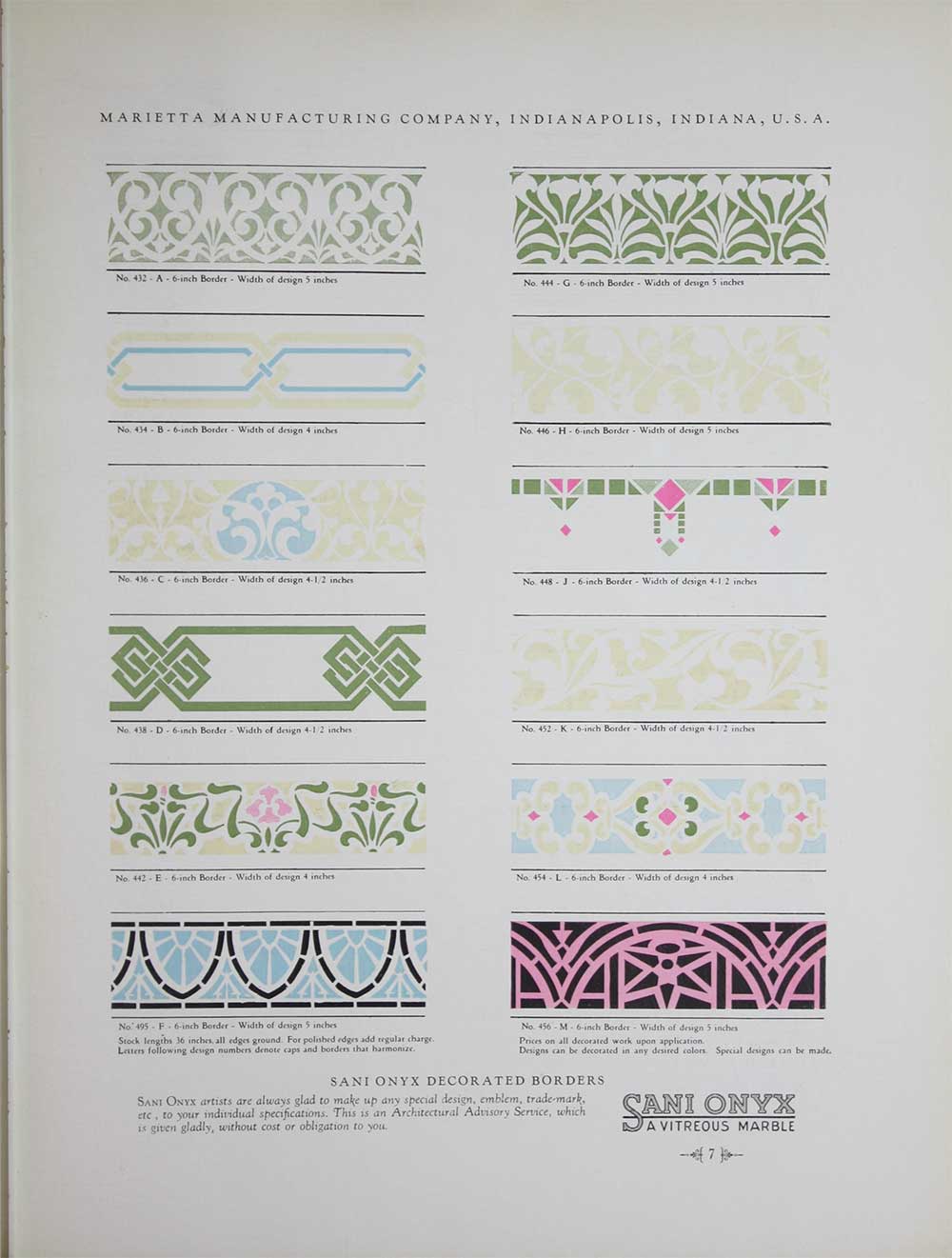
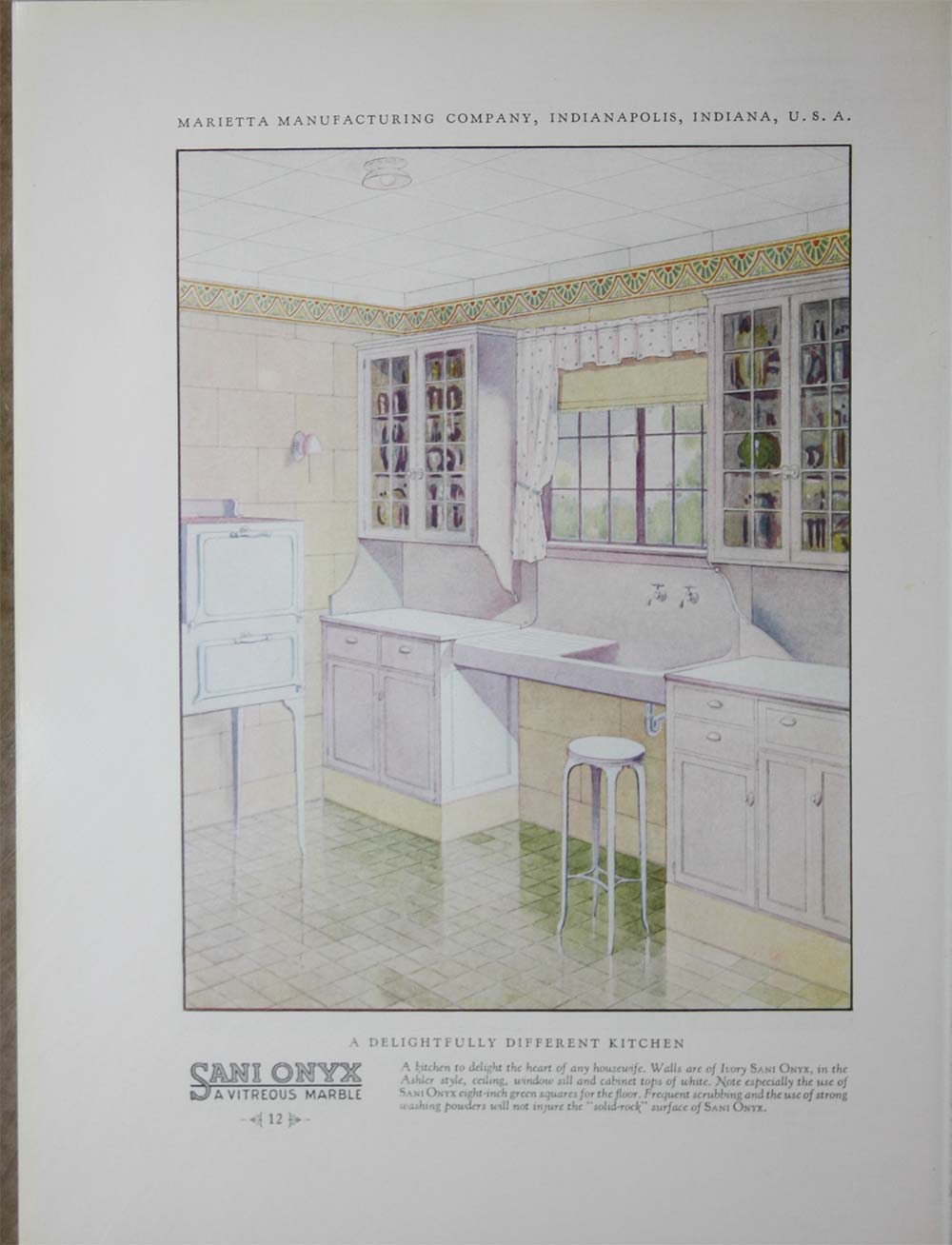
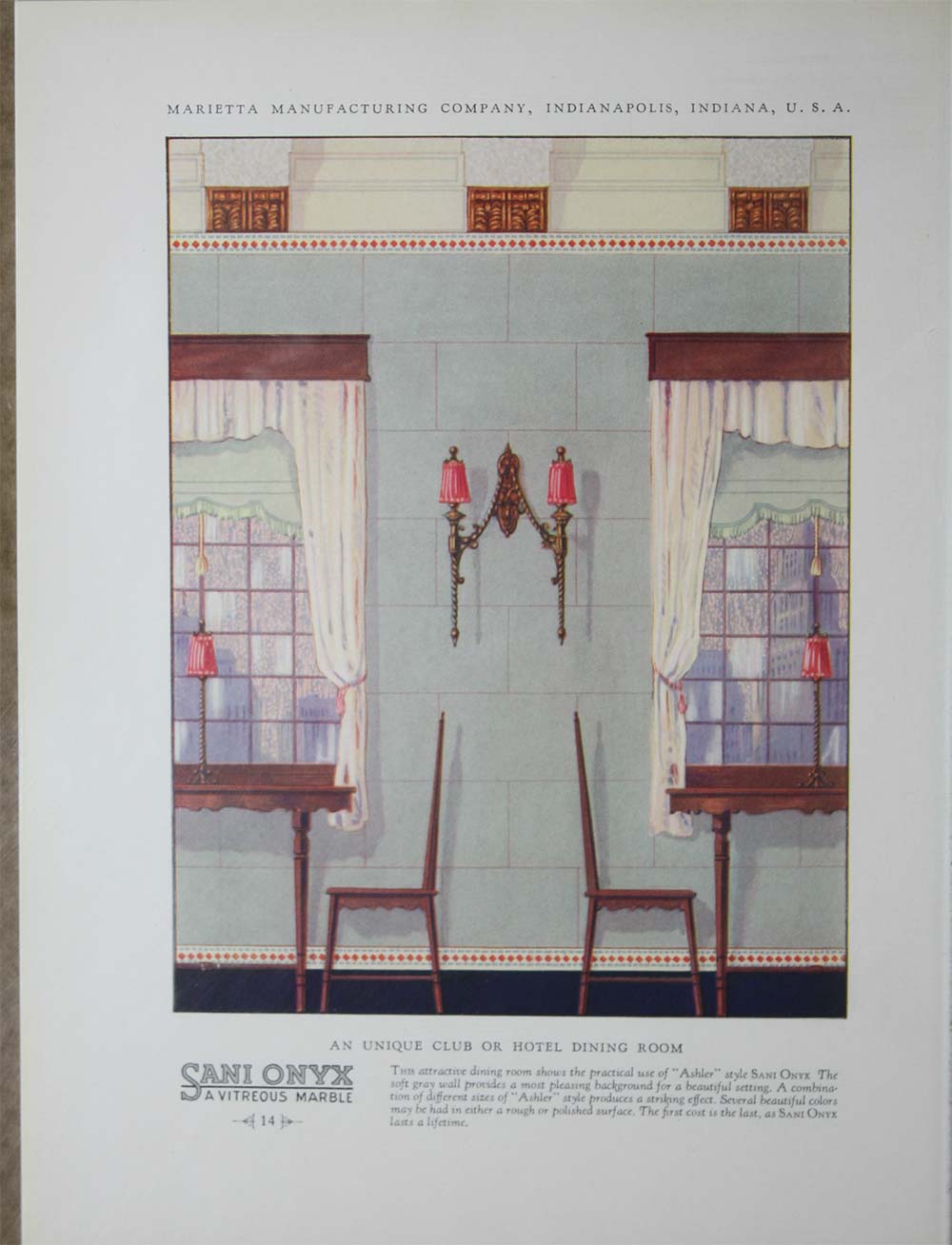
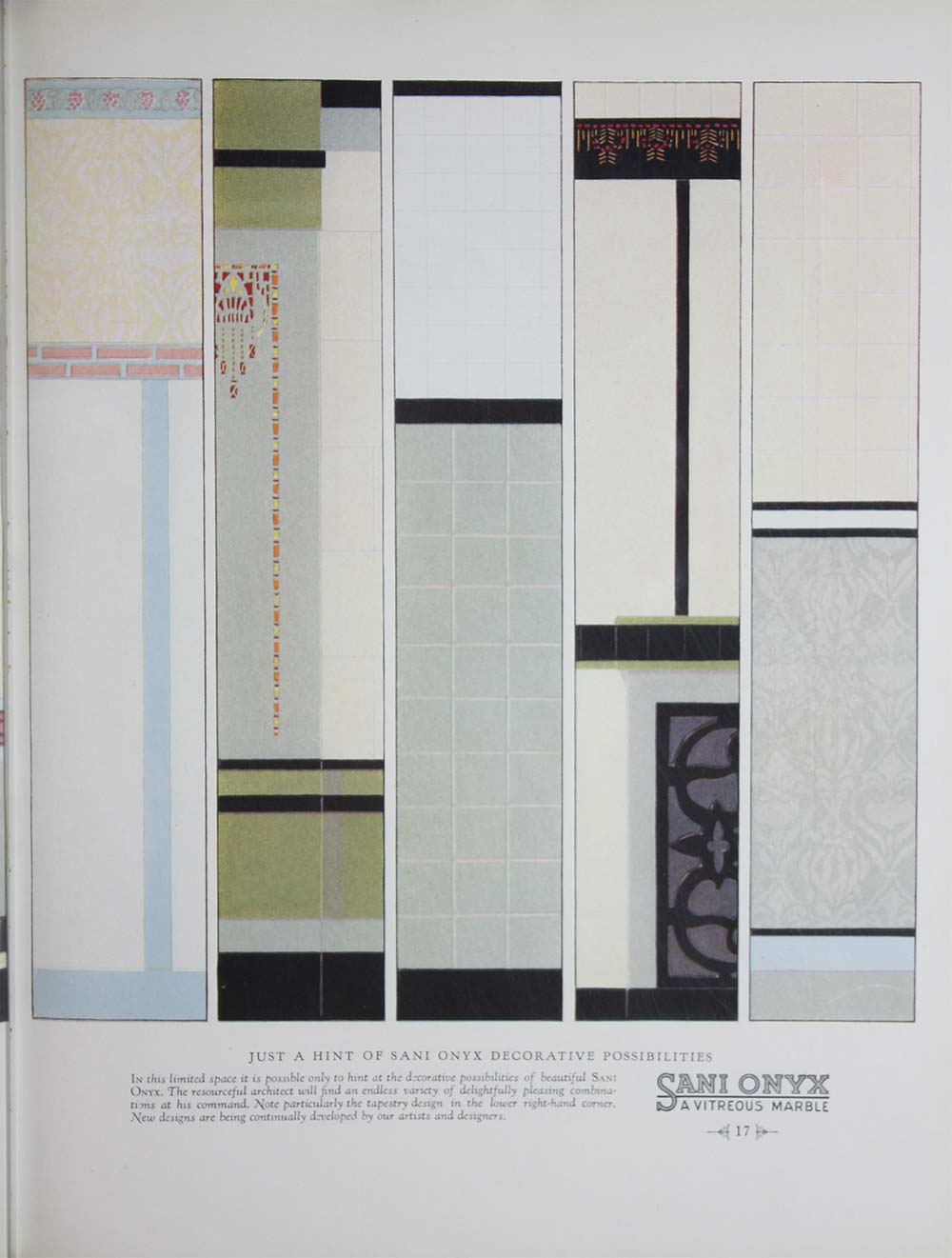
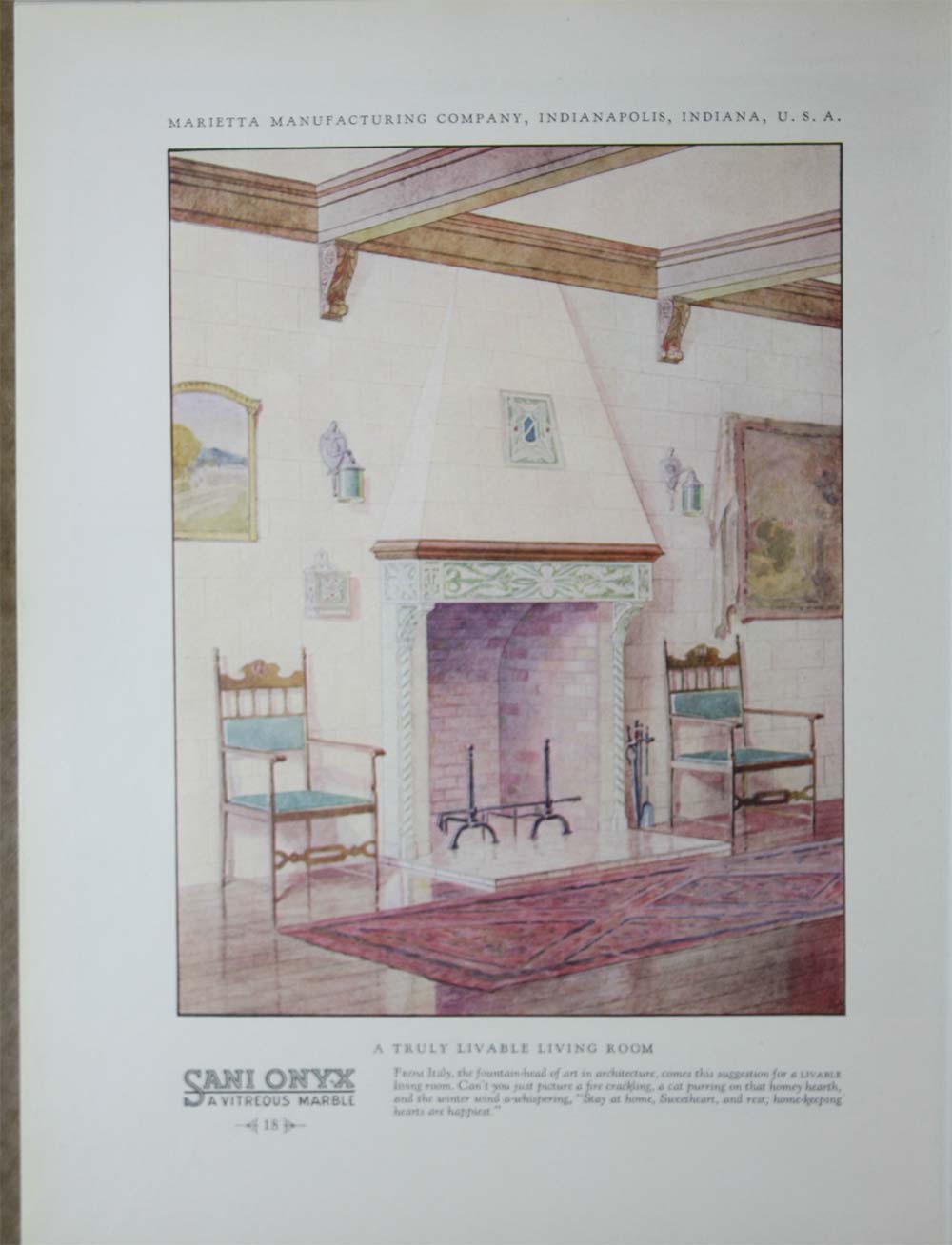
 We get inquiries all the time from readers wanting to know more about their large size, pre-war glass wall tiles, so Pam sent me on a hunt through the vintage catalogs of Archive.org to see if I could find some examples. I didn’t find glass tiles, but I uncovered this Sani Onyx vitreous tile — a possibly rare(?) glass tile made from fused rock bu Marietta Manufacturing Company of Indianapolis. Sounds like the pre-war version of solid surface countertops to us. Readers, have you ever heard of this before?
From the catalog:
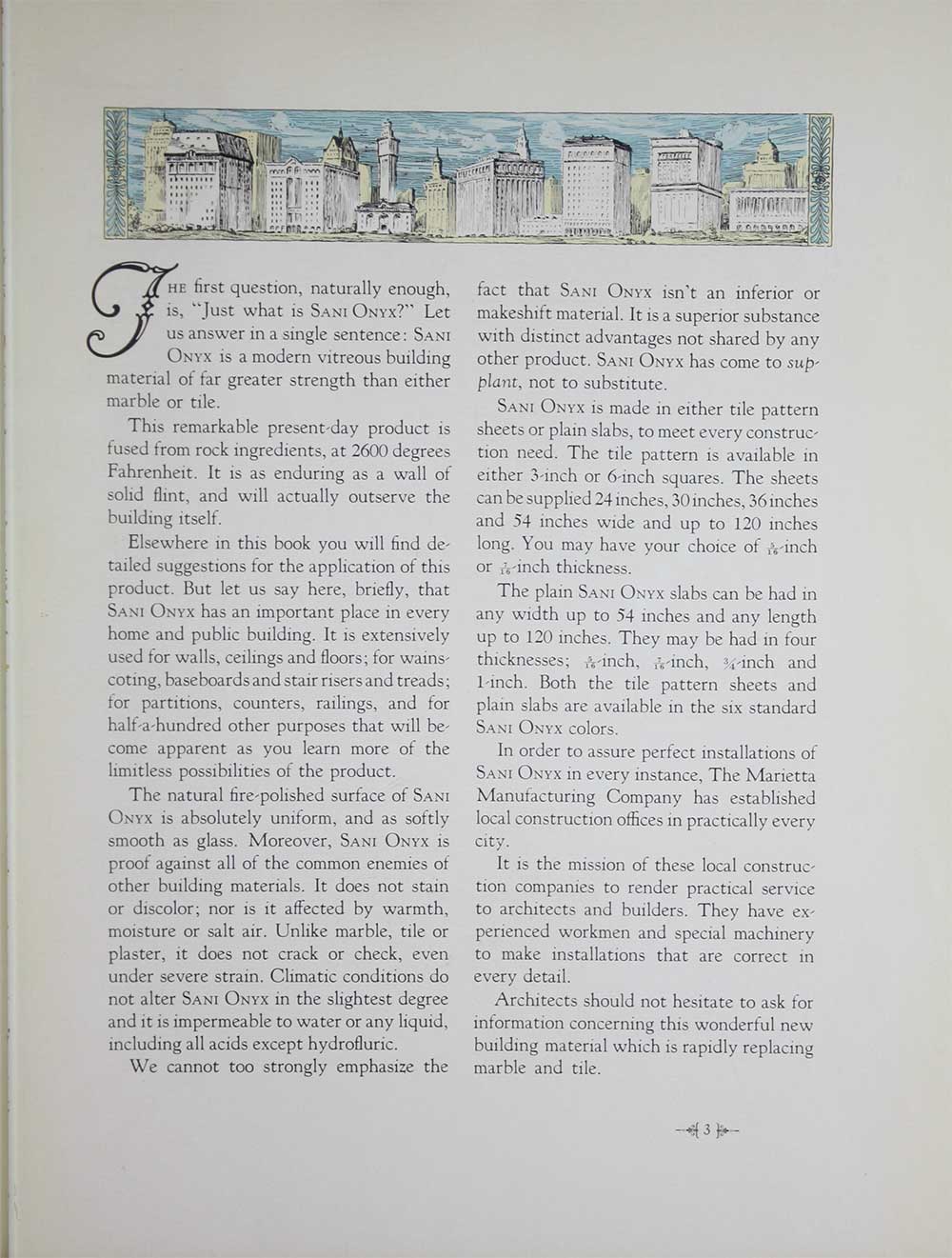
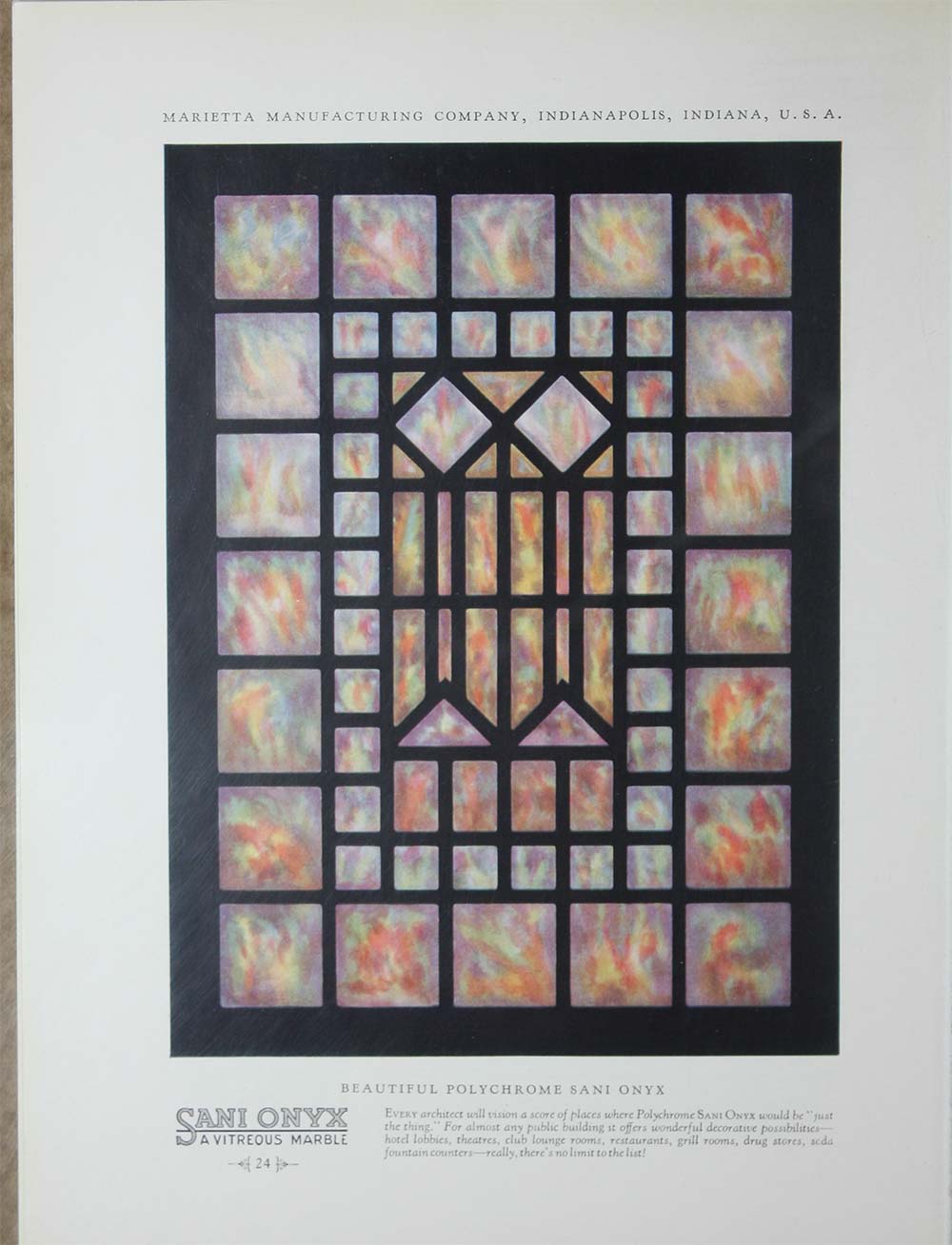
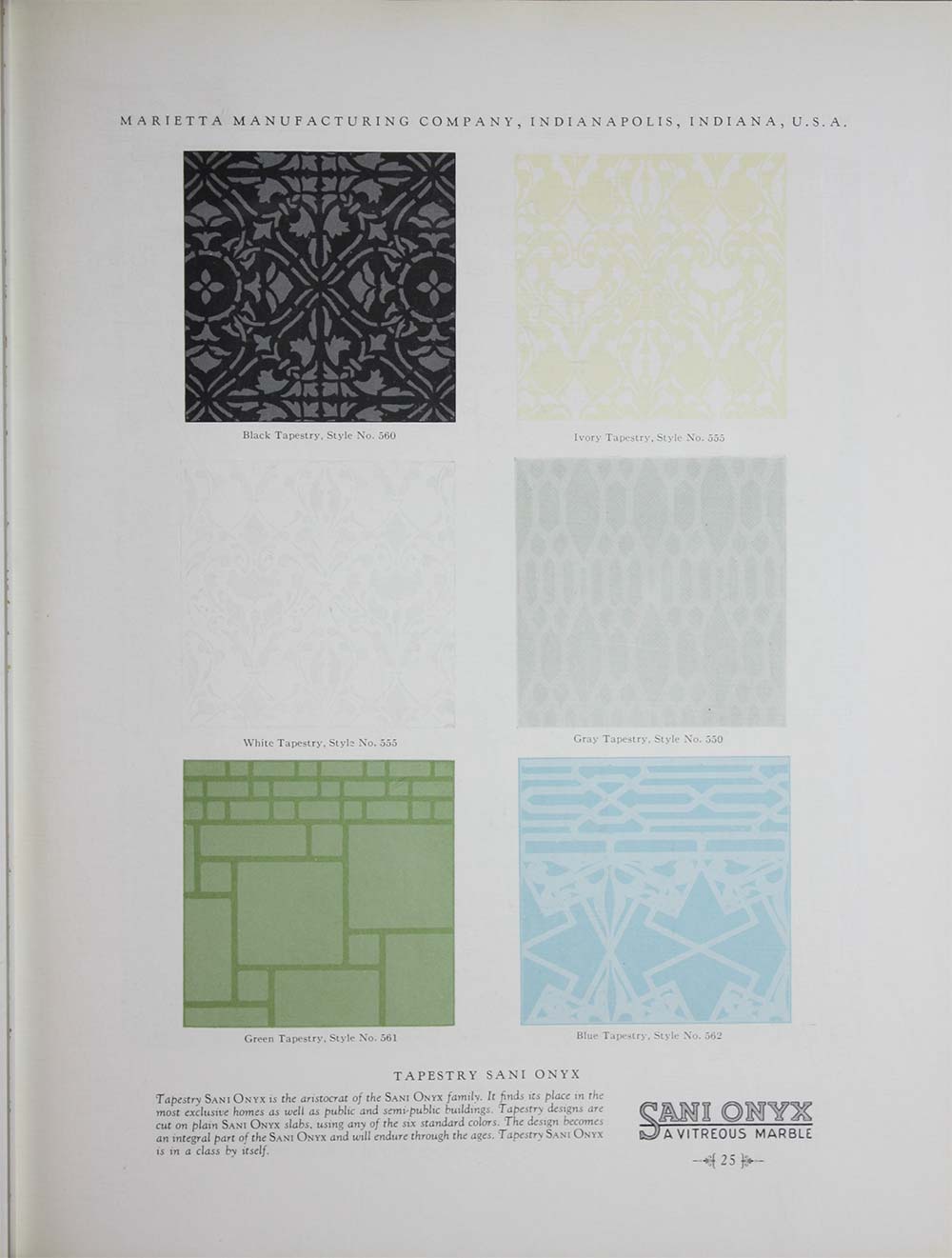
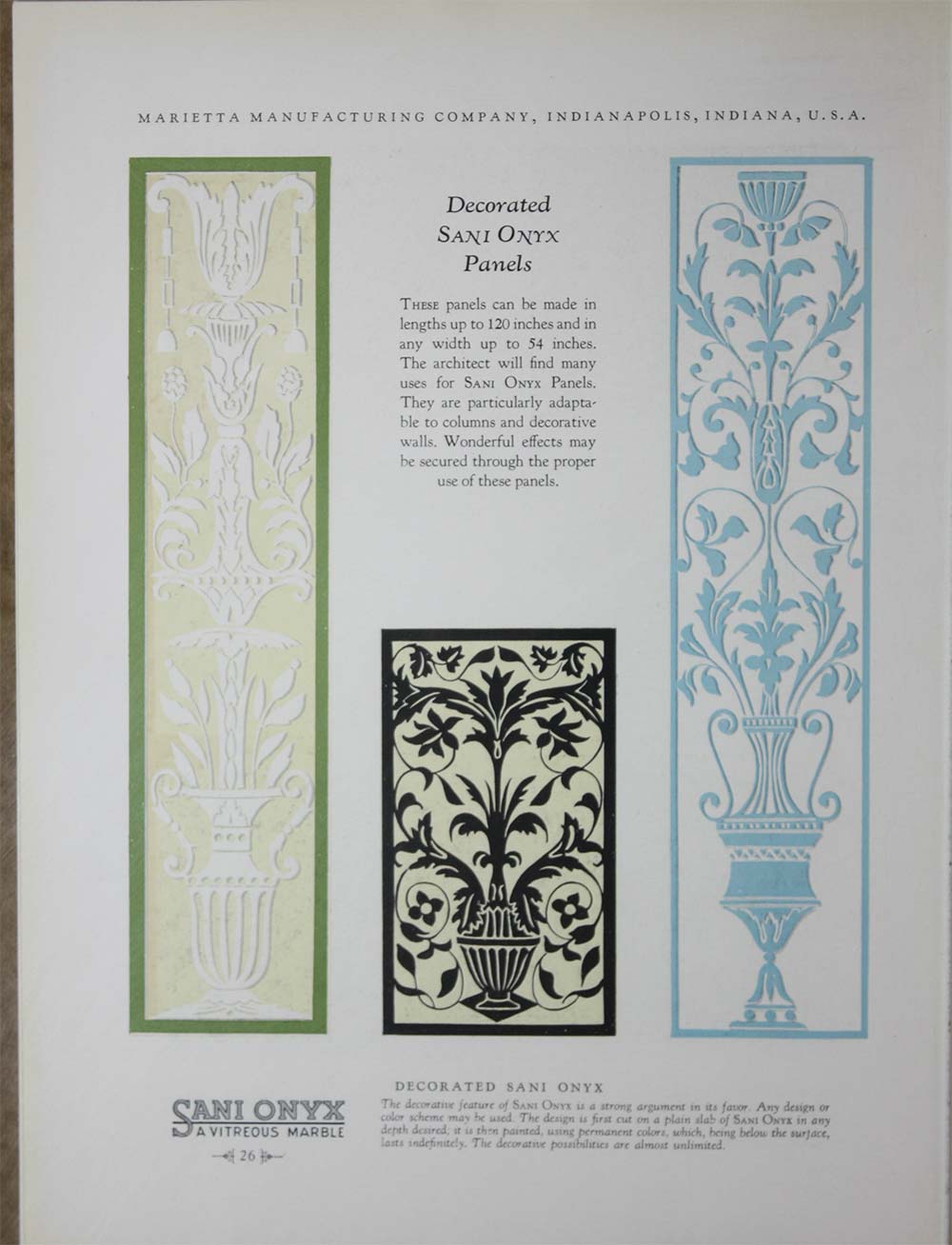
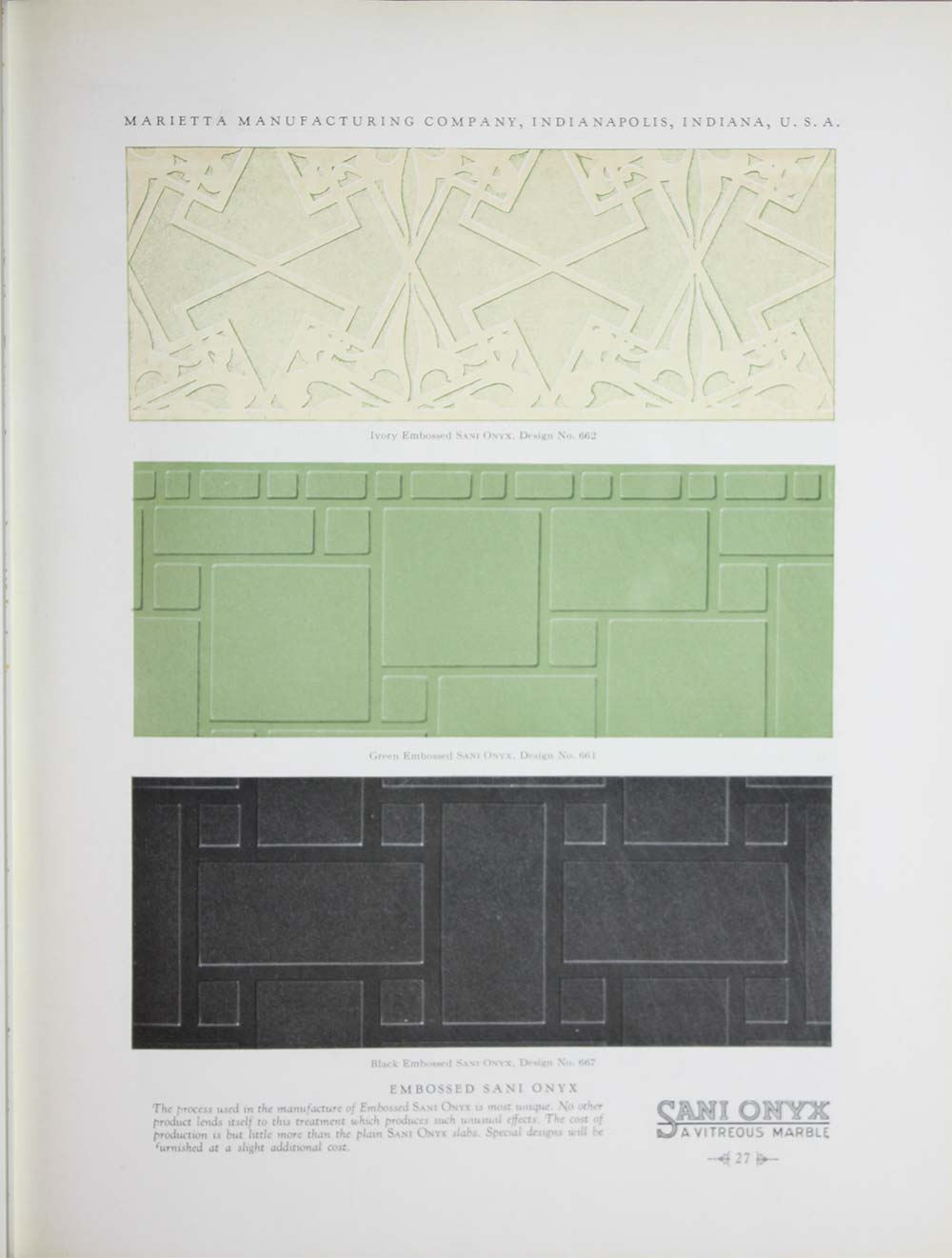
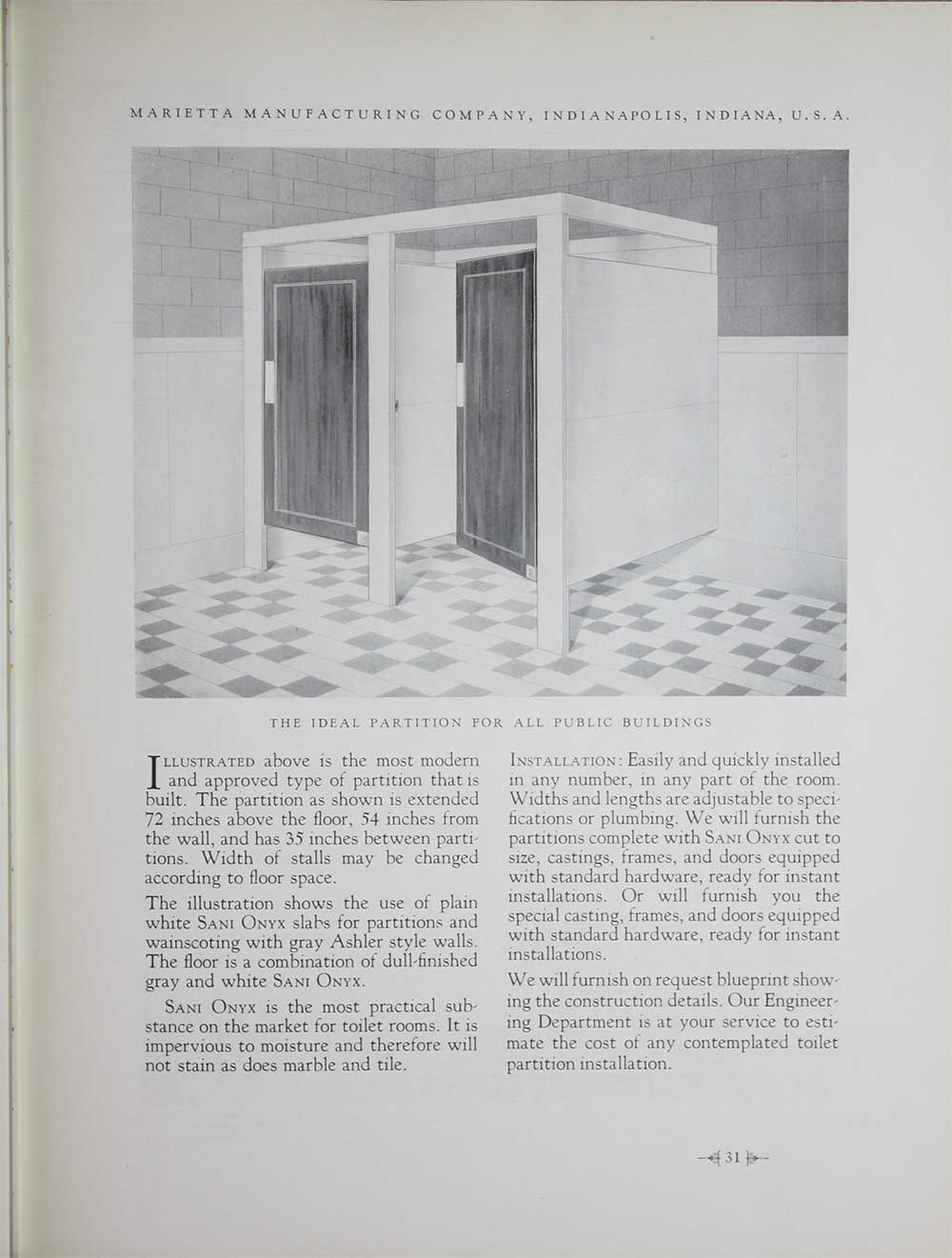
Sani Onyx is a modern vitreous building material of far greater strength than either marble or tile. This remarkable present-day product is fused from rock ingredients, at 2,600 degrees Fahrenheit. It is as enduring as a wall of solid flint, and will actually outserve the building itself.
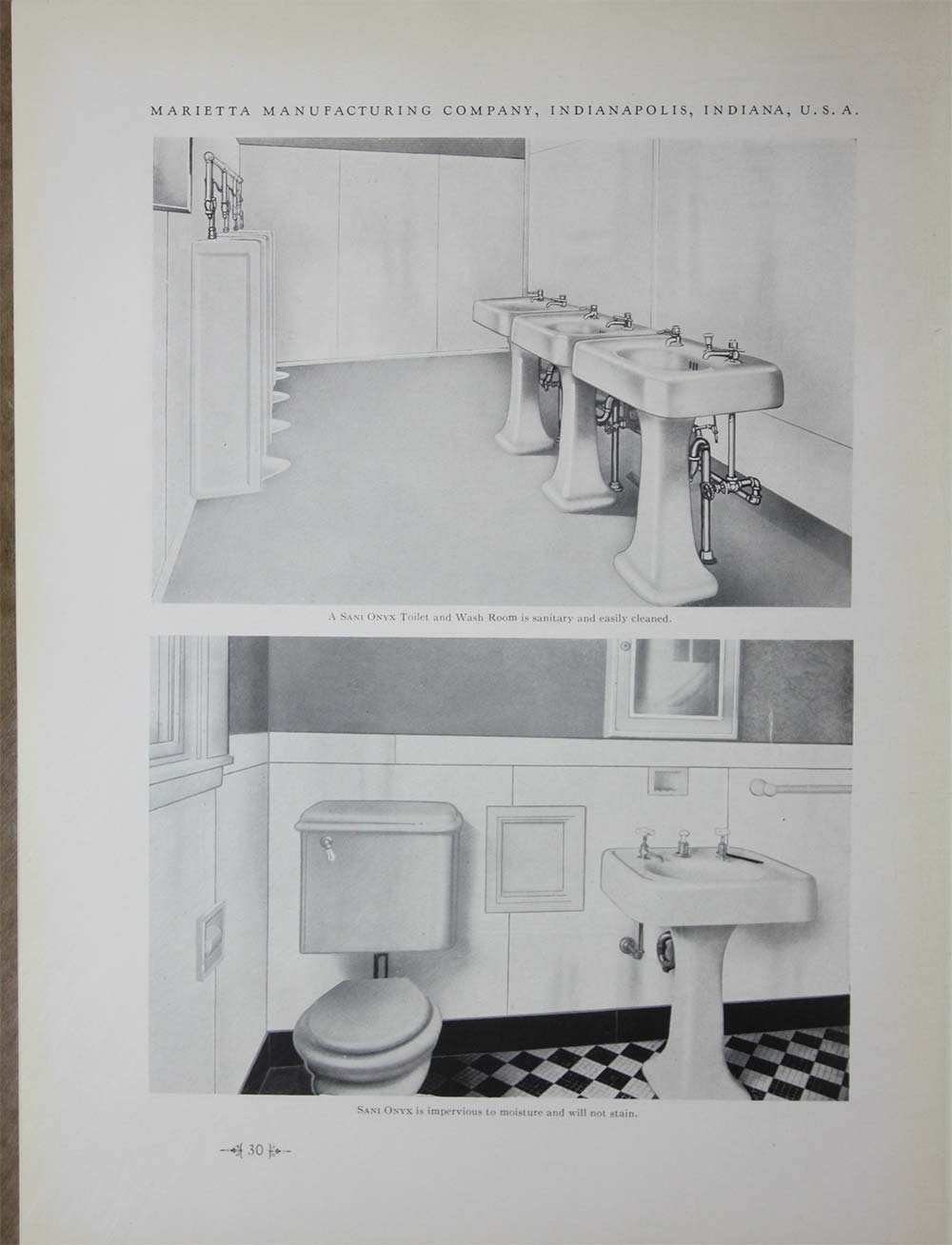
The natural fire-polished surface of Sani Onyx is absolutely uniform, and as softly smooth as glass. Moreover, Sani Onyx is proof against all of the common enemies of other building materials.It does not stain or discolor; nor is it affected by warmth, moisture or salt air. Unlike marble, tile or plaster, it does not crack or check even under severe strain. Climactic conditions do not alter Sani Onyx in the slightest degree and it is impermeable to water or any liquid, including all acids except hydrofluoric.
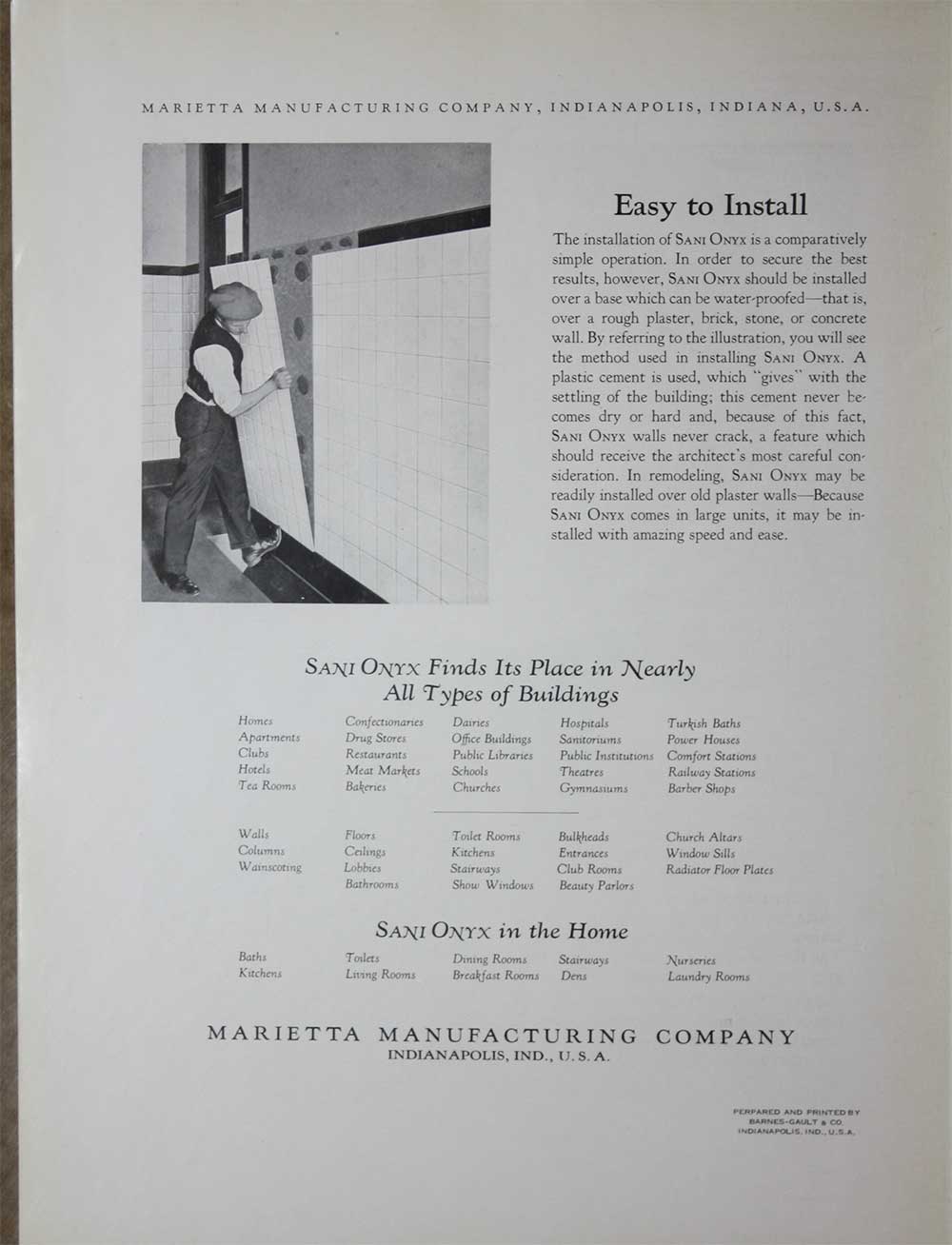
Easy to Install
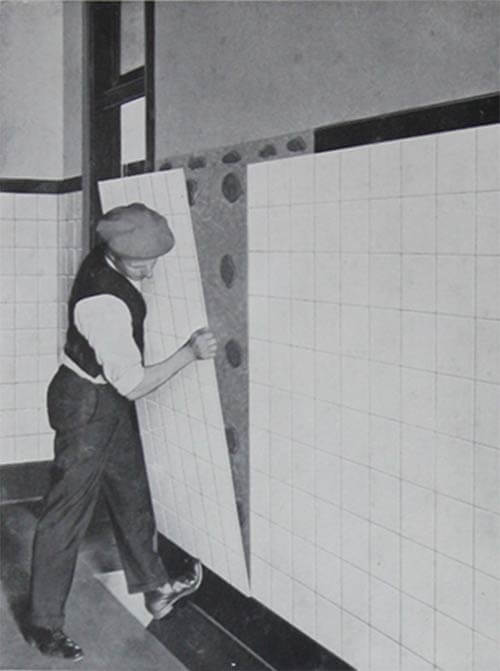
The installation of Sani Onyx is a comparatively simple operation. In order to secure the best results, however, Sani Onyx should be installed over a base which can be water-proofed — that is, over a rough plater, brick, stone, or concrete wall. By referring to the illustration, you will see the method used in installing Sani Onyx. A plastic cement is used, which “gives” with the settling of the building; this cement never becomes dry or hard and, because of this fact, Sani Onyx walls never crack, a feature which should receive the architect’s most careful consideration. In remodeling, Sani Onyx may be readily installed over old plaster walls — Because Sani Onyx comes in large units, it may be installed with amazing speed and ease.
Sani Onyx Finds its Place in Nearly all Types of Buildings
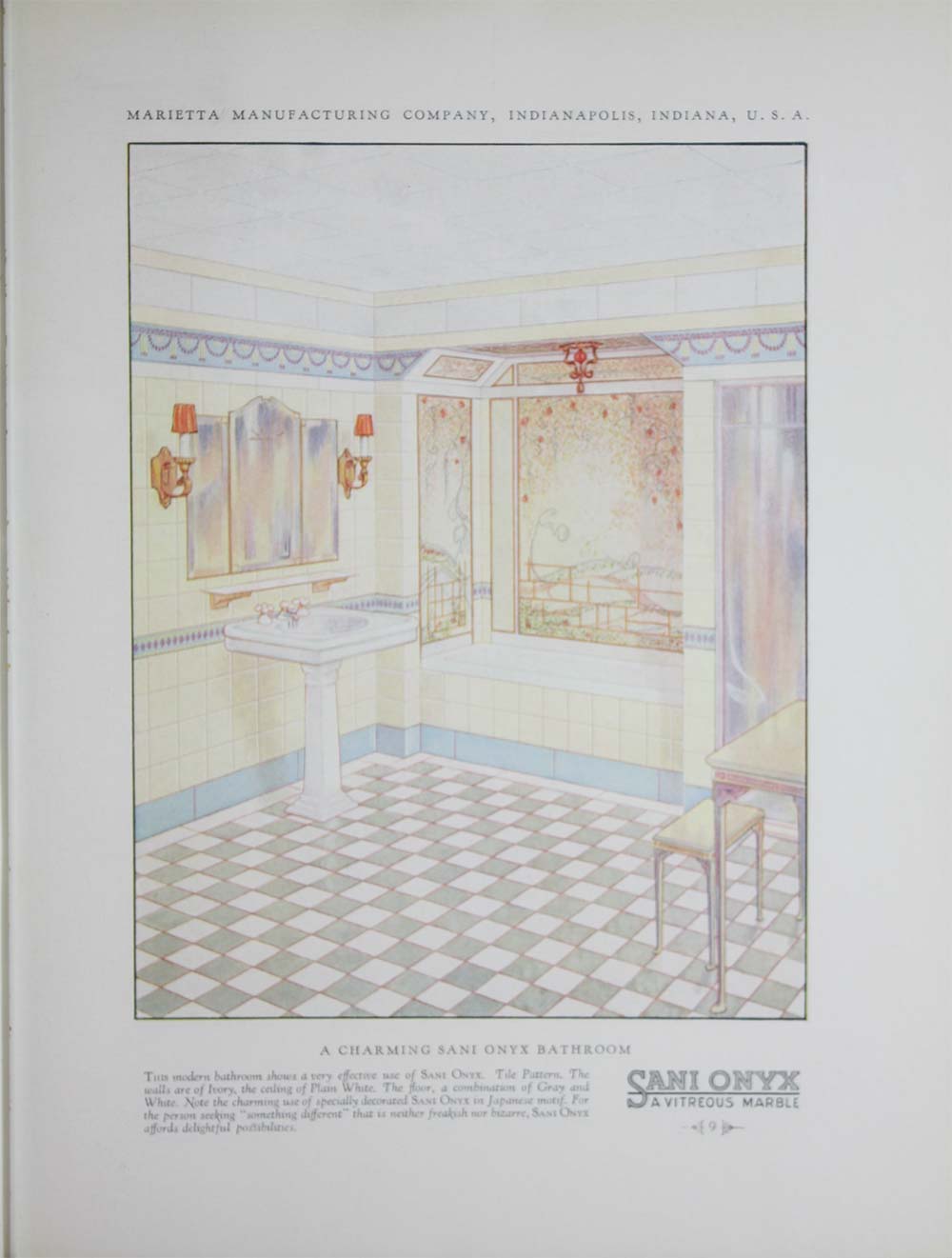
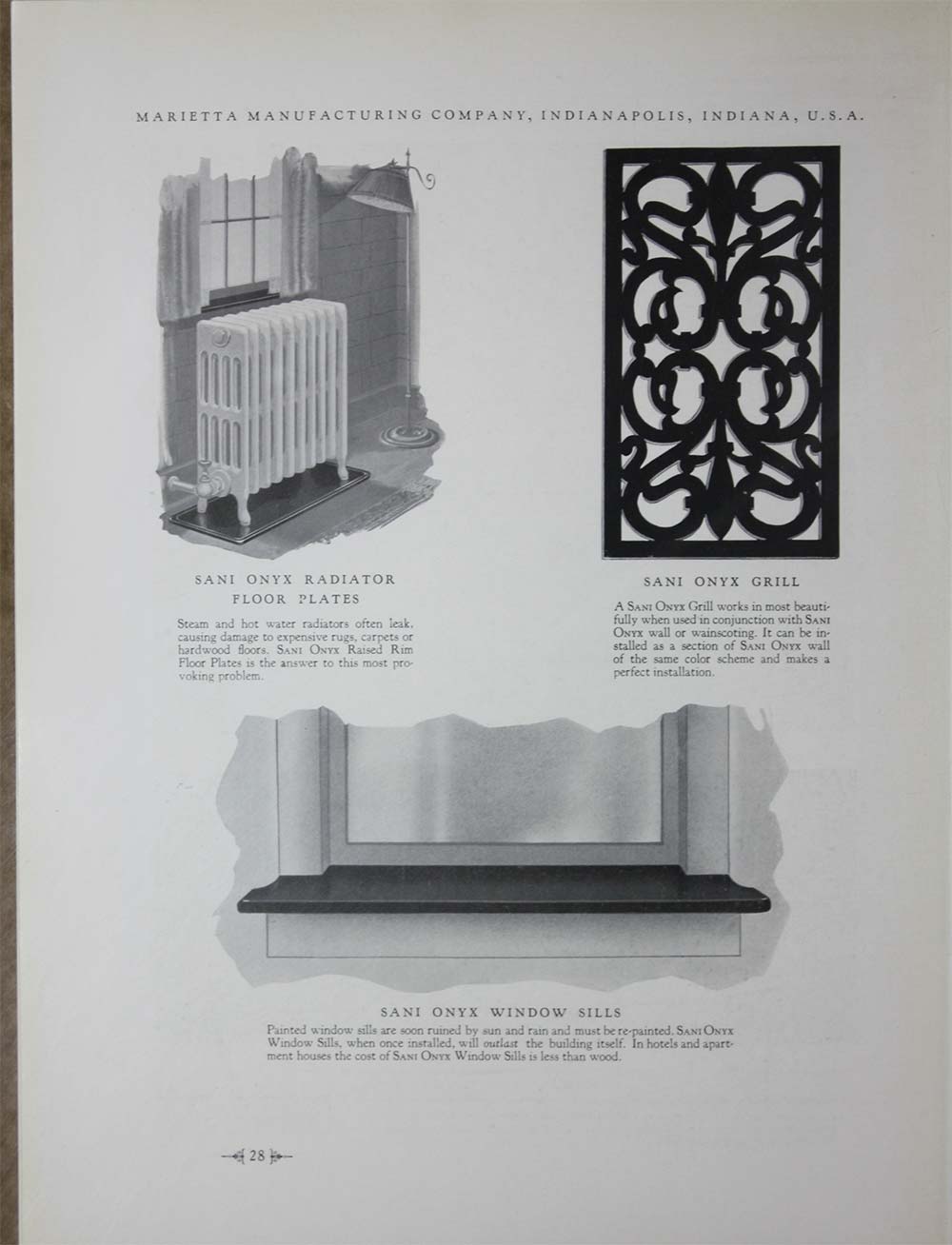
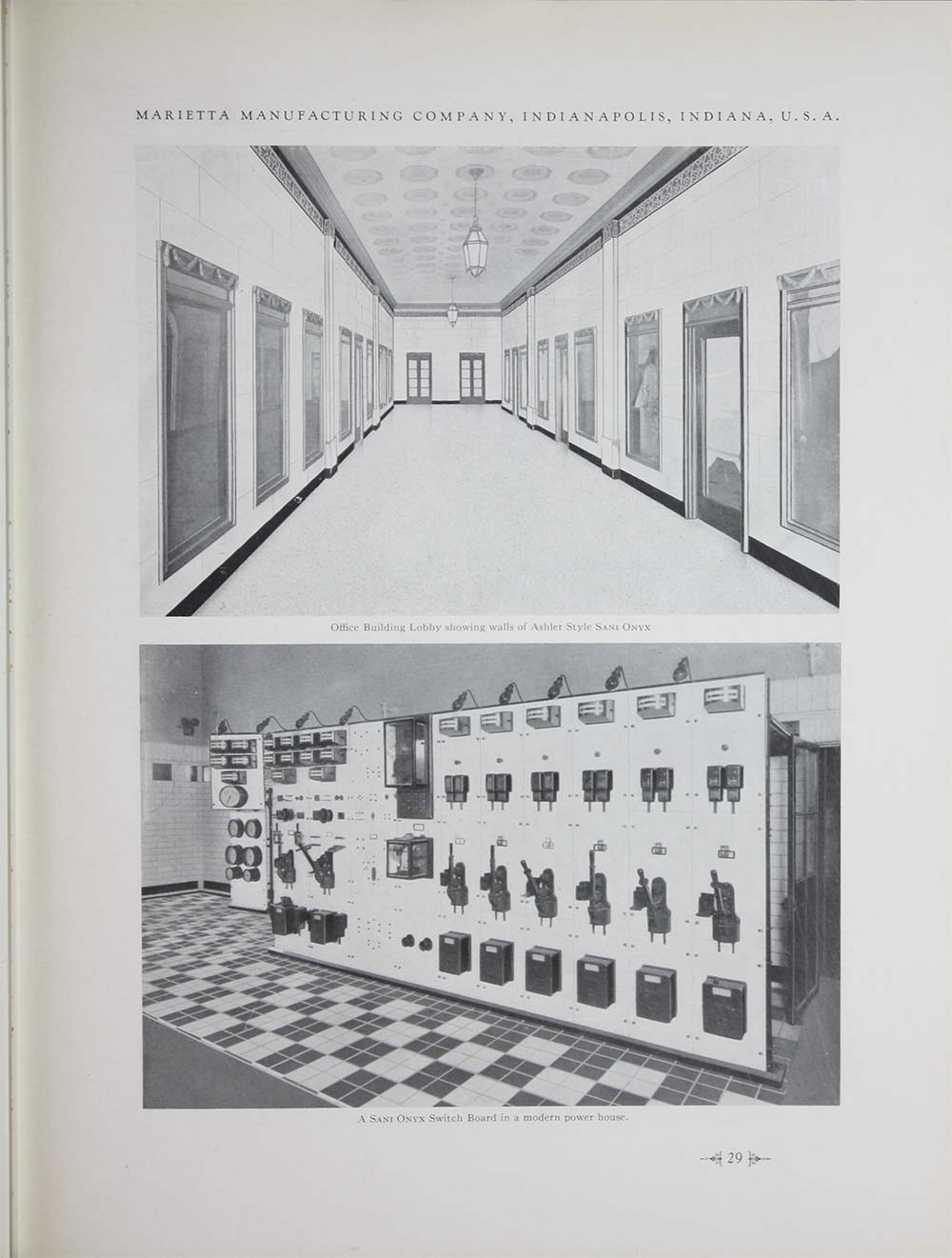
 Sani Onyx was marketed for public spaces as well as residential homes and was commonly found in bathrooms, kitchens, stairways, dens, laundry rooms, nurseries, even living and dining areas.
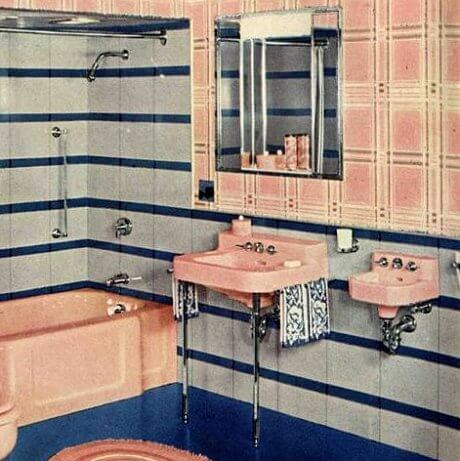
Pam with her broken arm adds: We are accustomed to seeing glass tile today used in kitchens and bathrooms, but it is usually in small mosaic patterns. In the pre-war era, glass tiles were made in these large sizes — Pam believes they were likely quite expensive…sanitary, streamline moderne in style…used in kitchens, but especially bathrooms. In the post-war era, glass tile faded from view in favor of less expensive ceramic tile.
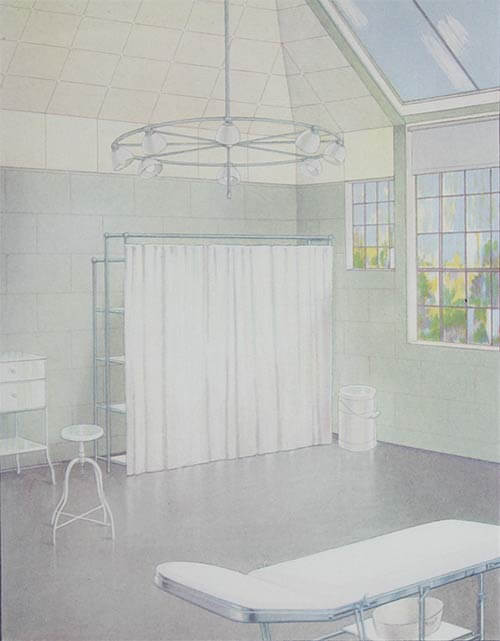
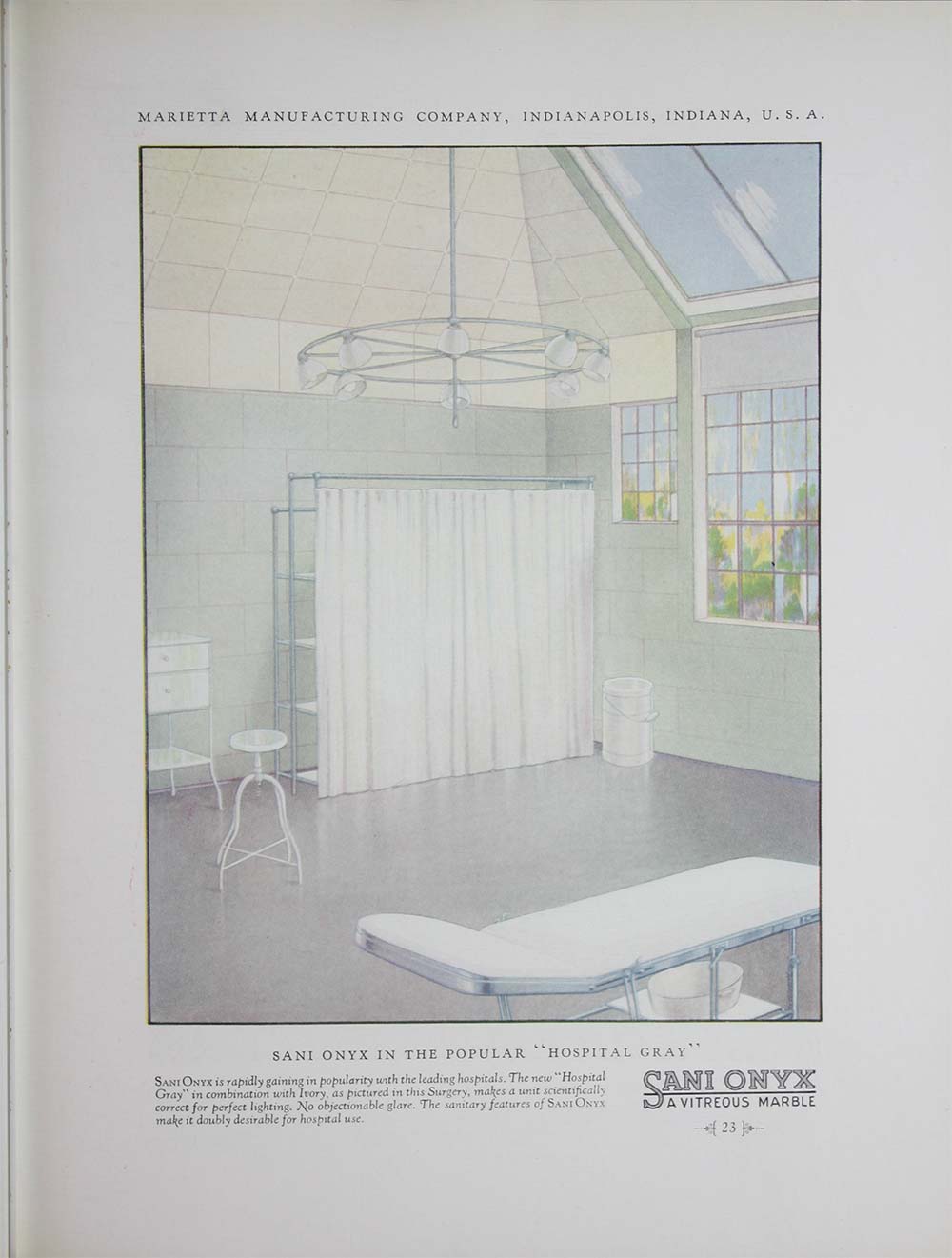
Sani Onyx in the popular “hospital gray”
Sani Onyx is rapidly gaining in popularity with the leading hospitals. The new “Hospital Gray” in combination with Ivory, as pictured in this Surgery, makes a unit scientifically correct for perfect lighting. No objectionable glare. The sanitary features of Sani Onyx make it doubly desirable for hospital use.
Another notable tidbit from this vintage catalog — the popularity of “Hospital Gray,” which was promoted, with “no objectionable glare.” So for all of today’s ‘trendsetters’ decorating their homes from top to bottom in gray, they can take comfort in the fact that their decor is the perfect backdrop for conducting surgery.
A huge thanks goes out to the Canadian Centre for Architecture and Archive.org for making this vintage catalog available.
Readers: Does anyone know more about this material?
Is fused rock the same as glass?
Tips to view slide show: Click on first image… it will enlarge… move forward and backward via the arrows on each photo… you can start or stop at any image:







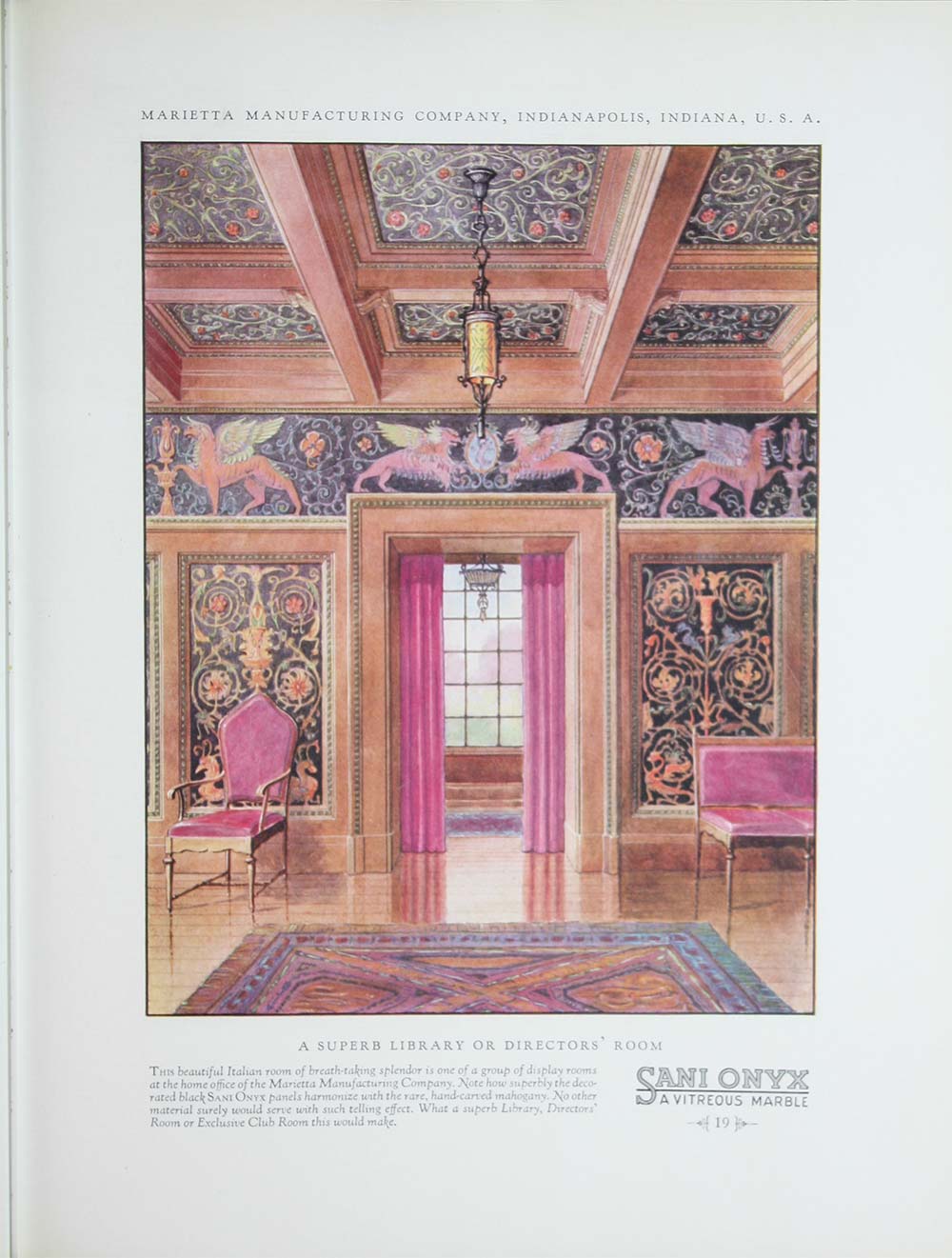
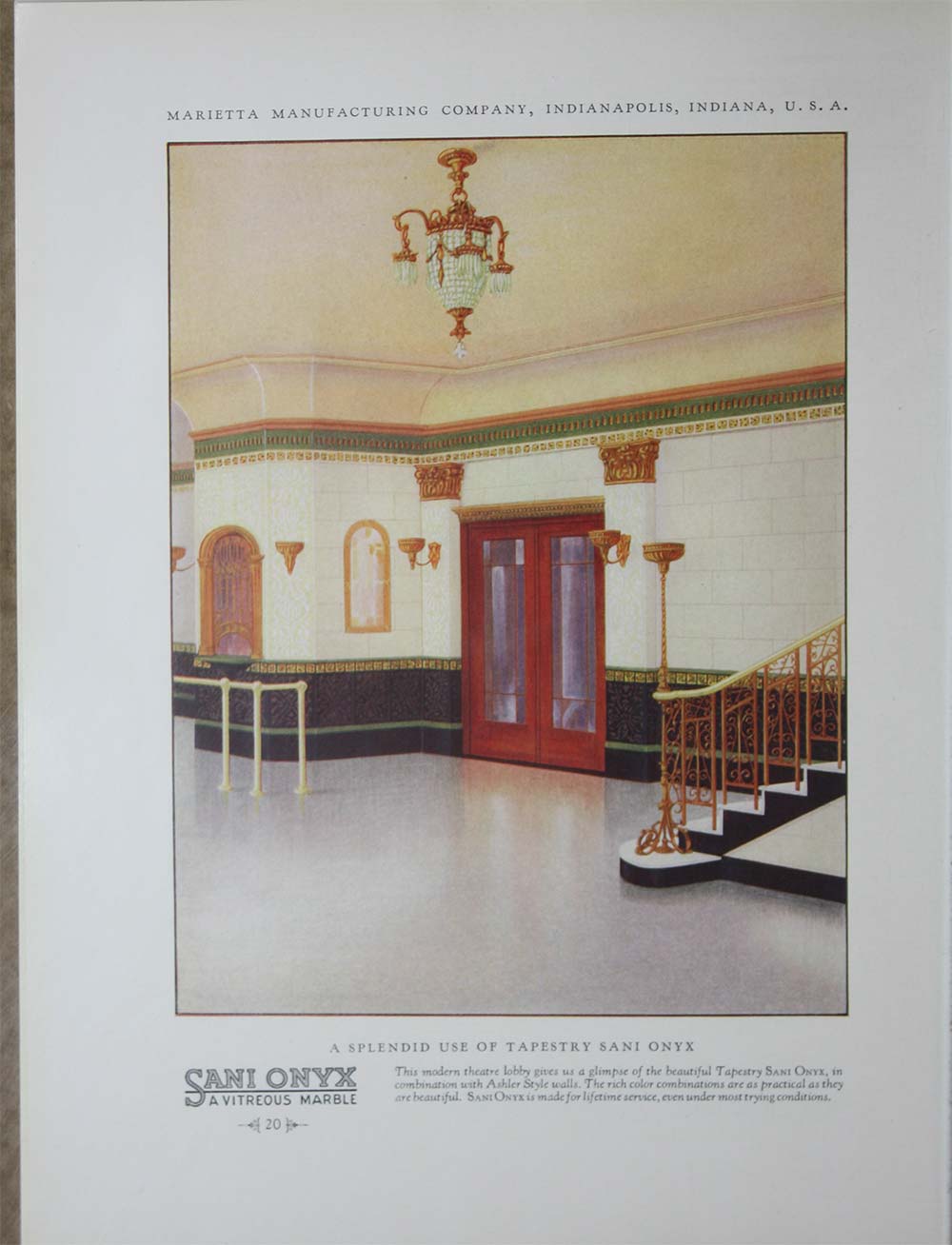
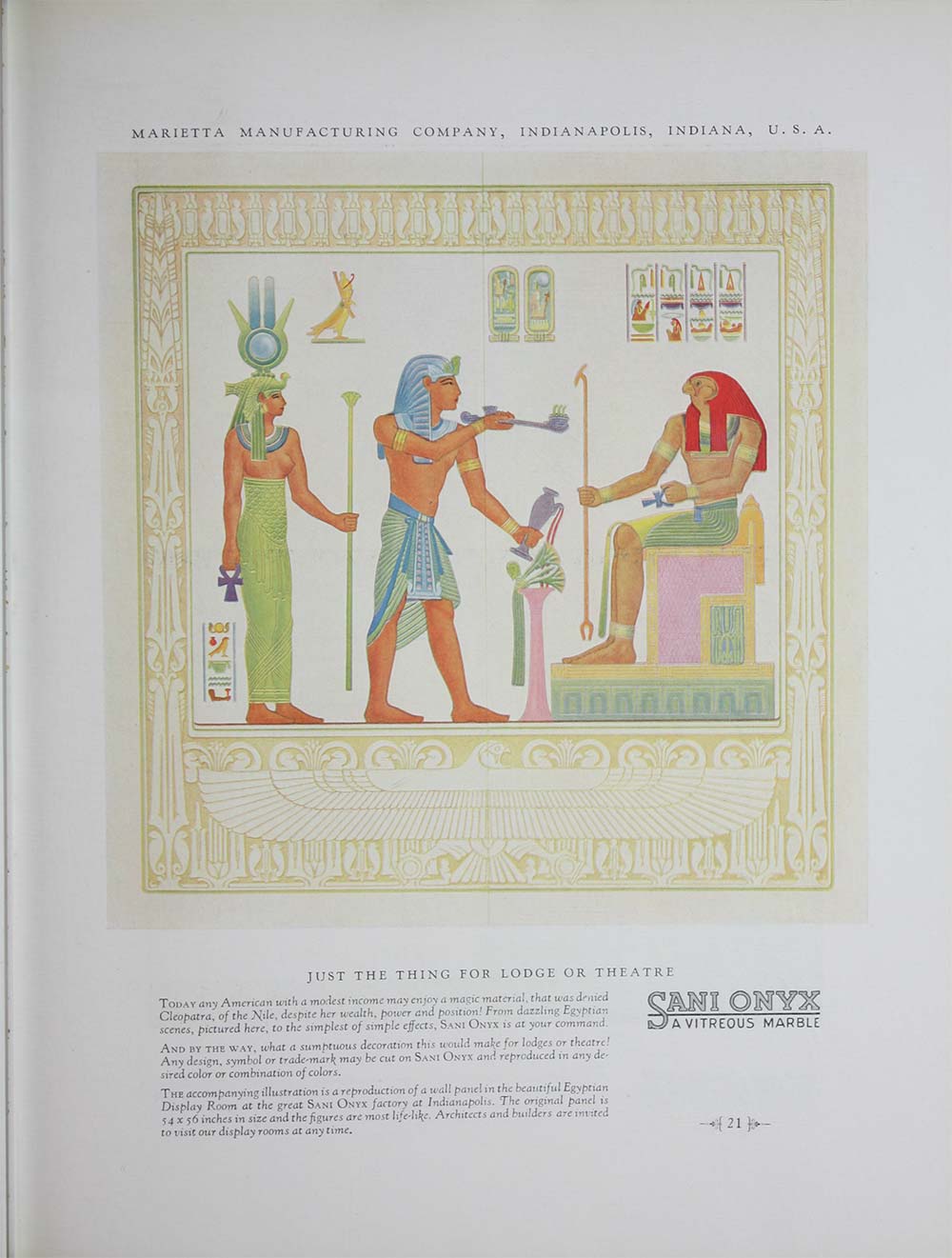
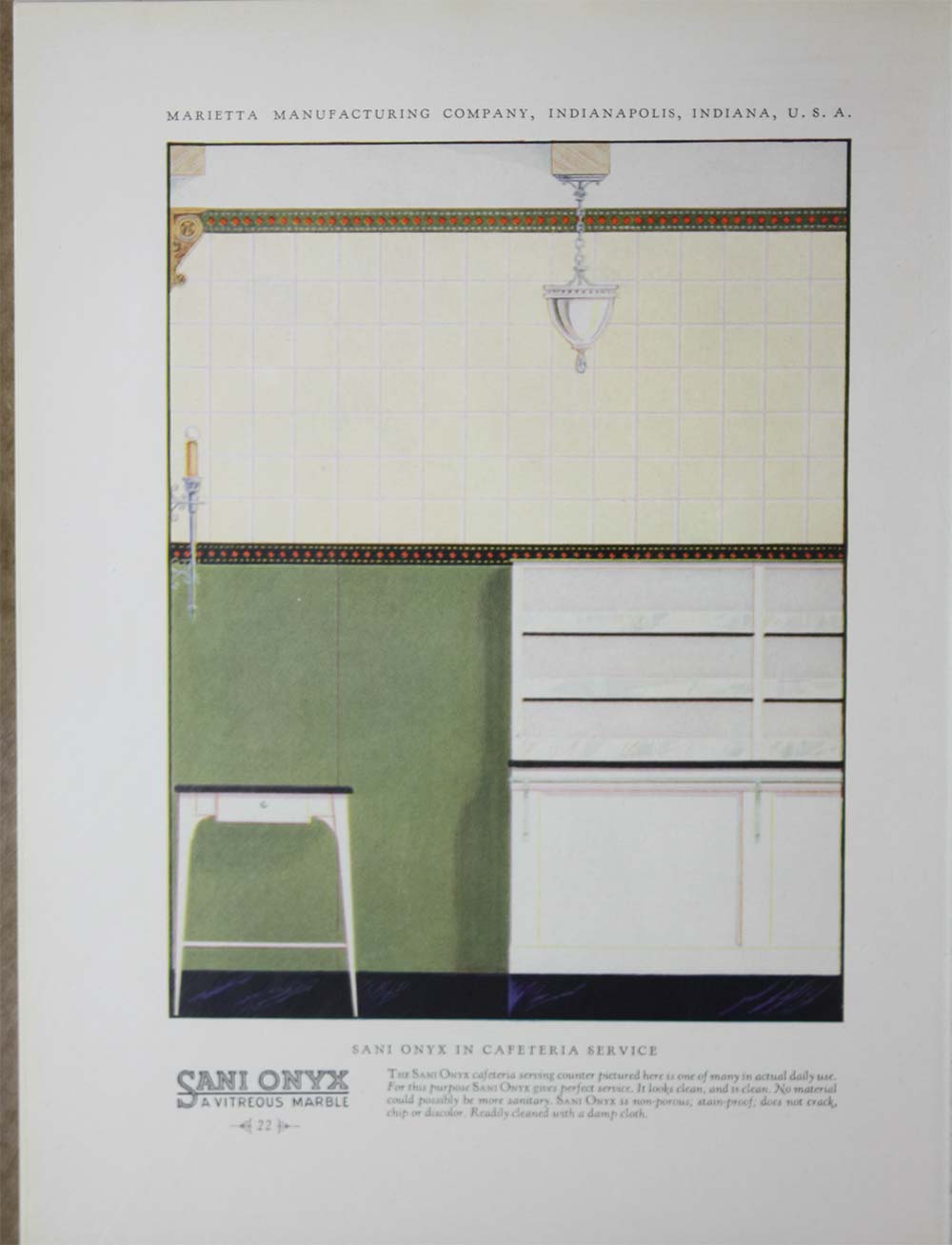





Nan says
If you want an really nice look, we did a bathroom for my boss using a technique our architect remembered from visits with her grandmother in her 1930s house.
The shower stall is large pieces of glass that are painted on the side that goes against the wall. Each wall is a single piece of painted glass epoxied to the wall and a slate floor. Clear grout/pointing. We did it exactly the same color as the walls, so when you look in it looks as if there is nothing there, but you could pretty much do anything you wanted. It’s incredibly clean and modern looking….but fits a retro bath. Squeegee off after a shower and you’re fine.
Heart says
What a great idea, Thanks for the tip!
Natalie says
So I was super intrigued by this and wanted to see if the company was still around. Apparently, they got into big trouble with the Federal Trade Commission for marketing their product as onyx/marble!
https://casetext.com/case/marietta-mfg-co-v-federal-trade-commission/
carol says
I love the first sentence of the paragraph that states “Pam with the broken arm says:”. That’s funny!
Cynthia says
This story reminded me of a similar material called “Vitrolite” vitreous panels manufactured in the 30s and 40s, used interior and exterior, in residential applications (baths, kitchens, etc.) and commercial (even as store fronts). I inquired about it years ago, and some is still available, and very, very expensive. Check out this website: http://modreco.com/index.php. This is a company which sells it, restores it, the whole nine yards.
Steve H says
Ohhh, I love the pics of the kitchen with the jade backsplash! So pretty!
pam kueber says
Thanks Tracy, this is Pam with the broken arm so I’m using Siri so I apologize for the typos. I’ll be sure to check out that site – no question I can bet that this sort of tile today made either new or as this company seems to salad, restored, he’s going to be very expending indeed
Ha ha I’m reading the typos now and I think I’ll just leave them as is it’s fun sometimes to see what Siri does dictation thanks
Karin Jeffrey says
Thanks guys, for the Toronto Eglinton subway tile mention, I’m thrilled when Toronto gets a shoutout. I never knew this tile was vitreous glass. There’s even a station with minty Jadeite green tile. The Toronto subway also has a cool Art Deco font that’s been around since the fifties. We moan a lot here about the service interruptions, but it’s so convenient and safe, it’s not even worth it to have a car if you live in the city.
Steve H says
Here in Minneapolis we have a wonderful example of a vintage glass tile interior originally built of the Forum Cafeteria in 1929 ( and sadly now closed).
http://www.atreasuryof.com/2010/08/02/forum-restaurant-bar/
I remember eating here as a kid, and it just seemed like the most magical, transcendant space in the whole world.
tamiam@socal.com says
It really does look magical..gorgeous!
Jacki says
Steve H. I lived in Minneapolis for 5 years while my husband attended UofM back in the ’80’s. How in the world did I MISS this. It’s Incredibly gorgeous!
Susan D says
Steve H, that’s a stunner! Thanks for sharing.
Jacki says
I would love to see a surviving bathroom done in this. Some of those designs are so Art Deco and some even Art Nouveau. I wish I could find some of this NOS.
Sean says
I owned a condo in a prewar building in Philadelphia in original condition. All the bathrooms and maids quarters were done in a half walls of vitro lite. I actually own a ceiling tile from the lobby of the Hadley Dean glassworks company, it’s framed on my dining room wall. Very cool piece
Daryl H. Johnson says
That is so awesome. Could you please tell me how you acquired the tile? I have started a Facebook page for Sani-Onyx. Would it be possible to post a picture.
Robin, NV says
To answer your question, yes technically fused rock is glass. Obsidian is volcanic glass but its cousin, basalt, is not, even though they are chemically identical. The difference between obsidian, a glass, and basalt, a rock, is melting temperature, pressure, and cooling times. All glass is made from silica, which is present in nearly every rock in the world.
Jennifer says
“So for all of today’s ‘trendsetters’ decorating their homes from top to bottom in gray, they can take comfort in the fact that their decor is the perfect backdrop for conducting surgery.”
Hee!
pam kueber says
i was very proud of katiedoodle for that one. you get megapoints, jennifer, for close reading. heheheheheeheh
Kate says
hehehe. 😉
Sandra says
Hence the name, “Sani.”
Anna says
The twelve original (1954) subway stations in Toronto used Vitrolite tile – which sounds like the same thing.
The tile has been replaced in all but one – you can see a photo of them here:
http://en.wikipedia.org/wiki/Vitreous_marble
pam kueber says
That’s a great link, Anna, thank you. So, it’s sayin’ this is the same as Vitrolite and Carrara Glass.