You know I do love my Royal Barry Wills’ houses. This one has a wishing well, a cupola with a cricket, a knotty pine den and Early American kitchen wallpaper. But best of all: the sweetest ever vintage street sign. Will the list of things I find to covet never ever end? Good job on the real estate agent who included this photo in the listing.
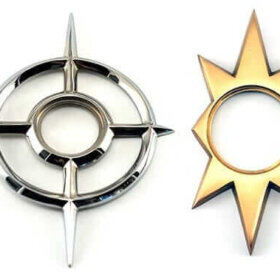
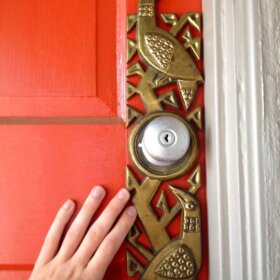
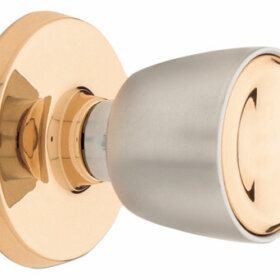
This is a major find: Many readers are hunting decorative vintage doorknob backplates, formally known as escutcheons. Now, it seems that Liz’s Antique Hardware has scored some major inventory, and is featuring it all on ebay. Heck yeah there is more →
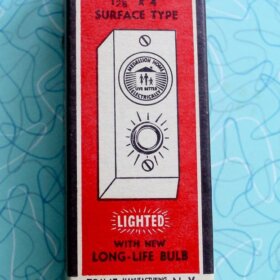
Missouri Michael over at Cul-de-sac Shack is now entered into our reader of the year contest for this fantastic find: The Peek-O Revolving Home Viewer — also known as a “peep hole” or more formally as a “door viewer.” What a wonderful story about determined sleuthing:
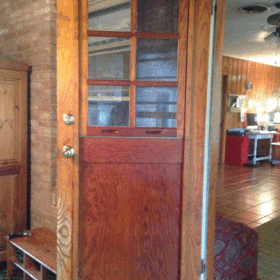
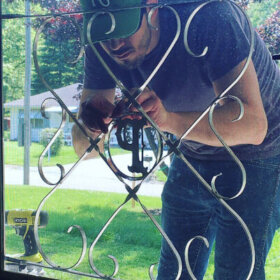
Michael showed his cool front door on his blog. Folks asked about the peep hole. He disassembled the whole thing (the “hole thing” get it? tee hee). He found a Patent Number. Went online to the government’s patent website and found the “Peek-O Revolving Home Viewer,” which was patented on Dec. 20, 1949. Then, he did the google thing and found the manufacturer, who still makes Peek-O’s today, 60 years later. Is this a great country or what. Heck yeah there is more →
Elizabeth added a retractable fabric awning to the back of her house about a month ago. She wrote me: “What a difference it will make in my use of the backyard…. Why did I wait so long to do this?? That is the big question.” Thank you, Elizabeth, the awnings — and the garden, especially — look so beautiful, so inviting.

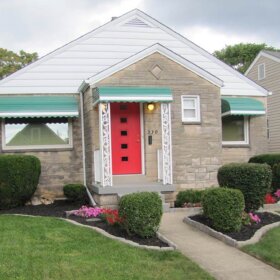
New declaration: We all need aluminum awnings. The are wonderfully decorative. They are authentic retro. They will help your pinch pleats resist sun rot. And if you have any heat beating down on your house – they can cut your air conditioning costs dramatically – they’re green! I’ll be doing more research on this topic around where to get authentic midcentury style aluminum awnings today. Meanwhile, the National Park Service has a detailed Preservation Brief all about window awnings, including how to care for vintage ones still on your home. Its focus is principally on historic commercial structures, but it’s still quite useful and interesting. For example, here’s what they say about awnings in the 1950s:
Widely available by the 1950s, aluminum awnings were touted as longer-lasting and lower-maintenance than traditional awnings. Though used on small-scale commercial structures, they were especially popular with homeowners. Aluminum awnings were made with slats called “pans” arranged horizontally or vertically. For variety and to match the building to which they were applied, different colored slats could be arranged to create stripes or other decorative patterns. While aluminum awnings were usually fixed, in the 1960s several operable roller awnings were developed, including one with the trade name Flexalum Roll-Up.
Here’s the link to the NPS Brief. Meanwhile, stay tuned for research on where-to-buy. And of course, I’ll take any help you have to share!