

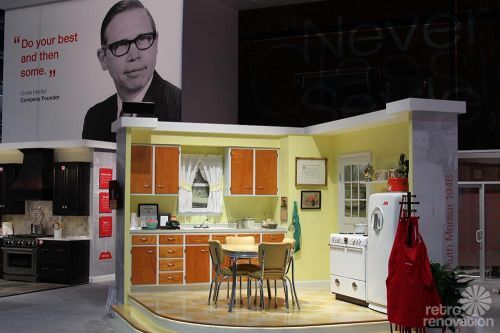
 Here’s another company using its mid-century roots to underscore its brand longevity: At this year’s big Kitchen & Bath Industry Show (KBIS), Merillat assembled a (company)-historic 1946 Merillat kitchen on site. Seems like it was a big hit — I heard about it from several readers and friends. So I chased down the photos, and here they are — a happy sunny vintage Merillat kitchen, classic Americana complete with original counter top and dinette and period-correct flooring and appliances.
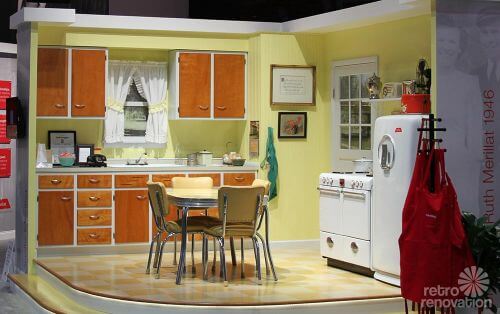
1940s birch kitchen made for the parents of one of Merillat’s first employees
The kitchen has a nice story: The company says that this was one of the first kitchens that founder Orville Merillat built — by hand, no factory yet! — when he launched Merillat in 1946. His wife Ruth Merillat stained and finished the kitchen. (I tend to believe the original finish was all wood — that is, the cabinet boxes were stained, not painted. The company is trying to confirm this for me.)
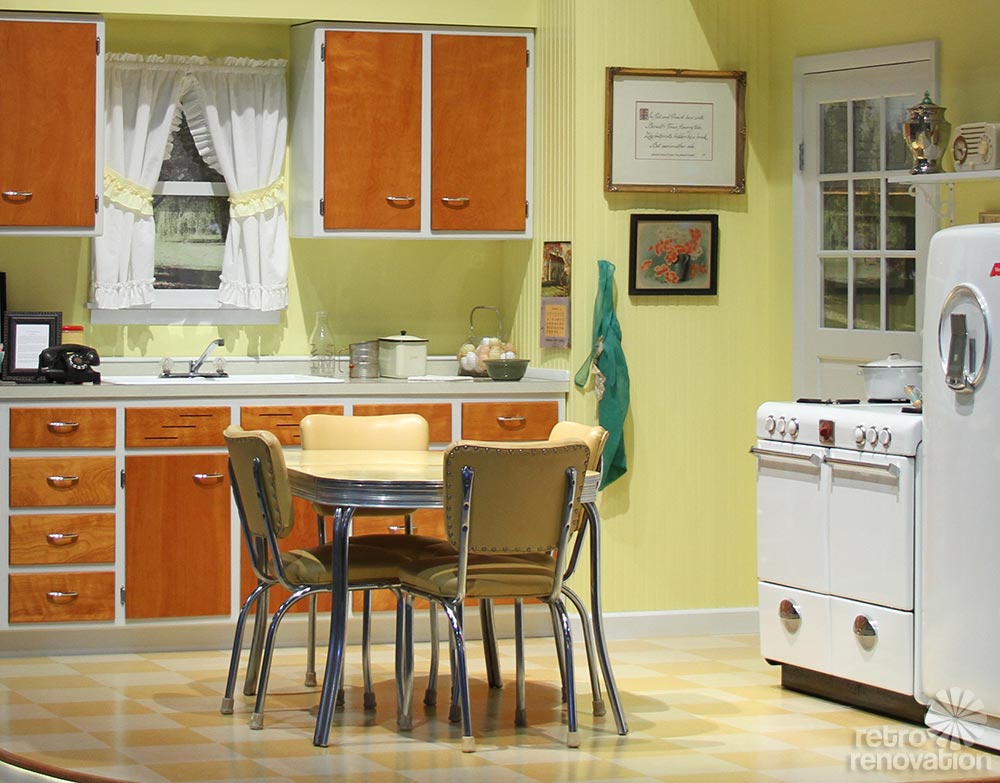 Orville and Ruth built the kitchen, made from birch, for the parents of the company’s first employee. It remained in its original home — located in Adrian, Mich., where Merillat was founded — for decades. In 1996, as the company was approaching its 50th anniversary, Merillat employees located the kitchen, purchased it from the homeowners, removed it, and gave the homeowners new Merillat cabinets. They then reassembled the 1946 kitchen and presented it to Orville and Ruth as an anniversary gift.
The company says the appliances are all from the same time period, but that they can’t confirm whether they are from the original kitchen. The counter tops are original, but are missing the original metal edging.
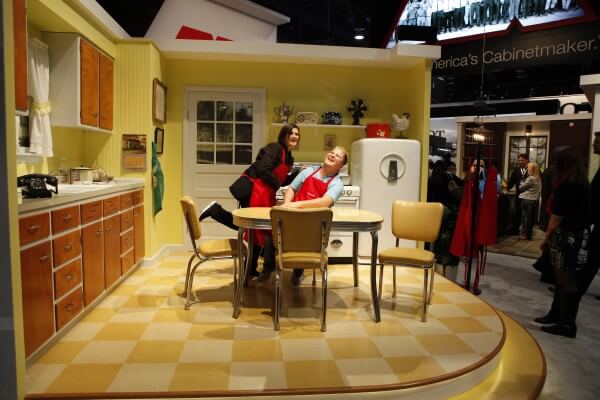 It seems like the kitchen was a big success at KBIS — lots of happy picture-taking going on, in this cheery sunshine-y kitchen. Seriously — you can keep your breakfast-bar-style seating — I will choose a kitchen with a dinette plopped in the middle over the island any day.
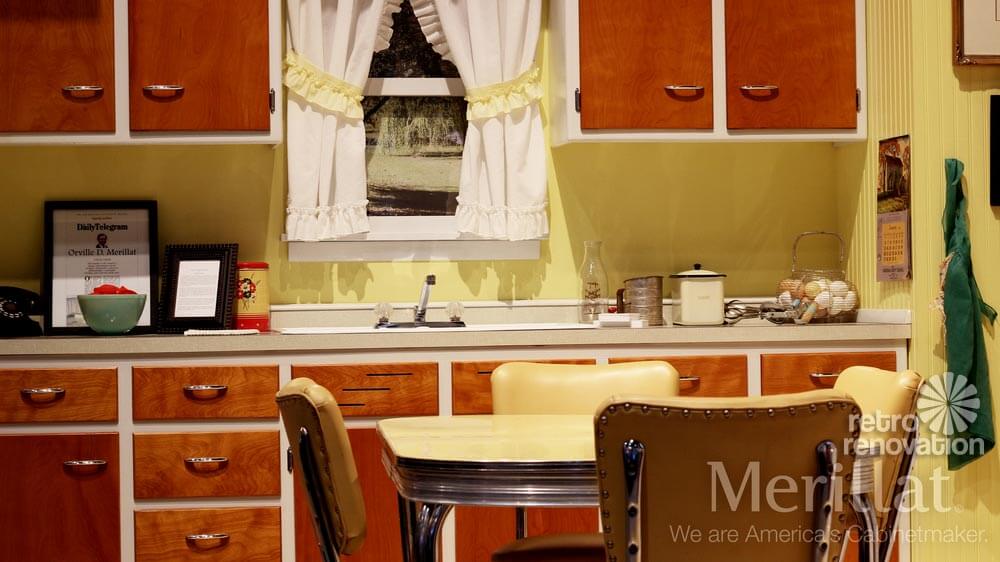
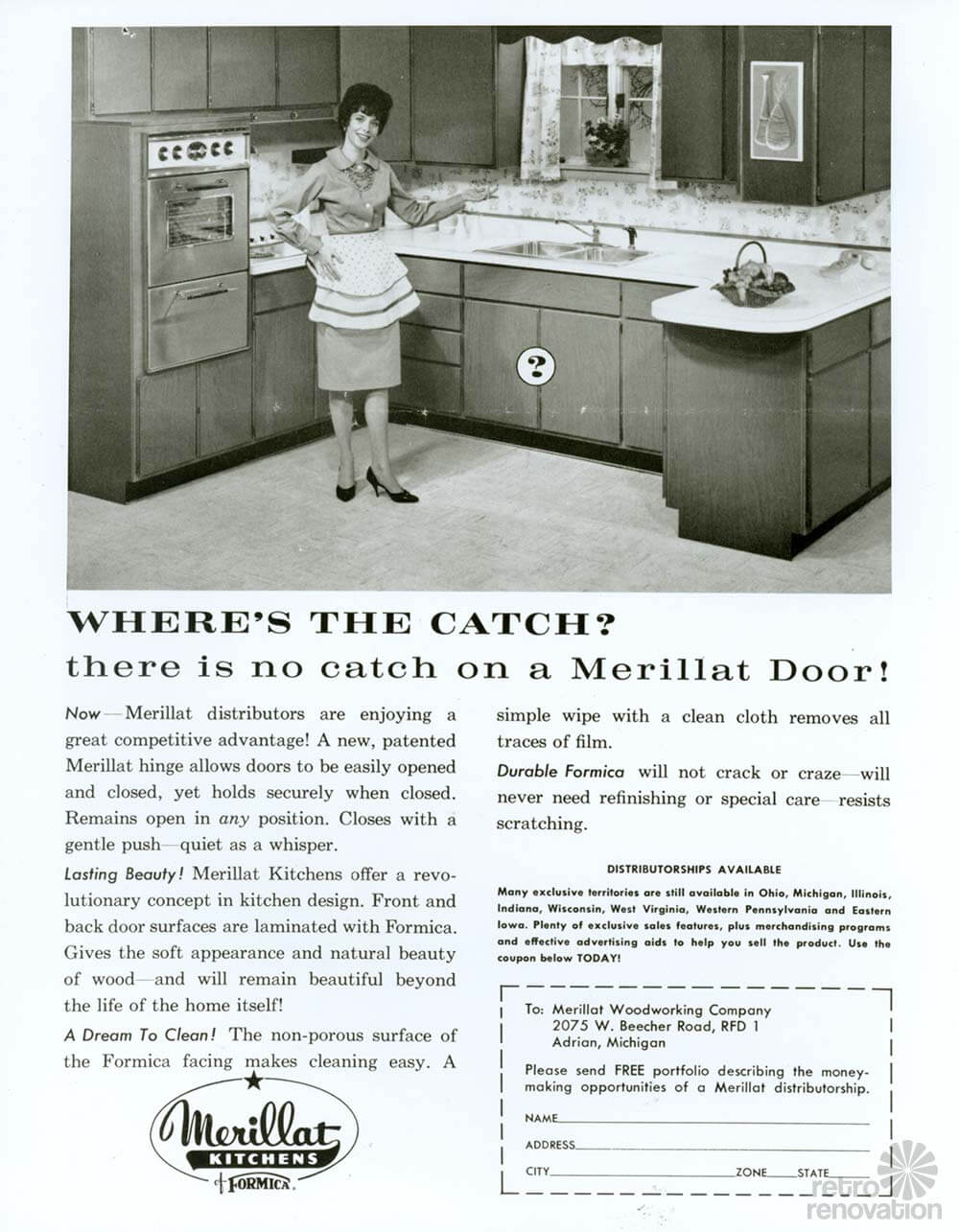
A peek at Merillat history:
- 1940s — During World War II, Orville Merillat enlists in the Coast Guard as a carpenter. He sends $150 from each paycheck to his wife Ruth and keeps $1. This money, along with the sale of Ruth’s 1938 Chevrolet, was used to start Merillat Woodworking.

original Merillat logo, circa 1946 - 1946 — Orville and Ruth Merillat start the Merillat Woodworking Company in a 2,400 square foot workshop in Adrian, Michigan. Fueled by an incredible work ethic and a post-war building boom, the business grows steadily.
- 1950s — Drawing from manufacturing practices popularized in automotive plants, Merillat standardizes its cabinets to facilitate assembly line production. It becomes the first company to use exclusive Formica laminates on cabinetry. Sales break the $1,000,000 mark.
- 1960s — The Adrian plant expands to over 290,000 sq. ft. with a manufacturing capacity of 270 kitchens per day. By the end of the 1960s, Merillat was manufacturing 1,500 kitchens a day, the company says. In 1962, Merillat says, it introduced a patented hinge that allowed cabinet doors to be easily opened and closed quietly with a gentle push, replacing the standard magnetic latch of the time. The company also received a U.S. patent for its injection molding Romance cabinetry line.

The company was first to put Formica-brand laminate directly on to kitchen cabinet doors, it says. - 1970s — Merillat grows to eight strategically located manufacturing/assembly plants. The ability to control materials and manufacturing processes gives Merillat a competitive edge in production and delivery. Merillat becomes the nation’s largest cabinet manufacturer (although on Facebook, the company says it hit this #1 milestone in 1985.)
- 1980s — The successful cabinet business joins Masco Corporation, an industry leader in home improvement and building products. Orville and Ruth Merillat retire.
- 1990s — Merillat pioneers the development of new door styles, including raised panel vinyl clad doors, and the use of premium woods. The company also begins assembling cabinets a kitchen-at-a-time, a manufacturing model which remains in practice today.
- 2010 — The company became part of Masco Cabinetry, which also includes the KraftMaid, QualityCabinets and DeNova brands. The group is based in Ann Arbor, Mich. Today, Merillat remains the #1 selling kitchen cabinet brand in the U.S., the company told me.
Many thanks to Merillat for the photos and for rockin’ the retro at KBIS 2014! And thanks, too, to our reader-tipsters!


9075 says
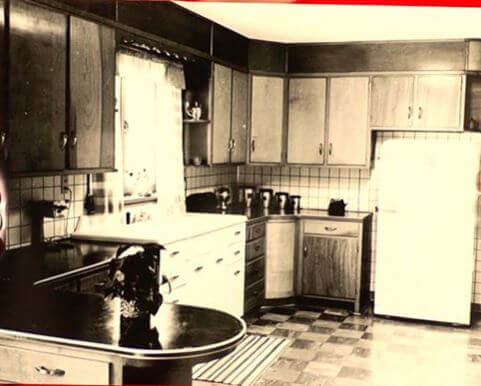
Interestingly enough, the walls in the 1940s B+W photo appear to be covered in the same faux tile wallpaper that originally graced my 1940 kitchen.
Unlike the photo, the paper in my kitchen was only used as a wainscot/back splash to 4′-0″, with regular wallpaper above. It is glossy and heavier grade than typical wallpaper of the period. Does anyone know anything about this product? I have never seen it in any other houses or in advertising from the period.
Luke says
The Merillat company will not confirm if the appliances are original to the kitchen – well, I can say for sure that the Crosley refrigerator would not have been the original in the kitchen from 1946. That fridge is nearly 10 years newer. I’m not putting down the fridge or the kitchen, just wanted to put proper information out there 🙂
pam kueber says
I did not say they “wouldn’t” confirm, I said they “couldn’t” confirm. Thanks for your info!
Cynthia says
Very charming. Many delicious meals were cooked in “small”, modest kitchens like those. And people actually cooked and baked, as in from scratch – usually three meals a day – not just microwaving or assembling pre-cooked ingredients which is what cooking means to many people today. It’s also very cozy to sit at the kitchen table.
Katie says
I love those cabinets, and the yellow paint is so cheerful. For whatever its worth, the remaining original cabinetry in my house is the same shade of birch, and my house was built in 1960.
Jackie says
It does look miniature ! Enjoy it very much though!
PAppel says
OMG!!!! Thank you, thank you for saying you would take a dinetter over an island in the kitchen any day!
I thought I was the only one that felt that way.
elle says
I love this! Is that bead board on the walls? Would this have been used on the walls during this time? My husband and I have been going around and around about tiled walls or bead board.
tammyCA says
Aw, sweet kitchen..at first, I thought it was a miniature. 🙂 Always love reading about the histories.
Amy in Sacramento says
What???!!! Dang it! I was AT that show and missed this!!! It was my first time at KBIS, and there were 3 halls — I was only able to get through 1 with all of the talks I attended. I would have LOVED to have seen that! I hope they’ll be back. It is important to see how kitchens, and how we use them, have evolved.
Sam R says
Lovely kitchen, and a great story as to how the company preserved it as part of their history. However, if they really wanted to be period correct, they would have had to have cut those 12″ VCT tiles down to 9″. 😉
I have to agree with everyone else – the painted cabinet bodies with wood doors do look great, even if the style might be a bit more 1962 than 1946. I’ll have to consider that as an option if I decide to keep the (mostly) original wood cabinets in my 1954 kitchen that have been painted white.
pam kueber says
Yes. 9″ was most universally common. BUT, I think I have seen 12″ tiles in catalogs. AND, in my foyer: 6″ tiles!!!!
Robin, NV says
My ENTIRE house was floored in 9″ tiles – living room, kitchen, dining room, bedrooms, bathrooms, closets . . . My husband and I can’t quite fathom why they did that. I would be OK with it except that it’s not the most attractive tile – tan with yellow and green splotches.
Allen says
OH. I never knew they had 6 inch VAT back in the day. This size would be easy to make with no waste out of the standard 12×12 VCT we have today and would look fantastic especially if you had a smaller area to use it in.
pam kueber says
I guess I should take a photo!
Allen says
Please Do!