by pam kueber on November 5, 2009

Take a neighborhood full of cookie-cutter tract houses … let their owners fuss with them … and 50 years later photographer Julia Baum finds that they have been “transformed from modest white cubes into a vibrant display of personality and present a rebellion against conformity….human individuality cannot be contained. Inevitably it shines through even the most average facade.” I love her study, which demonstrates again that their is so much to love about our jewel box mid-century homes. No matter how small, the opportunity is there to make them our own. Read more about Julia’s project and see her slide show of 13 same-yet-different homes here.
by Dave Stuhlsatz on November 2, 2009

Guest post today from Dave Stuhlsatz, architect with Royal Barry Wills Associates, and my main contact there for all things RBW. I am very pleased that Dave will contribute an occasional article on mid-century architecture, design and related issues. – Pam
The Royal Barry Wills Cape Home
By Dave Stuhlsatz, Royal Barry Wills Associates
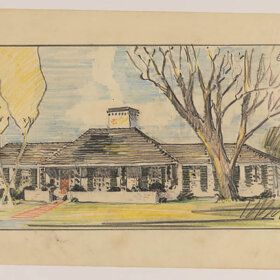
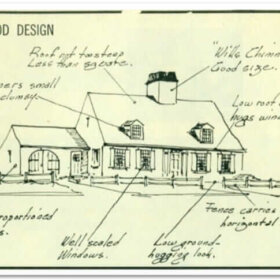
The time seems appropriate to revisit Cape Cod House design as it was promoted by a pioneer of their twentieth century revival, Boston architect Royal Barry Wills. When Wills started out in his architecture career he established himself designing English Tudor inspired homes in suburban towns around Boston like Newton and Brookline. But, it was his rigorous examination and subsequent success with the Cape and Colonial Revival homes that cemented his reputation as one of the most influential residential architects in America. Heck yeah there is more…
by pam kueber on October 26, 2009
Today is RetroRenovation.com’s second birthday. And on this occasion I would like to introduce something I’ve been noodling for the better part of the year — an all-new term that I have invented: “Mid-century Modest.” I first used the term at my home show talks in Eugene in March…and then again when I met with the wonderful Portland MCM League group for dinner right after. I believe that author Cara Greenberg is credited with coining “mid-century modern,” in 1985, with her book of the same name. A mere 24 years later, let me introduce “Mid-century Modest” and along with it, the Mid-Century Modest Manifesto. Heck yeah there is more…
by pam kueber on October 12, 2009
Maintaining windows – wood, steel or aluminum? Concerned about abrasive cleaners? Ceramic tile? Moisture problems? The National Park Service has preservation briefs to help on all these topics — 44 in all — available at your fingertips online. While these briefs appear to be intended for historic preservation pro’s — and while I’m not sure the NPS would yet classify our little pieces of the American dream as “historic” — the reports certainly appear to be informative reading for renovation geeks who want to know as much as they can about what they may be dealing with. Remember, I always advise to consult with pro’s when it comes to environmental and safety issues — renovate safe. Here is the link to all the NPS Technical Service Briefs. You can read them online — or order them in print, for free.
by pam kueber on October 1, 2009
Think your bathroom is a problem? Let us not forget that until well after WWII, many homes in America did not have indoor bathrooms. My mom and grandmother, in Shenandoah, Pa. — outhouse out back until they moved to an apartment in 1950. Dad — farm in Aneta, North Dakota — outhouse ’til about the same time. The poster at left, produced between 1936 and 1941 as part of the Work Projects Administration Federal Art Project, appears to indicate that many homes didn’t even have outhouses. Gulp. Image: Library of Congress.
by pam kueber on September 2, 2009

In contrast to the sleek and modern 1938 Gropius kitchen, here is a June 1938 country kitchen that must have been an even greater joy to its new owners. This photo was taken as part of a U.S. Farms Services Administration project and is now housed in the Library of Congress. Their documentation identifies the photo as, “Resettled farmer’s wife and daughter in kitchen of new home. Wabash Farms, Indiana.” This can only mean — resettlement from the Dust Bowl droughts of the Great Depression. John Steinbeck’s The Grapes of Wrath was published in 1939. And the photographer, meanwhile, was Arthur Rothstein. When I google him, I find that he has been called, “simply the definitive photographer of the Dust Bowl.” Later, he went on to be the photo director for Look Magazine from 1946-1971, then Parade. He has a book – which I’ve added to Pamazon. Finally, here’s a link to a Library of Congress learning lab about that era. (Photo info: LC-USF34- 026361-D.)
by pam kueber on August 4, 2009
In the early 50s, Duco paint featured advertisements that showcased beautiful interiors – as well as some gorgeous paint colors. This Early American living room is a classic. I love the paneling above the fireplace, and the pegboard for pewter mugs. Also notice the use of a small chest in the living room. Moreover, this image inspired me to do some more research on Early American design, which remained quite popular into the 1950s and even the 60s. Heck yeah there is more…
by pam kueber on June 24, 2009
“America’s Kitchens” by Nancy Carlisle, Melinda Talbot Nasardinov, and Jennifer Pustz is possibly the only comprehensive book on the history of the American kitchen. I am reading it right now. This is just the stuff I love: How Hoosier cabinets, frozen food, open plan architecture and other tweaky things changed the way we live in, and use, our kitchens. And I like to hear the story right from the beginning, too…because virtually no development can be understood in isolation. For example, when I was busy researching “Why steel kitchen cabinets?” it took me all the way back to…Florence Nightingale…Another story for another day. I supported Historic New England by paying them full price. You can get an even better deal at Amazon…via my Pamazon store, of course.
by pam kueber on June 12, 2009
WOW, THIS IS AN AMAZING TREASURE TROVE: An online archive of 46 years of Aladdin Home Sales Catalogs, courtesy of Central Michigan University and its Clarke Historical Library. I’m serious: Complete catalogs: Page through for hours and watch the history of middle-class housing styles in the first half of the American 20th century unfold. The catalogs were the principal marketing method for the houses…. So also you get all kinds of little detail that paints a picture of how people lived, what they considered when looking for a house… See the dramatic shifts during the Depression and wartimes, for example. They are little social history books. Aladdin’s were kit houses… manufactured houses like the famous Sears’ models. These kinds of homes are EVERYWHERE across America. Heck yeah there is more…
by pam kueber on June 3, 2009


DID YOU STILL HAVE A MILKMAN growing up? (Do you look suspiciously like him? tee hee.) Historic New England has a really wonderful virtual-online exhibit about the history of milk home delivery from 1860-1960. The exhibit also helps explain some of the history of modern kitchens. Alas, we retro renovators know how the story ends. –> Heck yeah there is more…