by Erica Donnis on March 25, 2009

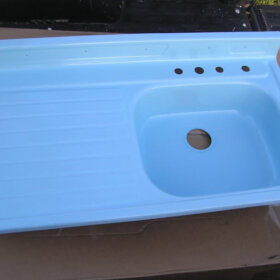
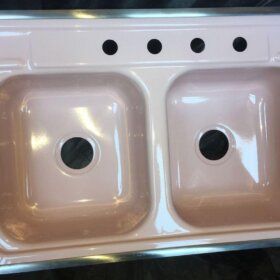
When I visited Rejuvenation in Portland, I saw this wonderful early 20th century reproduction sink for sale. I am not sure of the exact timeline for sinks like this. They were originally porcelain enamel on cast iron — and I would guess they spanned the 1910s through the 1940s. These reproductions — from St. Thomas Creations — are made of vitreous china. Even so – the sink looks like the real deal – gorgeous – and would be a wonderful choice for a pre-war retro renovation bathroom – for a bungalow, four-square or romantic revival bathroom, for example.
by Pam Kueber on December 9, 2008
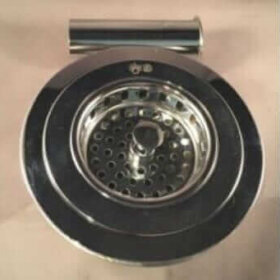
It’s not a hootie ring. Or a huddee ring. It’s a hudee ring. I still don’t know why it’s called that exactly – presumably there was a Mr. Hudee involved. But now, we at least have a paper trail via these 1958 and 1959 ads. At this point the ubiquitous metal ring for porcelain kitchen and bathroom sinks was sold by the Walter E. Selck and Company of Chicago. And according to the second blue ad, there were 1062 different kitchen and bathrooms sinks to take a metal ring!
Heck yeah there is more…
by pam kueber on October 23, 2008

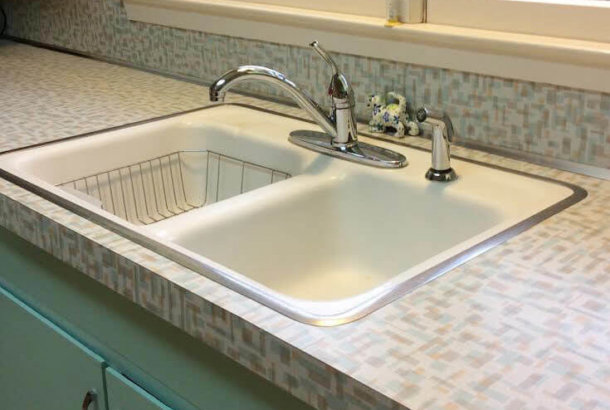
Elizabeth asks, “Do I need clips to hold my drop-in sink and hootie ring in place?” Three approaches – read on: Heck yeah there is more…
by Pam Kueber on October 8, 2008
I don’t know if these were just recently introduced… or whether I missed them all this time…but these two sinks from Kohler are terrific, authentic choices for a 40s, 50s or 60s kitchen. Both sinks are cast iron. And of course — you MUST get the metal rim.
This selection now becomes my #1 choice for a kitchen sink, if you want white cast iron and don’t want to hunt down or wait for a vintage sink.

The double-bowl Kohler Delafield is 32″ wide – and allows you to order up to 5 holes for your faucet, spray and other accoutrements.

The single-bowl Kohler Bakersfield is almost as wide.
Kohler.com
Faucet choice
Elkay stainless steel sinks
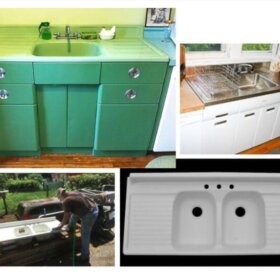
Classic white sink/counter drainboard sinks:
by pam kueber on March 20, 2008

Maggie writes,
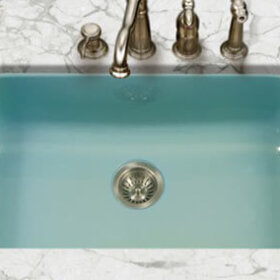
Pam..thanks for your great photos. I’m moving back to my childhood home and restoring the 1959 kitchen. I’m looking for the silver color trim ring that seals in the TURQUOISE porcelain sink! That matches the turquoise wall oven and stove-top and the white, black and turquoise design in the floor! Thank for any help or direction!
maggie
NP, Maggie. Mac the Antique Plumber to the rescue again — well, maybe. They seem to have these metal mounting rings (sold separately from the vintage style sinks, which are also a great find!) in number of sizes.
However, one big potential issue/problem I can see – is if you have an integral faucet. These are not for that style. I’m concerned, I’m afraid that’s what you have – because that’s what I have – my metal ring is about 42 x 21. My reco, if none of these listed sizes are right, to start: Ask the Mac folks, my experience is that they are great. Let me know how what they say. If it doesn’t work out, we’ll search some more — and maybe other readers have some ideas.
AND IMPORTANTLY, what is this torturing us with a juicy description of your kitchen and NO PHOTOS? What do the cabinets look like? Send ‘em to me, sister! Thanks for writing, Maggie!

by pam kueber on February 22, 2008
by pam kueber on January 10, 2008


American-Standard, an absolutely great name in postwar bathroom fixtures, continues to make several porcelain sinks that would look great in a 50s or 60s bathroom.
Isn’t the Hexalyn model at the top fabulous? So much fun to wake up to every morning. Set it into a countertop of retro laminate with steel edging, install one of two vintage style lavatory faucets (Deabath.com or American Standard), add a mirror, sconces, wallpaper and accessories — and you are all set to go. These are all very delicious.
by Pam Kueber on December 5, 2007


The bathroom fixtures above are from 1955 — deep in the heart of the postwar boom. From “Homart” — a Sears brand.
I have more images from this brochure – stay tuned – but I love this page in particular as it gives a great look at sink and toilet styles that were very typical. Please click on the main photo to see the correct scale and lines of the fixtures.
Scrutinizing this material also enabled me to make my third (whoopee!) recommendation for a bathroom sink faucet. The American Standard Colony single control is not too far off from the vintage design of the two sinks on the right. (The faucets on two sinks to the left look identical to one of my earlier recommendations.)
If you like the sinks with chrome legs, be sure to see my sink posts. And that countertop sink to the far left can still be had from Kohler, their Tahoe model, including with steel trim, if you like. Finally — ignore that orange and bright yellow tile in this advertising material. These colors are only shown for contrast, I think. Yellows were used in the 50s, but nothing this neon took hold, as far as I’m aware.
by Pam Kueber on December 1, 2007

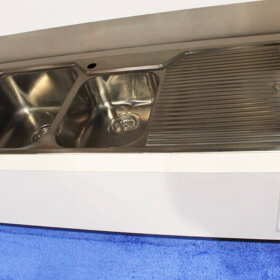
This ad from 1953 spotlights the Elkay Lustertone sink/countertop/drainboard combo. You can still get these today – and they are an awesome choice if you can make it work with your cabinetry and layout.
Stainless steel is a great surface to work on and to be sure, when you’re moving dishes into and out of the sink, it’s great to have a waterproof surfaces to the right and left.
<—- This Elkay Lustertone sinktop is almost identical (albeit a single-bowl) to the one above. It would look great butted up next to stainless-steel trimmed laminate. And don’t forget to put a slab of butcher block nearby.
<—- This second choice has a double bowl and can be set directly into laminate (no countertop edge) or onto another countertop material like granite (argh).
And this one —-> combines double bowl with edging although I’d need to find out if that super bright surface is for real – I don’t like it.
Overall: It seems like the best choice may be #1, if you can live with the single bowl.
I have numerous posts on countertops - they are all worth reading to put together your own plan, if I say so myself!
<—- BTW, notice in the 1953 design how the grey steel kitchen cabinet is married with the colonial pine. Very typical of the era.