


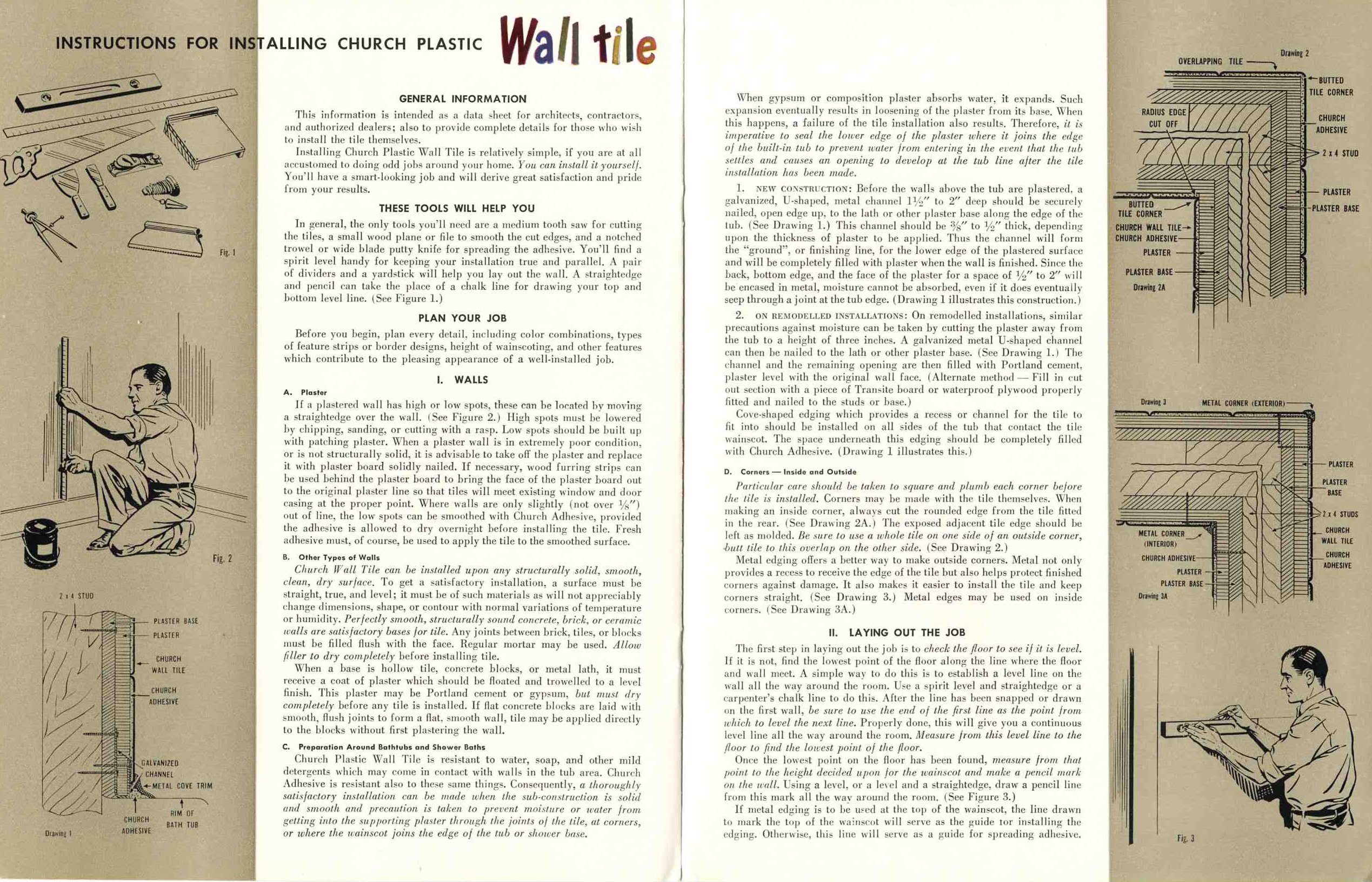
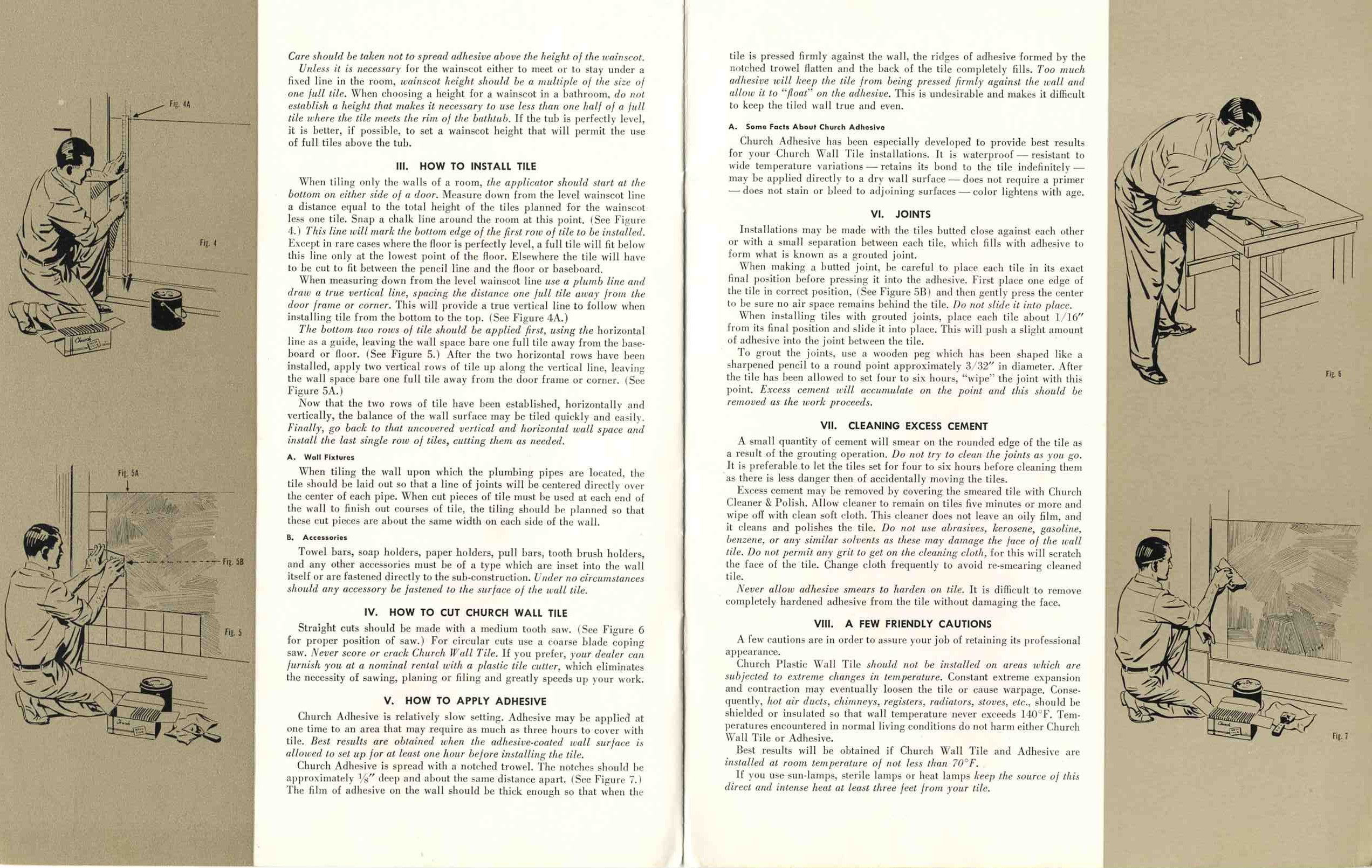
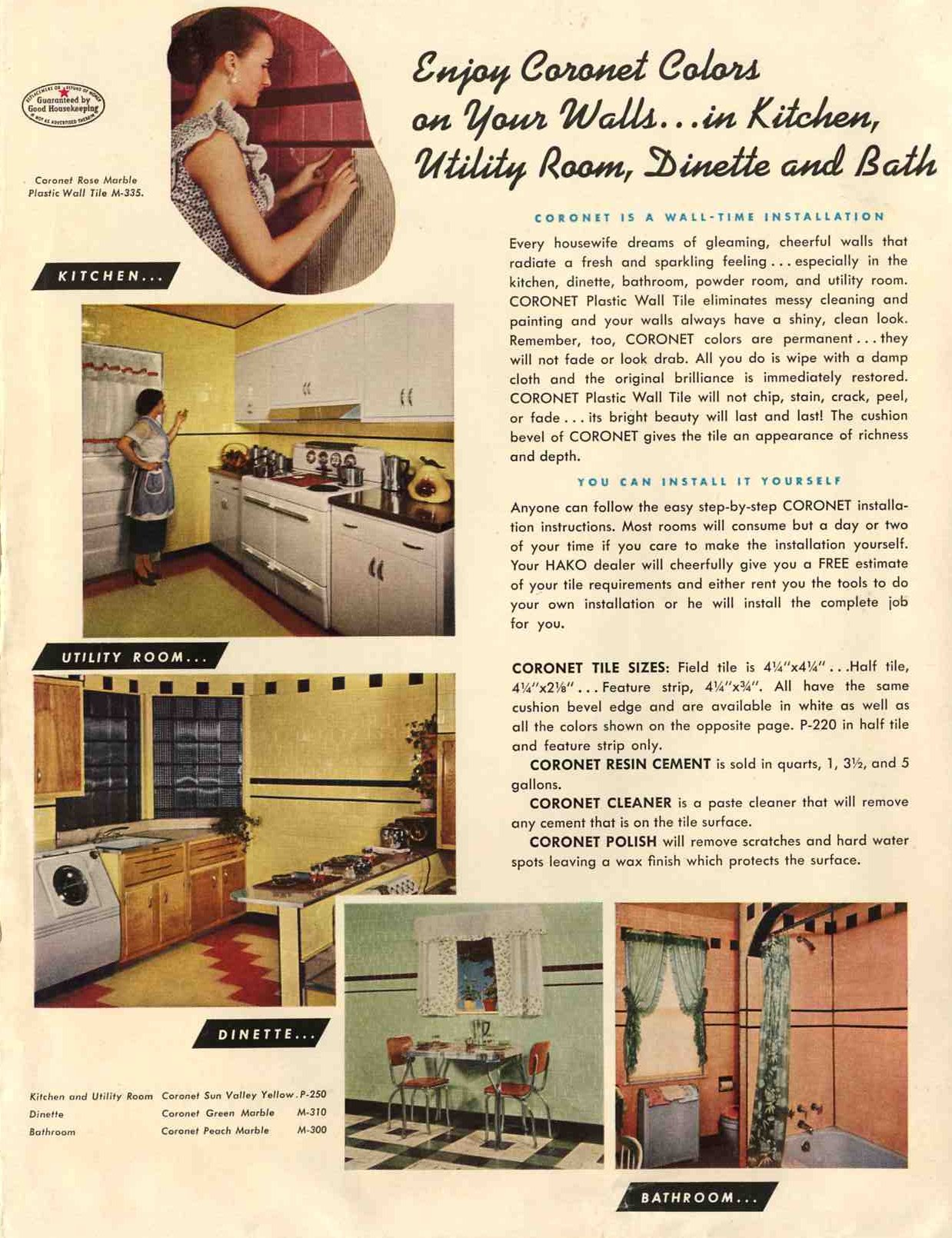
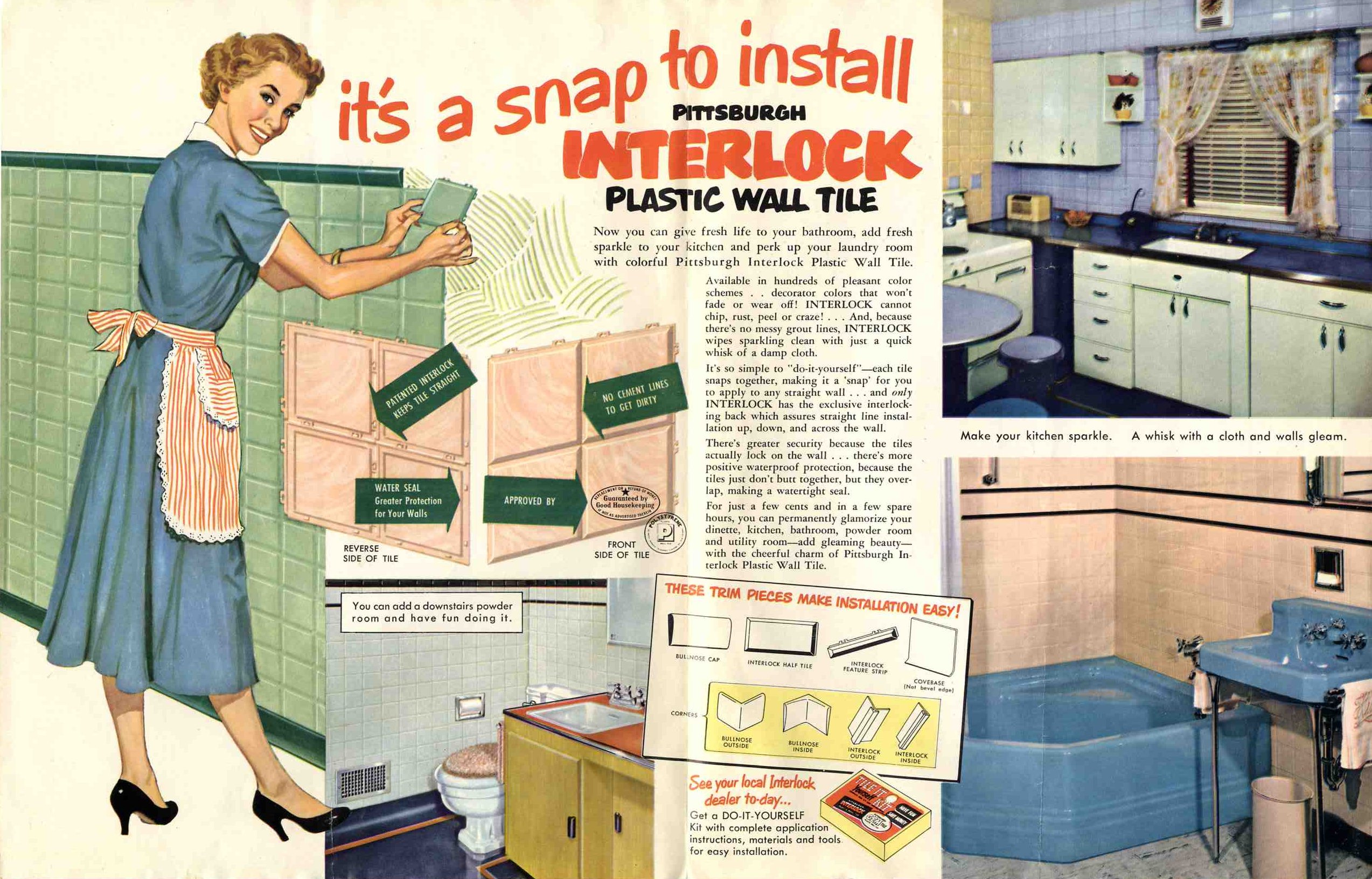
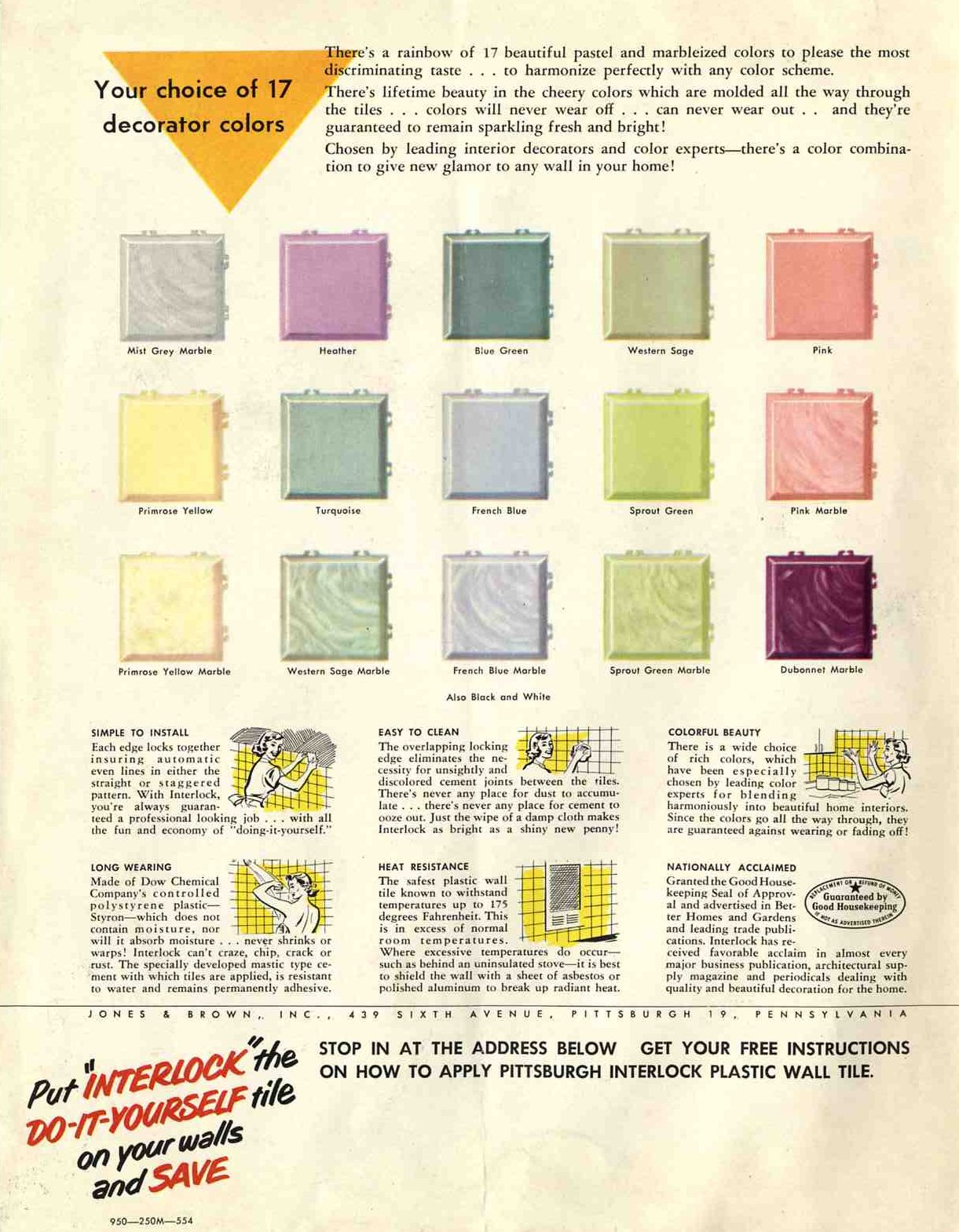
Plastic tiles seem to have been very popular in the 1950s and, my mom tells me, into the 1960s. In estate sale houses, I see them in both bathrooms and kitchens. I attribute their popularity to the fact that homeowners could install them themselves — and we were a very DIY nation at the time. Also, these tiles could be easily installed over existing plaster walls — meaning that they were good for renovating the “imperfect” plaster walls in old farmhouses, Victorians and bungalows and to get that “modern” look.
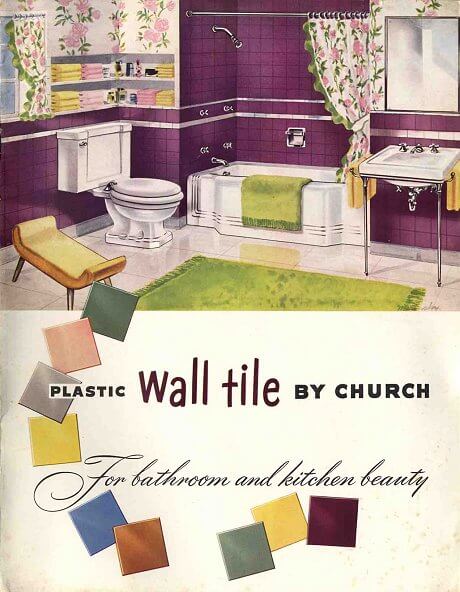
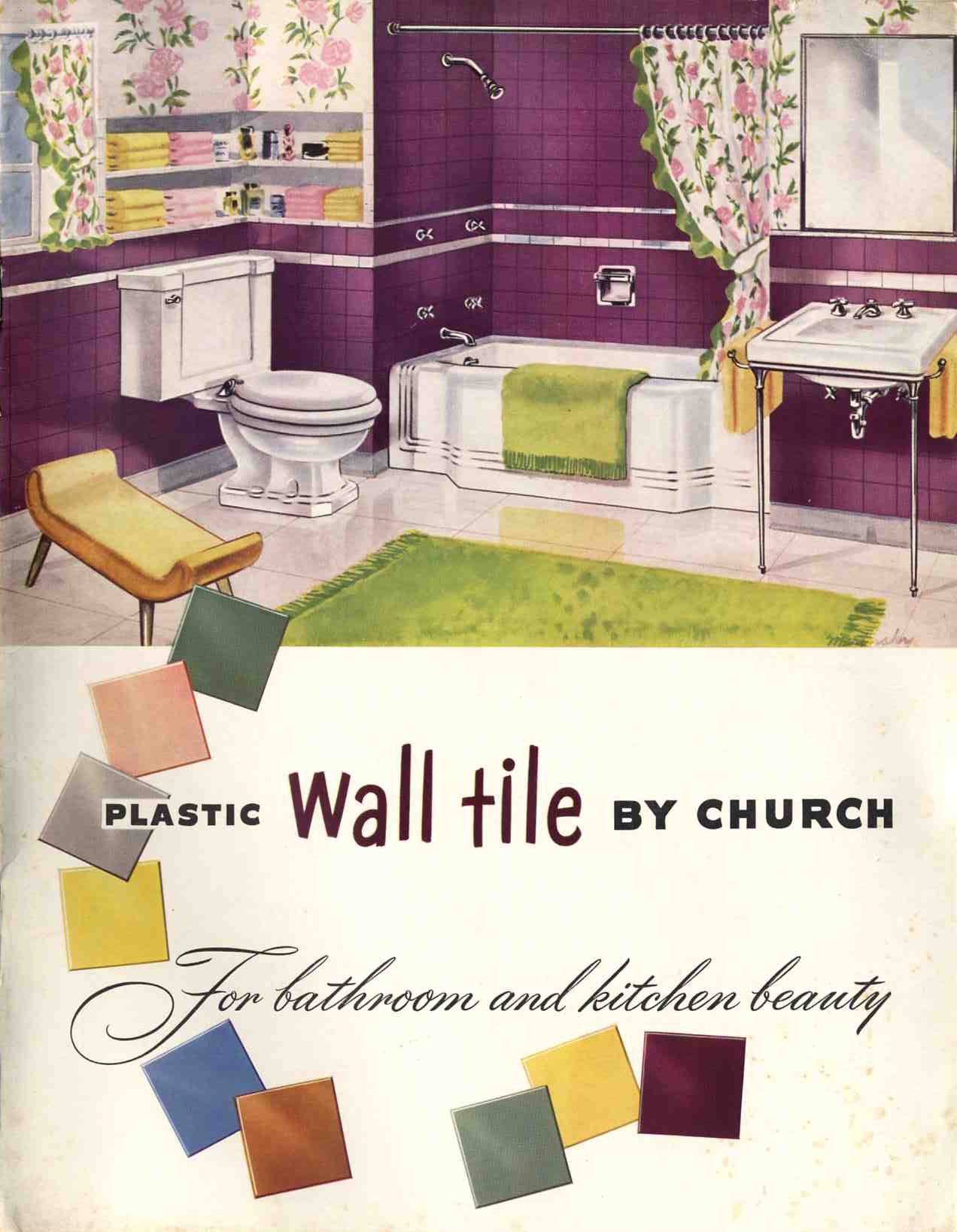
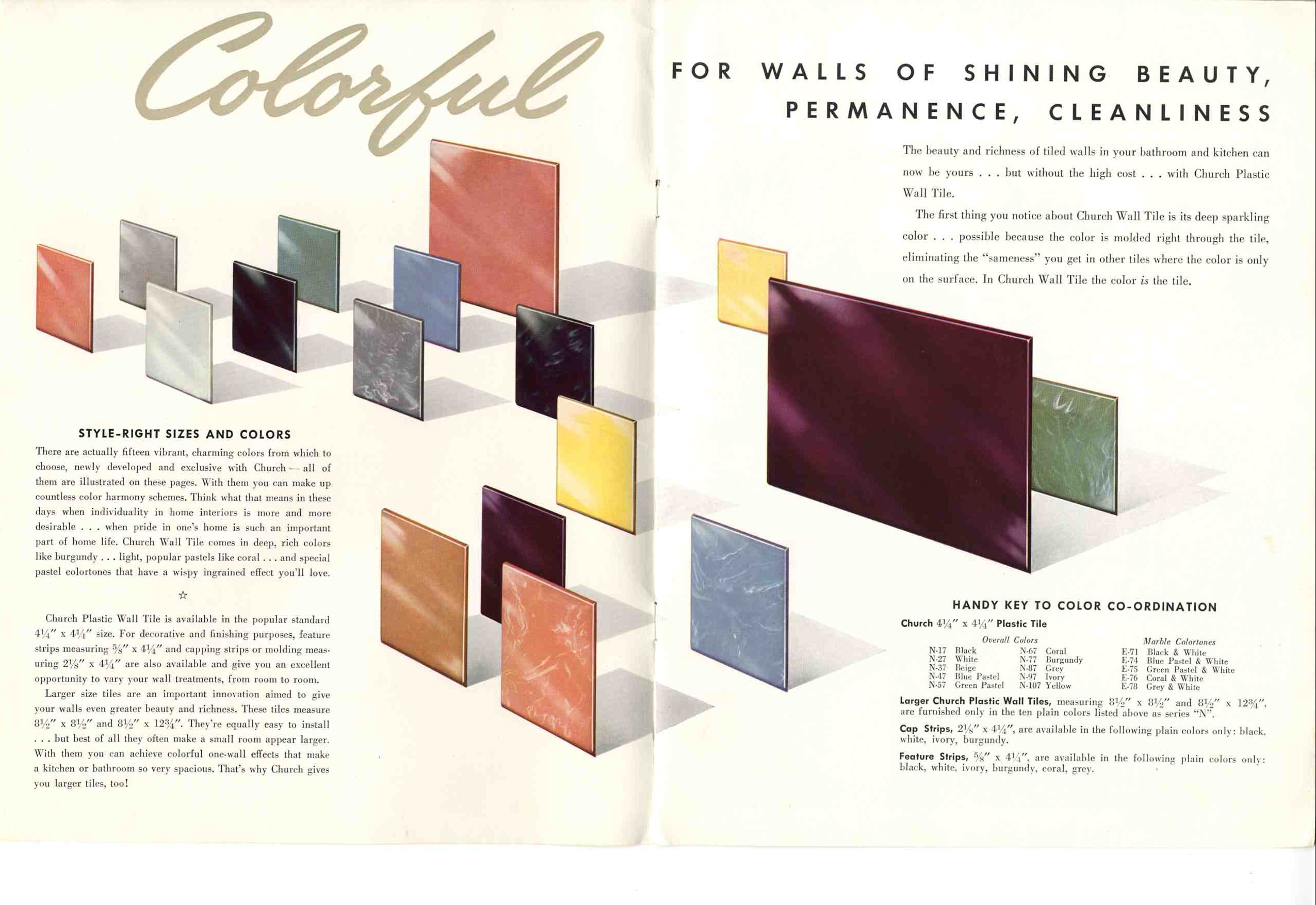
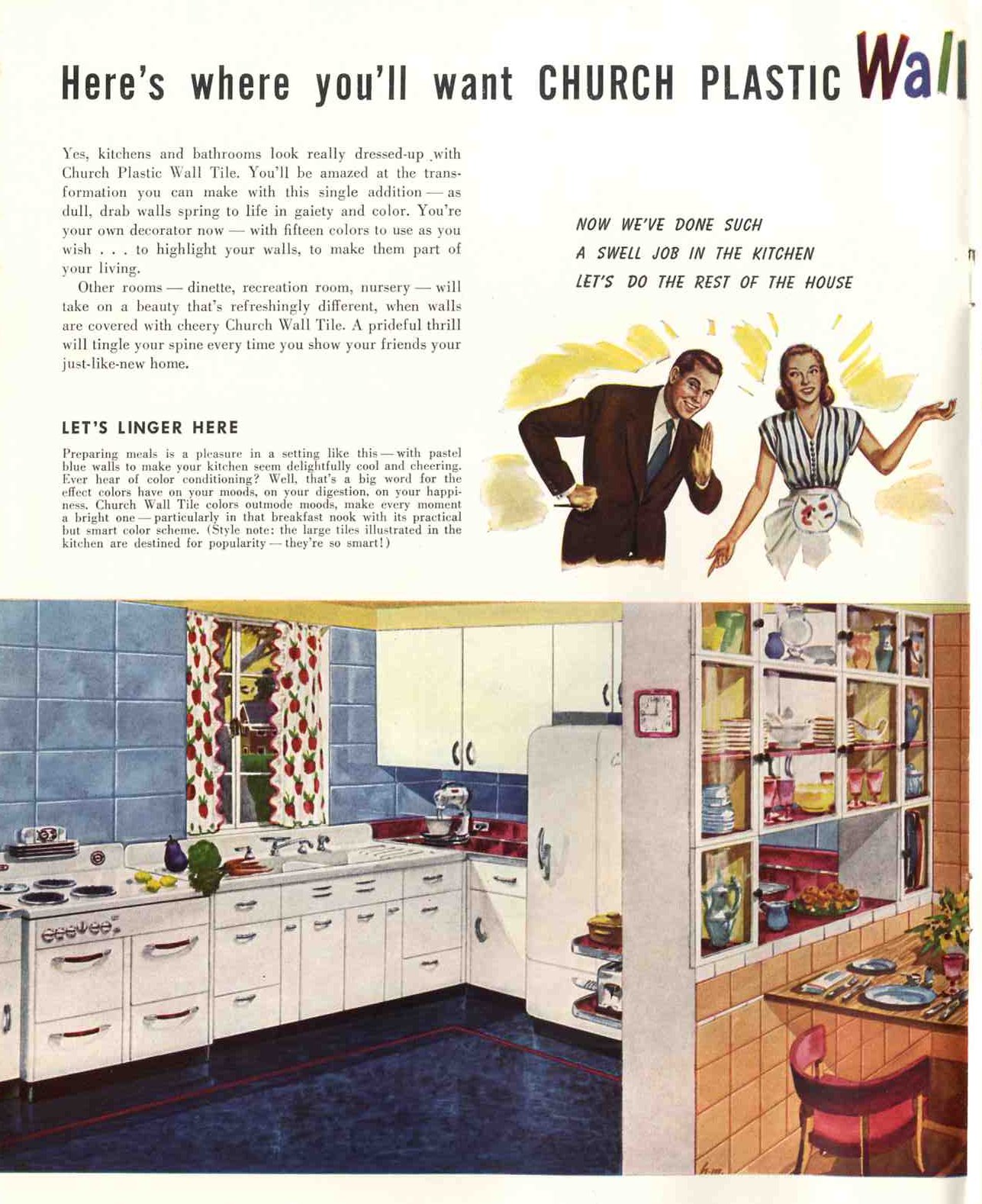
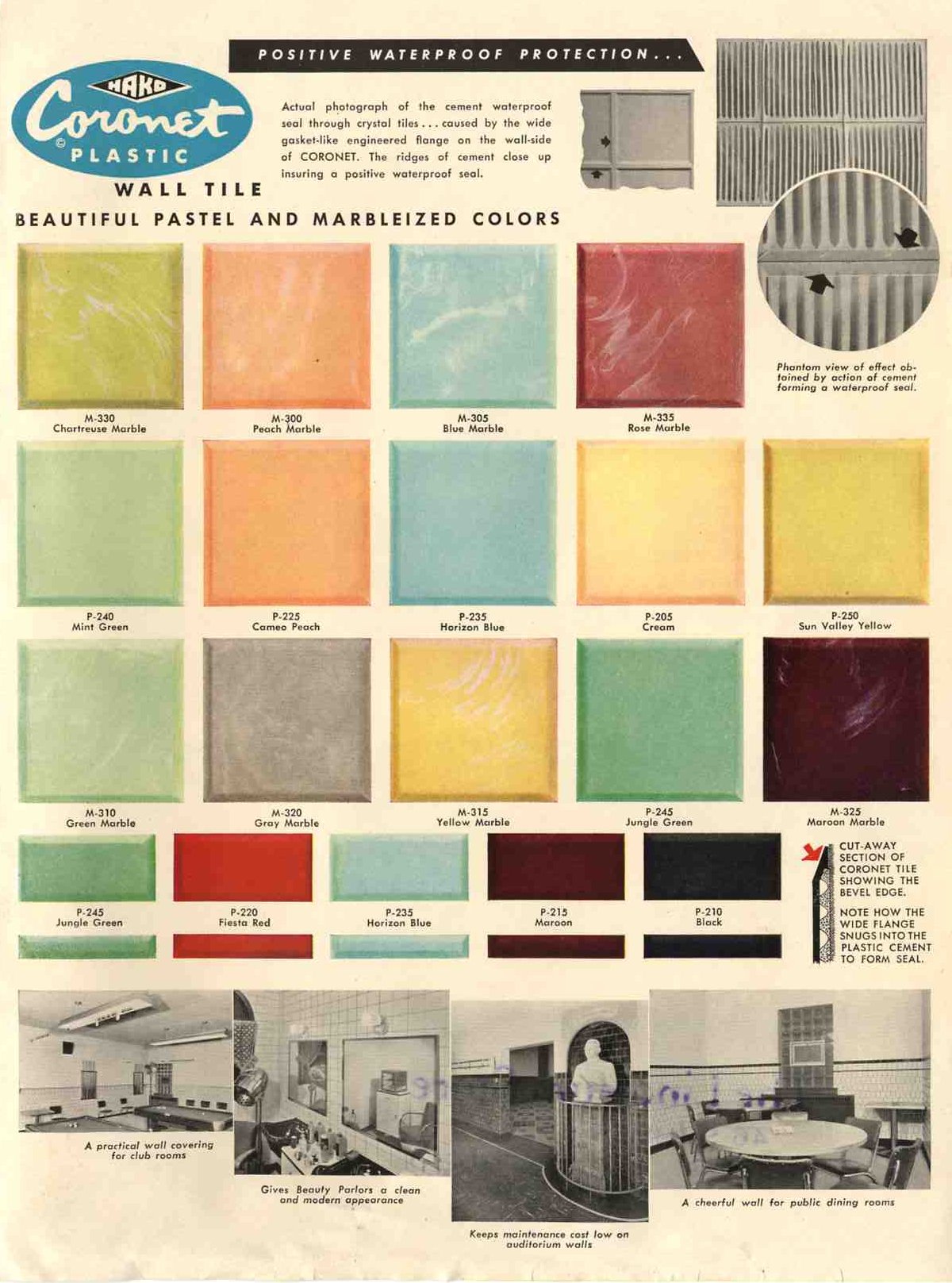
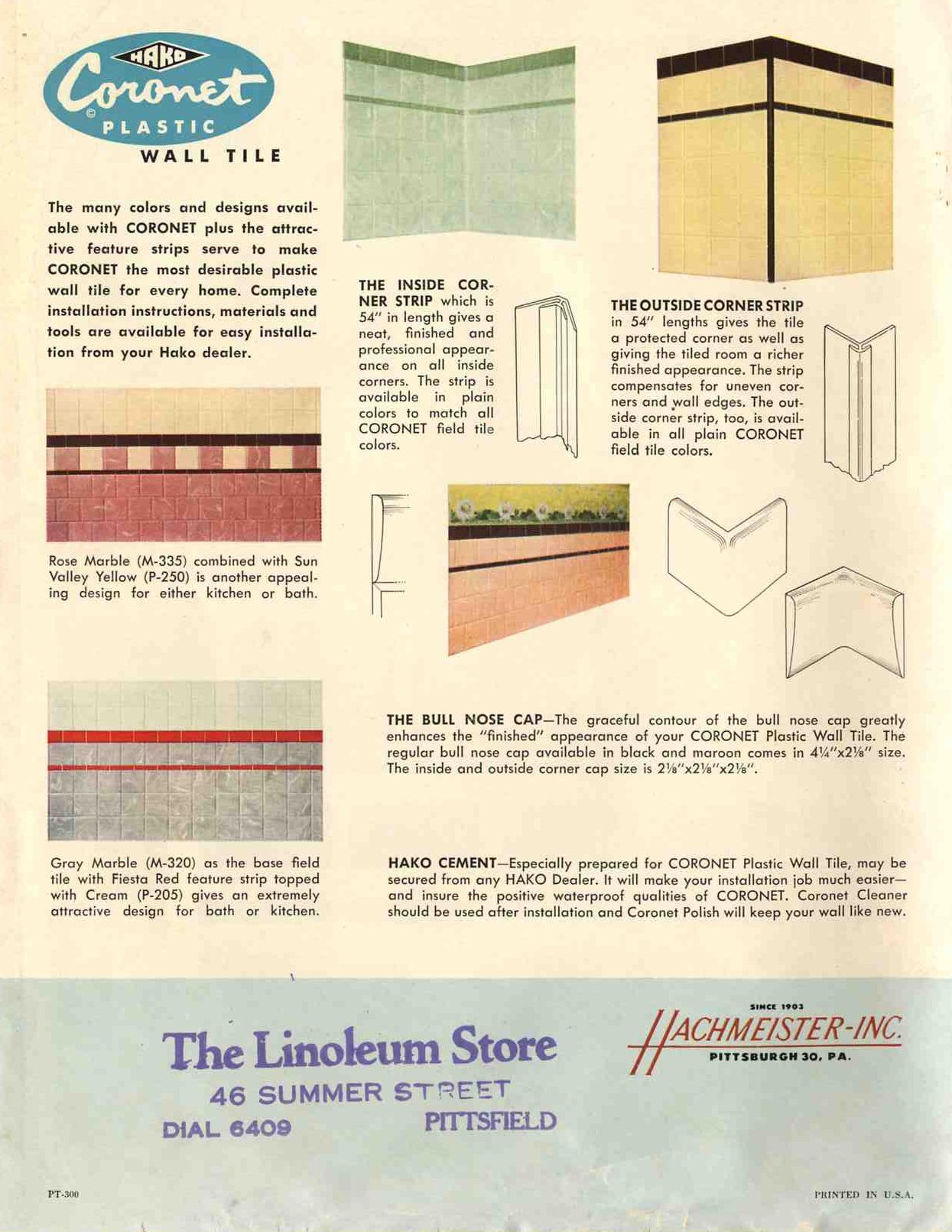
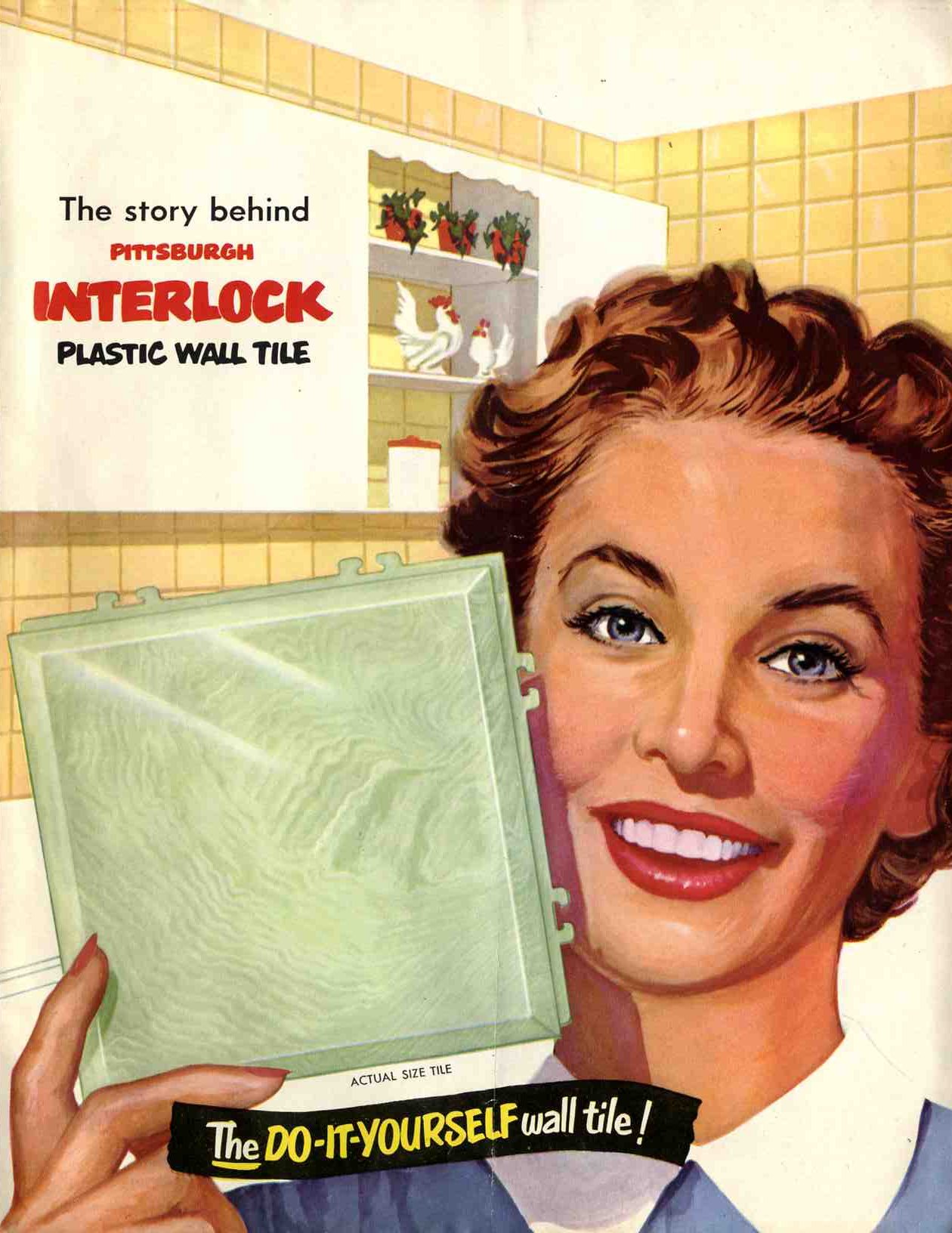
In fact, the benefits of plastic were highly touted during the entire postwar period. I kind of have a feeling folks thought plastic and ceramic were equal in attractiveness? We were fascinated with the lure of the man-made and technology — this is a critical part of the American identity, even still. Also, I am pretty sure it’s a good guess that plastic tiles were significantly cheaper than ceramic tiles, and that must have been part of the allure as well. In my very recent travels I have picked up three vintage brochures — from Church, Pittsburgh and Coronet Tile Companies — and have scanned the prettiness, and info, for all to share.
Check out the complete slide show…. Click on first thumbnail to launch it, then move forward via the arrows below each image:



Mind you:
- I am not necessarily the world’s biggest fan of plastic tile. All three of my bathrooms were outfitted with the stuff. The bathrooms had seen some hard livin’, I think, and the stuff was…. nasty. The plastic tiles in my tub/shower surrounds had all rotted through. So much so that previous owners had then pasted marbleized vinyl panels on top of it. The seams were grucky and moldy and oh, I shudder at the memories…. I had that plastic ripped out with joy in my heart and replaced it with ceramic tile all around. Bottom line: I fear that if plastic tile has not been installed well, and if the bathrooms or kitchens have been used heavily, it may not be worth salvaging. I am all for function, folks, and in a bathroom especially, there is nothing that beats waterproof ceramic tile, in my mind.
- All that said, I did buy a bundle of vintage plastic tile for my kitchen backsplash. Two (gulp) years later, it’s still in a box waiting to be installed. (I’m nerve wracked about how it will look, and yes, simply procrastinating regarding launching yet another house project, one of a gazillion always in the works, or at least, rattling around in my head.) So, you can see, I am not “anti” plastic tile, either.
- And importantly : Precautionary Pam here: If you do decide to rip your plastic tile out, Lord knows what’s in the old adhesive… smart to have it tested.
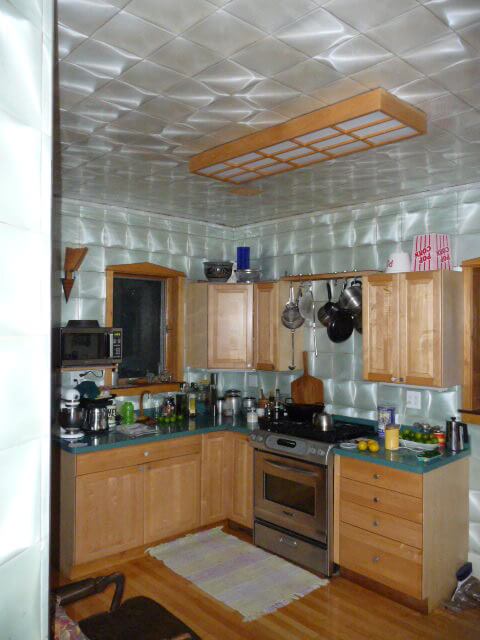
Finally, hey, remember this post? Kurt’s kitchen with the large 8″ tiles all around. Wow!
 !
!



Emilene Pierce says
We are currently renovating my grandpa’s (now our) house, and part of this includes installing a shower in the main bath, where before there was only a tub. Because we LOVE the tile in there (plastic yellow with black borders and accents) we are trying to keep as much of it as possible. Here’s the question – what might be the best way to clean these plastic tiles? After probably 60-70 years, they are looking pretty darn good, but they are a little grimy looking. I am thinking nothing too harsh, but I honestly have no idea. Anyone have ideas for this?
Marianne says
Be careful when removing plastic tile. I had the mastic tested for asbestos and lab results indicate that it contains 4% tremolite!
Kat says
Anyone feel like playing name that tile? late 60 early 70s slate blue glazed octagon and dot with a five circle floral in octagon and the dot is rectangular with 3 ovals on it, marked JAPAN on some with something else I have not figured out yet? Have a few sq feet of it Im going to list on ebay eventually as I get it cleaned up and identified. thanks!
Nicki says
And another photo of the bathroom with new flooring – which is what kicked me in the rear to fix this problem. 🙂 https://www.facebook.com/Nicki.Greenwood.Author/photos/pb.412632228772950.-2207520000.1434037051./855851577784344/?type=3&theater
pam kueber says
Hi Nicki, I suggest you talk to a local tile store. Also remember: There can be vintage nastiness in the layers of our vintage houses — for example, what’s in all the grout / mastic? The only way to know is to have it tested. On such matters, we advice: Get with your own properly licensed professional to determine what you have so that you can make informed decisions how to handle.
Nicki says
Consulting you all, since you are more informed on the topic than I. I have a half bath done in tan tile with a chocolate brown border. Some of these tiles are coming loose, and the “grout” is yellowed and cracking. Am I looking at a big project, or can I get away with regrouting the ones that are not loose, then peeling off and re-adhering the ones that ARE loose? How do you re-grout? Do you need to scrape all that old grout totally out first? I really do like the “retro” look to these tiles, and I want to keep them. Advice? Thanks everyone!
Nicki says
Here’s a photo: https://www.facebook.com/Nicki.Greenwood.Author/photos/pb.412632228772950.-2207520000.1434037051./855851441117691/?type=3&theater
Charly says
FYI … Ceramic tile was developed after the Korean War and didn’t become widely used until the late 1960’s. The introduction of ceramic tile to the US from Japan was the death of the plastic tile industries. When taken care of properly, the plastics lasted for years. My uncle’s old apartment even had entire walls and even the ceilings in his kitchen and bath tiled with it. The work had been done in the early 1950’s. The last time I saw the apartment was in 1997 and it was still in perfect condition. Probably because it was done without a grout space between the tiles which would have created the space for mold, dirt, grease, and bacteria to cause deterioration. Personally, I wouldn’t want it, but it still brings back a lot of memories,
pam kueber says
Late ’60s??? I see manufactured ceramic tile many decades prior to that…. ?
Joe Felice says
I think he meant 1860s.
pam kueber says
but he says Korean War…
Joe Felice says
I was being facetious, but we know what you say is true.
Maureen Graber says
I’m looking to replace about 20 of the plastic tiles by Church in a light marbled green. Any ideas where I can locate some of the tiles?
pam kueber says
eBay — start stalking it, these do come up!
Mary Pleuss says
I may have extras when I’m done in our 50’s bathroom later this week.
Maureen Graber says
Great! Please let me know when your done with your bathroom.
Mike B says
I spent 18 years as a remodeling contractor and still remodel in my spare time (no, I never did a new install of plastic tiles – I’m not THAT old).
The adhesive looks to me like an early latex, very similar to what is still used on vinyl base molding. It gets extremely brittle, which can help in removing it – IF you’re only doing a small area, and want to replace tiles. Patience, a hammer and a sharp chisel (the wider the better) can be used to carefully peel it off the wall. If the drywall is in good condition you should only just peel half of the paper face off. If the whole paper face comes off leaving bare gysum, there was moisture attacking the drywall and it should be replaced anyway.
If you are doing away with your plastic tiles, first check for an architectural salvage store (including a Habitat for Humanity Re-Store) in your area. If you have one, please try to save a number of tiles to donate! The most sustainable remodeling methods are those that consume the least new material. You’ll be giving someone like me a chance to avoid tearing out a whole room of tile for lack of a handful. Thanks in advance!
michelle says
mike b. i don’t see your comment. there’s one from you one september 9, 2013. is that the one or is there a current one. i desperately want to put this in, i have the tile i just can’t find any information on what type of adhesive to use, and what the grouting situation is as the tiles are to butt up against each other. it just going to be a backsplash for my kitchen counters. i just haver painted wall there now and it doesn’t see much action as far as wet, or dirt. just a quick wipe down each week. any information would be awesome. thank you.
Mike B says
Michelle I left a rather long post (at the same time I left you that message to check it) but soon noticed that it was awaiting approval by the moderator. Probably due to length. I see it’s still not here so I’m emailing Pam to see if she plans to give it a thumbs up or down.
Mike B says
Michelle my missing comment was held due to the site policy against giving safety or environmental advice. Pam suggested I resubmit minus that advice. Much of that advice was surrounding removal of old adhesive, and I can’t in good conscience instruct on that subject WITHOUT the safety/enviro advice. Since your question is strictly on new install I’ll ditch the old post and start over.
Any modern LATEX ceramic tile adhesive will work well for your plastic tile (IE: water cleanup). Use a 3/16″ v-notch trowel held at near 90 degrees from the wall for the final pass to scratch the adhesive down to proper depth.
Look for an all plastic trowel that is (typically) 4-1/8″ square and has one flat edge and 3 other notch sizes. They are inexpensive and no other trowel works as well for small jobs. You must achieve a minimum of 65% contact with the back of the tile, so check by peeling your first tile back off as soon as you’ve applied it. Also don’t press the center of tiles hard to achieve bond, you want that minimum 65% with normal pressure (the tile will flex slightly as you press it to wall).
Use a new, sharp cornered sponge to clean up adhesive, using a long corner to clean down into the cracks, and rinse it very often. The latex adhesive leaves no trace as long as you get it soon and thoroughly.
Grout: I have never seen a line of plastic tile that was intended for grouting. Plastic expands and contracts with temperature much more than ceramic tiles (or many other materials), so real portland cement based grout would never last – it would pop out over time. I have never seen an installation that was “grouted”, and I’m guessing that any such installation used the adhesive as “grout”. This is a bad idea because it will yellow with age and would be MUCH harder to get a clean intial installation.
For your backsplash I would suggest you use a thin 1/16″ to 1/8″ temporary spacer between the counter top and the tiles and then caulk the joint. This will help guard against material movement possibly popping tiles later, and also allow the possibility of being able to remove the countertop at some future point without taking the tiles with it (esp. if you use the 1/8″ spacer).
Good luck!
pam kueber says
Thank you for resubmitting, Mike B. Yes, Michelle: Before you go REMOVING old layers of anything in your old house, consider that the layers may contain such nasties as lead, asbestos, etc. Get with your own properly licensed professional to determine what you are working with so that you can make informed decisions. As Mike B. said, I do not want readers giving advice that involves environment/safety issues — the advice here is: Get with your own properly licensed professional etc. as above.
Mary Elizabeth says
Here is some new-in-box Homart plastic tile on sale on eBay. (Noboby I know, so I’m just pointing you to it.) If you are thinking of using plastic in your mid-century bathroom, keep in mind that this tile, properly installed, has lasted in my bathroom over 50 years. The plastic tile adhesive is not sold by Sears any longer, but you can get it in other brands.
http://cgi.ebay.com/ws/eBayISAPI.dll?ViewItem&item=310735271709&ssPageName=ADME:B:SS:US:3160
Mike B says
Mary Elizabeth – thank you! I bought those tiles! I have a property I am trying to do a conscientious repair/remodel to which has a large bathroom (first floor laundry in the bath) completely done in those tiles. They covered the walls about 4-1/2 ft high all the way around a 12 ft by 6-1/2 ft room – (except the tub/shower).
The vast majority of the room is in beautiful shape, including the 1/2″ black border along the top. But a couple of square feet of water damage near the head of the tub put me in a difficult position: remove all the tile in the whole room or do what?
No easy answers to that dilemna – until you provided it!
I was the only bidder 🙂 Thanks again!
Adam says
Cassie – I just had the exact same issue last week remodeling my grandmother’s 1957 ranch with plastic tiles in the bathroom. Tiles popped right off but the adhesive didn’t. We ended up tearing out the walls and re-drywalling. 🙁