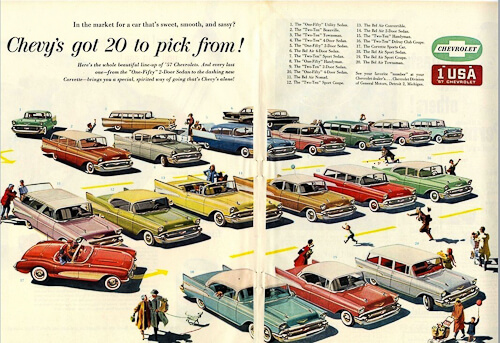
When it comes to studying interior design in the 1950s, the ideas captured in this 1957 Chevy ad certainly are memorable: A rainbow of eye-popping pastels, design that is long and low and angles and flourishes that suggest speed and even, flight. But just like today, there wasn’t just “one” look in the 1950s — there were several. Some looks gained popularity consecutively, as technology, tastes and social mores evolved… while some ran concurrently, recognizing that the U.S. is a diverse, individualistic, creative nation. In this “What’s Your Major?: Retro Renovation” post, I create my own categories out of seven major interior design trends that I have identified from the 1950s. That said, these are big, non-academic buckets. — I’d love to hear your ideas and analysis, too.
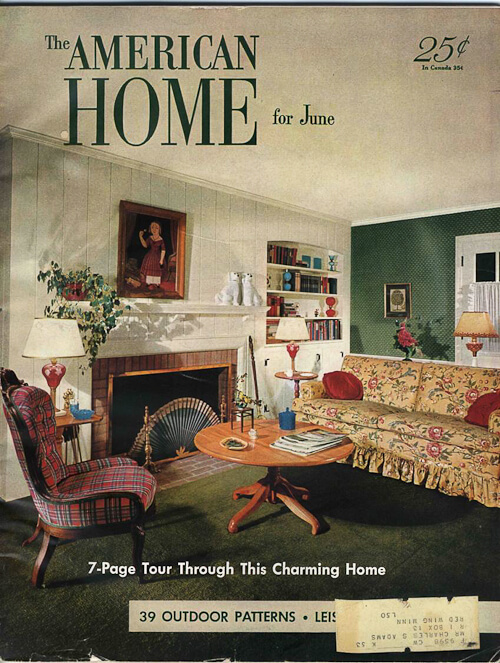
1. Early American all across the U.S.A. — Today, when the mass of shelter media talk about “mid-century” they usually focus on the “modern.” But I believe that in the immediate post World War II-era and well beyond, Early American interiors were far more common. I’ve talked a lot on this site about the influence of Royal Barry Wills and his Cape Cod homes. This style of home was massively popular for many years following the war. True ranch-style homes in the Cliff May style took much longer to take hold and even then, merchant builders all across the country designed ranches with Cape Cod and Colonial design touches. And inside, we often saw: Ranch-style floor plans with Early American interiors. Key elements of an Early American interior could include: Paneling, brick fireplaces with colonial-style molding, maple furniture, Americana wallpaper, plaids and traditional prints, and heirloom pieces from… Colonial days! Here are three more of my favorite stories about Early American design and decor:
- My Mid Century Modest Manifesto
- Mid Century Modest and the blog profiled in an Etsy.com video
- The Royal Barry Wills Cape Home
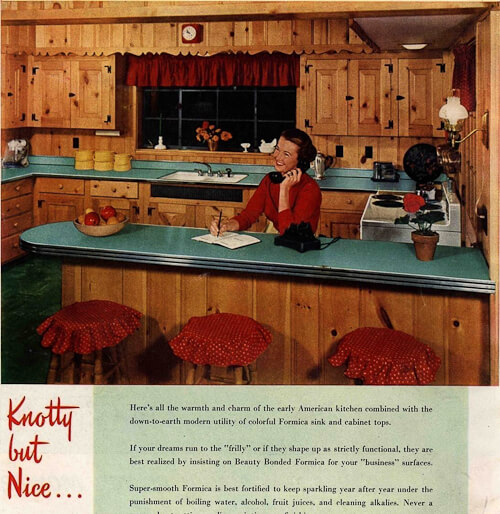
2. Do It Yourself with Knotty Pine and Resilient Floor Tile — In the same vein as the massive trend to Early American interior design, we saw millions of kitchens with knotty pine kitchens and basements, attics, sunrooms and even main living areas paneled with knotty pine. However, I think this particular design cue was not just about the colonial, but as much or more about the: Do It Yourself. In the aftermath of World War II, Americans did have money to buy homes, but from what I’ve read, they were very conservative about parting with their hard-earned cash. They had the famous Depression mentality. They also had woodworking skills and tools. These factors led them to do a lot of the interior finishing work of their homes themselves. For example: Quite famously, 1.5 story Cape Cod homes — like those at the original Levittown — often were sold with the top story unfinished. Homeowners knew they could finish that space later, as their families grew. Knotty pine fit with the Early American aesthetic of the time, and was relatively easy and cheap to install upstairs. Here are a few of my favorite stories on knotty pine:
- Everyone loves Eartha Kitsch’s knotty pine kitchen..
- And Traci’s, with adjacent, knotty pine dining room…
- And Betty Crafter’s, with its aquamarine appliances and countertop…
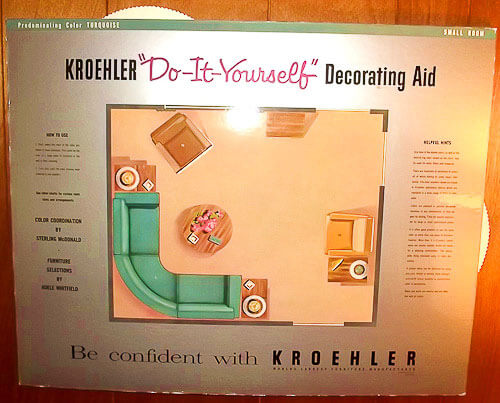
3. Heywood-Wakefield and Kroehler Streamline Moderne — At the same time Early American decor was popular, we also saw strong consumer interest in what I will call “Heywood-Wakefield and Kroehler Streamline Moderne” style interiors. These particular pieces, with their bulky, rounded edges, are carryovers from the pre-war Streamline era. The way I remember what “streamline” is, is to recall it’s like a Streamliner train — meant to look like it’s moving, even when it’s standing still. In a way, this is not really 1950s style — it’s 1940s style. But, when World War II was on, manufacturing of discretionary items like furniture ground to an almost complete halt. In the immediate aftermath of the war, manufacturers just pulled out their designs from before the war and started producing them to meet immediate demand. It took a while for new design looks to be introduced. Here are some favorite stories about the streamline look that was still popular from around 1946-1953:
- 1948 Streamline Moderne time capsule house. (Okay, it’s 1948, but you gotta see it!)
- Heywood Wakefield furniture — still made, in the USA, today
- Readers upload photos of their sofas. (Okay, mish mash – but it sure does show the diversity!)
4. Pretty in Pastels — The author Thomas Hine dubbed the years 1953-1963 the Populuxe years in a book of the same name. It was an exuberant time — and that led to exuberant colors inside the home, and out. If you have read this blog for more than a week, you know that I love to talk about pink bathrooms. Not necessarily because they are my favorite — I love all the midcentury pastel bathrooms — but because they are “emblematic” of the period. That is: In one little room, they capture the optimism of the 1950s — and they have a story that even includes Mamie Eisenhower. At the same time, though, the pink is not well understood among the mass of homeowners today — which puts these sweetheart bathrooms at risk. Emblematic = Learn about the pink bathroom and you can begin to understand an entire era. More pastel loveliness:
- Where to get vintage colored tile (and more) — all my resources.
- Scenes from 22 blue midcentury bathrooms
- And, my microsite Save The Pink Bathrooms, of course.
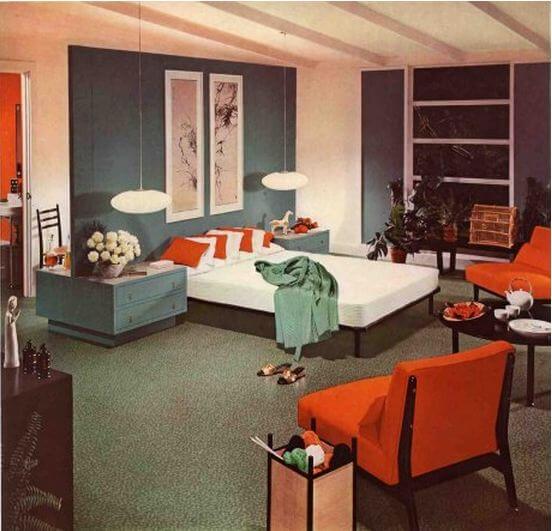
5. Full-on Midcentury Modern — The 1950s were glory days for proponents of full-on mid century modern design. To me, the key determinant of what’s MCM is that it lacks unnecessary ornamentation — focusing first and foremost on the function. “Form follows function.” Also important: Using newly available technology to develop new solutions… And then, there is a whole artistic side to things, such as referencing nature and organic shapes. Above: From Armstrong Floors. More:
- 28 places to buy a mid century modern style sofa
- Video tour of the Miller House in Columbus, Indiana
- Steven’s 1957 Alcoa Aluminum ‘Care-free’ demonstration house
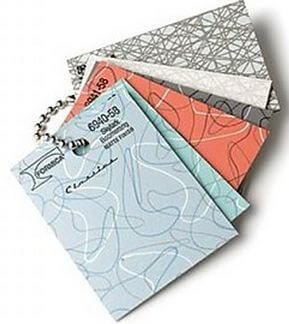
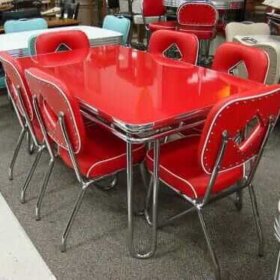
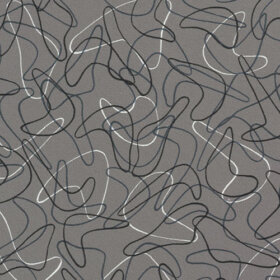
6. Better Living through Technology – The invention and mass merchandising of plastic countertops — like Formica — was a big breakthrough for American homemakers. Plastic surfaces were much easier to install and clean, and this was a big deal in a nation where things like automatic washing machines and dryers were will still not accessible to the masses. Ask any woman from back in the day about “washing day” and watch her cringe — it was arduous, to say the least. Things that could make keeping house easier were a BIG DEAL. Gas and electric stoves… refrigerators… dishwashers… air conditioning… vacuum cleaners… even INDOOR PLUMBING… made their way into the majority of American homes only after World War II. Into this “Technology” bucket, I also will included products, through their styling, that reflected the Atomic Age. We saw lights that looked like flying saucers… cabinet pulls and doorsets that looked like starbursts…. and those boomerangs on the Formica are organic shapes.
- Video tour of The Wilson House – a shrine to laminate
- 30 wonderful oddities — “woddities” — from midcentury America (list as of Sept. 2011 – keeps growing)
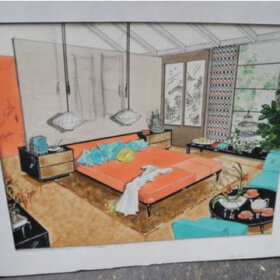
7. William Pahlmann Eclectic — Of course, no one is forced to follow any single design trend religiously. My favorite new interior designer from the postwar era is William Pahlmann, who is recognized for introducing “eclectic” into the world of interior design. For example, he would put European antiques and ancient South American pottery into a room with a long, low modern sofa… he would mix things up. The room above is not his (as far as I know), it is from a 1950s paint advertisement. It’s always been one of my favorites. And interestingly for this story, it includes a bit of most every trend (although no Streamline) that I’ve talked about. Early American: In the painting and paneling. Resilient floor: In the kitchen. Pastels: On the kitchen cabinets and far wall. Full-on Midcentury Modern: In the furnishings. (Although that lovely dining room table adds Shaker-esque cues to the MCM. Me like.) Atomic: In the light fixture. There’s even a European porcelain coffee pot. A timeless room.
- William Pahlmann time capsule house — 15 interior design lessons (okay, 1962, but I think he’s timeless)

- Some of the interiors designed by Hazel Dell Brown and her Armstrong Floors team in the 1950s are stunning — like this 1954 beach cottage …
- … and this 1954 living room.
My “Bible” of fabulous 1950s images (affiliate link):


I think that in the “Mass Market World O’ Design 2011″ we have more choices, but at the expense of range….52 flavors of Vanilla.
“52 flavors of vanilla” I love it. So true. Thankfully many of us have local craftspeople which is where we can still find some real innovation.
be nice
I really enjoyed this article. It’s funny that recently, I’ve been thinking about many of the same design fundamentals for a post I’m working on as well. You did a really good job of covering many of the major factors in detail, but concisely. Plus, your reference post are spot on as well.
Thanks for your work. Keep it up.
Eric
I love reading your blog, especially the time capsule homes with lots of pictures. Love MCM kitchens and bathrooms. Mine, unfortunately, are not. So I get to drool over the pictures you post. I am selling my house and when it is sold, buying a new one. Have my eye on a flat-roofed ranch built in 1955. Have not yet seen in person, but per the pictures, the kitchen looks like it has only had appliances updated. The cabinets are georgeous with simple doors, little rounded shelves at the ends of the upper cabinets and a scalloped panel above the sink in front of the window to hide the task light. The bathroom needs work–basically a blank canvas.
The other rooms of my house are mixed up periods, eclectic stuff that I have collected over the past 30 years–but it all works for me–not really MCM. If i could find a sunburst clock, that would be my MCM touch to my very eclectic style. (Mom had one and i think brother sold it in a yard sale after she died).
Anyhow, love your blog.
Yay, Tania! Good luck with your house hunt — let us know when you’re into your new/old time capsule house!
The Early American reminds me of my Grandmothers so much. All of them had this style in their living rooms. The pink and mint green bathrooms are also a GREAT reminder of their homes. I’d love a knotty pine room in my home, it’s so warm and homey. Thanks for this post, it has given me some good ideas!
Another feature of DIY was making your own furniture. Issues of “Living for Young Homemakers” feature many ads for furniture legs, etc, and instructions for making your own tables and sofas. Who actually builds their own sofa today?
Back then, though, we didn’t have the credit economy we do today, so young families often struggled to make ends meet in a way they don’t today. DIY was a great option.
One more thing that strikes me in those old magazines is the sheer quality of the furniture. A table would be advertised as solid maple and made in the United States. That table is probably still going strong somewhere, whereas the made-in-China junk you get at Pottery Barn today is going to be in a dumpster in 15 years.
I wonder how much of Colonial vs. MCM was a difference between East Coast and West Coast. Much of East Coast and eastern parts of the Mid-West were already fairly established by the end of WWII, whereas much of the West was still farm land. Also, you have weather on the West Coast (particularly Southern California) that played well into the MCM look (walls of glass, etc.)
I tend to agree that there had to be regional differences and that the percolation of MCM happened faster on the west coast, ELS. Except to wonder: All the transplants to the West Coast came from the East Coast and Midwest. My grandmother — “retired” (at about 45) with grandpa (older) from North Dakota to Oceanside, California, around 1960 — had her entire interior done up all Early American. I think it took some time for MCM to percolate and even then, I don’t know how much “more” popular it was than “traditional” decor overall.
In Western NY where I am from, the early American/colonial look was very popular. It seems all the relatives and friends had that colonial look. I don’t recall anyone with something resembling modern decor. Some homes were built post WWI but some were built post WWII.
My Grandparents worked their dairy farm & Filbert orchard which had all Colonial decor but when our famous Columbus Day storm ruined their orchard they built a pink flat sloped roofed MCM in town but didn’t get new furniture, so it had Colonial decor. Eclectic decor done. No wonder I am so confused about liking so many different styles.
Grandpa built a dumb waiter from the garage straight up to the kitchen – oh the threats my cousins made! So cool.
I so want the bedroom, love the hanging UFO lamps on either side of the bed!!!!
Those are George Nelson bubble lamps, Mason. You can still get them today – original style, knockoffs, and if you are really lucky, vintage.
Kroehler!–never knew the brand-name originator of this style, I always referred to it as “the big wide arms and itchy boucle stuff from the 40s.” That was not the description we used in an ad, however, when we gave a set away a couple years ago because we couldn’t get anybody to pay us for it, pleased just to get it out of the house.
ELS – My parents immigrated from London to Escondido, California in 1955. They had to leave behind beautiful modern furniture (G-plan, etc.) and were very disappointed when all they could find to re-furnish was colonial-style furniture there. Consequently, I grew up with that style of furniture. I think it was likely more a case of city vs. small town to find modern vs. early-American. But in my experience, colonial was everywhere as I grew up in the late 50s and early 60s.
Pam – great descriptions of some major trends. And I think you may be headed for a degree in Popular Culture…at the very least a keynote appearance at some convention somewhere (oh, wait, you did that already!)
Thank you for relating the experience of your parents, Jane. See my response to ELS — I tend to agree that Early American was Way More Common in the 50s and into the 60s than in widely recognized today. It’s funny, when I graduated university, the professor who was my mentor thought I should go get a degree in Popular Culture from a particular university in Ohio that I forget the name of now. I couldn’t wait to get away from school and tests and such, though, and into a real job. That said: Popular culture including social history seems to be my destiny nonetheless. I have given up the idea of Home Shows, by the way. I am somewhat more interested in “lectures” — not so much in “entertainment.” Mostly, though, I have my hands full running this website, it’s been real busy !
My grandmother furnished a house (mostly on lay-away!) in French Provincial in 1954. I guess FP didn’t get its game on till the 60s, but it was always popular in the South. In fact, while one grandmother went FP, the other one went Colonial America all the way. So I guess you could say they were both fashionable in their own way.
Yes, I think FP may need to go into 1950s. I need to do some research…
FP has been popular since its beginings.
I have seen Victorian incarnations, a huge amount of it was sold in the 1920′s-40s, and of course the iconic Drexel Touraine, which is the “high style/we’ve arriived” trophy bedroom of the 1960′s.
What we see since the 1970′s is a much more rustic, casual version.
My favorite room in this post is that first one; the plaid chair is amazing.
Pam, I have been waiting for a post about the set design of The Help. Have you seen it? Amazing rooms! a gorgeous pink bathroom, a knotty pine den, pinch pleats and pelmets. Let’s have a tour!
Actually – I have it on my list!
I read this article with glee, as I do most of your bloggings – and how funny to hear of the knotty pine kitchens coming back into conversation. (I honestly hadn’t given them a thought for, oh, 40 years until a recent episode of MadMen revealed that the Draper’s kitchen was knotty pine).
I however have to wonder: I always associated the knotty pine era as being spurred on by the whole late 50′s – early 60′s “Spaghetti western” thing. Do you think there’s any relevence to that or am I off my rocker?
In any case – it’s always a delight to read and see some of these topics. You reminded me that I (think) I still have my mother’s 1963 “wagon wheel” magazine rack somewhere up in the attic.
Mick, I really believe it started much earlier…
oh and here’s my post on how to recreate Betty Draper’s knotty pine kitchen: http://retrorenovation.com/2008/08/18/recreate-don-betty-drapers-50s-mad-men-kitchen/
Oh, and thanks for the GLEE
This is a huge topic and includes geography, family, education and economics.
I think that in the process of becoming a diverse society, we have each become similar; right down to our interiors.
The Cheverolet ad says it all: “Twenty cars in the line-up…..”
Manufacturers have learned to offer less selection for greater profit.
Don’t hold your breath for a new graphic from Formica. Why should they?
Boomerang cost them nothing, they got some market play and it peaked.
I think the Pahlmann house could have been the home of Lady Bird Johnson or Barry Goldwater: I see great cocktail parties- notice the multiple umbrella tables in the backyard.
Early American was a big hit in the Suburban frontier….whereas Dunbar marketed itself as “Modern, for people who don’t like Modern” to cosmopolitan professionals.
Oh, my goodness Pam…the teacher in me wants to give you an A+ on your report! Very thorough, truly fascinating, and real-life applicable as always. Thank you for yet another fantastic story.
Yay, an A+. My mommy will be so proud of me!
I’m new to your blog and love it! (So new, in fact, sometimes it feels like I’ve walked into a party in progress). Yes, your reports are A+, but no kidding – write a book! I would buy it!
What I like about the 50′s style: uncluttered, cheerful, bright, charming. It just gives off a feeling of … being happy!
Yay, Stacy! Yes, I like my happy. And yes, the party’s been going on for a while — but the night is still young! Re a book — I’m not so sure, have my hands full with the blog right now. Maybe sometime…
The house I grew up in was built and decorated in 1961 and my mom was all about mid century modern. The formal living had the traditional sleek sofa in cobalt blue, a kidney shaped tile top 3 legged coffee table, and a touch of Japanese modern – a scroll hanging in the foyer, silk floor pillows with tassels, and a black teakwood cube shaped end table. And to balance things out, a tiki bar at the other end with danish modern shelves on the wall.
Across the street our neighbors were all about Colonial with braided rugs and maple arms on the furniture. Paintings and etchings of horses and hunt scenes and brass and copper items decorating the walls. As an MCM kid, it was like going to a foreign country when I’d go visit. It all seemed so strange by comparison.
I’m shopping for my first home and am diligently looking for those pink tile bathrooms and vintage kitchen features I’ve come to appreciate through your blog. When I land one, I hope to share the photos with you.
Good luck with your house hunt, Lisa. Hold out for the one of your dreams and yes – send me photos when you make a deal! Also, thank you for sharing the memories of your neighborhood yin and yang!
brilliant article…i cant tell u how informative and descriptive your posts are…to someone who is new to all the mcm mania
Thank you!
Pam, thanks for enjoyable reading today. Growing up in the Philadelphia area, formal mahogany and cherry ruled, especially the furniture that was modeled after the likes of Chippendale ,Duncan Pfyfe, Sheraton etc. What is now derisively referred to as brown furniture. All very formal. Perhaps this was a holdover from the 40′s. as my parents married in 1950 and so many of the neighbor’s houses were similarly furnished. My parent’s dining room set now resides in my house. I think in many ways I have recreated this home as the enormous plate glass mirror now hangs over my couch in the livingroom. Alas, I can’t use the ceramic lamps as they would sit too low on the MCM glass tables.
My mom embraced the colonial American style in the early 60s, in a small town in Ohio. While the upholstered pieces have long since been replaced, she still uses all of the maple end tables, coffee table, hutch and dining set, and accessories such as a clock with an eagle on the top. They are of such good quality.
A house that really stood out in our neighborhood back in the mid- to late 60s was a ranch with a mediterranean flair. (At least that is what the girl who lived in it told me that it was!) It was nothing like the Tuscan look of today. It was more sleek and modern and airy looking. I was only in the living room, and I remember that the sofas were covered in a pretty aquamarine or turquoise color, and there was white carpeting, which seemed astonishing to me. (We had the obligatory harvest gold.) The exterior brick was a light color, and so was the brick fireplace inside. That made it so different from all of the red brick houses in the neighborhood.
I brought up the mediterranean house because I wanted to point out that it had a sunken living room. Then I forgot to mention it. The sunken living room seems like a detail that may have emerged in the 50s or thereabouts. Not sure.
I think you are absolutely right — there is one in my house, built 1951!!!
I like knotty pine, but a little goes a long way. Those kitchens that are entirely pine don’t appeal to me, but I think using the pine to cover the soffits above metal cabinets is awesome. As I recall, many homeowners enclosed the area above the cabinets with overhead bins made out of panelling, mostly knotty pine, including the doors. Very-nice touch.
The floor tiles were mostly linoleum, with the color and pattern impermeated (all the way through). They also, unfortunately, usually contained asbestos. They were extremely durable and long lasting. I remember putting them down with black glue that oozed up between the joints forever. That had to be cleaned up with gasoline or benzine. Today, similar tiles are avaialble , and they are called “vinyl-composition tiles” (VCT). Easy does it on the glue!!
I remember my parents having maple furniture in the typical Early American style with a twist. In stead of bging bulky, it was sleek, and modern. Copper pans exposed, and Copper fixtures..
Hi Pam, long time fan and reader and love your site. Your article made me think of the whole Hollywood influence, as I grew up in southern Ca. I am thinking of Hitchcock’s late 50′s movie ‘North by Northwest’ with the very stylish Cary Grant and that MCM house – maybe Frank Lloyd Wright? We actually had a FLW house a few blocks away from us!
So nice to have lured you out of lurking status, Aleta! I’ll have to watch that movie on Netflix and check out the house you’re talking about!
Hi Pam,
Love your site. I don’t usually participate in the conversations, but do read almost everything.
I was wondering where you would put the Danish Modern style. Is it a later design or would you include it under mid century modern?
Keep up the good work, and thanks for everything!
Helen
Hi Helen, it’s great to lure you out of lurking status! I would put Danish Modern in the 1950s – but yes, I think that in terms of this story, I was making one broad category “Full-On Modern.” Goes to show: There was more than one kind of modern. Hey: An idea for another story!!!
My sadly remodeled 1920′s house has a knotty pine room upstairs. At some point, the garage was moved from one side of the house to the other (majorly weird) and an addition was added to make the 1 floor house a 1.5. The upstairs addition is perpendicular to the original roof.
Anyway, there are dormers added on the east and west sides along with windows on the north. With the pine, 6 windows and the pitched roof, it’s pretty much like being in a tree house. Pictures have been unsuccessful, but I’ll keep trying.
Love these old pictures! It is my in-laws house! They have knotty pine everywhere except the bedrooms! AND they still have the green counter tops and peach tile back splash. We inherited the orange chair in the next picture for our first apartment! It was that bright orange.
The pink bathroom reminds me of the pink my Mom painted the outside of the house in the ’60′s. She had extra so she painted the upright piano too. Fun stuff!